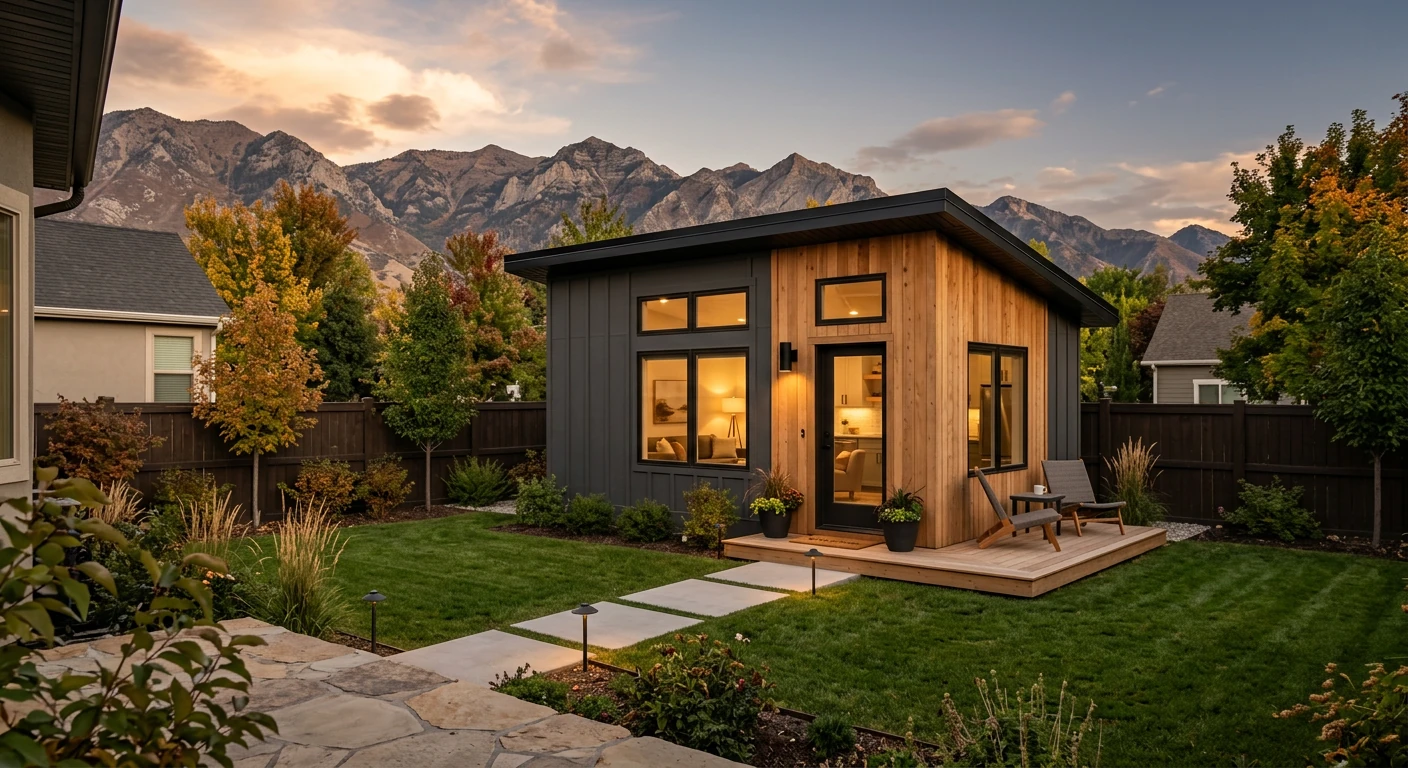
Prefab ADU Utah: Real Costs, City Rules & the Smartest Path for Your Lot
Prefab ADUs can work in Utah — but brochure prices are almost never your finished project price. On simple, flat lots with easy delivery access and short utility runs, prefab is often a smart, fast path. On tighter, sloped, or hard-access lots — which are common along the Wasatch Front — custom-built or an internal conversion frequently delivers better value once site work, foundation, delivery, crane, utilities, and permits are added to the real total.
The table below is the fastest way to find your path:
These are editorial planning ranges, not current supplier quotes. Ask for the complete installed cost, including site work, foundation, utilities, delivery, and permits.
We're an ADU lead-generation and research site based along the Wasatch Front. If you request an estimate, we may connect you with a local builder option. There's no cost and no obligation. Verify licensing, insurance, and references before hiring.
Last Updated: October 3, 2026 · Supplier pages checked: October 3, 2026 · City Rules Verified: June 27, 2026 · By: Utah ADU Builders Research Team
Both prefab and custom-built ADUs can be strong investments in Utah. The question isn't which method is "better" — it's which method is better for your specific property.
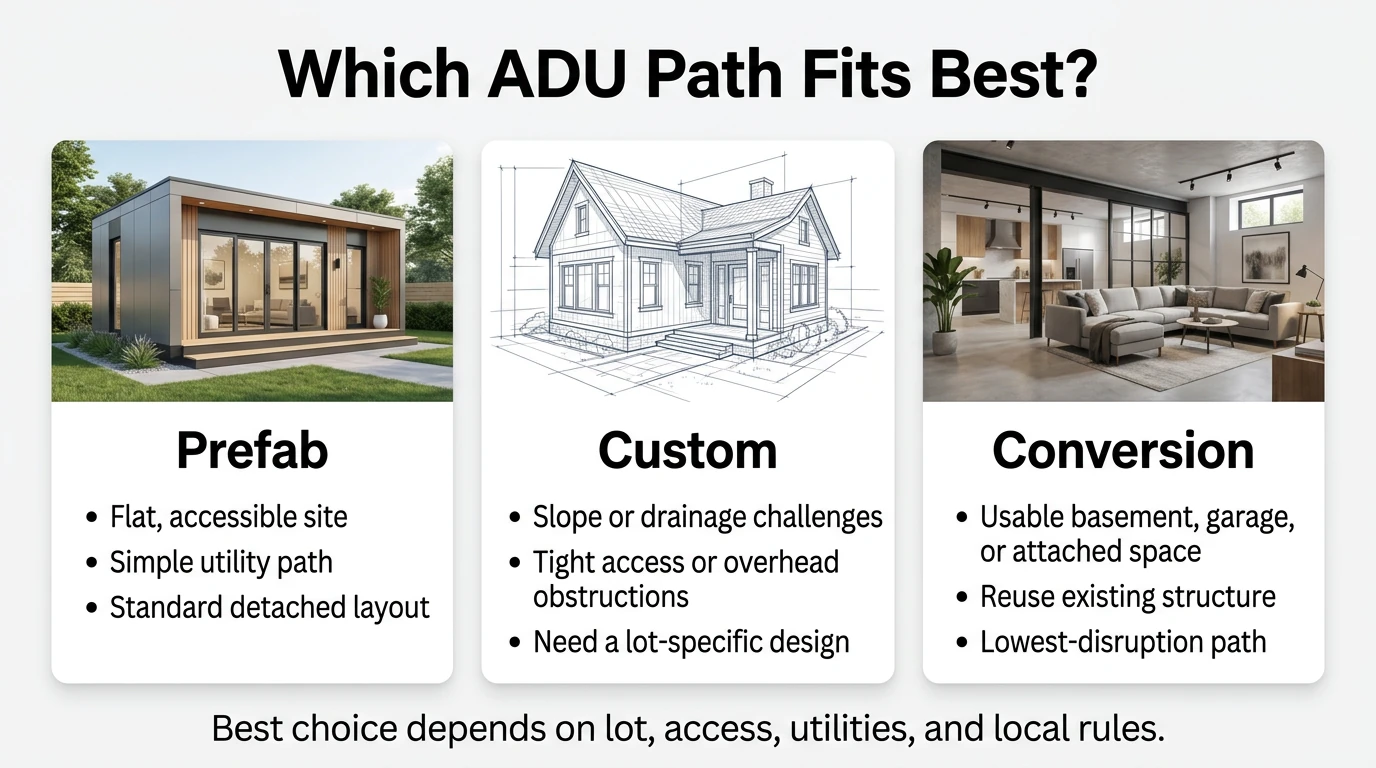
The best ADU path depends on your specific lot, access, utilities, and city rules — not on any company's marketing
Prefab is strongest when your lot is simple
The ideal prefab scenario: a flat or gently sloped backyard, clear side-yard or alley access wide enough for a delivery truck and crane, existing utility lines reasonably close to where the ADU will sit, and a city that doesn't impose strict design-matching requirements.
When those conditions line up, prefab delivers real advantages. The factory build overlaps with your site prep, which can compress your total timeline. Factory quality control means fewer weather delays and tighter construction tolerances. And the base unit cost is often lower than equivalent custom framing — though how much lower depends heavily on what happens at the property level.
Custom is stronger when your lot has complications
A lot of Utah lots have complications. The Wasatch Front is full of bench properties with slopes. Older Salt Lake City neighborhoods have narrow side yards, mature trees, and overhead power lines. Many Ogden and Provo lots have tight access. If your lot has any of these realities, the extra costs of making prefab work — extended grading, retaining walls, tree removal, specialized crane setups — can erase the price advantage quickly.
Custom-built ADUs adapt to your lot instead of forcing your lot to adapt to a box. A good local builder works with slopes, odd setbacks, and tight access because that's what they do every day on the Wasatch Front.
Custom also wins when your city requires architectural compatibility. Salt Lake City, Provo, and Cottonwood Heights all have rules requiring ADUs to visually harmonize with the primary home. Modifying a prefab exterior to comply can add cost and delay.
Internal conversion may beat both in some situations
If you have an unfinished basement, an oversized garage, or above-garage space, conversion is often the fastest and most affordable path to a legal ADU.
Utah's statewide internal-ADU rule is important here. Under Utah Code §10-21-303 (formerly §10-9a-530) (codified through HB 82 in 2021), an internal ADU — defined as a unit created within a primary dwelling and within the existing footprint — is a permitted use in residential zones statewide, subject to conditions like owner occupancy and long-term rental use (30+ consecutive days). This means most cities cannot block a compliant internal ADU.
Important distinction: The statewide permitted-use rule applies specifically to internal ADUs within the existing footprint. Attached additions, detached ADUs, and garage conversions that create a separate structure still follow local ordinance. Don't assume "HB 82 means any ADU is automatically allowed" — it doesn't.
2026 Utah detached ADU law update (SB 284)
Utah SB 284 created Utah Code §10-21-304, effective October 1, 2026. In a "specified municipality," cities must allow one detached ADU on lots or parcels of 11,000 square feet or larger where a single-family home is allowed, and cities may allow detached ADUs on smaller lots. Cities may still regulate size, height, setbacks, lot coverage, design compatibility, utility capacity, owner-occupancy, front-yard placement, short-term rental use under 90 days, and whether more than one ADU is allowed. Local permits and building, fire, utility, and health-code review still apply.
The "don't choose prefab if…" check
Skip prefab and look at custom or conversion if:
• Your backyard access is narrow enough to make crane placement difficult or expensive
• Your lot has significant slope across the building area
• Your city's design standards will require major exterior modifications to a prefab unit
• You're building above a garage or on top of an existing structure
• Utility runs from your house to the ADU site are long or complex
• You need ADA-accessible features that aren't available in standard prefab floor plans
Not sure which path fits your property?
Request a free lot feasibility check — we'll walk your property conditions and give you a straight recommendation: prefab, custom, or conversion.
Is Prefab Actually Cheaper in Utah?
Most people searching "prefab ADU Utah" are really asking: Can I get a backyard home for less money by buying prefab?
The honest answer: sometimes, but usually not by as much as the sticker price suggests.
Why the factory price and the project price aren't the same
When a prefab ADU is advertised at a base price, that may cover only the factory unit or package. It does not necessarily include what it takes to make the unit a legal, livable home on your Utah property.
ADU Utah’s current models page presents named layouts without a published price in the content we reviewed. Request its current model price and installation scope directly. DC Structures advises that a complete project can cost several times its design-and-materials package. Neither source establishes the finished-project price for your lot.
These aren't hidden disclosures — they're right on their websites. But most shoppers see the base number and stop.
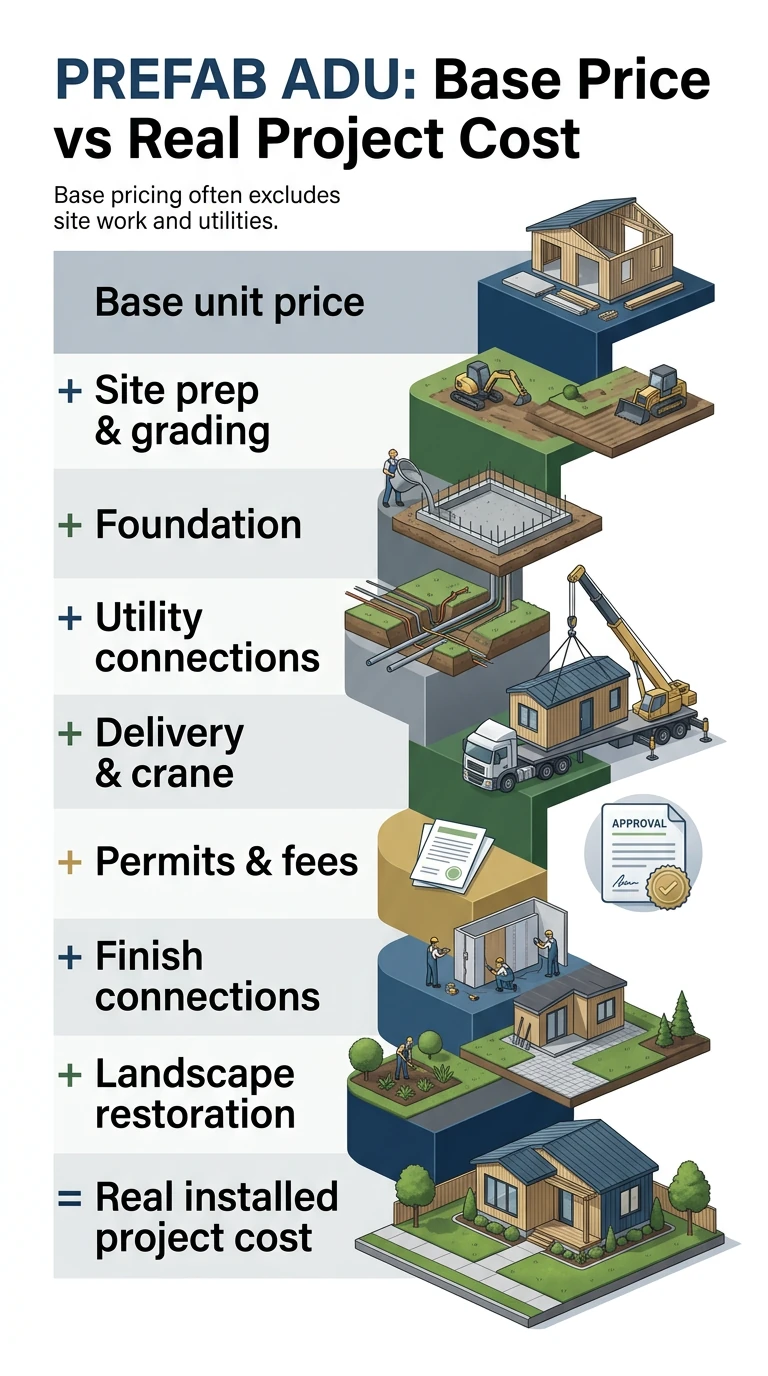
The real installed cost of a prefab ADU in Utah — every layer the brochure doesn't show
Here's what's typically missing from that base price:
The real cost waterfall
Cost Layer
Estimated Utah Range
Notes
Factory / base unit price
$50,000–$200,000
What the brochure shows
+ Site preparation
$15,000–$50,000+
Grading, excavation, access prep. Slopes and clay soil (common along the Wasatch Front) push costs higher
+ Foundation
$8,000–$25,000
Must be poured to the manufacturer's specs before delivery. Utah's frost depth requires footings below ~30 inches along the Wasatch Front
+ Utility connections
$10,000–$30,000
Water, sewer, electric, gas trenching. Panel upgrades are common in older Utah homes
+ Delivery and crane
$5,000–$15,000
Flatbed transport + crane rental. Tight access or overhead lines increase cost
+ Permits and impact fees
$2,000–$15,000
Building permit, plan review, impact fees, utility fees — varies widely by Utah city
+ Finish, connect, and landscape restoration
$3,000–$15,000
Interior hookups, final connections, yard repair from crane/trenching
Statewide installed prefab/modular planning range
$150,000–$300,000+
Use the shared editorial range; this is not the arithmetic sum of the independent allowances above
These are editorial planning ranges, not current supplier quotes. Ask for the complete installed cost, including site work, foundation, utilities, delivery, and permits.
Where prefab savings are real
We're not saying prefab is a ripoff. The savings are genuine in specific areas:
Factory labor efficiency. Workers build the same design repeatedly in a controlled environment — no weather delays, fewer scheduling gaps.
Fewer change orders. You're choosing from pre-designed plans, which means fewer mid-project decisions that inflate custom budgets.
Parallel timelines. The unit is manufactured while your site prep happens simultaneously, which can shorten the overall project.
Where Utah conditions can erase those savings
Wasatch Front slopes. Many properties along the benches from Draper to Bountiful have sloped backyards that require extensive grading or retaining work before a prefab unit can be placed.
Clay soil. Utah's clay-heavy soil expands and contracts with moisture, which can complicate foundation engineering.
Access problems. Older neighborhoods in Sugar House, the Avenues, and downtown Ogden often have narrow side yards, fences, mature trees, or overhead power lines that make crane placement difficult or expensive.
Long utility runs. The farther your planned ADU site sits from existing utility connections, the more trenching costs climb — especially through established landscaping, driveways, or rocky soil.
Winter conditions. Foundation pours and site prep can slow down during Utah's cold months.
The takeaway: When you compare prefab and custom on a true all-in basis — not factory price vs. custom price — the gap is often much smaller than expected. On challenging lots, custom can sometimes come in lower because it adapts to conditions instead of fighting them.
Get a free all-in cost estimate — not a brochure price
Get a preliminary planning range for your lot and identify site work, foundation, utilities, delivery and permit questions to resolve in a written contractor proposal.
What Does a Prefab ADU Really Cost in Utah?
Here's what the numbers look like across the Wasatch Front, broken down by size and by build path.
Estimated cost by size
ADU Size
Prefab Estimated All-In
Custom-Built Estimated All-In
Typical Use
Studio (200–400 sq ft)
$80,000–$160,000
$75,000–$140,000
Home office with bath, guest suite, single occupant rental
1-Bed / 1-Bath (400–650 sq ft)
$120,000–$220,000
$110,000–$200,000
Long-term rental, aging parent suite
2-Bed / 1-Bath (650–1,000 sq ft)
$180,000–$300,000+
$160,000–$280,000+
Family rental, multi-generational living
The size rows are illustrative editorial scenarios, not verified vendor quotes or measured Utah project averages. The statewide build-path ranges below use the site's shared planning assumptions. For a particular model, confirm the current package scope and obtain a property-specific installed quote. your city's frost depth
Estimated cost by build path
Build Path
Estimated All-In Range
Timeline
When It Wins
Prefab / modular detached
$150,000–$300,000+
4–7 months (illustrative)
Flat lots, easy access, standard designs
Custom detached
$200,000–$400,000+
5–9 months (illustrative)
Complex lots, design control, premium value
Garage conversion
$60,000–$175,000+
3–5 months (illustrative)
Existing garage in good condition
Basement / internal conversion
$60,000–$150,000+
2–4 months (illustrative)
Existing space with proper egress potential
What contingency should you carry?
Budget 10–15% above your estimated total for contingencies. Utah ADU projects regularly encounter surprises: unexpected rock during excavation, electrical panel upgrades required by the utility, city plan review comments that require design changes, or winter weather delays.
The investment perspective
These numbers aren't small. But here's the other side of the math:
Rental income: ADUs in Utah rent for an estimated $1,200–$2,500/month in 2026, depending on size, location, and finishes.
Property value: A well-built ADU can meaningfully increase your home's assessed value and buyer appeal.
Flexibility: Today it's rental income. Tomorrow it's space for aging parents. ADUs are one of the most versatile improvements you can make to a Utah property.
The cost is real. But so is the return. The key is going in with accurate numbers, not brochure numbers.
What Hidden Costs Get Left Out of Most Prefab ADU Quotes?
This might be the most valuable section on this page. These are the line items that turn a "great deal" into a budget surprise.
Site work, grading, drainage, and retaining
Your property needs a level, properly graded pad before any prefab unit can be placed. Salt Lake City's official ADU Handbook flags drain grade and slope as "a major up-front issue" for detached ADUs. If your backyard slopes — and many do along the Wasatch Front benches — you're looking at excavation, grading, potentially retaining walls, and stormwater drainage work before the foundation even starts.
Estimated cost: $15,000–$50,000+. Flat lots are on the low end. Sloped lots can push this into the single largest expense on the project.
Getting water, sewer, electric, and gas to the ADU location requires trenching, running new lines, and professional installation. Key Utah-specific factors:
• Electric panel upgrade: Many older Utah homes have panels that can't support an ADU's electrical load. Upgrading is a common added expense.
• Separate metering: Salt Lake County's 2024 ADU ordinance allows separate utility meters for detached ADUs, but the property owner must receive bills for both units. Some cities prohibit separate meters entirely.
• Water provider confirmation: Salt Lake County requires written confirmation from your water provider before issuing a building permit.
Estimated cost: $10,000–$30,000. Short utility runs on easy terrain are on the low end.
Prefab units require a foundation poured to the manufacturer's exact specifications before the unit arrives. Salt Lake County requires detached ADUs to be built on a concrete slab (unless above a garage) — not on piers, a basement, or any mobile or temporary foundation.
Estimated cost: $8,000–$25,000, depending on size and soil conditions.
Delivery, crane, and installation
The prefab unit arrives on a flatbed truck and gets lifted onto your foundation by crane. This cost simply doesn't exist with custom-built ADUs. Factors that increase this cost in Utah: narrow residential streets, overhead power lines requiring coordination with the utility, backyard access requiring fence removal, mature trees in the crane path, and multi-section units requiring multiple lifts.
Estimated cost: $5,000–$15,000. Can go higher in tight-access situations.
Permits, impact fees, and administrative costs
Prefab does not exempt you from local permitting in Utah. You'll need a building permit, plan review, and inspections — same as any other construction project. Impact fees vary widely by city and can add $3,000–$10,000+. One important note: internal ADU construction is not subject to impact fees under Utah law. But detached ADUs — which is what most prefab units are — typically are.
Most Utah cities require at least one additional off-street parking space for an ADU. Salt Lake City's ADU Handbook notes that fire department access must be maintained within 150 feet from the public right-of-way.
The hidden cost total: When you add these up, the gap between the factory base price and your actual installed cost is typically significant — often $30,000 to $80,000 or more, depending on lot conditions. On particularly challenging lots, it can exceed $100,000. These are real cost categories that show up on Utah projects regularly. Knowing them in advance means you can budget accurately and make a genuinely informed decision.
Get a free all-in estimate that includes everything
We'll itemize every cost layer — site prep, foundation, utilities, delivery, permits — so you can compare fairly against a custom-built quote.
What Counts as "Prefab" in Utah? Modular vs. Manufactured vs. Tiny Home
This distinction matters more than most people realize — for permitting, financing, insurance, and resale.
Modular is usually the right fit for a permanent ADU
Modular ADUs are built in a factory to the same building codes as site-built homes — specifically, the International Residential Code (IRC) as adopted under Utah's State Construction Code. They're transported to your property and placed on a permanent foundation. Utah law treats modular building units as structures built from modules or panelized systems under the State Construction Code, with local on-site review and permitting still required. For ADU purposes in Utah, modular is usually the right category. It qualifies for standard residential permitting, standard homeowner's insurance, and standard appraisal methods.
Manufactured homes are built to federal HUD code (not local building code) on a permanent steel chassis. HUD requires that manufactured homes built after June 15, 1976 bear a HUD certification label. Many Utah city ADU ordinances don't allow manufactured homes as ADUs. Provo's code, for example, states that shipping containers may not be used as an ADU "unless they can meet all building codes and are clad with materials similar to and architecturally compatible with those of the main dwelling." Financing and appraisal treatment can also differ. If a vendor is selling you a "prefab ADU" built on a steel chassis to HUD code, that's a manufactured home — verify your city allows it as an ADU before you commit.
A tiny home on wheels is typically classified as an RV in Utah and generally can't serve as a permanent ADU. A tiny home on a permanent foundation, built to IRC standards, can potentially qualify — but must meet all the same requirements as any other detached ADU in your city. The Utah Office of the Property Rights Ombudsman notes that "whether a tiny house or tiny home is permitted in any particular area will depend on local land use regulations" and whether the structure is treated as modular or manufactured housing.
The takeaway: When shopping for a prefab ADU in Utah, confirm the unit is modular (built to IRC/state construction code) and designed for a permanent foundation.
Are Prefab ADUs Legal in Utah?
Short answer: yes. Utah is one of the more ADU-friendly states in the country. But "legal in Utah" and "legal on your lot" are two different things.
What state law clearly covers
Utah's clearest statewide ADU rule is for internal ADUs. Under Utah Code §10-21-303 (formerly §10-9a-530), an internal ADU — defined as a unit created within a primary dwelling and within the existing footprint, for the purpose of long-term rental (30 consecutive days or longer) — is a permitted use in residential areas, subject to conditions including owner occupancy and code compliance. HB 82 (2021) further codified this framework, making it illegal for HOAs to prohibit compliant internal ADUs and setting statewide baseline standards for internal ADU regulation.
Separately, SB 34 (2019) included ADUs as one of the strategies cities can adopt in their moderate-income housing plans — but SB 34 was a housing-planning framework, not a blanket ADU permission mandate.
Critical distinction: detached ADUs — which is what most prefab units are — remain governed primarily by local ordinance. Cities set the rules for maximum size, height limits, setbacks, lot size minimums, owner-occupancy, parking, design compatibility, and short-term rental restrictions. This is why a prefab model that works perfectly in one city can hit a wall in the next city over.
Can an HOA stop you?
For internal ADUs (within the existing footprint): no. State law prevents HOAs from prohibiting compliant internal ADUs where they don't violate local land use ordinance or building, health, or fire codes.
For detached ADUs (most prefab units): it depends. The statewide HOA override applies specifically to internal ADUs. Detached ADUs may still face HOA restrictions depending on your CC&Rs and how your HOA interprets current law. Get clarity in writing before investing.
How Much Do Utah City Rules Change the Answer?
A lot. A prefab model that fits Salt Lake City's rules can fail in Murray, Ogden, or Provo.
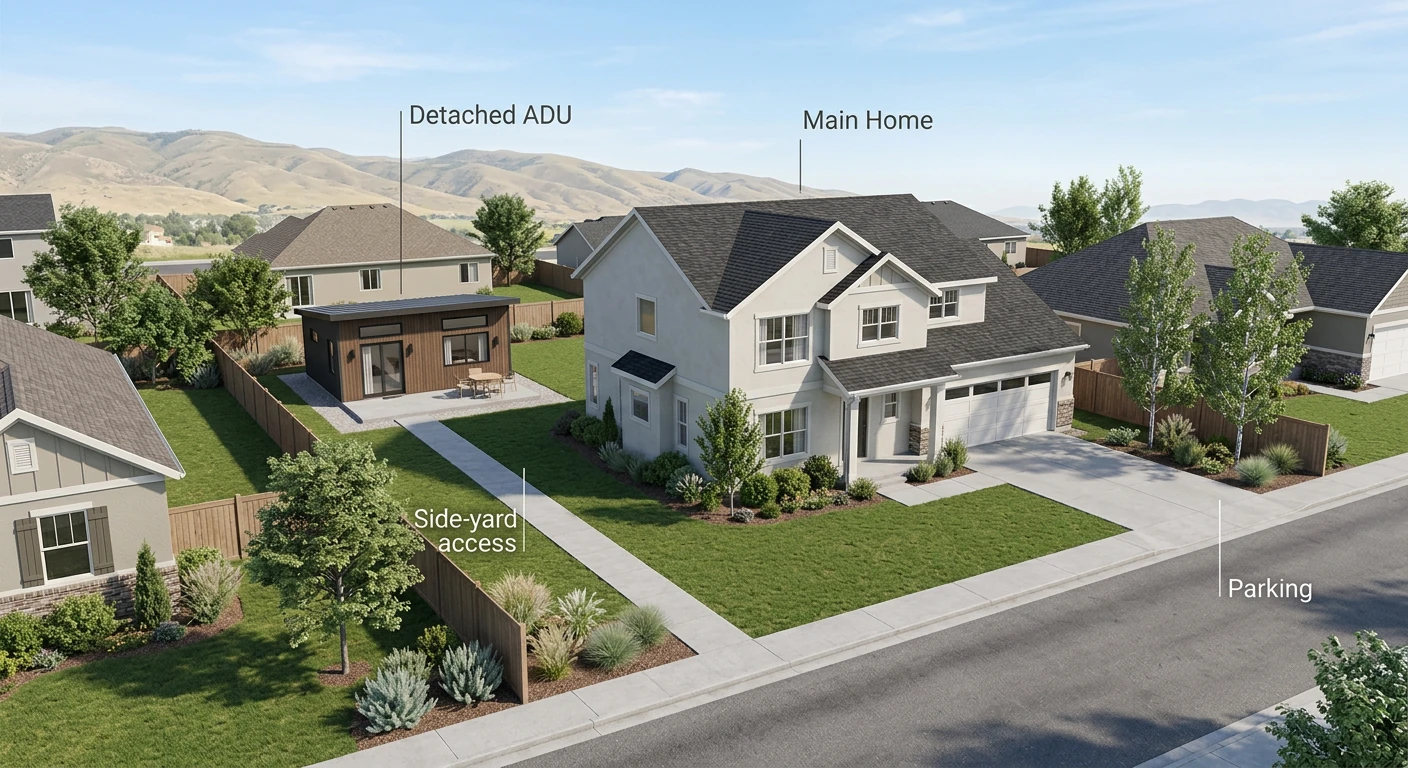
Key site considerations for a prefab ADU in Utah: side-yard access for delivery, setbacks from property lines, parking requirements, and utility distances
Verified Utah City ADU Regulations
We've verified the following from official city sources. Rules change — always confirm with your local planning department before committing.
Rules last verified: March 2026. City codes change — always confirm with your local planning department before committing to any design or purchase.
Why this matters for prefab specifically
Prefab units come in fixed dimensions. If your city's setback rules leave you with a buildable area narrower than the prefab model's footprint, you're stuck. Custom-built ADUs adapt to whatever buildable area your lot allows.
Notice also that Provo's published rules describe an accessory-apartment framework (inside the dwelling, over a garage, or by addition) — not a clean path for a standalone prefab cottage in the backyard. Sandy's accessory-apartment rules similarly require the unit to be connected to the existing living area. If you're targeting these cities with a detached prefab unit, verify the current detached-ADU path directly with the planning department before purchasing.
Not sure about your city's rules?
We'll check your lot and city rules for free — zoning, setbacks, lot size requirements, and the fastest permitting path for your property.
Will a Prefab Model Actually Fit on Your Lot?
City rules are one filter. Your actual lot is the other. Here's a practical checklist for evaluating whether prefab makes sense on a specific Utah property.
Ideal prefab conditions: flat lot, accessible side yard, adequate setbacks, and Wasatch Mountain views — but these conditions are not universal along the Front
The Utah Prefab Fit Checklist
✓
1. Is your property in a zone that allows detached ADUs?
Check with your city planning department. Single-family residential zones usually qualify, but some zones require conditional-use approval.
✓
2. Does your lot meet size and coverage requirements?
Salt Lake County requires 7,000 sq ft minimum for a detached ADU. Murray requires 10,000 sq ft. West Jordan requires 10,000 sq ft for external ADUs. Other cities vary.
✓
3. Do the prefab unit's dimensions fit your setbacks?
Measure your available backyard space after subtracting setback requirements from all sides. If the remaining rectangle is smaller than the prefab model's footprint, it won't work.
✓
4. Can the unit be delivered and placed?
The unit arrives on a truck and needs to be craned into position. That requires a delivery path wide enough for the truck, overhead clearance for the crane, firm ground that supports crane outrigger pads, and enough swing radius for placement.
✓
5. Are utilities close enough?
Every additional foot of trenching adds cost. Long or complex utility runs can significantly erode prefab's cost advantage over custom.
✓
6. Can you satisfy parking and fire access?
Most cities require one additional off-street parking space. Salt Lake City requires fire access within 150 feet from the public right-of-way.
✓
7. Are there slope, drainage, or access complications?
On the Wasatch Front, this is often the deciding factor. Significant slope, poor drainage, large trees in the build zone, or easements crossing the planned site can all complicate or eliminate a prefab project.
✅ Green flags for prefab
• Flat lot, minimal slope
• Wide side yard or alley access
• No overhead power lines in the crane path
• Short utility runs
• Newer subdivision with generous lot layout
• City has straightforward detached-ADU rules
🚩 Red flags that push toward custom
• Sloped backyard (common in SLC bench areas, Millcreek, Bountiful)
• Narrow side access
• Mature trees in the build/access zone
• Overhead power lines between the street and backyard
• Long or complex utility runs
• City requires architectural matching
• HOA with restrictive CC&Rs on detached structures
Most homeowners can't definitively evaluate all of these from their kitchen table. A site visit from someone who builds ADUs in your city is worth more than hours of online research.
Request a builder site assessment
We'll check every one of these points and tell you straight what makes sense — prefab, custom, or conversion — for your specific property.
How Long Does a Prefab ADU Take in Utah?
One of prefab's genuine advantages is speed. But "faster" doesn't mean "fast."
Realistic Utah timeline
Phase
Prefab
Custom-Built
Feasibility, design selection, city pre-check
2–4 weeks
2–6 weeks
Permitting and city approval
2–8 weeks
2–8 weeks
Site prep, foundation, utility work
3–6 weeks
3–6 weeks
Manufacturing / On-site construction
4–12 weeks (overlaps with site prep)
12–24 weeks
Delivery, set, finish, connect
2–4 weeks
N/A (included above)
Final inspections and certificate of occupancy
1–3 weeks
1–3 weeks
Total
~4–7 months
~5–9 months
The time savings with prefab come from the factory build running in parallel with your site prep. That overlap can compress the overall project meaningfully compared to sequential custom construction.
But notice what doesn't change: permitting takes the same amount of time regardless of build method. Salt Lake City's ADU process involves zoning certification, plan review, utility coordination, owner-occupancy review, and potentially deed restriction recording. That takes as long as it takes, whether your unit is factory-built or site-built. ADU Utah estimates approximately 60–80 days from purchase to completion for their prefab models, noting that city approval can take 2–8 weeks on top of that.
Prefab reduces on-site construction time. It does not remove permitting, site work, or inspections.
Can You Rent a Prefab ADU in Utah?
Yes — but the rules vary by city, and getting them wrong can cost you.
Long-term rental: the standard Utah ADU play
Many Utah cities allow ADU rentals with a minimum 30-day lease term. This is the bread-and-butter use case: rent to a tenant on a standard lease and collect steady monthly income. ADUs in Utah are renting for an estimated $1,200–$2,500/month in 2026, depending on size, location, and finishes. That math works: a $180,000 ADU generating $1,500/month produces $18,000/year in gross income, before property management, maintenance, and the property tax increase. For a deeper analysis, see our Utah ADU Rental Income Guide →
Short-term rental (Airbnb): city-specific, not blanket
Many Wasatch Front cities restrict ADU rentals to long-term use, but not every city handles it the same way:
Salt Lake City: Rentals under 30 days are "generally not permitted in residential zoning districts where ADUs are allowed." (Source: SLC ADU Handbook)
Murray: ADUs cannot be used for stays shorter than 30 days.
Ogden: Short-term rental "may not be housed within an ADU or the primary single-family dwelling associated with" one. (Source: Ogden City Code 15-13-39)
Sandy: STRs are allowed in owner-occupied dwellings with a special-use permit and business license, with a maximum of 182 rental nights per year.
Verify your specific city's rules before planning any rental strategy. The consequences of violating short-term rental restrictions can include fines and permit revocation.
Owner-occupancy: a real requirement
Almost every Utah city that allows ADUs requires the property owner to live on-site — either in the primary home or the ADU — as their principal residence. Salt Lake County allows limited exceptions of up to 2 years for military deployment, medical needs, or religious missions.
Business license and deed restriction
Several cities require additional steps beyond the building permit. Murray requires a separate business license for rental. Provo requires a recorded deed restriction and four parking spaces. Salt Lake City requires an owner-occupancy affidavit. When you sell the property, the ADU and all its recorded restrictions transfer to the new owner — which can actually be a selling point, as buyers often pay more for a property with a legal, income-generating ADU already in place.
Compare Utah prefab suppliers by model and quote scope
Current supplier pages help you compare models and package scope, but they do not establish the total installed cost for your property. Request a written quote that separates the unit or materials package from site work, foundation, utilities, delivery, permits, and finishes.
Comparison of current ADU Utah and DC Structures supplier pages, their listed model or package information, price evidence, scope questions, and source links.
Supplier
What the current cited page shows
Current price evidence
What to clarify in writing
Source
ADU Utah
Rondavel and Skylight models plus a custom-design option
No price found on the cited models page in this review
Construction method, model availability, dimensions, installation responsibilities, and total installed cost
Supplier pages checked October 3, 2026. This is a comparison of published information, not a ranking or a guarantee of service. Ask suppliers to confirm current availability and quote the same complete scope before comparing prices.
What to ask any prefab vendor before committing
1. Does your price include foundation, or is that separate?
2. Does your price include utility connections (water, sewer, electric, gas)?
3. Does your price include delivery, crane, and installation?
4. Does your price include permits and impact fees?
5. Does your price include site preparation (grading, excavation)?
6. What is the estimated total installed cost for a property similar to mine?
7. Can you provide references from completed Utah installations?
If the vendor can't clearly answer question 6, you don't have enough information to compare with a custom-built quote.
Want a custom-built quote for comparison?
Get an all-in estimate from a local Utah builder alongside any prefab quotes. Twenty minutes could save you tens of thousands.
When Does Prefab Win, and When Does Custom Beat It?
Scenario
Likely Better Path
Why
Flat lot, easy access, standard layout
Prefab
A repeatable plan may reduce design work; site-specific design, engineering and fees still apply
Sloped lot on the Wasatch Front bench
Custom
Adapts to terrain; prefab site prep costs can erase savings
City requires architectural compatibility
Custom
Designed to match your home from the start
Fastest path to occupancy (simple lot)
Prefab
Factory build overlaps with site prep
Aging parent or accessibility needs
Custom
Can design for wide doorways, zero-step entry, grab bars
The best decision depends on your property, not on any company's marketing — including ours. That's why we recommend every homeowner get at least one custom-built quote alongside any prefab quotes, so you can compare real numbers for your real lot.
How We Put This Guide Together
We're Utah ADU Builders — an ADU lead-generation and research resource based along the Wasatch Front. We connect homeowners with experienced local builders across Salt Lake, Davis, Weber, and Utah counties.
For this guide, we:
• Reviewed published pricing from prefab companies that serve Utah, directly from their websites
• Verified municipal ADU codes using official city sources (linked throughout this page)
• Referenced Utah Code §10-21-303 (formerly §10-9a-530) and HB 82 (2021) directly from the Utah Legislature website
• Reviewed Salt Lake City's official ADU Handbook and Building Services pages
• Referenced Salt Lake County's ADU ordinance (adopted June 4, 2024)
• Consulted the Utah Office of the Property Rights Ombudsman's published guidance on ADUs and tiny homes
What we're not: We're not affiliated with any prefab ADU manufacturer. If prefab is the best path for your property, we'll tell you. If custom-built or a conversion makes more sense, we'll tell you that too.
Lead generation disclosure: When you request a free estimate through our site, we may connect you with a local builder partner. This is a free service — you're never obligated to proceed.
All pricing reflects estimated 2026 ranges and is reviewed regularly. City codes change — always confirm with your local planning department before committing.
Is a prefab ADU cheaper than custom-built in Utah?
Not always. Supplier pages may describe a model or design-and-materials package without giving a complete installed price for your property. Compare written quotes for the unit or package, site work, foundation, utilities, delivery, permits, installation, and finishes; complex site conditions can change which method costs less.
Are modular ADUs allowed in Utah?
Yes. Modular ADUs built to the International Residential Code (IRC) and placed on permanent foundations are treated the same as site-built structures under Utah's State Construction Code. They go through the same local permitting process as any other ADU. (Source: Utah Code Title 15A)
Are prefab and modular the same thing?
Prefab is the umbrella term for anything built off-site. Modular specifically means factory-built to local building code (IRC) and placed on a permanent foundation. Manufactured homes (HUD code, steel chassis) and tiny homes on wheels are also 'prefab' but have different legal status. For ADU purposes in Utah, you generally want modular.
Can I put a manufactured home in my backyard as an ADU?
It depends on your city. Manufactured homes built to HUD code on a steel chassis face additional restrictions in many Utah municipalities. Provo explicitly requires ADU structures to meet local building codes and prohibits shipping containers unless fully clad with compatible materials. Check your city's specific ADU ordinance.
Can I use a tiny home on wheels as an ADU in Utah?
Generally no. Tiny homes on wheels are typically classified as RVs under Utah law. A tiny home on a permanent foundation, built to IRC standards, may qualify — but must meet all the same requirements as any other detached ADU. (Source: Utah OPRO)
Which Utah cities allow detached ADUs?
Salt Lake City, Salt Lake County (unincorporated), Ogden, Murray, Cottonwood Heights, and West Jordan all have published detached-ADU provisions, though rules differ significantly. See the city regulation table above for verified details.
How big can a detached ADU be in Salt Lake City?
Up to 1,000 square feet, and it must be smaller than the primary dwelling. Height is limited to 17 feet, with the option for up to 24 feet with a pitched roof if setbacks are increased. (Source: SLC ADU Handbook)
Do I need to live on the property (owner-occupancy)?
In most Utah cities that allow ADUs, yes. The property owner must occupy either the primary home or the ADU as their principal residence. Salt Lake County allows exceptions of up to 2 years for military deployment, medical services, or religious missions.
Can I Airbnb a prefab ADU in Utah?
It varies by city. Salt Lake City, Murray, and Ogden restrict ADU rentals to long-term use (30+ days). Sandy allows short-term rentals in owner-occupied dwellings with a special-use permit. Always verify your specific city's rules.
Do prefab ADUs pay impact fees in Utah?
Detached ADUs typically do — fees range by city. Internal ADUs (within the existing footprint) are not subject to impact fees under Utah law. (Source: Utah OPRO)
How close can a prefab ADU be to my property line?
It depends on your city. Salt Lake City requires 3-foot side and rear setbacks for detached ADUs. Salt Lake County requires the ADU to be set back 10 feet from the primary dwelling's front facade. Ogden, Murray, and Provo each have their own setback rules. Check your city before choosing a prefab unit size.
Do I need separate utility meters for a detached ADU?
It varies. Salt Lake County allows separate meters but requires the property owner to receive bills for both units. Sandy prohibits separate utility connections or meters. Other cities differ.
Do I need a licensed contractor?
Yes. Both prefab installation (site prep, foundation, utilities, connections) and custom construction require licensed contractors. Salt Lake City's ADU Handbook notes that a licensed general contractor must take out the building permit for a second dwelling unit per Utah Code 58-55-301 and 58-55-305.
Are pre-approved ADU plans available in Utah?
Salt Lake City offers pre-approved standard ADU plans through SLC Building Services. Using pre-approved plans can streamline permitting because the building code review is already complete. (Source: SLC Building Services)
Can I sell the ADU separately from the house?
No. ADUs in Utah cannot be sold or subdivided as separate lots. The ADU is part of the property and transfers with it when you sell. Recorded restrictions (owner-occupancy affidavit, deed restrictions) also transfer to the new owner.
What is the cheapest legal ADU path in Utah?
An internal conversion, such as a basement apartment, can be the lowest-cost path when the existing structure and code requirements work. The site's statewide editorial ranges are $60,000–$150,000+ for internal/basement work and $60,000–$175,000+ for a garage conversion. Site conditions and the actual scope can put your project outside those ranges.
How do I compare prefab quotes fairly?
Get every vendor to itemize: base unit price, site preparation, foundation, utility connections, delivery and crane, permits and fees, landscaping restoration, and total estimated installed cost. If a vendor won't provide an all-in estimate, that's a red flag. Then compare against a custom-built bid that includes the same scope.
What Should You Do Next?
You've made it this far, which means you're serious. Here's the next step based on where you are:
💡
"I think prefab might be right."
Before you put money down with a prefab company, get an all-in cost estimate that includes every line item in the hidden cost section above. Then get a custom-built quote for comparison. The 20 minutes it takes to request both could save you tens of thousands.
⚖️
"I'm deciding between prefab and custom."
A site feasibility assessment is the fastest way to clarity. We'll check your lot conditions, your city's rules, your utility setup, and your access — then tell you which path makes the most financial and practical sense.
🏗️
"My lot is tricky."
Slopes, tight access, awkward setbacks — these are solvable problems for experienced local builders. But they're problems that typically push toward custom. Let's take a look.
🙋
"I'm overwhelmed and just want someone to tell me what to do."
We get it. ADUs involve zoning, permitting, construction, utilities, and city bureaucracy. Start with one step: request a feasibility estimate. We'll do the research for your specific property and give you a clear recommendation.
Get a Free Utah ADU Feasibility & Cost Estimate
Here's what you'll get:
✓ Lot and city screening — we verify your zoning, setbacks, and local rules
✓ Path recommendation — prefab, custom, or conversion based on your actual property
✓ Realistic cost range — the all-in number, not a brochure price
✓ Timeline estimate — based on your city's permit process and lot conditions
✓ No obligation — genuinely free, no pressure to proceed