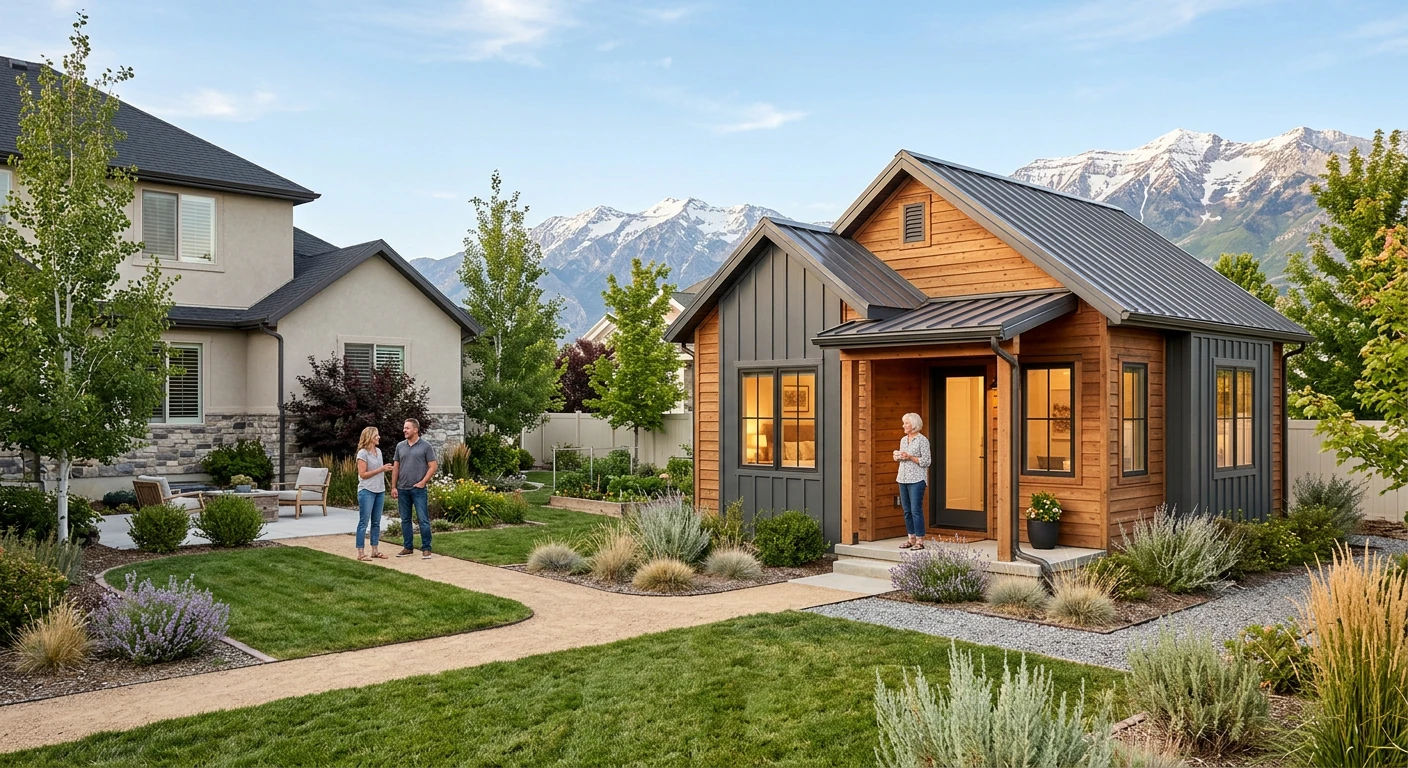
For many Utah homeowners, an ADU can be worth it — but only if your address qualifies, your city allows the ADU type you want, and the cost-to-value math works for your hold period. This guide helps you make that decision with current Utah law, city-specific rules, and scenario-based payback math.
The Quick Verdict
✅
Usually worth it if you own a qualifying lot, your city allows the type of ADU you want, you plan to hold the property at least five years, and you intend to rent the unit or house a family member.
⚠️
Maybe worth it if you're in a city with restrictive ADU rules, your timeline to sell is three to five years, or you're unsure about financing. Dig into the details before committing.
❌
Probably not worth it right now if you plan to sell within one to two years, your lot doesn't meet local minimums, or you're counting on short-term rental income that your city doesn't allow.
A permitted ADU can create rental income, family-housing value, and resale appeal — but the actual result depends on city rules, ADU type, total project cost, financing, and how long you hold the property. The rest of this page helps you work through each of those variables for your specific situation.
Updated March 2026 · Checked against current Utah Code (§§10-21-303, 17-80-303, 11-36a-202) and municipal ordinance pages · City sources linked in the matrix below
We gave you the quick verdict above. Now let's dig into the "why" behind each category.
When the Math Usually Works
You own a single-family home on a qualifying lot. Your city allows the type of ADU you want. You plan to hold the property for at least five years. And you intend to either rent the unit or house a family member who would otherwise pay rent elsewhere. In these situations, ADU owners in Utah typically see positive cash flow within the first year of operation, and the permitted unit can meaningfully increase the property's appraised value over time.
When You Need to Dig Deeper First
You're in a city with restrictive ADU rules (detached not allowed, tough parking requirements, or tight lot-size minimums). Or you're unsure about financing. Or your timeline to sell is three to five years. In these situations, an ADU can still work — but you need to verify your city's specific rules and run realistic numbers before committing. That's what the rest of this guide helps you do.
When It's Probably Not the Right Move
You plan to sell within one to two years, your lot doesn't meet minimum size requirements, your city doesn't allow the type of ADU you want, or you're building your financial projections around short-term rental income (Airbnb) — which most Utah cities restrict or prohibit for ADUs. In these cases, the investment may not pay off in time.
One Honest Caveat Before We Go Further
We're not going to pretend ADUs are a guaranteed money machine. Appraised value is difficult to predict upfront — the Appraisal Institute describes ADU valuation as a data challenge, especially in markets with limited comparable sales. Property taxes will increase. Permitting takes longer than you'd like. And if you sell too soon, the math can disappoint.
But here's the other side of that honesty: if your property qualifies, you hold long enough, and the ADU solves a real income or family-housing problem, it is one of the few ways to create long-term financial flexibility and real value on land you already own. A kitchen remodel or a pool doesn't generate monthly income. An ADU can.
The rest of this page is about helping you figure out which side of that line you're on.
Want the quick answer for your property?
Explore planning costs with our free tools, or request a provider review of your address and project type. Confirm eligibility with your city; provider fit and availability need review.
What Type of ADU Is Most Worth It in Utah?
Not all ADUs are created equal. The type you choose is the single biggest factor in your total cost, your timeline, your rental income, and how quickly the project pays for itself. Here's how the four main types compare in Utah:
Basement / Internal ADU
Garage Conversion
Attached Addition
Detached New Build
Typical cost range
$60,000–$150,000+
$60,000–$175,000+
$150,000–$275,000+
$200,000–$400,000+
Best for
Budget-conscious owners with an existing basement
Owners with an unused garage and limited yard
Proximity + privacy (shared wall)
Maximum rental income and resale value
Privacy level
Low (shared structure)
Moderate
Moderate
High
Permit friction
Lowest (statewide framework under Utah Code)
Low to moderate
Moderate
Highest (city-by-city rules)
Rental potential
$1,000–$1,500/month
$1,100–$1,600/month
$1,400–$2,000/month
$1,800–$2,500/month
Typical payback
3–6 years
4–7 years
6–10 years
7–12 years
Biggest downside
Less privacy, no new square footage added
Lose your garage/storage
Construction disrupts main home
Highest cost, most complex permitting
Cost and rental estimates based on 2025–2026 Utah market data from ADU Utah, Rock Top Construction, PropertyWire, and statewide rental data.
Important: A garage conversion is not one legal category. If the garage is within the existing footprint of the primary home, it may qualify as an internal ADU under Utah's statewide framework. If it is a detached garage, local detached-ADU rules apply instead. This distinction affects your permit process, impact fees, and timeline.
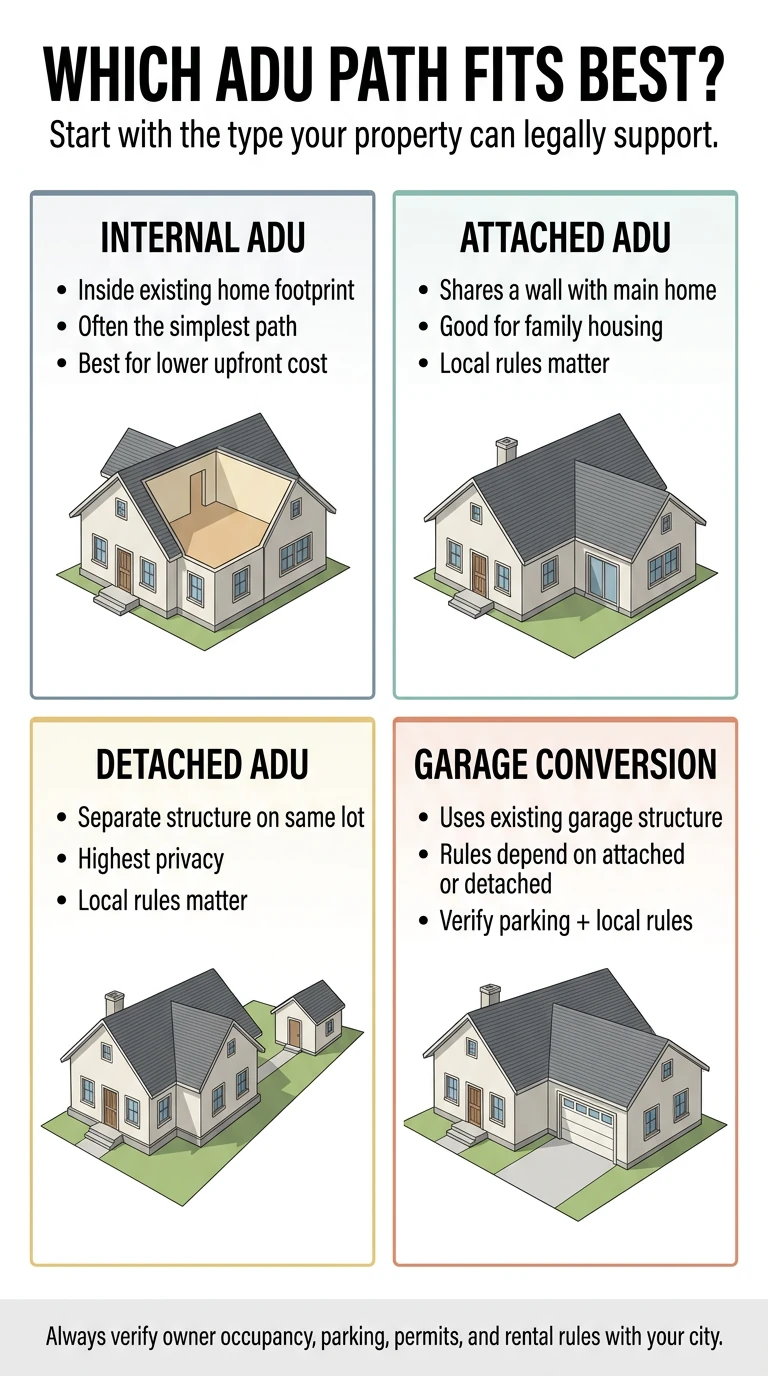
Which ADU Path Fits Best? Start with the type your property can legally support.
Basement and Internal ADUs
These are the easiest path for most Utah homeowners. Utah state law (Utah Code §10-21-303 for municipalities, §17-80-303 for counties) requires cities to allow internal ADUs in residential zones, with limited exceptions. They're not subject to impact fees (Utah Code §11-36a-202). And since the structure already exists, your costs are focused on finishes, a separate entrance, egress windows, and code compliance — not foundation, framing, or roofing. If you have an unfinished or underused basement, this is usually the fastest payback play.
Garage Conversions
A popular middle ground. You're converting an existing structure, which saves on foundation and framing costs, but you lose your garage — so factor in the value of that covered parking and storage. Some cities require you to replace the garage parking with another on-site space.
Attached Additions
Think of these as a small addition that shares a wall with your main home. They're less expensive than detached builds because you share some infrastructure (foundation edge, utilities). They work well for family housing — close enough to help aging parents, private enough that everyone still has their own space.
Detached New Builds
These are standalone structures in your backyard. They command the highest rents, add the most resale value, and offer the most privacy — but they also cost the most and face the most regulatory friction. Detached ADU rules are not covered by Utah's statewide framework; they're set city by city. Some cities allow them freely. Others don't allow them at all.
Which Type Usually Wins on Payback?
Basement conversions. Lower upfront cost, moderate rental income, and the structure is already there. But if your goal is maximum long-term return and you can handle the higher upfront investment, a detached ADU typically generates the strongest rental income and the highest equity boost at resale.
Which Utah Homeowners Benefit the Most from an ADU?
"Is it worth it?" is really "is it worth it for me?" Here's a quick way to find yourself in the answer:
Your Situation
Best ADU Path
Why It Works
I want monthly rental income
Detached or garage conversion
Highest rent potential, separate from your daily life
I want housing for aging parents
Attached addition or internal ADU
Proximity for caregiving, avoids $4,000–$8,000/month assisted living costs
I want a place for an adult child or newlywed
Internal or attached ADU
Affordable path to keep family close while they save for their own home
I want maximum privacy between units
Detached new build
Separate structure, separate entrance, separate living experience
I want the lowest-cost entry point
Basement conversion
$60,000–$150,000+ planning range; compare scope, site constraints and current bids
I might sell in 3–5 years
Internal or attached (lower cost)
Smaller investment to recoup, still adds value at sale
I mostly want flexibility, not rent
Any type — match to budget
Home office today, guest suite tomorrow, rental next year
The common thread: ADUs work best for homeowners who think in terms of years, not months. This is not a flip-it project. It's a long-term asset that gets more valuable over time — through rental income, through equity growth, and through the sheer flexibility of having a second living space on your property.
Here's something most guides won't tell you: the "why" behind your ADU matters more than you think. Homeowners who build with a clear purpose — rental income, multigenerational housing, a future downsize plan — make better design decisions and end up happier with the result. Homeowners who build because it "seems like a good idea" sometimes end up with a unit that doesn't quite work for any purpose.
The other factor worth mentioning: your ADU's purpose will likely change over time, and that's one of its greatest strengths. The unit that houses your aging mother today might become a rental five years from now, and then a place for your adult child to land after college. A well-designed ADU with a separate entrance, full kitchen, and bathroom works for nearly any scenario. Design for flexibility, and you'll never run out of uses.
How Much Does an ADU Cost in Utah in 2026?
Let's start with the real number, then break it down.
The all-in cost for a Utah ADU in 2026 ranges from about $50,000 to $400,000 or more, depending on the type. "All-in" means design, permits, site work, utilities, construction, and finishes — not just the building itself.
Here's where that money goes:
What Basement and Internal ADUs Usually Cost
$60,000–$150,000+. The bulk goes toward interior finishes, a separate entrance, egress windows, fire separation, plumbing for a kitchen and bathroom, and electrical work. Since the shell already exists, you skip foundation, framing, and roofing costs entirely.
What Garage Conversions Usually Cost
$60,000–$175,000+. You're converting an existing structure, so foundation and framing costs are minimal. But you'll likely need new insulation, drywall, plumbing, electrical, HVAC, and potentially structural modifications to meet residential building code.
What Attached or Over-Garage ADUs Usually Cost
$150,000–$275,000+. These share a wall with your main home, which saves some infrastructure cost. But you're building new space — foundation extension, framing, roofing, full utility connections, and interior finishes.
What Detached ADUs Usually Cost
$200,000–$400,000+. This is essentially building a small house from the ground up. Foundation, framing, roofing, full utility trenching and connections, HVAC, kitchen, bathroom, and finishes. The price varies significantly based on size, finish level, and site conditions (slope, access, distance from existing utility lines).
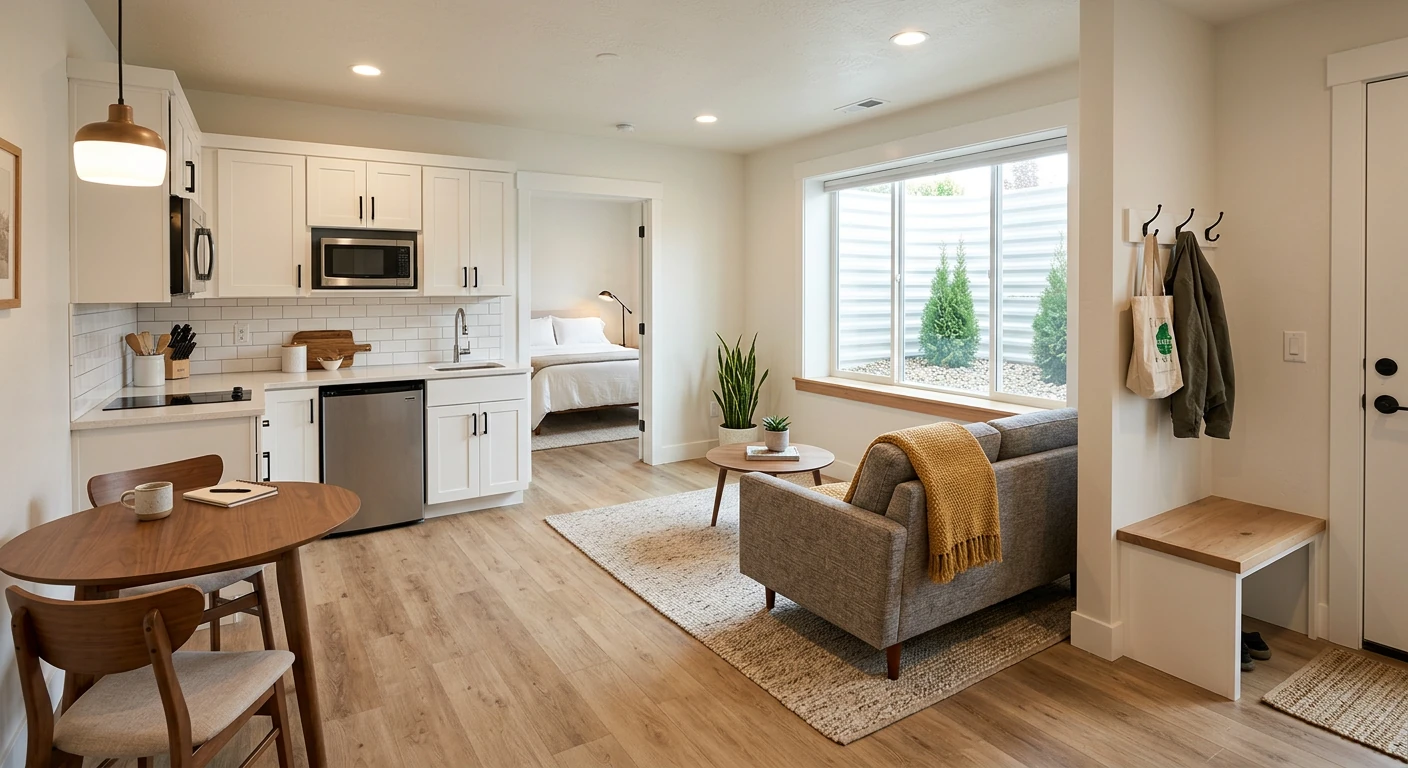
A well-finished ADU interior — open kitchen, living area, and bedroom in a single thoughtfully designed space
What Hidden Costs Surprise Utah Homeowners Most
The construction number is only part of the picture. Here's what catches people off guard:
Design and engineering drawings: $2,500–$10,000. Required for building permits.
Permit and plan review fees: $2,000–$5,000, depending on your city.
Impact fees: $3,000–$10,000 for detached ADUs. Internal ADUs are exempt from impact fees under Utah Code §11-36a-202.
Utility trenching: $5,000–$20,000. Connecting water, sewer, and electrical to a detached structure — costs depend on distance and lot slope.
Site preparation: $3,000–$15,000. Grading, leveling, excavation.
Landscaping restoration: $2,000–$8,000. Your yard will need work after construction.
Insurance adjustment: $300–$800/year for a landlord rider or separate policy.
Property tax increase: Typically $800–$2,500/year (more on this below).
A realistic rule of thumb: budget 15–25% above the construction quote for these soft costs and surprises. If a builder quotes $200,000 for a detached ADU, your true all-in number is probably $230,000–$250,000.
That sounds like a lot. It is a lot. But context matters: you're building a real asset that generates income and grows in value every year you own it. We'll get to the payback math in a moment.
Want a cost range specific to your property?
Get a free estimate — a local builder looks at your specific lot, city, and ADU type and gives you a realistic all-in number, not just a starting price.
How Much Rent or Family Value Can a Utah ADU Actually Create?
This is where the "worth it" math starts to get interesting — and where we need to talk about two completely different kinds of value.
The Income Lens: Rental Income
Utah ADUs are renting for roughly $1,200–$2,500 per month in 2026, depending on type, size, location, and finish level. For context, the statewide average rent for a one-bedroom apartment is around $1,400 per month, and a two-bedroom averages about $1,666 (Apartments.com, 2025). The Salt Lake City metro area commands a premium, with desirable neighborhoods like Sugar House, Millcreek, and downtown regularly exceeding $1,500 for small units.
A few real-world benchmarks:
A well-finished basement ADU in Salt Lake County: $1,200–$1,500/month
A garage conversion in the Ogden or Provo area: $1,100–$1,400/month
A detached 600–800 sq ft ADU in SLC or Sandy: $1,800–$2,200/month
A premium detached ADU in a high-demand neighborhood: $2,000–$2,500/month
That's $14,400 to $30,000 per year in gross rental income. Even after vacancy, maintenance, insurance, and management costs, most ADU owners are cash-flow positive.
Important: Utah's statewide internal-ADU framework is built around long-term rentals of 30 consecutive days or longer, and many cities apply similar limits for all ADU types. Millcreek allows short-term rentals in internal and attached ADUs (with an ADU application and business license), while prohibiting them in detached ADUs. Other cities like Salt Lake City, Draper, and Cottonwood Heights prohibit short-term ADU rentals across the board. Always check your specific city's rules before using short-term rental income in your projections.
The Family-Value Lens: What You Save, Not Just What You Earn
Not every ADU is rented to a stranger. Many Utah homeowners build ADUs for family — and the financial value can be just as significant:
Avoiding assisted living costs: A private room in a Utah assisted living facility runs $3,500–$6,500 per month. An attached ADU for an aging parent costs a fraction of that and keeps your family together.
Housing an adult child: Instead of paying $1,400/month in rent somewhere else, your son or daughter lives on your property and saves for a down payment. That's $16,800/year in avoided cost for your family.
Caregiver housing: If a parent or family member needs regular help, having a caregiver live on-site in an ADU can be significantly less expensive than round-the-clock in-home care.
The point: even if your ADU never generates a dollar of rental income, it can create enormous financial value for your family. Don't overlook this when running the numbers.
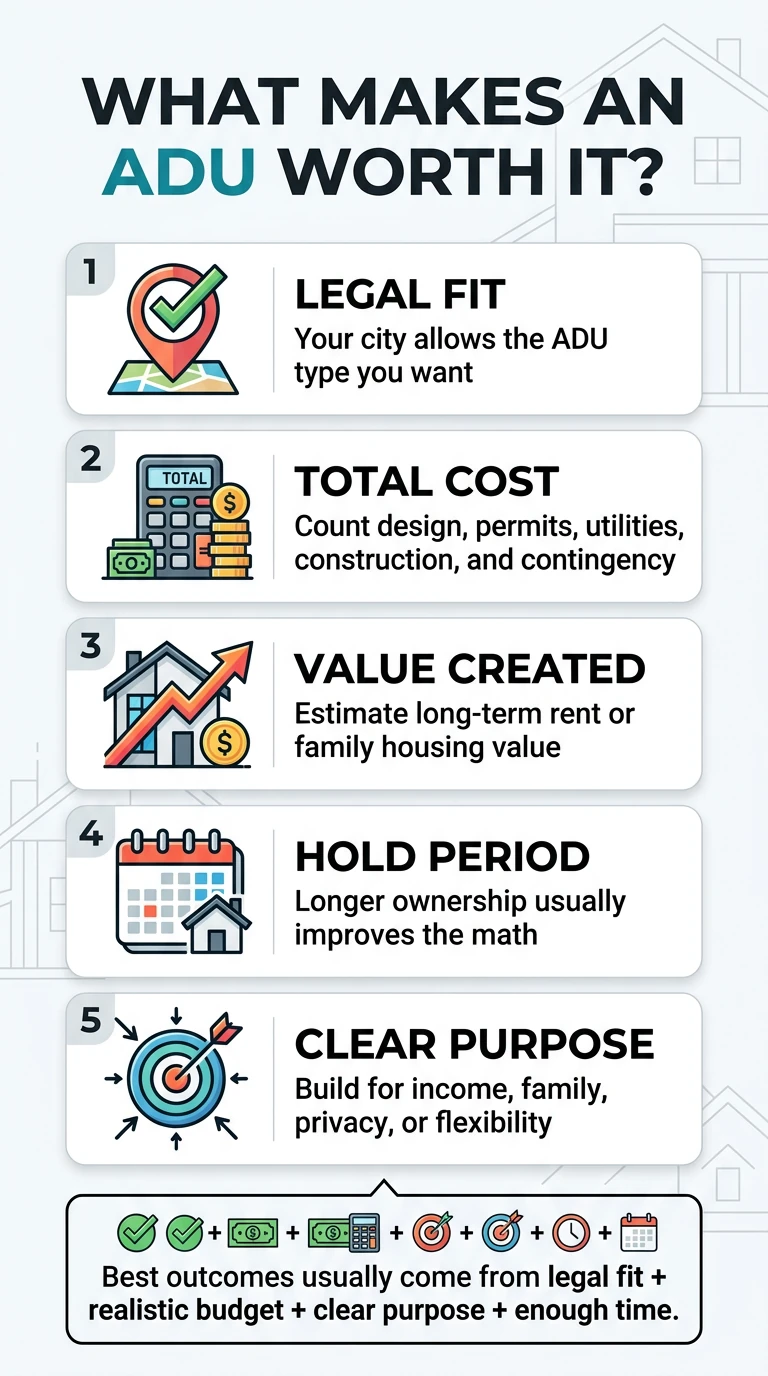
What makes an ADU worth it: legal fit + realistic budget + clear purpose + enough time
What NOT to Count as Guaranteed Value
Be honest with yourself on three things:
1. Don't count on Airbnb income unless you've confirmed your city explicitly allows short-term rentals for your specific ADU type. Many cities don't, and the rules can differ between internal, attached, and detached units even within the same city.
2. Don't assume 100% occupancy. A reasonable vacancy assumption for a long-term rental is 5–8%.
3. Don't assume the rent you'd charge a stranger when housing family. Family use creates real value — but it's not the same as rental income on a spreadsheet.
What Is the Real Payback Period on a Utah ADU?
The honest answer: it depends on what you build, what you spend, what you charge, and how you finance it. Rather than hand you a single number, here are three illustrative scenarios using sample assumptions for cost, rent, financing, vacancy, and maintenance. Your numbers will differ — use these as a framework, not a forecast.
Scenario 1: Basement ADU in Salt Lake County
Total cost (all-in):$85,000
Financing: HELOC at 8.5%, interest-only first year
Monthly payment:~$602
Monthly rent:$1,350
Monthly net cash flow:+$748
Annual net cash flow:+$8,976
Simple payback (if paid cash):~6.3 years
Financed payback: Cash-flow positive from month one. The rental income covers the HELOC payment and puts nearly $750/month in your pocket.
Scenario 2: Garage Conversion in Utah County
Total cost (all-in):$130,000
Financing: Home equity loan at 8%, 15-year term
Monthly payment:~$1,243
Monthly rent:$1,400
Monthly net cash flow:+$157
Annual net cash flow:+$1,884 (after maintenance reserve)
Simple payback (if paid cash):~7.7 years
Financed payback: Tight but positive from month one. The real win is the $80,000–$130,000 in equity added to your property.
Scenario 3: Detached New Build in Salt Lake City
Total cost (all-in):$275,000
Financing: Construction loan converting to 7.5% fixed, 20-year term
Monthly payment:~$2,213
Monthly rent:$2,200
Monthly net cash flow:–$13 (roughly break-even)
Simple payback (if paid cash):~10.4 years
Equity added:$150,000–$200,000 on day one
That third scenario is the one that trips people up. "Break-even? That doesn't sound worth it." But look at the full picture. In this example, the owner added significant equity to the property. The tenant's rent covers the loan. And if rents increase over time — even modestly — the unit moves into positive cash flow within a few years. By year ten, the owner could have a free-and-clear income-producing asset. That's why experienced ADU owners tend to think in five- to ten-year horizons, not months.
How the Payback Can Change Over Time
One thing most payback calculations miss: rents tend to increase. Utah rents have risen steadily over the past decade. While no one can guarantee future increases, even a modest 2–3% annual rise on a $2,000/month ADU adds $40–$60/month each year — while a fixed-rate loan payment stays the same. Utah's population is also projected to grow significantly in the coming decades. That kind of sustained demand tends to support both rental rates and property values over the long term. None of this is guaranteed, but the structural tailwinds are real.
How Long Does Construction Actually Take?
The financial payback doesn't start until the unit is finished and occupied. Here's a realistic timeline for each type:
Phase
Basement / Internal
Garage Conversion
Attached Addition
Detached New Build
Design & engineering
1–3 weeks
2–4 weeks
3–6 weeks
4–8 weeks
Permit application & review
2–6 weeks
4–8 weeks
4–10 weeks
6–12 weeks
Construction
4–8 weeks
6–10 weeks
10–16 weeks
14–24 weeks
Final inspection & occupancy
1–2 weeks
1–2 weeks
1–2 weeks
1–2 weeks
Total range
2–4 months
3–6 months
5–9 months
7–12 months
Pro tip: Start zoning and code verification early. Permitting is the longest lead-time item, so submit your application once your plans are complete enough to meet the city's requirements. Budget for application and permit fees — they vary by city.
A Note on Financing
Fannie Mae allows rental income from an existing ADU to count toward qualifying for a mortgage in limited situations: it must be a one-unit principal residence with one ADU, on a purchase or limited cash-out refinance, and the ADU income is generally capped at 30% of total qualifying income. This applies to income from an ADU already built and rented — not projected future income. Talk to a lender who has handled ADU transactions before.
HELOC (Home Equity Line of Credit): Most popular. Draw on equity as needed, pay interest only on what you've used. Variable rate.
Home equity loan: Fixed rate, lump sum. Good if you know your exact costs.
Cash-out refinance: Replaces your mortgage with a larger one. Only smart if current rates are favorable.
Construction loan: Short-term loan for the build, converts to permanent financing after. Good for detached new builds.
SLC West Side ADU loan program: Low-interest loans up to $200,000 for qualifying West Side residents. Rent to income-qualified tenants and 10% of the loan may be forgiven.
Get a free feasibility assessment. A local builder checks your address, confirms what's allowed, and gives you a realistic cost range and payback estimate for your specific situation.
Can I Legally Build the Kind of ADU I Want Where I Live in Utah?
This is where most Utah ADU guides fall apart. They'll tell you "ADUs are legal in Utah" and move on. That's technically true but practically useless, because the rules vary dramatically depending on what type of ADU you want and which city you live in. Here's what you actually need to know.
What Utah State Law Says About Internal ADUs
Utah's statewide framework (originally passed as HB 82 in 2021, now codified at Utah Code §10-21-303 for municipalities and §17-80-303 for counties) requires all municipalities to allow internal ADUs as a permitted use in residential zones. An internal ADU is one created within the footprint of an existing primary dwelling — think basement apartments, attic conversions, or in-law suites inside your home.
Key provisions of the state framework:
Internal ADUs are a permitted use in areas zoned primarily for residential use.
They are not subject to impact fees (Utah Code §11-36a-202).
Minimum rental period: 30 consecutive days or longer.
Owner occupancy is required — you must live in either the primary dwelling or the ADU.
Cities can exempt up to 25% of residential-zoned land from the IADU requirement (67% for cities with a university of 10,000+ students).
Cities can require: egress windows, one additional parking space, a permit or business license, and that the ADU doesn't change the exterior appearance of the home.
HOAs generally cannot prohibit internal ADUs that comply with local land use ordinances and building codes (see Utah Code §57-8a-218), though there are nuances — always check your specific CC&Rs.
What State Law Does NOT Settle for You
The statewide framework covers internal ADUs only. Detached ADUs, attached additions, and garage conversions are governed by your individual city or county ordinance. Some cities welcome them. Others restrict them heavily. A few don't allow detached ADUs at all.
In 2025, HB 88 attempted to mandate detached ADUs statewide — it failed. So for now, detached ADU rules remain a patchwork across Utah's cities. This is why an address-level check matters more than reading a state-level summary. The rules that affect your project are local.
Why This Is Actually Good News
Utah has a more ADU-friendly legal landscape than most states. The statewide internal ADU framework gives you a reliable floor — if you want a basement apartment, you're almost certainly covered. And as cities across the Wasatch Front continue adopting and loosening their own ADU ordinances, the options for detached and attached ADUs are expanding every year. Salt Lake City alone doubled its active ADU permits after updating its ordinance in 2023. The trend is moving in your direction.
Which Utah Cities Are Easiest or Hardest for ADUs Right Now?
We reviewed the current ADU ordinances for major Utah cities so you can see, at a glance, what your city allows.
A detached ADU can provide independent living for aging parents while keeping family on the same property
Detached up to 1,000 sq ft; frosted windows within 15 ft of neighbors
Ogden
Yes
Yes
Varies
Yes
Check ordinance
Detached ADUs: 300–800 sq ft, max 25% of rear yard
Provo
Yes
Limited
Varies
Yes
Restricted
University town (67% IADU exemption zone); 4 off-street parking spaces; rental dwelling license required
Lehi
Yes
Separate process
Varies
Yes
Check ordinance
Permits + active ADU license required while rented
West Jordan
Yes
Lots > 10,000 sq ft only
10,000 sq ft
Yes
No
Owner may not rent primary and ADU separately; business license required if renting
Orem
Yes
No (within main building only)
N/A
Yes
Check ordinance
Accessory apartments are within the main residential building only
St. George
Yes
Yes
Varies
Yes
Check ordinance
2025 update: removed rear-yard setback (except 6 ft from main structure); detached size increased
Cottonwood Heights
Yes
Yes
6,000 sq ft (internal)
Yes
No
Internal: 1 extra parking stall; Detached: 2 extra stalls; tandem parking does not count
Layton
Yes
Yes
Varies
Yes
No
ADUs permitted in all single-family residential zones; short-term rental not permitted
City ordinances change. This table reflects the most current information we could verify as of March 2026. Always confirm with your city's planning department before beginning your project.
Quick Takeaways from the Matrix
Most flexible for detached ADUs: Salt Lake City, Salt Lake County (unincorporated), St. George (post-2025 update).
Most restrictive for investors: West Jordan, Orem, Provo (university town exemptions apply).
Best for the internal/basement path: Every city on this list — it's required by state law.
Where an address check matters most: Draper (12,000 sq ft minimum for detached), Cottonwood Heights (extra parking requirements), and any city where you're not sure about detached ADU rules.
Why City-Level Variation Matters So Much
Here's the reality that frustrates a lot of Utah homeowners: two houses on the same street, in different cities or jurisdictions, can have completely different ADU rules. One might allow a detached backyard cottage with straightforward permitting. The other might not allow detached ADUs at all.
This happens because Utah's state law creates a floor (internal ADUs must be allowed), but leaves the ceiling — detached ADUs, lot size requirements, parking rules, size caps — entirely to local cities and counties. The result is a patchwork that can only be navigated address by address.
Not sure what your city allows?
Request a provider review of your address and project type. Confirm zoning, lot size and city rules before committing; the provider confirms fit, fees and availability.
What Can Make an ADU Not Worth It in Utah?
We've covered the case for ADUs. Now let's cover the case against — or at least the conditions that undercut the investment.
Your City Only Allows Internal ADUs and You Want Detached Privacy
Some cities haven't adopted detached ADU ordinances yet. If your heart is set on a backyard cottage but your city only allows basement apartments, you'll need to either adjust your plan or wait for your city's ordinance to evolve. The trend across Utah is toward more permissive rules, but today's rules are what you're building under.
What to do: Check whether an attached addition might give you the privacy you want within your city's current rules.
You're Counting on Airbnb Income
Utah's statewide internal-ADU framework is built around 30+ day rentals, and many cities apply similar rules to all ADU types. Some cities create exceptions — Millcreek, for example, allows short-term rentals in internal and attached ADUs with proper licensing. But many others, including Salt Lake City and Draper, don't allow short-term ADU rentals at all. If your financial model depends on Airbnb rates, verify your city's rules first.
What to do: Build your projections around long-term rental rates. If your city and ADU type qualify for short-term use, treat that as potential upside — not your baseline plan.
You Need Major Infrastructure Work
If your lot has steep slopes, poor drainage, a failing septic system, or utility lines that are far from where the ADU would sit, site work and utility trenching costs can balloon. We've seen utility connection costs alone range from $5,000 to $20,000 in Utah.
What to do: Get a site assessment before committing. A good builder will flag these issues early.
Parking Rules Wreck Your Plan
Several Utah cities require one or two additional on-site parking spaces for an ADU. If your lot is tight or your driveway is already at capacity, this can become a surprisingly difficult constraint.
What to do: Review your city's parking requirements early. In some cases, tandem (stacked) parking counts; in others, it doesn't.
Your HOA Has Restrictions
Utah law prevents HOAs from banning internal ADUs that comply with local ordinances and codes (Utah Code §57-8a-218). But detached ADUs? HOAs may still have a say. And some CC&Rs have restrictive language that could create friction even for internal projects.
What to do: Read your CC&Rs carefully. If there's ambiguity, consult with the Office of the Property Rights Ombudsman or a real estate attorney.
You Plan to Sell Within One to Two Years
ADUs are a medium- to long-term investment. Construction takes 4–12 months. You need time for the asset to generate rental income and for the market to recognize the added value. Selling within a year or two of completion means you may not recoup the full investment — especially after accounting for transaction costs.
What to do: If selling soon is the plan, a lower-cost internal ADU (basement conversion) gives you the shortest payback window and least financial risk.
You Already Have an Unpermitted Unit
This is more common in Utah than most people realize. If you have an existing basement apartment or secondary unit that was never properly permitted, it may not receive any appraisal credit — and it could create legal complications when you sell.
What to do: Going through the permitting process retroactively is almost always better than leaving it unpermitted. Many cities have created pathways for this. A permitted unit is an asset. An unpermitted one is a liability.
Does an ADU Increase Home Value, Change Taxes, or Affect Financing?
These are the money questions people are afraid to ask out loud. Let's answer them directly.
Does an ADU Increase Your Home's Value?
Often yes, if it's legal and properly permitted — but the amount depends on your neighborhood, the quality of the build, and the availability of comparable sales data. Federal appraisal data compare groups of whole properties rather than measuring the value an ADU adds to a specific home; see what federal appraisal data shows about ADU property value for the national and Utah figures and their limits. Fannie Mae acknowledges that ADUs can add both value and rental income potential. However, the Appraisal Institute describes ADU valuation as a data challenge, especially in markets where few ADU-equipped homes have sold recently.
What this means in practice: a permitted ADU will likely add value, but the exact appraised amount is hard to predict upfront. Appraisers need local comparable sales to support their numbers. As more Utah ADUs are built and sold, this data gap is narrowing — but it's honest to say the appraised value today may not fully reflect what a buyer would actually pay.
The bottom line: permitted ADUs add real value. But the full benefit often shows up over time — through rental income, equity growth, and increased buyer appeal when you eventually sell.
What Happens to Your Property Taxes?
Your property will be reassessed after you add an ADU. In Utah, residential property receives a 45% exemption, meaning taxes are calculated on 55% of fair market value.
Here's how to estimate the impact:
Estimated added market value × 55% × your local tax rate = approximate annual tax increase
For illustration: if your ADU adds $150,000 in assessed market value, and your combined local tax rate is around 1.0%, the math would be roughly $150,000 × 0.55 × 0.01 = $825/year. Your actual number will depend on your county's assessment of the added value and your specific tax area's rate. If the ADU generates rental income, that income will typically exceed the tax increase by a wide margin.
Can Rental Income from an Existing ADU Help You Qualify for Financing?
Sometimes. Under Fannie Mae guidelines, rental income from an existing ADU on a one-unit principal residence may be used in limited cases — on purchase or limited cash-out refinance transactions, with one ADU only, and the qualifying income is generally capped at 30% of total qualifying income. This applies to income from a unit already built and producing rent. Talk to a lender who has handled ADU transactions before.
What Happens to Your Home's Value If You Sell?
A properly permitted ADU is a premium feature for buyers. More and more buyers are specifically looking for homes with income-producing potential — especially in Utah's competitive housing market. A legal ADU is a selling point. An unpermitted one is a negotiation problem. The best thing you can do to protect future resale value is to get proper permits. Full stop.
Should I Build an ADU, Finish My Basement, Add On, or Move?
This is a question most ADU guides ignore — but it's the real comparison running through your head. Here's how the alternatives stack up:
Option
Typical Cost
Permit Difficulty
Income Potential
Privacy
Timeline
Resale Impact
Internal ADU (legal basement apt)
$60,000–$150,000+
Low (state framework)
$1,000–$1,500/month
Low
2–4 months
Strong (adds legal income unit)
Detached ADU
$200K–$400K+
Moderate to high (city rules)
$1,800–$2,500/month
High
6–12 months
Very strong (most desirable to buyers)
Basement finish (non-ADU)
$30K–$80K
Low
$0 (no separate unit)
N/A
4–8 weeks
Moderate (added living space, no income)
Traditional home addition
$100K–$250K
Moderate
$0 (no separate unit)
N/A
3–6 months
Moderate (square footage boost)
Move to a different home
$15K–$50K+ in transaction costs
None
Depends on new property
Depends
2–6 months
N/A
The key insight: a finished basement adds living space. A legal ADU adds living space and income potential and a separate legal dwelling unit that appraisers and buyers value differently. The permit process is the difference between a nice basement and a wealth-building asset.
A finished basement (non-ADU) gives you more living space — a rec room, a guest bedroom, a home theater. It's nice. It adds some value to your home. But it doesn't create a separate legal dwelling unit, it doesn't generate rental income, and it doesn't get appraised as an income-producing asset. Typical cost: $30,000–$80,000. Typical value added: maybe $15,000–$40,000 in appraisal terms.
A legal basement ADU (with a proper permit, separate entrance, kitchen, and bathroom) creates a real second dwelling unit on your property. It qualifies for rental income. It adds $75,000–$125,000 in equity. It can generate $1,000–$1,500/month. The incremental cost over a basic basement finish is $20,000–$40,000 — money that pays for itself in the first year or two of rental income.
A traditional home addition (family room, extra bedroom, expanded kitchen) costs $100,000–$250,000 and adds square footage to your primary living space. It makes your home bigger and more comfortable, but it doesn't create a separate income-producing unit. For the same money, a detached ADU generates monthly income and typically adds more resale value.
Moving to a different home costs $15,000–$50,000+ in transaction costs (agent commissions, closing costs, moving expenses, mortgage requalification). If the goal is more space, more bedrooms, or a specific location, moving can make sense. But if the goal is income, family flexibility, or long-term wealth building, an ADU achieves those goals on property you already own — without the disruption of selling, buying, and relocating.
The choice depends on what problem you're solving. But if income potential, flexibility, and long-term wealth building are anywhere in the conversation, a properly planned ADU is hard to beat.
What Should I Do Next If My Property Might Qualify?
If you've read this far, you have a better understanding of Utah ADUs than 95% of homeowners who start this process. Here's how to turn that knowledge into action:
01
Check your address and zoning
Find out whether your city allows the type of ADU you want, what the lot-size and setback requirements are, and whether there are any deal-breakers for your specific property.
02
Choose the most likely ADU type
Based on your budget, your goals, and what your city allows, narrow it down to one or two options — basement conversion, garage conversion, attached addition, or detached new build.
03
Get a realistic cost range
Not a builder's starting price — the all-in number including permits, site work, utilities, design, and contingency.
04
Run the payback math
Compare your total cost to your expected rental income (or family-use savings). Make sure the numbers work for your hold timeline.
05
Get matched with a qualified local builder
ADU construction is specialized. Work with someone who knows your city's process, has pulled ADU permits before, and can give you a realistic timeline.
Our free planning tool helps you explore project paths and planning cost ranges. It does not establish legal eligibility. Confirm current rules with your city, and request a provider review of your address and project type if you want to discuss possible next steps.
Check My Address & Get a Free ADU Feasibility Estimate
Explore planning cost ranges, then request a provider review of your address and project type. Confirm current rules with your city; provider fit, assessment fees and availability need review.
How We Built This Guide
We want you to trust the information on this page, so here's how we put it together.
Legal citations reference current Utah Code (§§10-21-303, 17-80-303, 11-36a-202, 57-8a-218) and the Utah Office of the Property Rights Ombudsman. We use the post-recodification section numbers — if you see older references elsewhere (like the pre-2025 §10-9a-530), that's the same law under its previous numbering.
Cost estimates are compiled from ADU Utah, Rock Top Construction, Steve Austin Homes, PropertyWire (2026), Built by Design Construction, and Angi. Payback scenarios are illustrative examples using sample assumptions — your numbers will differ.
Rental income data draws from Apartments.com, Zillow Rental Manager, iPropertyManagement, and current Utah market listings.
City-by-city rules were verified against each city's published municipal website and ordinance pages. Source links are included in the city matrix above. City rules change — always confirm with your city's planning department before beginning a project.
Last updated: March 2026 · This guide is informational only and does not constitute legal, financial, or tax advice.
Is an ADU legal on every single-family lot in Utah?
Internal ADUs (basement apartments, in-law suites within your home) are allowed by state law on most residential lots. However, cities can exempt up to 25% of their residential-zoned area, and lots under 6,000 square feet may be excluded. Detached ADUs depend entirely on your city's local ordinance — they are not covered by the statewide framework.
Are detached ADUs allowed everywhere in Utah?
No. Detached ADU rules are set city by city. Some cities like Salt Lake City and St. George allow them in many residential zones. Others restrict them or don't allow them at all. Always check your specific city's ordinance.
Do I have to live on the property to rent my ADU?
In most cases, yes. Nearly all Utah ADU ordinances require the property owner to occupy either the primary dwelling or the ADU as their primary residence. This is commonly called the owner-occupancy requirement.
Can I Airbnb my ADU in Utah?
Sometimes, but never assume it. Utah's state framework for internal ADUs is built around long-term rentals of 30+ days. Millcreek allows short-term rentals in internal and attached ADUs with proper licensing but prohibits them in detached ADUs. Salt Lake City, Draper, Cottonwood Heights, and Layton prohibit short-term ADU rentals. Always check your specific city's ordinance before using short-term rental income in your financial projections.
Are impact fees charged on an internal ADU in Utah?
No. Utah Code §11-36a-202 specifically exempts internal ADUs from impact fees. This is one of the biggest cost advantages of the internal/basement ADU path. Detached ADUs are typically subject to impact fees, which can add $3,000–$10,000 to your project.
Can I install separate utility meters for my ADU?
It depends. Most cities prohibit separate utility meters for internal ADUs. Detached ADUs may be separately metered in some jurisdictions, but the property owner must typically receive the bills for both units. Check your city's specific rules.
Do I need extra parking for an ADU?
Usually yes. Most cities require at least one additional on-site parking space for an ADU. Some cities, like Cottonwood Heights, require two additional spaces for detached units. If you convert a garage into an ADU, many cities require you to replace the lost garage parking with another on-site space.
How long does permitting take?
Plan for 4–12 weeks for the permit process, depending on your city. Salt Lake City has streamlined their process significantly and publishes pre-approved ADU plans to speed things up. Smaller cities may take longer.
Which Utah cities are most ADU-friendly?
Salt Lake City stands out for its streamlined process, pre-approved plans, and west-side loan program. Salt Lake County (unincorporated) updated its ordinance in 2024 to reduce restrictions. St. George loosened detached ADU rules in 2025. These markets offer the least friction for ADU projects.
Is a basement ADU usually a better ROI than a detached one?
On a pure cost-to-payback basis, yes. Basement ADUs cost less and often pay for themselves in three to six years. Detached ADUs generate higher rent and more equity but take seven to twelve years to pay back. The best choice depends on your budget, goals, and timeline.
Does an ADU increase my property taxes?
Yes. Your property will be reassessed at a higher value. Utah's residential assessment ratio is 55% of market value, which buffers the increase. Use the formula: estimated added value × 55% × your local tax rate. The actual amount depends on your county's assessment, but rental income typically exceeds the tax increase.
Does an ADU increase my home's value?
Generally yes, if it's properly permitted — but the exact amount depends on local comparable sales, the quality of the build, and the type of ADU. Federal appraisal data compare groups of whole properties, not the value an ADU adds to a specific home; see what federal appraisal data shows about ADU property value for the national and Utah figures and their limits. Unpermitted units may add nothing or actively complicate a sale.
Can an existing ADU's rental income help me qualify for financing?
Sometimes. Under Fannie Mae guidelines, rental income from an existing ADU on a one-unit principal residence may count in limited cases — on purchase or limited cash-out refinance transactions, with one ADU only, and the qualifying income is generally capped at 30% of total qualifying income. This applies to income from a unit already built and producing rent, not projected income from one you plan to build.
Can an HOA stop me from building an ADU?
For internal ADUs, Utah law limits HOA authority to block units that comply with local ordinances and codes (Utah Code §57-8a-218). For detached ADUs, HOAs may have more leeway depending on your CC&Rs. Always review your association's governing documents.
Can I sell the ADU separately from my house?
No. An ADU cannot be subdivided from the primary lot and sold as a separate property. It's permanently tied to your main home. This is true across all Utah jurisdictions.
Is an ADU still worth it if I only want it for family use?
Often, yes. Even without rental income, an ADU can save your family thousands per month in avoided rent, avoided assisted-living costs, or avoided housing expenses for adult children. You also gain the equity increase and the flexibility to rent the unit later if family circumstances change.
What if I already have an unpermitted basement apartment?
Get it permitted. An unpermitted unit provides no appraisal value, creates legal risk, and can complicate a future sale. Many Utah cities have created pathways for retroactive ADU permitting. A permitted unit is an asset, an unpermitted one is a liability.
What is the biggest mistake Utah homeowners make with ADUs?
Underestimating the total cost. Homeowners often focus on the construction quote and forget about design, permits, impact fees, utility connections, site work, and landscaping. Budget 15–25% above your construction estimate for these items, and you won't be caught off guard.
You've Done the Research. Now Check Your Property.
If you've made it this far, you're serious about this — and you're more informed than most people who actually start building.
Here's what we know: the difference between an ADU that changes your financial future and one that becomes a regret almost always comes down to one thing — checking the details for your specific property before you commit. That's exactly what our feasibility estimate does. Give us your address, and we'll verify your city's rules, check your lot's qualifications, and give you a realistic cost range. No pressure, no commitment — just the numbers you need to make a confident decision.
Check My Address & Get a Free ADU Feasibility Estimate
A local Utah ADU builder checks your property — zone, lot size, setbacks, ADU type eligibility — and gives you a realistic cost and payback range. Free. No obligation.