Independent ADU Planning Resource801-441-4365

Weber County ADU Guide: Rules, Costs, Permits & What You Can Build in 2026

By Utah ADU Builders Editorial Team · Last Updated March 2026 · Verified against Weber County Code Ch. 108-19, Ogden City Code §15-13-39, Utah Code §10-21-303 (formerly §10-9a-530), and individual city ordinances

Disclosure: Utah ADU Builders connects homeowners with local builder options. If you request an estimate through this page, we may receive a referral fee. Verify licensing, insurance, and references before hiring. This never influences our editorial content.

Thinking about building an ADU in Weber County? Start here. We break down the actual rules — city by city — so you can find out what's allowed on your property, what it costs, how the permit process works, and the fastest path from "thinking about it" to breaking ground.

Weber County ADU Guide: Rules, Costs, Permits and What You Can Build — detached ADU with Wasatch Mountain backdrop in Northern Utah

Can I Build an ADU on My Weber County Property?

Yes, you can build an ADU in Weber County. Internal ADUs (basement apartments) are broadly protected by Utah state law in all residential zones. Detached ADUs are allowed in most jurisdictions too, but the size limits, parking requirements, and permit paths differ significantly between Ogden, unincorporated Weber County, and the smaller cities.

Here's what you need to know right now:

  • Internal ADUs (basement apartments, in-law suites) are a permitted use in residential zones across Weber County, backed by Utah state law.
  • Detached ADUs (backyard cottages, casitas) are allowed in some major Weber County jurisdictions — including unincorporated Weber County and Ogden — but rules on size, height, and setbacks vary by city. Ogden caps detached units at 300–800 sq ft. Unincorporated Weber County allows up to 1,500 sq ft footprint.
  • Owner-occupancy is required nearly everywhere. You must live in either the main home or the ADU.
  • Short-term rentals (Airbnb) are restricted or banned for ADUs in most Weber County cities. Plan for long-term rental of 30+ days.
  • Typical build cost: $50,000–$100,000 for a basement conversion; $150,000–$300,000+ for a detached new build.
  • Typical rental income: One-bedroom apartments in Weber County generally rent in the $900–$1,500/month range.

Your first job — before you spend a dollar on plans:

Figure out whether your property is in Ogden, unincorporated Weber County, Ogden Valley, or one of the other dozen-plus municipalities. That single question changes almost everything.

Get My Free Weber County ADU Feasibility Check

We'll confirm your jurisdiction, check your zoning, and tell you exactly what's allowed on your lot — free, no obligation.

Am I in Unincorporated Weber County, Ogden, Ogden Valley, or Another City?

This is the question that trips up more Weber County homeowners than any other — and it matters more than almost anything else in this entire guide.

Weber County isn't one set of rules. It's a patchwork of fifteen-plus cities and towns, each with its own ADU ordinance layered on top of Utah state law. Ogden has different size limits than unincorporated Weber County. Roy has different parking rules than Farr West. And if you're in Eden, Huntsville, or Liberty, you're now in a brand-new municipality that's actively building its own code.

We've talked to homeowners who spent months designing an ADU based on "Weber County rules," only to discover their lot is actually inside a city with a completely different ordinance. That's wasted money and wasted time.

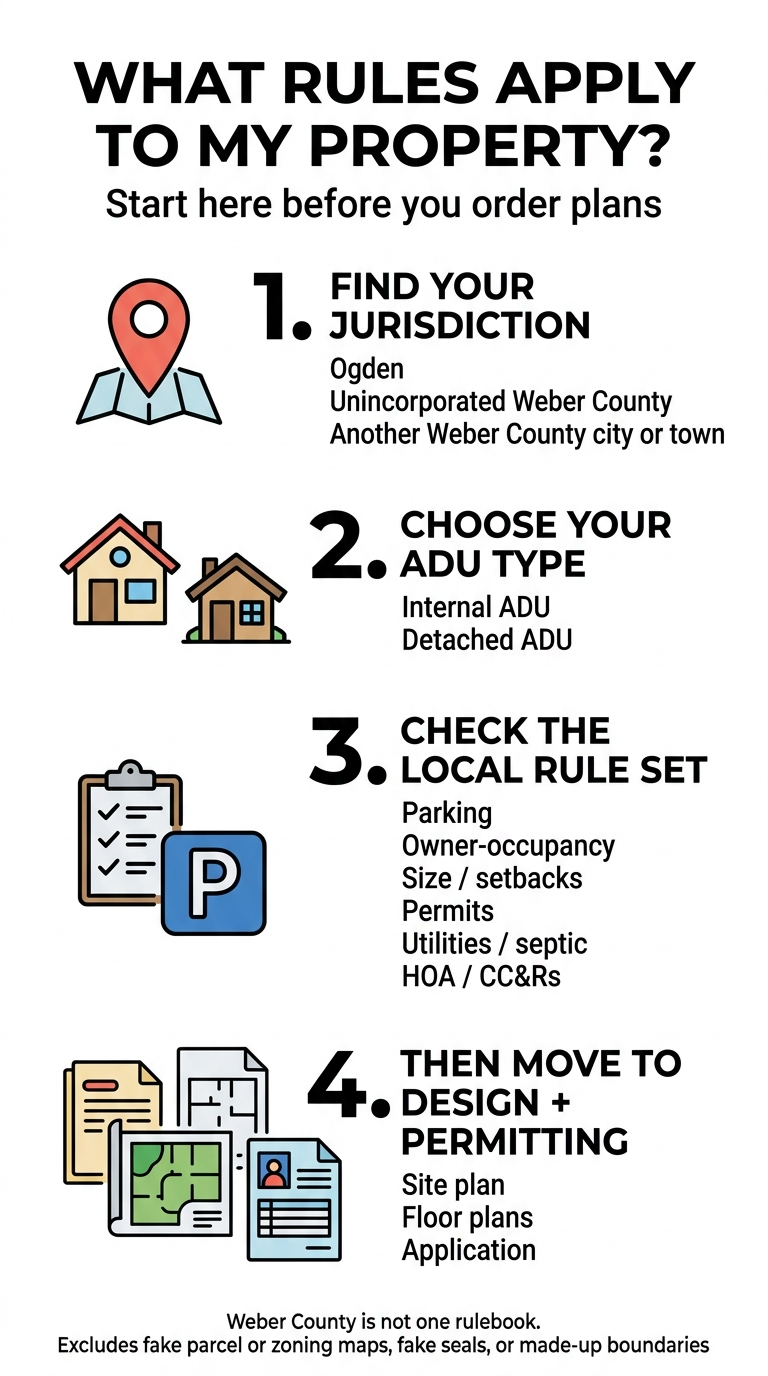
What rules apply to my Weber County property? 4-step guide: find jurisdiction, choose ADU type, check local rule set, then design and permit — Weber County is not one rulebook
Weber County is not one rulebook. Your first step — before ordering plans — is confirming which jurisdiction controls your lot.

How to check your jurisdiction in about three minutes

1

Pull up the Weber County Parcel Search

Go to the Weber County Assessor's website. Enter your address and look for the "City/Town" field on your parcel record.

2

Check the Weber County Interactive Planning Map

Use the GIS map at the Weber County Planning Division website. Turn on the city boundary layer and locate your parcel.

3

If you're in Ogden Valley communities (Eden, Liberty, Huntsville)

Verify the current jurisdiction and permit path directly before proceeding. Administrative authority shifted on January 1, 2026, when Ogden Valley became its own incorporated city. Weber County has interlocal agreements in place for some planning and permitting services during the transition.

Don't order plans until you know which ordinance controls your lot.

Seriously. This is the single biggest source of ADU project delays in Weber County.

Not Sure Which Jurisdiction You're In?

Tell us your address — we'll look it up for you and tell you exactly which rules apply to your property.

What Does Utah State Law Allow for Internal ADUs?

Before we dive into city-by-city rules, you need to understand the statewide baseline — because Utah law gives you more protection than most people realize.

Under Utah Code §10-21-303 (formerly §10-9a-530), a qualifying internal accessory dwelling unit — one built within the existing footprint of an owner-occupied, detached single-family home, for rental terms of at least 30 consecutive days — is a permitted use in areas zoned primarily for residential use. That protection applies to qualifying internal ADUs that meet those conditions; local governments retain authority to regulate the process and may apply additional conditions permitted by statute.

For qualifying internal ADUs, state law limits some restrictions cities can impose — for example, on relative ADU size, street frontage, or internal connection requirements. However, cities and counties retain broad regulatory authority within the bounds of what the statute allows, and conditions vary. Verify the current rules with your city before proceeding.

What State Law Protects

  • Qualifying internal ADUs are generally protected as a permitted use in primarily residential areas (see statute for conditions)
  • State law limits certain restrictions cities can impose on qualifying internal ADUs, such as relative size and street frontage requirements
  • HOAs generally may not prohibit compliant internal ADUs under Utah law — confirm with your HOA attorney

What Local Governments Can Still Regulate

  • Permits and licenses (required ADU permit + business license if renting)
  • Parking (additional on-site spaces, replacement parking for garage conversions)
  • Building codes (structural, electrical, plumbing, fire)
  • Owner-occupancy requirements
  • Short-term rental restrictions (can ban nightly rentals)
  • Lots 6,000 sq ft or smaller (additional restrictions allowed)
  • Failing septic systems (can deny permit)
  • Exterior appearance standards

The key distinction

Utah state law establishes a baseline of protection for qualifying internal ADUs, but your local city or county still controls the permit process. You still need permits, and you still need to follow the rules. Whether your specific project qualifies for that protection depends on the conditions in the statute — verify with your city before starting.

Source: Utah Code §10-21-303 for municipalities; §17-80-303 for counties — formerly §§10-9a-530 and 17-27a-526, renumbered in the 2025 Utah code recodification

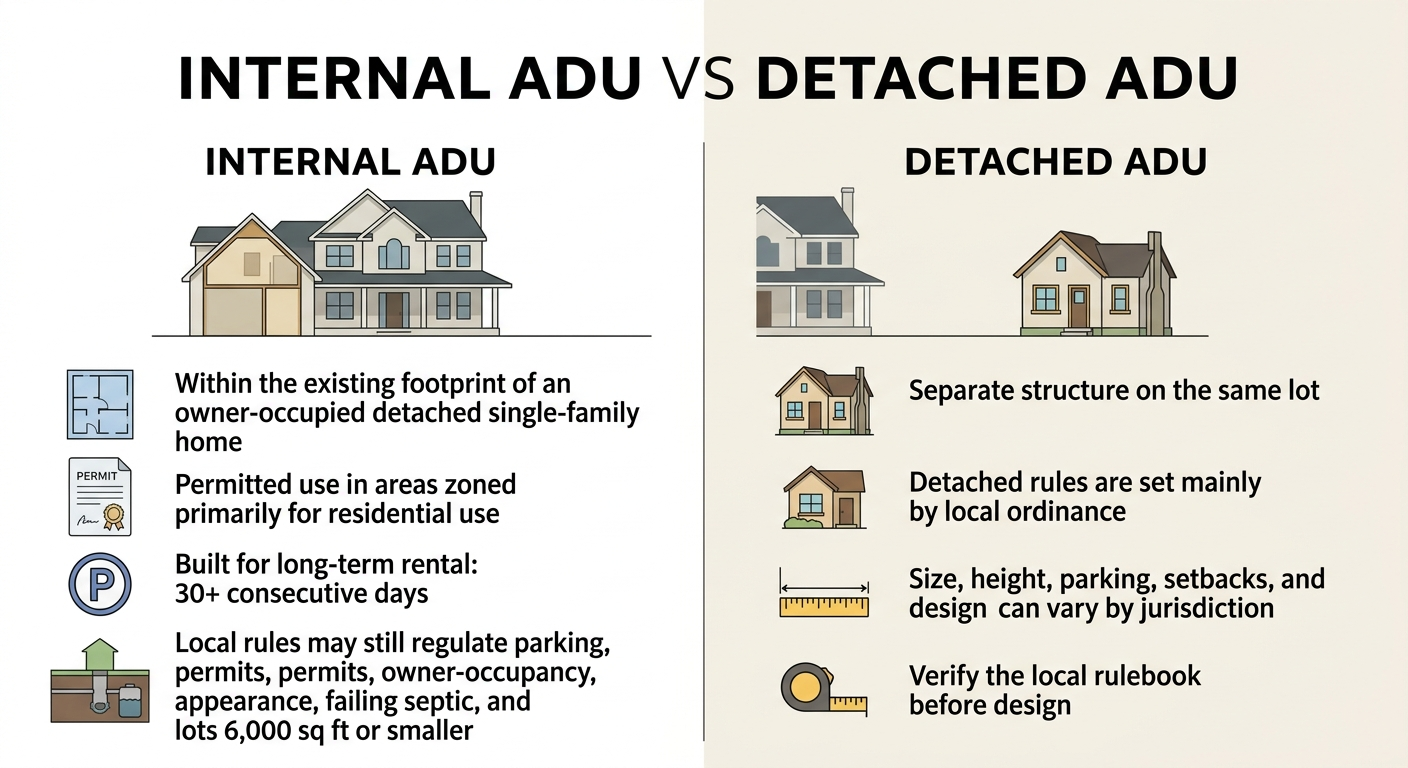
Internal ADU vs Detached ADU comparison infographic — internal ADU within existing footprint permitted by state law, detached ADU separate structure governed by local ordinance with size, height, parking, and setback rules
Internal ADUs are protected by Utah state law; detached ADUs are governed by local ordinance — rules vary significantly across Weber County cities.

How Do ADU Rules Change Across Weber County Cities?

This section is the reason this guide exists. We've gone through the actual ordinances, application packets, and code libraries for every jurisdiction in Weber County so you don't have to.

A word on accuracy: Municipal codes change. We verify this information regularly, but you should always confirm current requirements with your local planning office before starting a project.

Weber County ADU Comparison Matrix

This table covers the major jurisdictions. Scroll right on mobile to see all columns.

JurisdictionInternal ADUDetached ADUMax Detached SizeOwner-OccupancyShort-Term RentalParkingKey Reference
Unincorp. Weber CountyYes (permitted)Yes (permitted)1,500 sq ft footprint / 2,000 sq ft max floor area; basement ADU may use entire basementYes — 7 months/year minimumNot allowed (§108-11-3(b))2 additional spaces (hard surface) (§108-8-2)Ch. 108-19, as amended
OgdenYes (permitted)Yes (permitted)300–800 sq ft; max 25% of rear yard (§15-13-39)Yes — primary residenceRestricted (§15-13-39)Existing 2 spaces for main home; tandem driveway OK§15-13-39; filing fee $281.20
RoyYes (permitted)Check current codePer local codeYes30+ days only1 additional spaceRoy City rental licensing
South OgdenYes (permitted)Yes (Ord. 21-11, 23-21)Per local codeYesPer STR ordinancePer codeOrd. 21-11, Ord. 23-21
West HavenYes (permitted)Yes (land use permit req.)Per local codeYesCheck current codePer code; site plan requiredWest Haven Code Ch. 19
Farr WestYes (permitted)Yes (DADU code adopted)Per local codeYes30+ days onlyOff-street parking plan requiredFarr West DADU code
Washington TerraceYes (state law)No external ADUsN/AYes30+ days onlyPer code; no ADU on lots ≤6,000 sq ftWT city ADU info
Ogden Valley (Eden, Liberty, Huntsville area)Yes (state law + county transition)Verify current status — new city forming own codePer transition rulesYesVerify current statusPer transition rulesNew city — verify with Ogden Valley planning
Other Weber County cities (North Ogden, Harrisville, Pleasant View, Riverdale, Hooper, etc.)Yes (state law)Verify with local planning dept.VariesYes (likely)Check local codeCheck local codeContact city planning

Note: Where a city's current ADU standards could not be confirmed from an official current source, we say so instead of guessing. Rules change — always confirm with your local planning office before starting a project.

Key Takeaways From the Matrix

Ogden

The largest city in Weber County has the most detailed ADU ordinance. Detached ADUs are capped at 300–800 sq ft and cannot exceed 25% of your rear yard area. The current filing fee is $281.20 per Ogden's ADU application packet. The dwelling must retain its single-family appearance — you can't make it look like a duplex from the street. New entrances go on the side or rear, not the front. Tandem parking (one car behind the other) on your driveway is acceptable. If you sell the property, the ADU permit is voided and the new owner must reapply.

Source: Ogden City Code §15-13-39, Ord. 2024-12

Unincorporated Weber County

Allows substantially more room for detached ADUs — up to 1,500 sq ft footprint and 2,000 sq ft of total floor area. A basement ADU may consume the entire basement regardless of square footage. Height can go up to 35 feet, though lots 20,000 sq ft or smaller have tighter height restrictions (90% of the main dwelling's height). The design must either match the main home's architecture, or be designed by a licensed architect in barn/agricultural or local-historic style. Here's a major advantage: an existing dwelling lawfully established for at least 5 years can be converted to an ADU and is exempt from the size and design standards above.

Source: Weber County Code §108-19-4, as amended

Washington Terrace

One of the more restrictive cities — their materials indicate no external/detached ADUs and no ADUs on lots 6,000 sq ft or smaller. Internal ADUs only. If you're in Washington Terrace and want a detached unit, this is a dealbreaker you need to know about upfront.

Source: Washington Terrace city ADU materials

Farr West

Has adopted a specific Detached ADU (DADU) code that prohibits rentals under 30 days and requires application materials including a floor plan, elevations, and an off-street parking plan.

Source: Farr West DADU code

West Haven

Worth noting because their code explicitly states that HOA/CC&R research is the homeowner's responsibility — local government approval doesn't override private restrictions. Always check your CC&Rs.

Source: West Haven Code Ch. 19

This Table Is a Starting Point

Want us to pull the exact rules for YOUR address? We verify jurisdiction, zoning, and property-specific eligibility — free.

Can I Build a Detached ADU in Weber County?

This is where the real variation lives. Internal ADUs are broadly protected by state law, but detached ADUs — backyard cottages, casitas, standalone guest houses — are still largely governed by local ordinance. The rules range from generous to nonexistent, depending on where you are.

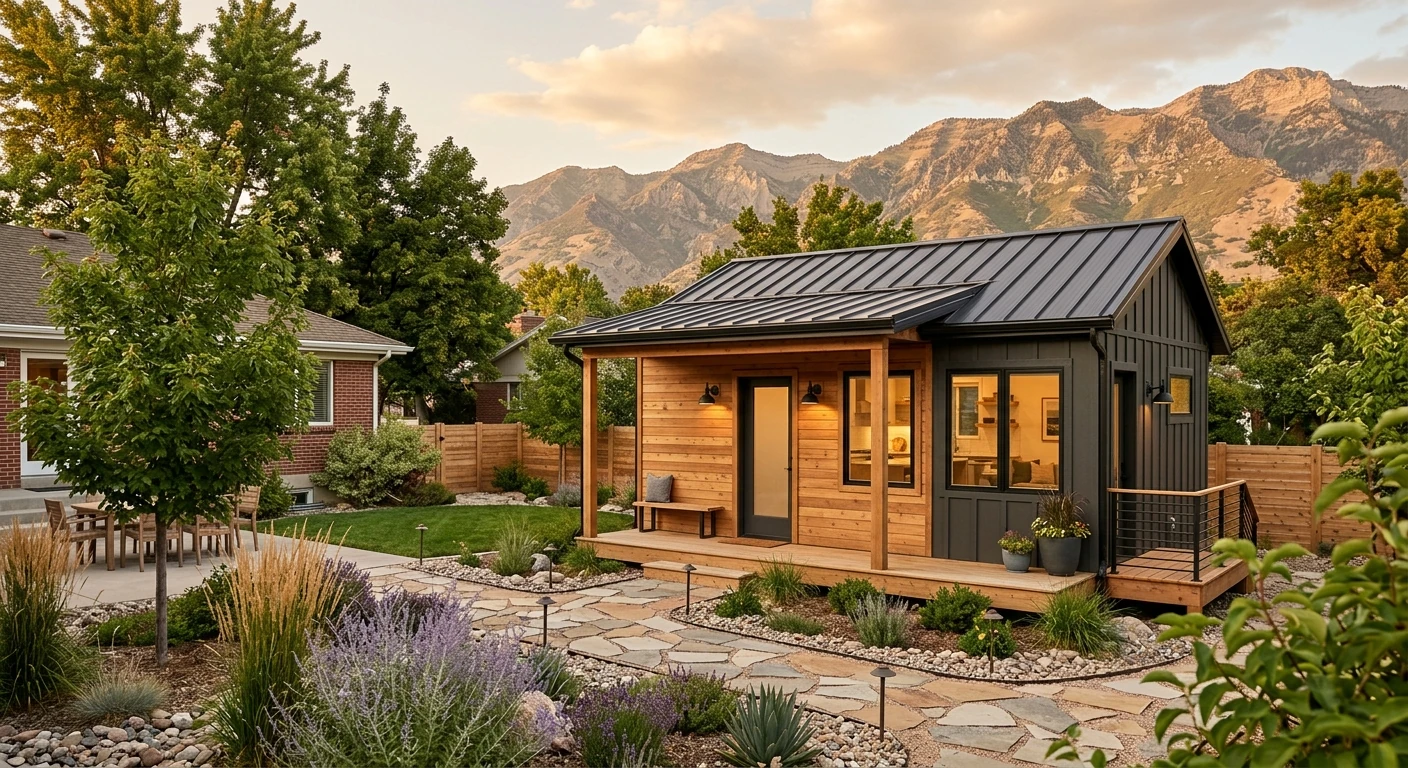
Detached backyard ADU in Weber County Northern Utah — modern board-and-batten cottage with metal roof, covered porch, stone pathways, and Wasatch Mountain backdrop at golden hour
A detached backyard ADU in Weber County delivers maximum privacy, the highest rental income, and the biggest property value increase — but requires more local approval steps than an internal ADU.

Internal vs. Detached: The Difference That Changes Everything

Internal ADU

Built within the existing footprint of your home. Basement apartments are the most common type. Because Utah state law specifically protects these, you have strong legal ground in any residential zone.

Pros: Cheaper, faster to permit, legally simpler

Detached ADU

A separate, standalone structure on your lot. Think backyard cottage, converted garage, or above-garage apartment. More local approvals, more design restrictions, higher cost — but higher rents and more privacy.

Pros: Higher rental income, maximum privacy, biggest equity increase

Detached ADUs in Unincorporated Weber County

If you're outside city limits, Weber County's rules are relatively homeowner-friendly:

RuleRequirement
Minimum size400 sq ft footprint
Maximum size1,500 sq ft footprint; gross floor area cannot exceed 2,000 sq ft
Basement ADU exceptionMay consume the entire basement regardless of square footage
HeightUp to 35 feet (on lots ≤20,000 sq ft: max 90% of main dwelling's height)
Lot coverageOn lots ≤20,000 sq ft: ADU + main dwelling footprint can't exceed 25% of lot
DesignMust match main home in style and materials, OR be designed by licensed architect in barn/agricultural or local-historic style
Access / entranceMain entrance must be on the side or rear — not visible from the street
5-year conversion ruleAn existing dwelling lawfully established for at least 5 years can be converted to an ADU and is EXEMPT from size and design standards above

Source: Weber County Code §108-19-4

Detached ADUs in Ogden

RuleRequirement
Size300–800 sq ft for detached units
Rear yard coverageCannot exceed 25% of rear yard area (including all accessory buildings combined)
AppearanceHome must keep its single-family look — no alterations that make it look like a multi-unit property
EntrancesNew ADU entrances go on side or rear only
Permit on saleADU permit is voided if you sell the property — new owner must apply for a new one
Filing fee$281.20 per Ogden's ADU application packet

Source: Ogden City Code §15-13-39, Ord. 2024-12

The Ogden Valley Situation

If your property is in Eden, Liberty, Huntsville, or nearby Ogden Valley communities, you're now in the newly incorporated Ogden Valley (effective January 1, 2026). Under the previous Weber County rules (which may still apply during the transition), detached ADUs in Ogden Valley had an extra hurdle: your lot needed either (a) at least twice the minimum acreage required by your zone, OR (b) a transferred development right purchased from another landowner.

The city is actively building its land use framework. If you're planning an ADU in this area, verify the current permit path with Ogden Valley's planning team before you proceed. Internal ADUs are still protected by state law regardless.

Short-Term Rentals and Weber County ADUs

Utah's internal ADU framework is built around long-term rental — 30 consecutive days or longer. Most Weber County jurisdictions follow this.

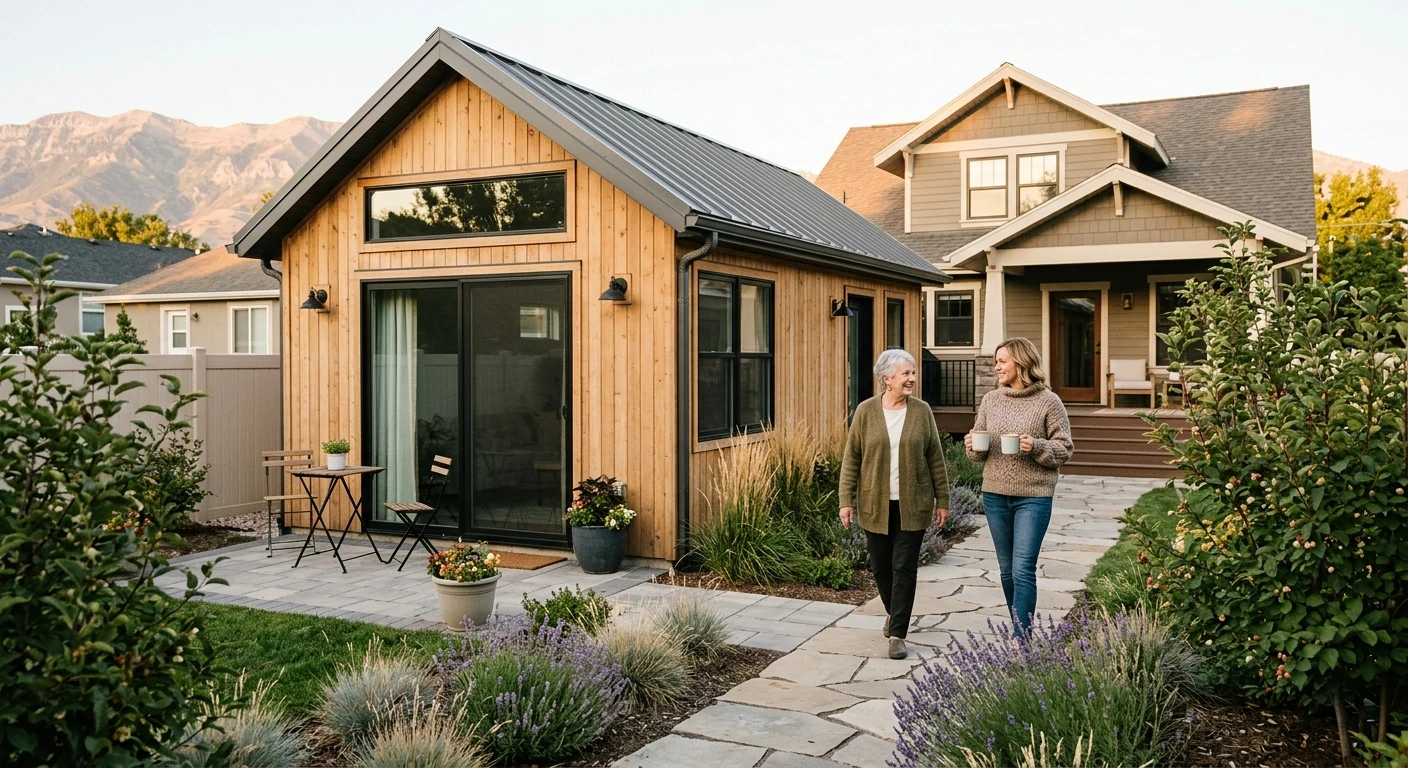
Mother and daughter walking outside backyard ADU in Weber County Utah — multi-generational living with aging parent in accessory dwelling unit
Most Weber County homeowners use ADUs for long-term tenants, aging parents, or adult children — not short-term Airbnb. The rules make this the practical path.
Unincorporated Weber County: Short-term rental license will not be issued for an ADU (§108-11-3(b)). Neither the main home nor the ADU can be used for nightly rental unless the zone specifically allows it, and most zones don't.
Ogden: An ADU may not be used as a short-term rental unless the primary single-family dwelling is owner-occupied (§15-13-39), and even then, the city's STR regulations are strict. Contact Ogden's Planning Division before assuming you can short-term rent.
Roy: 30+ consecutive day rental only for ADUs.
Farr West: 30+ consecutive day rental only for detached ADUs.
Washington Terrace: 30+ day rental only.

If short-term rental income is your primary goal

An ADU might not be the right vehicle. In many Weber County zones, nightly rental of your main home is possible with proper licensing, but the ADU itself is restricted to long-term tenants.

That said, long-term rental income in Weber County is strong. With Weber State students, Hill Air Force Base employees, and healthcare workers at McKay-Dee Hospital driving demand, there's no shortage of quality tenants looking for affordable one-bedroom apartments — exactly what a well-built ADU provides.

Sources: Weber County Code §108-19-3(e); Ogden City Code §15-13-39; Roy City rental licensing materials; Farr West DADU code

How Big Can an ADU Be, and How Much Parking Do I Need?

Size and parking are the two most common practical questions after "can I build one?" Here's the breakdown.

Size Limits by Jurisdiction

JurisdictionInternal ADU SizeDetached ADU SizeMax Height (Detached)
Unincorp. Weber CountyMust qualify as a dwelling unit (kitchen, bath, sleeping)400–1,500 sq ft footprint; max 2,000 sq ft floor area; basement may use entire basement (§108-19-4)35 ft (90% of main home on lots ≤20,000 sq ft)
OgdenPer building code300–800 sq ft; max 25% of rear yardPer building code
Other citiesPer building code / state lawVaries — check local codeVaries

Parking Requirements by Jurisdiction

JurisdictionADU Parking RequirementNotes
Unincorp. Weber County2 additional spaces on a hard surfaceIn addition to main dwelling parking (§108-8-2)
OgdenExisting 2 off-street spaces for main home must exist; tandem driveway parking acceptableNo widened driveways or side-yard parking slabs for the ADU
Roy1 additional spacePer city rental licensing materials
Other citiesVaries — typically 1–2 spacesCheck local code

What happens if you convert a garage

If you're turning your garage into an ADU, you're losing parking. Utah state law allows local governments to require replacement parking when a garage or carport is converted to habitable space. You'll likely need to demonstrate equivalent off-street parking elsewhere on your lot.

Source: Utah Code §10-21-303

What Permits, Plans, and Departments Are Involved?

The permit process is more straightforward than most people expect. It's not a single approval — it's a series of checkboxes from different departments, and once you know what they are, it moves quickly.

The General Weber County Permit Path

1

Prepare Your Application

You'll need: completed application form signed by the property owner; application fee (varies by jurisdiction); site plan drawn to scale showing property lines, existing buildings, proposed ADU, setbacks, and parking; detailed floor plans with elevations drawn to scale; written verification that you are the property owner and an owner-occupant.

2

Submit to the Planning Division

The Planning Division reviews for zoning compliance — are you in the right zone, does the ADU meet size/setback/design requirements?

3

Agency Routing

Your application gets sent to multiple agencies: Fire Authority (fire code, egress windows, smoke detectors); Weber-Morgan Health Department (especially if on septic); Building Division (structural, electrical, plumbing compliance); Culinary Water Authority (water capacity); Sanitary Sewer Authority (sewer capacity or septic approval).

4

Land Use Permit Issued

If everything checks out, the Planning Division issues a land use permit. If some agencies need more info, you'll get conditional approval while you work through their requirements.

5

Building Permit

After your land use permit, submit for a building permit. This covers the actual construction — framing, electrical, plumbing, HVAC, insulation, final inspection.

6

Inspections and Certificate

During construction, you'll have multiple inspections: foundation, framing, plumbing rough-in, electrical rough-in, insulation, and final. Once complete, you'll receive a certificate of occupancy.

7

Business License

If you're renting the ADU, you need a business license. In most jurisdictions, this is reviewed as a home occupation business license.

Source: Weber County Code §108-19-5

Ogden's Permit Path

Ogden requires a separate ADU permit application (distinct from the building permit). You'll need: a site plan, floor plans, elevation drawings, proof of property ownership from the Weber County Recorder, and proof of residency (driver's license or utility bill). Current filing fee: $281.20.

Source: Ogden City Code §15-13-39; Ogden City ADU Permit Application

How Long Does the Process Take?

Weber County Building Inspection advises to allow fourteen working days for plan review. In practice:

ADU TypeDesign & PlanningPermit ReviewConstructionTotal
Basement conversion2–4 weeks3–6 weeks2–4 months3–6 months
Garage conversion3–6 weeks4–8 weeks3–5 months4–7 months
Attached addition4–8 weeks4–10 weeks4–6 months5–9 months
Detached new build6–12 weeks6–12 weeks5–8 months7–14 months

These timelines assume no major revisions. Incomplete applications, utility/septic issues, or design changes will add time.

Feeling Overwhelmed by the Permit Process?

We can review your property and connect you with experienced Weber County ADU builders who handle design, permitting, and construction from start to finish.

How Much Does a Weber County ADU Cost in 2026?

Let's talk real numbers. Not national averages, not "it depends" — actual Weber County cost ranges based on the type of ADU you're building.

Cost by ADU Type

ADU TypeTypical Total CostCost Per Sq FtWhat's Included
Basement conversion$50,000–$100,000$80–$150Framing, egress windows, plumbing, electrical, kitchen, bathroom, fire separation, finishes
Garage conversion$60,000–$120,000$100–$180Foundation mods, insulation, utility connections, interior buildout
Attached addition$100,000–$200,000$150–$250Foundation extension, framing, roofing, full interior buildout, utility hookups
Detached new construction$150,000–$300,000+$190–$250Full standalone build: foundation, framing, roofing, siding, utilities, kitchen, bath, finishes

Sources: ADU Utah construction cost data for Weber County; PropertyWire 2026 ADU cost guide; Rock-Top Construction Utah ADU cost breakdown

Costs People Forget

The construction bid isn't the whole picture. Here's what catches homeowners off-guard:

Architectural / engineering drawings

$2,500–$8,000

Depending on complexity. Pre-designed plan sets run $1,500–$3,000 and can reduce this cost significantly.

Permit fees

$2,000–$5,000

Depending on the city. Ogden's ADU filing fee is $281.20 — total permit fees vary by project scope.

Impact fees (detached only)

$3,000–$10,000

Important: Internal ADUs are EXEMPT from impact fees under Utah Code §11-36a-202 — that's a real savings unique to basement conversions.

Utility trenching

$5,000–$20,000

Running water, sewer, and electrical from the main home to a detached ADU. Distance and terrain matter — rocky lots cost more.

Site work

$5,000–$15,000

Excavation, grading, foundation prep depending on conditions.

Landscaping repair

$2,000–$5,000

After construction, you'll need to restore your yard — often overlooked in initial budgets.

The honest cost conversation

The soft costs and permitting alone can run $15,000–$30,000 before a single nail is driven. Between architectural plans, engineering, permit fees, utility connection fees, and inspections, many homeowners are genuinely surprised by how much the project costs before construction begins.

But here's what makes the math work: those costs are front-loaded and one-time. Once you're past permitting, the construction phase is predictable. A Weber County ADU renting at $1,200/month generates $14,400/year in gross income — and on most builds, the simple payback math works within 6–14 years, before counting any increase in property value.

Want an Accurate Cost Estimate for Your Specific Property?

Get a free custom ADU estimate that accounts for your Weber County location, lot conditions, and project goals.

What Rental Income Can You Expect From a Weber County ADU?

Weber County is one of the strongest rental markets on the Wasatch Front for ADU owners right now. The average rent across Weber County is approximately $1,474/month, with one-bedrooms ranging from $895–$1,400. Weber County has seen the fastest-growing rents among Wasatch Front counties, with an average annual rent growth rate of 7.9% over the last decade — outpacing Salt Lake, Davis, and Utah counties.

Vacancy is tight. Stabilized building vacancy in the Davis-Weber area runs around 3.7%. Demand drivers include Weber State University students, Hill Air Force Base employees and contractors, McKay-Dee Hospital staff, and the steady stream of outdoor recreation workers near Ogden Valley.

Illustrative ADU Income Scenarios

These projections are illustrative — not guaranteed. Your actual rent, expenses, and returns depend on your unit's quality, location, and market conditions.

ScenarioEst. Monthly RentAnnual GrossEst. Build CostSimple Payback (Illustrative)
Basement conversion, 1-bed$900–$1,100$10,800–$13,200$70,0006–8 years
Garage conversion, studio$800–$1,000$9,600–$12,000$80,0007–10 years
Detached 1-bed, 650 sq ft$1,100–$1,400$13,200–$16,800$150,00010–13 years
Detached 2-bed, 800 sq ft$1,300–$1,600$15,600–$19,200$200,00011–14 years

Rent estimates based on Weber County market data. Payback assumes approximately 30% expense ratio for property taxes, insurance, maintenance, and vacancy. Actual results will vary. Sources: RentCafe Weber County data; Kem C. Gardner Policy Institute "State of the State's Housing Market: 2024–2025."

Property Value Impact

Adding a legal, permitted ADU generally increases your property's appraised value. A well-built ADU is an asset that appeals to future buyers looking for income potential or multi-generational living flexibility. Yes, your property taxes will increase proportionally — but Utah's 45% primary residence exemption still applies to your main dwelling, so the increase is modest relative to the rental income potential.

How Do You Finance an ADU in Weber County?

The biggest barrier to building an ADU isn't the permit process — it's the upfront capital. Here are the most common financing strategies Weber County homeowners are using right now.

Home Equity Line of Credit (HELOC)

The most popular method. If you've built equity in your home, a HELOC lets you borrow against it at relatively favorable rates. You only pay interest on what you draw, and you can draw as construction progresses. Most local banks and credit unions in Weber County offer HELOCs — talk to your current mortgage holder first.

Cash-out refinance

Refinance your existing mortgage at a higher loan amount and use the difference for ADU construction. This works best when you have significant equity and can secure a competitive interest rate. The advantage: one loan, one payment. The risk: you're increasing your mortgage balance.

Renovation-to-permanent loans

Some Utah credit unions and lenders offer loans that consider the future appraised value of your home with the ADU included, not just the current value. Ask your lender specifically about ADU financing — it's becoming a more recognized product category.

FHA 203(k) loans

If your ADU is an internal or attached addition, an FHA 203(k) renovation loan may cover the construction costs as part of your primary mortgage. These loans have specific requirements, but they can be a powerful tool for homeowners who don't have substantial equity yet.

Family funding

In multi-generational scenarios, the family member who will occupy the ADU often contributes to construction costs. Parents funding a backyard cottage they'll eventually live in, or adult children contributing toward a basement conversion on the family property.

Key financing tip

When talking to your lender, emphasize that the ADU will increase your property's appraised value. Ask them to qualify the loan based on the post-ADU property value, not the current value. A well-built ADU adds $100,000–$200,000 in equity — that changes the lending math significantly in your favor.

And remember: internal ADUs are exempt from impact fees under Utah Code §11-36a-202. That's $3,000–$10,000 you don't have to pay, which is money that can go directly toward construction quality.

For a broader breakdown of ADU financing options across Utah, see our Utah ADU Financing Guide.

What Can Kill or Delay an ADU Project in Weber County?

We'd rather tell you the hard truths now than let you find out the expensive way later.

📍You checked county rules, but your property is actually in a city

The number-one mistake. Weber County rules only apply to unincorporated areas. If your parcel is inside Ogden, Roy, South Ogden, or any other municipality, you're under that city's ordinance. Check your jurisdiction first. This single step saves more money and frustration than anything else in this guide.

🏘️HOA or CC&R restrictions

Utah state law (HB 82, passed 2021) makes it illegal for HOAs to prohibit internal ADUs in areas zoned for single-family residential. If your HOA says 'no basement apartments,' state law overrides them for internal ADUs. However, that protection may not extend to detached ADUs. Your HOA may still have authority to restrict standalone structures, setbacks, or design elements. West Haven's code even explicitly states that HOA/CC&R compliance is the homeowner's responsibility.

🚰Septic system issues

If your lot is on septic rather than municipal sewer, the Weber-Morgan Health Department will need to confirm your system can handle the additional capacity. A failing or undersized septic system can stop a project cold. Get this checked early — before you invest in design.

📐Lot size and parking constraints

Some properties are simply too tight. If your lot is under 6,000 sq ft, some cities (like Washington Terrace) won't allow an ADU at all. Even on larger lots, fitting the ADU, required setbacks, and required parking can be a puzzle. A good site plan early in the process reveals these issues before they become expensive.

🏙️The Ogden Valley transition

If you're in Eden, Liberty, or surrounding areas, the newly incorporated Ogden Valley is in the process of establishing its own land use regulations. County staff have been coordinating permit review during the transition, but rules may shift as the new city adopts its own code. Verify the current process before committing to plans.

Every one of these potential issues is solvable. The key is identifying them early, before you've spent money on the wrong plans or the wrong approach. That's exactly what a feasibility check is designed to catch.

Want Us to Check Your Property for Potential Issues Before You Invest?

A free property feasibility check surfaces jurisdiction, zoning, septic, parking, HOA, and site constraints — before you spend a dollar on plans.

Which ADU Type Makes the Most Sense for Your Property?

Not every property calls for the same type of ADU. Here's a decision framework to help you find your fit.

Choose a basement conversion if...

  • You have an unfinished or underutilized basement with adequate ceiling height (7 ft minimum)
  • You want the lowest cost entry point ($50K–$100K)
  • You want the simplest permitting path (internal ADU = state law protection + impact fee exemption)
  • You don't mind sharing the building footprint with a tenant
  • Speed matters — basement conversions are the fastest to permit and build

Choose a garage conversion if...

  • You have an attached or detached garage you rarely use for vehicles
  • You're willing to park outside or build replacement parking
  • You want a relatively affordable project ($60K–$120K) with a separate feel
  • Your lot is too small for a new detached structure but your garage has good bones

Choose an attached addition if...

  • You want to add square footage to your home and create an ADU simultaneously
  • Your lot has room to expand the building footprint on at least one side
  • You want the ADU connected but with its own entrance and private living space
  • Budget is moderate ($100K–$200K)

Choose a detached new build if...

  • Maximum privacy matters — for you and the tenant
  • You want the highest possible rental income (detached units command premium rents)
  • Your lot has sufficient space for setbacks, parking, and lot coverage requirements
  • You're willing to invest more upfront ($150K–$300K+) for a higher long-term return
  • You're in a jurisdiction that allows detached ADUs (most of Weber County does)

Don't start with a detached ADU if...

  • • You're in Washington Terrace (no external ADUs allowed)
  • • Your lot is under 6,000 sq ft and your city restricts ADUs on small lots
  • • Your HOA explicitly restricts detached accessory structures and you're not prepared to challenge it
  • • You need the project done fast and cheap — a basement conversion is a better first move

Is Building an ADU in Weber County Worth It?

We've given you the rules, the costs, the income projections, and the potential pitfalls. Now let's step back and answer the real question.

The Strongest Use Cases

💰

House-hacking your mortgage

A basement ADU renting at $1,000/month covers a significant chunk of a typical Weber County mortgage payment. Many homeowners tell us this single move took them from financially stretched to comfortable.

👴

Housing aging parents

An ADU lets your parents live independently with their own kitchen, bathroom, and entrance — while being thirty seconds away if they need you. No assisted living costs. No loss of dignity or privacy.

🎓

Adult children transitioning

Young adults launching their careers can live affordably on the family property while they build savings, without the awkwardness of 'living at home.'

📈

Long-term investment

Weber County rents are growing faster than anywhere else on the Wasatch Front. An ADU built today will be worth substantially more in rental income and property value five years from now.

🏔️

Retirement flexibility

Some homeowners build the ADU now, rent it out for income, and plan to eventually move into the smaller unit themselves — renting the larger main home for even more income.

The honest tradeoffs

Building an ADU is not free, not instant, and not without hassle. The permit process takes effort. Construction disrupts your yard and your routine for months. The upfront investment is real — $50K–$300K depending on what you build.

But here's the perspective that matters: you're adding a permanent, income-producing asset to a property you already own, in a market with tight vacancy and rising rents. Very few home improvements deliver a comparable return.

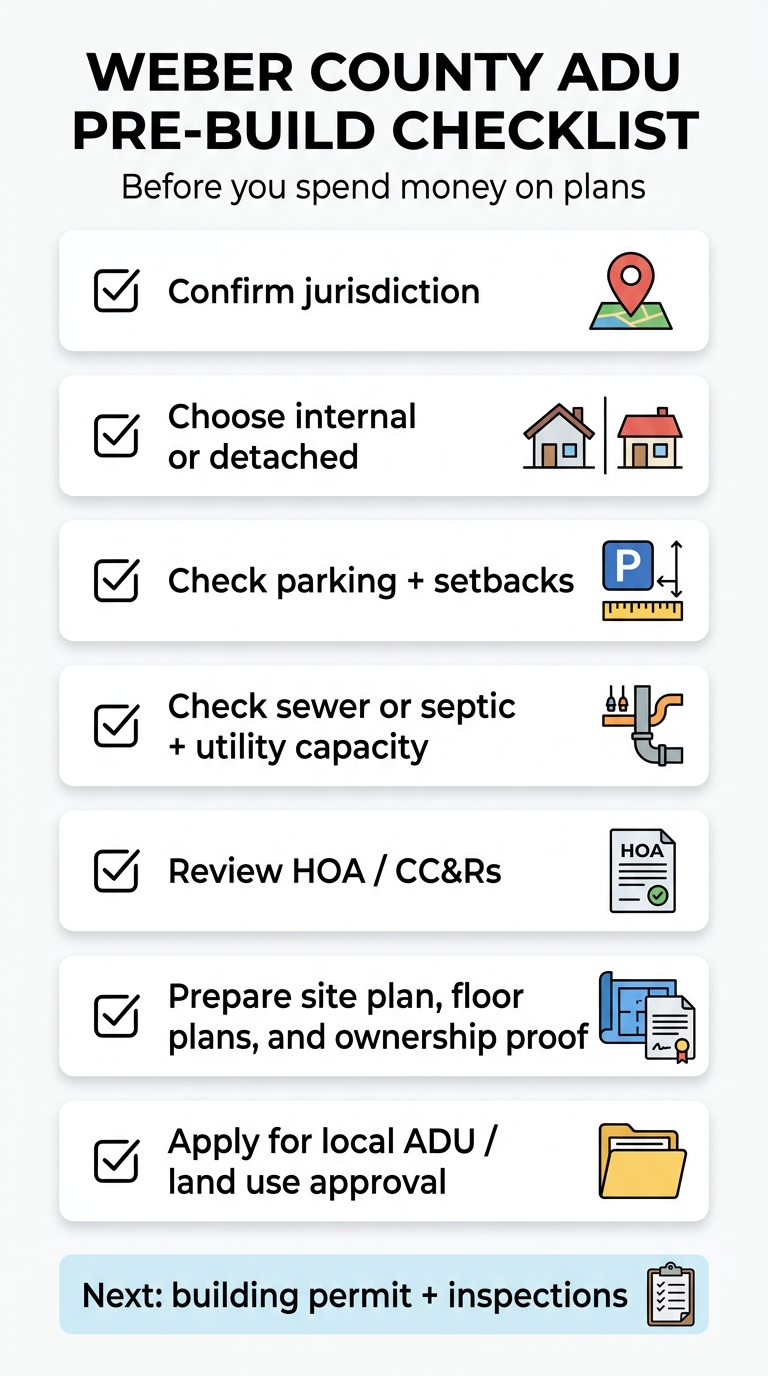
Weber County ADU Pre-Build Checklist

Before you spend money on plans, make sure you've completed every item on this list. Each checkbox represents a potential project-killer if skipped.

Weber County ADU pre-build checklist — confirm jurisdiction, choose internal or detached, check parking and setbacks, check sewer or septic and utility capacity, review HOA and CC&Rs, prepare site plan and floor plans, apply for local ADU approval, then building permit and inspections
Complete every item on this checklist before spending money on architectural plans — each item is a potential project-stopper if discovered late.

Pre-Planning

  • Confirmed your property is in the right jurisdiction (not just 'Weber County')
  • Verified your zoning allows ADUs (internal and/or detached)
  • Confirmed owner-occupancy eligibility
  • Reviewed HOA/CC&Rs for ADU restrictions
  • Checked lot size — if under 6,000 sq ft, some cities restrict ADUs
  • Confirmed septic or sewer can handle additional capacity
  • Checked parking availability for required ADU spaces

Design and Finance

  • Determined ADU type: internal, attached, garage conversion, or detached
  • Engaged architect or selected pre-designed plans
  • Obtained preliminary cost estimate from a licensed contractor
  • Secured financing (HELOC, refi, construction loan, family contribution, etc.)

Permitting

  • Prepared site plan drawn to scale with property lines, buildings, setbacks, and parking
  • Prepared floor plans with elevations and room labels
  • Gathered proof of property ownership
  • Gathered proof of owner residency
  • Submitted land use permit application to local Planning Division
  • Received land use permit approval
  • Submitted building permit application
  • Received building permit

Construction and Completion

  • Scheduled and passed all required inspections (foundation, framing, rough-in, final)
  • Obtained certificate of occupancy
  • Obtained business license (required if renting the ADU)
  • Recorded required deed notice/covenant per local ordinance

Get Your Free Weber County ADU Feasibility Check

We'll look at your address, confirm your jurisdiction, check your zoning, identify any potential issues, and give you a realistic picture of what you can build and what it will cost — at no charge. No pressure, no obligation.

STEP 1

Tell us your address and what you're thinking. We confirm your jurisdiction and zoning in minutes.

STEP 2

We connect you with a local Weber County ADU builder option that appears to fit your project type. Verify licensing and insurance before hiring.

STEP 3

They assess your property and give you real answers — what works, what it costs, and the realistic timeline.

If the project makes sense, you have a builder ready to go. If it doesn't, you saved thousands finding out now instead of halfway through architectural drawings.

Weber County ADU Frequently Asked Questions

Sources and Methodology

This guide was built by reviewing the actual ordinances, code libraries, and application materials for Weber County and its municipalities. We cite our sources so you can verify everything yourself.

  • Weber County Ordinance 2020-27 (ADU Regulations), Chapter 108-19 — Weber County municipal code
  • Weber County Code §§104-3-2 through 104-17-2 (permitted uses by zone)
  • Weber County Code §108-8-2 (parking requirements)
  • Weber County Code §108-15-2 (single-family dwelling standards)
  • Weber County Code §108-19-2 (Ogden Valley applicability)
  • Ogden City Code §15-13-39 (Standards for Accessory Dwelling Units), as amended by Ord. 2024-12
  • Utah Code §10-21-303 (Internal Accessory Dwelling Units, municipalities — formerly §10-9a-530)
  • Utah Code §17-80-303 (Internal Accessory Dwelling Units, counties — formerly §17-27a-526)
  • Utah Code §11-36a-202 (Impact fee exemption for internal ADUs)
  • Utah HB 82 (2021) — Single-Family Housing Modifications
  • Utah SB 34 (2019) — Housing Affordability Amendments
  • Roy City Rental Dwelling License information
  • West Haven City Code, Chapter 19 (ADU provisions)
  • Farr West City Detached ADU (DADU) code
  • Washington Terrace city ADU materials
  • South Ogden Ordinance 21-11, as amended by Ordinance 23-21
  • Kem C. Gardner Policy Institute, “State of the State’s Housing Market: 2024–2025” (July 2025)
  • ADU Utah (aduutah.com) — local construction cost data and plan pricing
  • RentCafe — Weber County average rent data
  • Weber County Elections Office — Ogden Valley City incorporation records

When you see "check current code" in this guide, it means either (a) we verified the baseline state-law protections apply, but the city's specific detached-ADU ordinance required direct confirmation, or (b) the city recently amended its code and the changes haven't been codified in their public code library yet. Always confirm current rules with your planning office before committing to a project. Last verified: March 2026.

© 2026 Utah ADU Builders. This guide is provided for informational purposes only and does not constitute legal, financial, or construction advice. Always verify current regulations with your local planning department before beginning any ADU project. Last verified: March 2026.

ADU guides by city in Weber County

Planning the budget? See our guide to ADU financing in Utah.