
Last Updated: June 27, 2026 · Sources: HUD Mortgagee Letter 2023-17, Fannie Mae SEL-2025-08, Freddie Mac ADU Fact Sheet, CFPB, IRS Pub 936, Utah Legislature HB 82, SLC CRA, CDCU · See full source list
Disclosure: Utah ADU Builders connects homeowners with licensed local builders. We are not a lender or financial advisor. Financing information is educational — always consult a licensed mortgage professional for personalized advice.
ADU Construction Financing Utah: Every Option, Cost & Program Explained
You've decided you want an ADU. Maybe it's a backyard cottage for rental income. Maybe it's a basement apartment so your parents can age close to family. Maybe you just ran the numbers on what a $1,500/month rent check would do for your household budget and thought, yeah, let's figure this out.
But then you hit the money question — and suddenly you're neck-deep in tabs about HELOCs, construction loans, 203(k)s, and some program in Salt Lake City you've never heard of. Half the results are national guides that don't know a thing about Utah, and the other half are lenders trying to sell you their one product.
So let's cut through it.
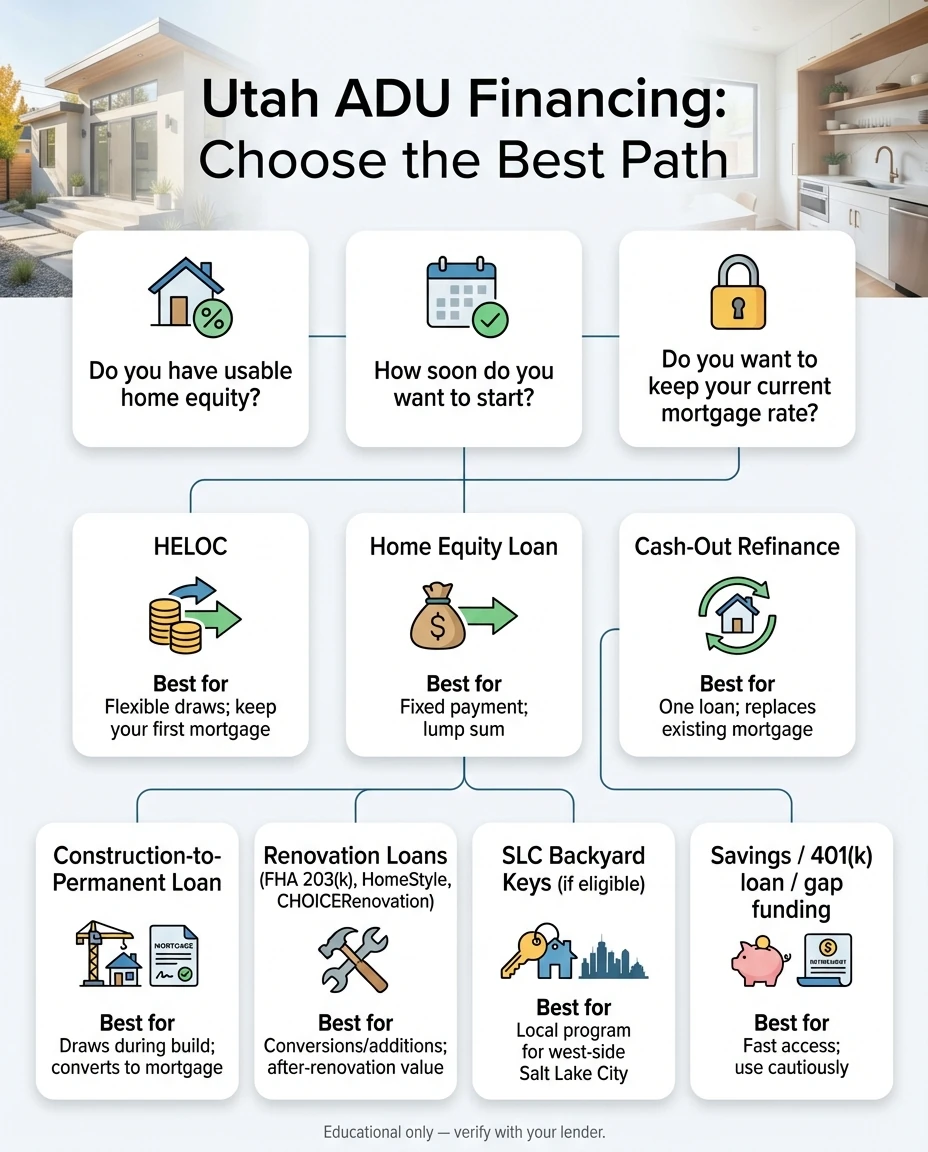
ADU construction financing in Utah comes down to seven realistic paths: a home equity line of credit (HELOC), a home equity loan, a cash-out refinance, a construction-to-permanent loan, a renovation loan (FHA 203k or Fannie Mae HomeStyle), the Salt Lake City "Backyard Keys" below-market-rate program, or personal savings and retirement funds. Salt Lake City's CRA ADU loan is a local program, not a statewide Utah ADU loan. It is limited by location, borrower eligibility, funding availability, occupancy, income/rent-restriction, training/counseling, and program rules. The right choice depends on three things — how much equity you have, what mortgage rate you're currently sitting on, and how fast you need to move. Most Utah ADUs cost $150,000–$350,000 to build, and whether a given ADU "pays for itself" depends on your build cost, financing rate, vacancy, maintenance, insurance, and the rent your neighborhood actually supports. In the ROI section below, we show a simple payback table so you can run your numbers.
Below, we compare every option side-by-side, walk through the Utah-specific programs most people never find, explain what lenders actually require, and give you the real numbers so you can take something concrete to the bank — not a guess.
This is the page we wish existed when homeowners started asking us these questions. One page. Every option. Utah-specific. Let's get you funded.
Get a Lender-Ready ADU Cost Estimate in 48 Hours
A licensed local builder reviews your property and gives you a detailed budget breakdown — the format banks actually want to see. No cost. No obligation. No sales pitch.
What you'll get: Itemized construction estimate for your lot, your city, and your ADU type. Soft cost breakdown (permits, site work, utilities). A number you can take straight to your lender.
Table of Contents
How Much Does It Actually Cost to Build an ADU in Utah?
You can't evaluate financing options without knowing what you're financing. So let's start with real numbers — not national averages, not ranges so wide they're useless.
Utah ADU Construction Costs by Type
| ADU Type | Total Cost Range | Cost per Sq Ft | Typical Size |
|---|---|---|---|
| Basement conversion (internal ADU) | $40,000 – $100,000 | $50 – $150 | 400–800 sq ft |
| Garage conversion | $50,000 – $120,000 | $75 – $175 | 400–600 sq ft |
| Attached addition | $120,000 – $250,000 | $175 – $300 | 500–800 sq ft |
| Detached new construction | $150,000 – $400,000+ | $200 – $350+ | 500–1,200 sq ft |
| Prefab / modular | $100,000 – $250,000 | $150 – $275 | 400–800 sq ft |
Sources: Rock Top Construction (Utah-specific), Marshall Homes (SLC data: $300–$350/sq ft for detached), Angi (national baseline: $150–$300/sq ft), ADU Utah.
A few things worth knowing about these numbers. First, even small ADUs are expensive because the fixed costs — foundation, permits, utility connections, architectural plans — don't scale down proportionally. A 400 square foot unit doesn't cost half as much as an 800 square foot one. It might cost 60–70% as much. That's the economics of small housing, and it surprises everyone.
Second, Salt Lake City and Utah County sit at the higher end of these ranges. Rural areas may see lower labor costs, but materials are priced similarly statewide.
The Costs Most People Forget (And the Ones That Blow Budgets)
The bid from your builder covers the structure. But there's a layer of soft costs and site work that adds 15–30% to your total — and this is where projects go sideways.
| Cost Category | Typical Range | Why It Matters |
|---|---|---|
| Architectural / engineering plans | $5,000 – $15,000 | Required to pull a building permit |
| Permits and impact fees | $2,000 – $8,000 | Varies significantly by city |
| Site preparation and grading | $3,000 – $15,000 | Sloped lots and rocky Utah soil add cost |
| Utility connections (water, sewer, electric) | $5,000 – $25,000 | Detached ADUs often need separate runs |
| Foundation | $8,000 – $25,000 | Utah soil conditions can add cost |
| Landscaping restoration | $2,000 – $8,000 | Your yard will need work after construction |
| Contingency (10–15% of total) | $15,000 – $50,000 | Non-negotiable. Things will come up. |
Here's the honest takeaway: if your detached ADU bid comes in at $200,000, your real all-in budget is more like $230,000 to $260,000 once you add permits, site work, utility connections, and contingency. Finance that number — not the construction bid alone.
Get this number first. Lenders need a real figure, a detailed budget, and usually a contractor agreement before they'll underwrite anything. "I think it'll cost about $150K" won't get you past the first conversation. Get a free, detailed ADU estimate here.
Every ADU Financing Option Available to Utah Homeowners (Compared Side-by-Side)
This is the table that should save you hours. We've organized every viable financing path into one comparison, then break each one down below with enough detail to actually make a decision.
The Definitive Utah ADU Financing Comparison
| Financing Option | Typical Rate (2025–26) | Max LTV | Min Credit Score | Time to Close | Keep Current Mortgage? | Best For |
|---|---|---|---|---|---|---|
| HELOC | 7–9% variable | 80–85% current value | 680+ | 2–4 weeks | ✅ Yes | Owners with 20%+ equity and a low existing rate |
| Home Equity Loan | 7–10% fixed | 80–85% current value | 680+ | 2–4 weeks | ✅ Yes | Want lump sum with predictable fixed payments |
| Cash-Out Refinance | 6.5–7.5% fixed | 80% current value | 620–680+ | 30–45 days | ❌ Replaces it | High-equity owners with existing rates above 6% |
| Construction-to-Perm | 7–9% (variable → fixed) | 80–90% after-completion value | 680+ | 45–90 days | Varies | Detached ADUs, owners who need future-value lending |
| FHA 203(k) | 6.5–8% fixed | 96.5% after-renovation value | 580 for maximum FHA financing; 500–579 limited to 90% LTV; lender overlays may be higher | 45–60 days | ❌ Replaces it | Lower credit, less equity, garage/basement conversions |
| HomeStyle / CHOICERenovation | 6.5–7.5% fixed | 95% after-renovation value | 620+ | 45–60 days | ❌ Replaces it | Similar to 203(k) but without FHA mortgage insurance |
| SLC Backyard Keys (CDCU) | 3% fixed; 5-year term with a 5-year extension option; 30-year amortization | Up to $200,000 | Program-specific | Rolling | ✅ Yes | Salt Lake City homeowners west of I-15 |
| Personal Savings / 401(k) | 0% (savings) / varies by plan | N/A | N/A | Immediate | ✅ Yes | Those with liquid assets, no loan process |
Rates are approximate ranges as of early 2026. Rates last checked: February 2026. Always get personalized quotes from multiple lenders.
Now let's break each one down so you can see which actually fits your situation.
HELOC (Home Equity Line of Credit)
A HELOC works like a credit card backed by your home equity. You get approved for a maximum amount, draw what you need during a "draw period" (typically 5–10 years), and pay interest only on what you've used. After the draw period, you enter repayment where you pay both principal and interest.
Why it's the most popular mortgage-based ADU financing option: In an Urban Institute analysis, 43% of ADU homeowners used a mortgage product to finance their ADU, and of that group, 56% used a HELOC or home equity loan — making equity products the most common mortgage-based path. The big reason: you keep your existing first mortgage intact. If you locked in a 3% or 4% rate during 2020–2021, a HELOC lets you tap equity without touching that rate. That's worth real money — potentially tens of thousands over the life of the loan.
The gotcha you need to plan for: According to the Consumer Financial Protection Bureau, HELOC payments can increase substantially when the draw period ends and you enter repayment. If you drew $200,000 at 8% and were paying ~$1,333/month in interest only, your payment could jump to $2,400+ when principal kicks in. Plan for this transition. Some homeowners take the HELOC for construction, then refinance into a fixed product once the ADU is complete and generating rent.
Best for: Homeowners who owe less than 60–65% of their home's value, have credit scores of 680+, and want to preserve a low first mortgage rate.
Skip it if: You don't have at least 15–20% equity remaining after the HELOC amount, or if variable rates keep you up at night.
Home Equity Loan (Second Mortgage)
Unlike a HELOC, this gives you a lump sum at a fixed rate with predictable payments over a set term (5–20 years). Same equity requirements, but you pay interest on the full amount from day one — even if construction hasn't started.
Choose this over a HELOC when: You know your exact project cost, want payment certainty, and don't need the flexibility of drawing in stages.
Cash-Out Refinance
You replace your entire existing mortgage with a new, larger one and pocket the difference as cash for your ADU.
The rate tradeoff (this is the make-or-break decision): If your current mortgage is 3.5% and today's rates are 7%, you'd be paying 7% on your entire balance — not just the new money. On a $300,000 mortgage, that rate increase adds roughly $650/month to your housing payment before you even count the ADU funds.
When it makes sense: Your existing rate is already close to today's rates (above 6%), you want one simple payment, and you have substantial equity.
When it's a trap: Your rate is under 5%. In that case, a HELOC at 8% on $200,000 is almost always cheaper long-term than a refi at 7% on $500,000. Run both scenarios with your lender before committing.
Decision rule: If your current rate is more than 1.5% below today's rates, keep it. If it's within 0.5%, the refi deserves a look.
Construction-to-Permanent Loan
This is a two-phase loan built for construction projects. During the build, the lender releases funds in stages called "draws" at construction milestones (more on how draws work below). You make interest-only payments on whatever's been drawn. Once construction is complete, it converts into a standard permanent mortgage.
The big advantage: These loans can be underwritten based on the after-completion value of your property — meaning the appraised value with the finished ADU. If your home is worth $450,000 today but will be worth $550,000 with the ADU, the lender uses that $550,000 figure. This is how homeowners without enough current equity can still get funded.
The complexity: You need detailed construction plans, a licensed general contractor with proper insurance, a line-item budget, and a realistic timeline before a lender will even start the process. The lender orders an appraisal that includes the "subject to completion" value, and they send their own inspector before releasing each draw.
Utah-specific note: Goldenwest Credit Union is one of the few local institutions with dedicated ADU financing, offering construction loan options (including one-time close and two-time close) that can be used for projects involving an ADU. Worth a conversation if this is your path.
Renovation Loans (FHA 203(k), HomeStyle, CHOICERenovation)
These are the most underrated ADU financing tools — especially for homeowners converting a basement, garage, or existing space.
FHA 203(k): Combines an eligible purchase or refinance with rehabilitation in one FHA-insured mortgage. A 620 score is not a universal FHA minimum: HUD’s general credit rule allows maximum financing at 580 or above and limits scores 500–579 to 90% LTV; lenders may impose stricter 203(k) requirements. Standard 203(k) can fund eligible ADU conversion, an attached ADU addition, or renovation of an existing attached or detached ADU. Confirm the project and down-payment requirements with the lender.
Fannie Mae HomeStyle Renovation: Similar structure, but it's a conventional loan — which means no ongoing FHA mortgage insurance premiums. That saves thousands over the life of the loan. Finance up to 95% of after-renovation value.
Freddie Mac CHOICERenovation: Nearly identical to HomeStyle. Some lenders price one better than the other, so ask about both.
When renovation loans may fit: You are a recent buyer without much equity, are converting an eligible existing space, or want to combine purchase or refinance and rehabilitation in one mortgage. FHA credit rules and lender overlays determine eligibility; compare the eligible ADU scope, down payment, mortgage insurance, fees, and final payment before selecting a product.
The trade-off: Renovation mortgages require lender review, project documentation, and a draw process. A HUD-approved consultant is required for the Standard 203(k); using one is optional for the Limited 203(k). The Limited program covers eligible nonstructural work up to $75,000, while Standard 203(k) supports major rehabilitation and structural additions with at least $5,000 in rehabilitation costs. Match the product to the ADU scope before comparing closing timelines.
Prefab and Modular ADU Financing
Prefab is gaining traction in Utah for faster timelines, but financing has a wrinkle: many lenders treat manufactured and modular units differently from site-built construction.
Fannie Mae explicitly allows factory-built ADUs (modular construction) as long as the unit sits on a permanent foundation and the primary home is site-built or modular. The manufacturer's price doesn't cover site work, foundation, or utility connections — budget $30,000 to $80,000+ for those on top of the unit cost.
The deposit schedule is different too. Manufacturers often want 10–50% upfront before fabrication begins, which doesn't align with standard construction draw timelines. Make sure your lender understands this.
Personal Savings, 401(k) Loans, and Gap Funding
Self-funding is the fastest path with zero loan costs. No applications, no appraisals, no waiting. The trade-off: you're locking $150,000+ into an illiquid asset.
401(k) loans let you borrow up to 50% of your vested balance (usually capped at $50,000) at an interest rate set by your plan (often tied to prime plus a margin). The exact rate and repayment terms vary by plan — confirm with your plan administrator before assuming a number. This works well as bridge or gap funding alongside a HELOC. The risk: if you leave your employer, the loan may come due immediately. Consult a financial advisor first.
Personal loans (unsecured, higher-rate than secured home equity products) and 0% credit card promos exist as last-resort gap fillers. Rates vary widely — get quotes before assuming a range. We mention them because people use them — not because we recommend them as primary ADU financing.
Which Financing Option Is Right for Your Situation?
Seven options is a lot. Here's how to narrow it down fast using the three numbers that actually matter.
Start With Your Equity Position
You owe less than 50% of your home's value (high equity): Your simplest path is a HELOC or home equity loan. You have plenty of borrowing room, and you keep your first mortgage intact. If your rate is under 5%, this is almost certainly your best move.
You owe 50–75% of your home's value (moderate equity): You may not have enough room for a full HELOC. Consider a construction-to-permanent loan or renovation loan — both use the after-completion value, giving you more borrowing power. If you're converting a garage or basement, an FHA 203(k) is worth exploring.
You bought recently and owe 80%+ (low equity): An FHA 203(k) or Fannie Mae HomeStyle is likely your best bet. These were designed for exactly this situation. If you're in Salt Lake City west of I-15, check the Backyard Keys program first — it may save you thousands.
Then Check Your Mortgage Rate
Below 5%: Protect it. Use a HELOC or home equity loan. Above 6.5%: A cash-out refinance might actually improve your situation by consolidating everything at a similar or better rate. Between 5% and 6.5%: It depends on the math. Ask a lender to run both scenarios and compare total interest paid over 10 years.
Finally, Consider Your Timeline
Need to start in 0–3 months: HELOC (fastest) or home equity loan. Starting in 3–6 months: Construction loan or renovation loan. You need this lead time for plans, permits, and underwriting. Starting in 6–12 months: Any option works. Use the extra time to improve your credit score, build equity, or save for a larger down payment.
Can ADU Rental Income Help You Qualify for a Loan?
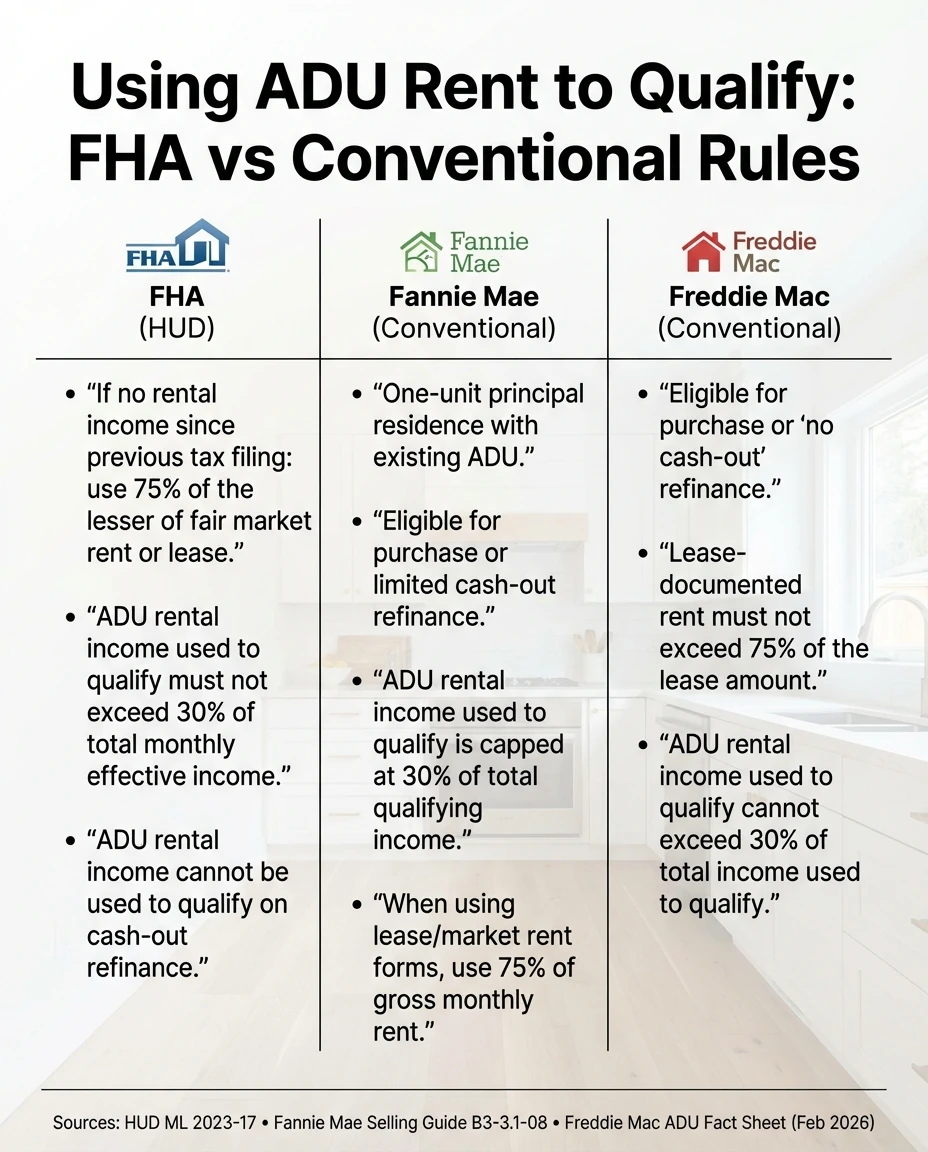
This is one of the most common questions we get — and the answer has gotten significantly better in the last two years. Both FHA and Fannie Mae have updated their rules to allow ADU rental income as qualifying income. But the details matter, and getting them wrong can derail your application.
FHA Rules (Effective October 2023 — HUD Mortgagee Letter 2023-17)
FHA now allows lenders to count ADU rental income toward your qualifying income. Here's how it works:
Existing ADU with documented rental history: Lenders generally use the borrower's documented rental history (e.g., tax returns/Schedule E), subject to FHA's standard rules for rental income.
Existing ADU, no rental history since last tax filing: Effective income may be calculated as 75% of the lesser of fair market rent (from Form 1007) or the lease amount.
New ADU being built via 203(k) — no rental history: Effective income is limited to 50% of the lesser of fair market rent or the lease agreement.
Income cap: ADU rental income used for qualifying cannot exceed 30% of the borrower's total monthly effective income.
Cash-out refinance: FHA does not allow ADU rental income to be used to qualify on cash-out refinance transactions.
Reserves: FHA requires at least two months' PITI reserves when using ADU rental income for qualification.
Fannie Mae rules: current rental-income guide
Fannie Mae’s current guide limits this qualifying-income rule to one existing ADU on a one-unit primary residence, for a purchase or limited cash-out refinance, with ADU qualifying rent capped at 30% of total qualifying income. Current-housing-payment, rental-management, and documentation rules also apply. This does not establish qualifying income from an ADU you have not built. Ask the lender to calculate your eligible income under the current guide.
Freddie Mac Rules (ADU Fact Sheet)
Freddie Mac follows a similar structure: lease-based rental income from an ADU is generally calculated at 75% of the lease amount, with qualifying income caps relative to total income. Limited to purchase and no-cash-out refinance transactions. Appraisal requirements include ADU-specific comps and rental analysis.
What This Actually Means (Real Scenarios)
Scenario 1: High earner, modest ADU rent. You earn $8,000/month. ADU will rent for $1,500. Lender uses 75% = $1,125. That's well under the 30% cap of your total income, so the full $1,125 counts. This could lower your DTI from 43% to 38% — potentially the difference between approval and denial.
Scenario 2: Moderate earner, counting on ADU rent. You earn $5,000/month. ADU rents for $1,800. Seventy-five percent = $1,350. Your total income becomes $6,350, and $1,350 is about 21% of that — still under the 30% cap. It works. But if you earned less, the cap would start biting.
Scenario 3: Building a new ADU with FHA 203(k). You're converting your garage. No rental history, so FHA uses only 50% of projected rent. If market rent is $1,400, you get $700. Helpful, but less impactful.
Questions to Ask Your Lender (Word for Word)
Not every lender has adopted these new rules yet. When you sit down with a loan officer, ask these exact questions:
- "Will you count ADU rental income toward my qualifying income?"
- "Which appraisal forms do you require for the ADU market rent analysis?"
- "Do you require ADU rental comps — and are those available in my area?"
- "Will you lend before the ADU is complete? How do construction draws work?"
- "What documentation do I need for projected rental income with no rental history?"
If one lender says no, try another. The federal policy is clear — it's a matter of individual lender implementation.
Utah-Specific ADU Programs and Incentives
This is where Utah homeowners have options that people in most other states don't — but only if you know these programs exist. Most people don't.
Salt Lake City "Backyard Keys" ADU Loan Program
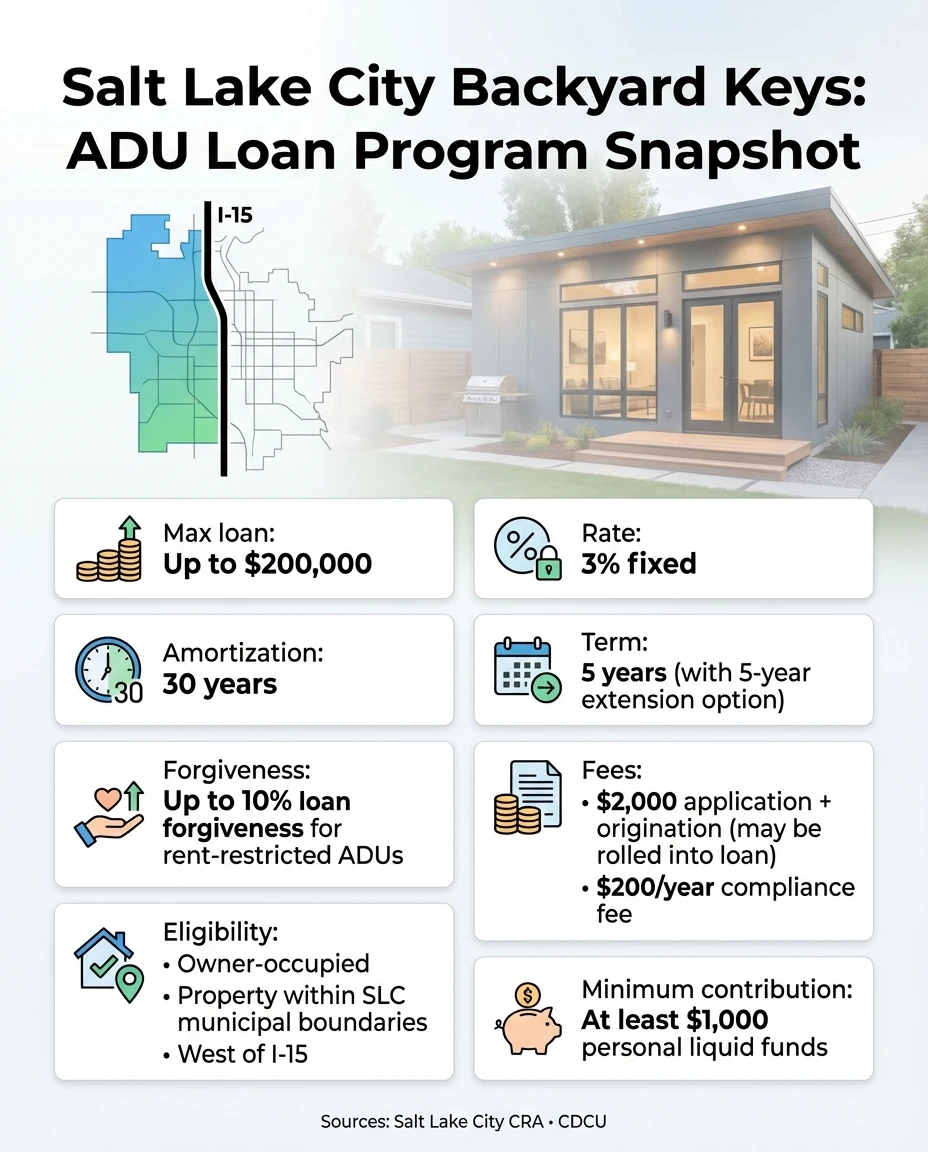
Administered by the Community Development Corporation of Utah (CDCU) in partnership with the Salt Lake City Community Reinvestment Agency, this is the most significant ADU financing program in Utah.
The basics: Construction loans up to $200,000 at 3% fixed interest, with payments amortized over 30 years and a 5-year loan term with a 5-year extension option. Do not assume a fully amortizing 30-year loan; confirm the maturity and extension terms before committing. Eligible properties are west of I-15 within Salt Lake City, with priority for the 9-Line Community Reinvestment Area.
Important: Backyard Keys is a local Salt Lake City program — not a statewide Utah loan. It is limited by location (Salt Lake City's Westside, west of I-15), eligibility and owner-occupancy requirements, available program funding, and the program's own rules. If you live outside Salt Lake City, this program does not apply to you, and you should plan around conventional financing.
Costs and requirements: $2,000 application/origination fee, including $200 due at application; the remainder may be included in the loan. The CRA also lists a $200 annual compliance fee for affordability verification. Homeowners must contribute at least $1,000 in personal liquid funds, use the property as a primary residence, complete Salt Lake City’s Good Landlord training, and participate in financial counseling.
The income rules: If you earn above 80% of Area Median Income (AMI): You must rent the ADU (or your primary home) at fair market rent to tenants earning 80% AMI or below. If you earn at or below 80% AMI: No rental restrictions — rent to anyone at any price, or live in the ADU yourself.
The loan forgiveness kicker: Homeowners who rent to income-qualifying tenants may be eligible for up to 10% loan forgiveness. On a $200,000 loan, that's $20,000 written off your balance.
How to apply: Fill out the ADU web inquiry form on CDCU's site. Applications are accepted on a rolling basis as funding becomes available during this limited pilot phase.
Former Utah Low-Income ADU Loan Guarantee Pilot
The former Utah low-income ADU loan-guarantee pilot under §35A-8-504.5 was repealed effective July 1, 2026 by H.B. 68. It is historical context, not an available financing option. The Legislature’s recodification crosswalk lists this section as repealed, separately from housing provisions that were moved. Do not budget for this guarantee or seek participating lenders as though the pilot remains active.
Goldenwest Credit Union ADU Financing (Statewide)
Goldenwest Credit Union publicly advertises ADU financing and offers construction loan options — including one-time close and two-time close construction loans — that can be used for projects involving an ADU. They also advertise options where the planned ADU value is factored into the property's appraised value, which is helpful for homeowners with limited current equity. Credit union membership is required but generally available to Utah residents.
USDA Rural Options (If You're Outside the Wasatch Front)
If your property is in an eligible rural area, USDA Direct Home Loans can help low and very-low-income borrowers buy, build, or improve homes. This isn't specifically an "ADU loan," but it can intersect with property improvements in qualifying areas. Check eligibility at rd.usda.gov.
The "ADU Grant Utah" Reality Check
Let's clear this up — because a lot of people keep searching for something that doesn't exist, and we'd rather save you the time.
Utah does not have a single, universal "free money" ADU grant that most homeowners can count on statewide. Most meaningful help is local — like the Backyard Keys program — or tied to specific affordable-housing programs with narrow eligibility rules. If you see an "ADU grant" claim online, verify the administering agency, eligibility requirements, and whether it applies to existing homeowners building an ADU versus new construction purchases.
The Backyard Keys program is the closest thing to a grant in Utah — and it's a below-market-rate loan with potential forgiveness, not free money. Individual cities may offer fee waivers or expedited permitting, but dedicated grant funding for homeowner ADU construction is extremely limited statewide.
Utah ADU Programs at a Glance
| Program | Geography | Who Qualifies | Key Benefit | Link |
|---|---|---|---|---|
| SLC Backyard Keys | SLC west of I-15 | Owner-occupants | Up to $200K at 3% fixed, 10% forgiveness | cdcutah.org |
| Former Utah Low-Income ADU Loan Guarantee | Historical statewide pilot | No new eligibility under the repealed pilot | Repealed July 1, 2026; not an available construction financing option | H.B. 68 and repeal crosswalk |
| Goldenwest CU ADU Financing | Statewide | CU members | Construction loans with ADU focus | gwcu.org |
| FHA 203(k) | Nationwide (through Utah lenders) | Maximum FHA financing generally requires 580+; 500–579 limited to 90% LTV; lender overlays and project eligibility apply | Finances purchase/refi + construction in one loan | hud.gov |
| HomeStyle / CHOICERenovation | Nationwide (through Utah lenders) | 620+ credit, 5% down | Up to 95% of after-renovation value, no FHA MIP | fanniemae.com / freddiemac.com |
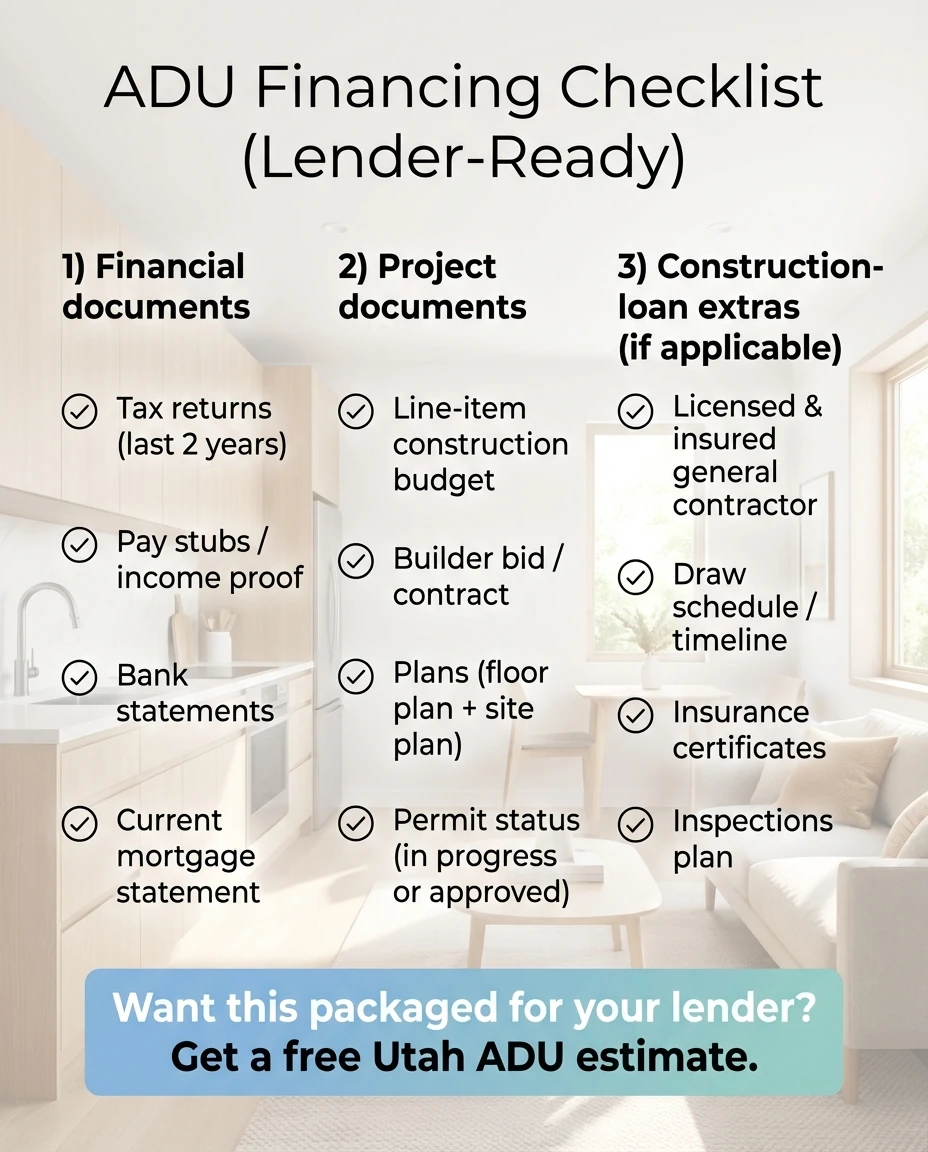
What Lenders Actually Require (The Full Qualification Checklist)
Walking into a lender's office prepared is the difference between a smooth process and a stalled one. Here's what you'll need, the thresholds you need to clear, and the things that catch people off guard.
Documents to Gather Before You Apply
- Last 2 years of federal tax returns (W-2s, or Schedule C/K-1 if self-employed)
- Last 2 months of pay stubs or a year-to-date P&L statement
- Last 2–3 months of bank statements (all accounts)
- Current mortgage statement showing balance, rate, and payment
- Property tax records and homeowner's insurance declarations page
- Completed ADU architectural/construction plans (for construction loans)
- Signed contractor agreement with a licensed general contractor
- Detailed line-item construction budget
- Title report (lender typically orders this)
Typical Qualification Thresholds
Credit score: FHA’s general rule allows maximum financing at a minimum decision credit score of 580 or above; 500–579 is limited to 90% LTV, and a scored borrower below 500 is ineligible. A renovation lender may set a higher 203(k) minimum. HELOC, home equity, construction, and conventional-renovation thresholds depend on the product and lender. Ask for the specific credit and down-payment rules rather than treating 620 as a universal FHA cutoff.
Debt-to-income ratio: Under 43–45%, including the projected new loan payment.
Loan-to-value: 80–85% for HELOC/equity loans. Up to 90–96.5% for renovation and construction loans that use after-completion value.
Reserves: Many lenders want 2–6 months of mortgage payments in liquid reserves after closing.
Three Things That Catch People Off Guard
The appraisal gap. An ADU can increase property value, but the appraised value impact varies by neighborhood, buyer demand, and how comparable sales in your area treat ADUs. Don't assume you'll get dollar-for-dollar value back immediately — in many Utah markets, the appraised increase is meaningfully less than the construction cost. Ask your lender and appraiser how ADUs are being valued in your specific area.
You can't get a separate mortgage for the ADU. An ADU is part of the same property as your primary home. It can't have its own mortgage, can't be subdivided into a separate lot, and can't be sold independently. All financing is secured against the entire property.
Not every lender does ADU loans. Especially for construction-to-permanent products, many banks simply don't have an ADU lending program. Ask specifically: "Do you offer financing for accessory dwelling unit construction?" If the loan officer seems confused by the question, move on.
How Construction Draws Work (And Why Your Budget Depends on Understanding This)
If you're using a construction loan, the money doesn't arrive in a lump sum. It's released in stages called "draws" — and understanding how this works prevents budget nightmares.
The Draw Schedule
Your lender and builder agree on a draw schedule before construction starts. Typical milestones:
Draw 1 — Foundation complete. The lender sends their inspector. If the foundation passes, they release the first chunk of funds (typically 15–20% of the total loan).
Draw 2 — Framing complete. Walls are up, roof is on. Another inspection, another release (20–25%).
Draw 3 — Rough-in complete. Plumbing, electrical, and HVAC are installed but not finished. Inspector checks, funds release (20–25%).
Draw 4 — Insulation and drywall. Interior is taking shape. Another draw (15–20%).
Draw 5 — Final. Finishes are in, final inspection passed, certificate of occupancy issued. The remaining funds release.
Why This Matters for Your Wallet
During construction, you make interest-only payments on the cumulative amount drawn. If $50,000 has been released so far at 8%, you're paying about $333/month. As more draws release, your payment climbs. By the time the full $200,000 is drawn, you're at $1,333/month in interest alone — and the ADU isn't generating rent yet.
Every week of delay is a week of interest accruing. In a worst-case scenario where the full amount is drawn early, a four-month project at 8% on $200,000 would cost roughly $5,300 in interest during the build phase. In practice, because draws are staggered, your average outstanding balance is typically around 50–60% of the total loan — so your actual interest cost during construction is often lower. Either way, budget for at least one month of delays beyond your contractor's estimate.
What Delays Draws (And Costs You Real Money)
Failed inspections. Weather delays (Utah winters aren't kind to construction timelines). Material shortages. Contractor scheduling conflicts. And the big one: if you go over budget, the lender won't release more than the approved loan amount. You'll need to cover overages out of pocket. This is why the contingency budget isn't optional — it's protection against the draws running out before the ADU is done.
Utah ADU Laws That Affect Your Financing
A lender will not fund an ADU you can't legally build. Understanding Utah's rules — even at a high level — prevents wasted time and money.
Utah HB 82: The Law That Changed Everything
In 2021, the Utah Legislature passed House Bill 82, requiring most municipalities to allow internal accessory dwelling units (basement apartments, in-law suites) in residential zones.
What cities CAN do: Require owner-occupancy. Require permits and ADU licenses. Require one additional off-street parking space. Prohibit short-term rentals (under 30 days). Prohibit separate utility meters for internal ADUs. Exempt up to 25% of residential zones (67% in college towns like Provo and Logan).
What cities CANNOT do: Ban internal ADUs outright in most residential zones. Allow HOAs or CC&Rs to prohibit internal ADUs — HB 82 includes language preventing associations from prohibiting the construction of a code-compliant internal ADU and from restricting the rental of a compliant internal ADU.
The critical distinction: HB 82 established internal-ADU protections. Detached ADUs now have a separate statewide requirement under Utah Code §10-21-304, effective October 1, 2026: specified municipalities must allow them on qualifying lots of at least 11,000 square feet containing a permitted single-family dwelling. Cities may allow smaller lots, and permitted local standards, utility capacity, and permits still matter. See our city-by-city guide.
Detached ADU Rules Vary by City — Verify Before You Finance
Detached ADU rules are city-specific and zone-specific. Requirements for lot size, maximum ADU size, setbacks, and height vary not just by city but often by zoning district within a city. Below is a starting-point reference with links to official planning resources — always confirm current rules with your city's planning department before committing to financing or construction.
| City | Detached ADU? | Official ADU/Planning Page |
|---|---|---|
| Salt Lake City | Yes (most permissive in state) | slc.gov/planning |
| Salt Lake County (unincorp.) | Yes | slco.org/planning |
| Ogden | Yes | ogdencity.com/planning |
| Provo | Required on qualifying lots under §10-21-304; verify local parcel standards | provo.org/planning |
| Draper | Yes (larger lot requirement) | draper.ut.us/planning |
| Murray | Yes (recently updated) | murray.utah.gov |
| Millcreek | Yes (recently overhauled code) | millcreek.us |
| South Salt Lake | Yes (recent external ADU ordinance) | southsaltlakecity.com |
Rules change frequently. A 5-minute call to your city's planning department can save you months of wasted effort.
Why This Matters for Your Loan
If your city doesn't allow detached ADUs on your lot (due to lot size, zoning, or other requirements), no lender will fund the project. Verify zoning before you apply for financing — not after.
The owner-occupancy requirement in most Utah cities also means you need to live on the property. This limits certain investment strategies and should be factored into your financial planning from day one.
The Real ROI: Will a Utah ADU Pay for Itself?
Let's be direct about the numbers — both the good and the realistic.
What Utah ADUs Actually Rent For
| Location | Studio / 1BR (400–600 sq ft) | 1–2BR (600–1,000 sq ft) |
|---|---|---|
| Salt Lake City | $1,000 – $1,500/mo | $1,400 – $2,000/mo |
| Ogden / South Ogden | $800 – $1,200/mo | $1,100 – $1,600/mo |
| Provo / Orem | $900 – $1,300/mo | $1,200 – $1,800/mo |
| Draper / Sandy | $1,100 – $1,600/mo | $1,500 – $2,200/mo |
| Utah County (suburban) | $800 – $1,200/mo | $1,100 – $1,700/mo |
Simple Payback Analysis (Gross Rent Only)
| Build Cost | Monthly Rent | Annual Gross | Simple Payback |
|---|---|---|---|
| $150,000 | $1,200 | $14,400 | ~10.4 years |
| $200,000 | $1,500 | $18,000 | ~11.1 years |
| $250,000 | $1,800 | $21,600 | ~11.6 years |
| $300,000 | $2,000 | $24,000 | ~12.5 years |
This is gross rent only. Does not subtract financing costs, maintenance, insurance, vacancy, or taxes. Actual net payback will be longer and depends heavily on your financing rate, operating expenses, and occupancy. Use this as a starting point — not a guarantee.
The Full Picture
Rental income is only part of the story. An ADU can meaningfully increase a property's value — but the exact impact varies by neighborhood, buyer demand, and how comparable sales in your area treat ADUs. In strong markets, the boost can be significant. In areas where ADU comps are limited, appraisers may be more conservative.
The honest reality: many builders and industry sources report that the appraised value increase from a new ADU is often less than the construction cost in the short term. You're building equity over time as the property appreciates, but don't expect dollar-for-dollar return on day one. Ask your lender and appraiser how ADUs are being valued in your specific market.
Beyond the numbers, there are the things that don't fit in a spreadsheet: having your parents five steps away instead of across town. Giving your adult kids a foothold in one of the country's tightest housing markets. Creating a rental income stream that supplements retirement. Those are hard to put a dollar value on — but they're often the real reason people build.
Step-by-Step: From First Phone Call to First Rent Check
Here's the realistic timeline with honest time estimates at each stage.
Step 1: Verify your property qualifies (1–2 weeks). Contact your city's planning department. Confirm that an ADU is allowed on your lot, check size limits, setback requirements, parking rules, and owner-occupancy requirements. Get it in writing if you can.
Step 2: Get a real construction estimate (1–2 weeks). Talk to 2–3 licensed Utah ADU builders. Get detailed bids with line-item budgets. This number is what your lender needs — and it's what your entire financing strategy depends on.
Step 3: Assess your financial position (1 week). Pull your credit reports. Calculate your current equity. Know your DTI ratio. Use the decision framework above to identify which financing lane fits.
Step 4: Get pre-approved (2–4 weeks). Talk to at least 2–3 lenders. Compare rates, terms, fees, and closing costs. Get a pre-approval letter so you know your budget is realistic and your financing path is viable.
Step 5: Finalize ADU plans and engineering (4–8 weeks). If you don't already have architectural drawings, hire an architect or use pre-approved ADU plans (some Utah cities offer these). You'll need structural engineering, energy calculations, and sometimes soils reports.
Step 6: Pull permits (4–12 weeks). Submit your plans to your city's building department. Plan review timelines vary significantly — Salt Lake City has been faster since recent reforms, but smaller cities can take much longer. Budget for at least one round of corrections.
Step 7: Close on your financing (1–4 weeks). Finalize the loan, sign closing docs, and fund. For construction loans, this is when the draw schedule starts.
Step 8: Build (4–8 months). Foundation, framing, rough-in, insulation, drywall, finishes, inspections, certificate of occupancy. Your lender sends an inspector before releasing each draw.
Step 9: Final inspection, loan conversion (2–4 weeks). The city does its final inspection and issues a certificate of occupancy. If you have a construction loan, it converts to a permanent mortgage. If you used a HELOC, you can assess whether to refinance into a fixed product.
Step 10: Rent or occupy. List the unit, screen tenants, and collect your first rent check — or move family in. The ROI clock starts.
Total realistic timeline: 9–18 months from first phone call to first rent check. It's a marathon, not a sprint. But every month you wait is a month of rental income you're not earning.
Tax, Insurance, and Resale Considerations
A few practical items that affect your long-term financial picture.
Is the Loan Interest Tax Deductible?
Interest is not automatically deductible because you build an ADU. A personal home-mortgage-interest deduction generally requires itemizing, a qualifying secured home, and eligible use of the borrowed funds, subject to debt limits. Rental-related interest may instead follow rental-expense allocation rules. Keep draw and spending records and have a tax professional determine the treatment under IRS Publication 936 and Publication 527.
Rental income from the ADU is taxable, but you can deduct associated expenses: mortgage interest allocated to the ADU, property taxes, insurance, maintenance, repairs, and depreciation. The tax math on an ADU can actually be quite favorable — but it's complex enough that you want a CPA running the numbers, not a website.
Insurance Updates You Cannot Skip
During construction, your builder should carry builder's risk insurance. Once the ADU is complete and occupied, update your homeowner's insurance to reflect the additional structure and any rental activity. Many insurance carriers require a landlord rider or separate landlord policy for the rental unit. Skipping this creates a dangerous coverage gap — if a tenant has an incident in an uninsured ADU, you're exposed.
Property Tax Impact
Adding an ADU will increase your property's assessed value, which means higher property taxes. The increase is typically proportional to the value the ADU adds to the assessment — not necessarily the full construction cost. Contact your county assessor's office for an estimate before committing.
Common Mistakes That Derail Utah ADU Financing
We see these patterns over and over. Avoid them and you'll save time, money, and genuine headaches.
1. Financing the bid instead of the project. Your builder's number covers the structure. Permits, site work, utility connections, design fees, and contingency add 20–30%. Finance the full project cost, or risk running out of money mid-build.
2. Talking to lenders before getting a builder estimate. Lenders need a real number, detailed plans, and contractor info. Walking in with a vague budget gets you a vague answer.
3. Giving up a low mortgage rate for a cash-out refi. If you're sitting on a 3.5% first mortgage, refinancing to 7% to fund a $200,000 ADU costs you dearly — you're paying that higher rate on your entire balance. A HELOC at 8% on $200,000 is almost always cheaper than a refi at 7% on $500,000.
4. Assuming you can get a separate mortgage. You can't. The ADU is part of your property. All financing is against the whole parcel.
5. Skipping the contingency budget. Utah construction is unpredictable. Material prices shift, site conditions surprise, change orders happen. Ten to fifteen percent contingency isn't conservative — it's realistic.
6. Not checking city rules first. If your city doesn't allow a detached ADU on your lot, no lender will fund it. Five minutes with your planning department can save you months of wasted effort.
7. Underestimating the timeline. From research to first rent, expect 9–18 months. If someone is moving in (aging parent, returning college grad), plan backward from their target date with generous buffers.
8. Ignoring interest during construction. Interest accrues during the build on whatever amount has been drawn. Even with a staggered draw schedule, a 5-month build on a $200,000 loan can cost several thousand dollars in interest before the ADU generates a dollar of rent. Factor this into your total cost.
Frequently Asked Questions About ADU Financing in Utah
What credit score do I need to finance an ADU in Utah?
There is no single ADU-loan score. FHA’s general credit rule permits maximum financing at 580 or above and limits 500–579 to 90% LTV; lenders may require a higher score for 203(k). HELOCs, construction loans, and conventional renovation loans use their own lender and product rules. Confirm your project’s credit threshold and down-payment requirement before assuming you are ineligible.
Can I finance an ADU with no equity?
It's difficult but possible. FHA 203(k) loans require as little as 3.5% down and are based on after-renovation value. HomeStyle requires 5% down. If you purchased very recently, these may be your only viable paths.
Are there ADU grants in Utah?
No universal statewide grant program exists for typical homeowners. The Salt Lake City Backyard Keys program offers below-market-rate loans (not grants) up to $200,000 at 3% fixed with potential 10% forgiveness — the closest thing to a grant in Utah. Some cities may offer fee waivers or expedited permitting, but dedicated grant funding for ADUs is extremely limited.
Can I use future ADU rent to qualify for a loan?
It depends on the loan product and whether the ADU already exists. Fannie Mae’s current qualifying-income rule is for one existing ADU on a one-unit primary residence, purchase or limited cash-out refinance, with a 30% cap and additional underwriting conditions. Eligible FHA Standard 203(k) projects have separate ADU and projected-rent requirements under HUD guidance. Do not assume rent from a not-yet-built detached ADU will qualify; ask the lender to apply the current rules to your project.
Do I need a licensed contractor?
For most loan types, yes. Construction loans, renovation loans, and many HELOC products require a licensed, insured general contractor. Even if you're handy, most lenders won't fund an owner-build ADU project.
Can I rent my ADU as a short-term rental on Airbnb?
Verify the rule for your ADU type before projecting rental income. Utah’s municipal internal-ADU statute permits cities to prohibit rentals shorter than 30 consecutive days. The detached-ADU statute permits restrictions on rentals shorter than 90 consecutive days. Confirm the applicable local ordinance, permit conditions and private restrictions before relying on Airbnb or another short-term rental model.
How much will an ADU increase my property value?
It varies by neighborhood, buyer demand, and how comparable sales treat ADUs in your area. In strong markets the boost can be significant, but the appraised increase is typically less than full construction cost in the short term. Ask your lender and appraiser for local ADU comps before assuming a specific number.
Can I build a prefab ADU with a construction loan?
Yes, as long as the unit goes on a permanent foundation and meets local codes. Fannie Mae explicitly allows factory-built ADUs. Make sure your lender understands the manufacturer's deposit schedule, which differs from standard construction draw timelines.
What's the fastest financing option?
HELOC — approval in 2–4 weeks if you have sufficient equity. Construction and renovation loans take 45–90 days. Self-funding with savings is immediate.
Can I combine financing sources?
Yes. Many homeowners use a primary source (HELOC or construction loan) for the bulk of costs and bridge smaller gaps with a 401(k) loan or savings. Some use a HELOC for early soft costs (design, permits) and then take a construction loan for the build.
What if construction costs exceed my loan amount?
The lender won't increase your loan mid-build. You'll need to cover overages out of pocket, tap additional credit, or use savings. This is exactly why a 10–15% contingency budget is essential — not optional.
Does my HOA allow an ADU?
Utah law (HB 82) limits what homeowners associations can do regarding internal ADUs — for example, HOA rules can't prohibit an owner from constructing a code-compliant internal ADU, and associations can't restrict renting a compliant internal ADU. Detached ADUs are different and may still be limited by your local ordinance and HOA governing documents. If you're in an HOA, verify your specific documents and consider legal advice for edge cases.
If I live in Salt Lake City west of I-15, how does Backyard Keys work?
Start with the CDCU inquiry form. Backyard Keys offers eligible westside owner-occupants up to $200,000 at 3% fixed, amortized over 30 years, with a 5-year term and a 5-year extension option. Up to 10% forgiveness is available for qualifying rent-restricted ADUs. Applications depend on pilot funding; confirm availability, fees, affordability conditions, and final loan documents with CDCU.
How do construction draws work?
Your lender releases funds in stages (typically 4–6 draws) after their inspector verifies each construction milestone: foundation, framing, rough-in, insulation/drywall, finishes, final. You pay interest only on the cumulative amount drawn during the build.
Will an ADU increase my appraisal enough to refinance afterward?
Usually yes, but by how much varies by market. The appraised increase won't typically equal your construction cost in the short term. Over time, as the property appreciates, the gap narrows. Plan accordingly for any post-construction refinancing.
Do banks even do ADU loans?
Not all of them. Especially for construction-to-permanent products, many institutions don't have ADU-specific programs. Goldenwest Credit Union is one Utah option with dedicated ADU lending. For HELOCs and home equity loans, most major banks and credit unions can help. Always ask specifically about ADU construction — don't assume.
What's the cheapest way to finance an ADU?
If you have the cash, self-funding has zero financing costs. Among loan options, a HELOC typically offers the lowest upfront costs (no closing costs at many lenders) with competitive rates. For lower-equity homeowners, FHA 203(k) offers the lowest down payment (3.5%) but comes with mortgage insurance premiums that add to the total cost over time.
Can I owner-build my ADU to save money?
You can, but most lenders won't finance an owner-build project. Construction loans and renovation loans typically require a licensed, insured general contractor. If you want to do some of the work yourself, discuss this with your builder — many will allow owner participation on certain tasks (painting, landscaping, finish work) while handling the licensed work themselves.
How do I find lenders who specialize in ADU financing in Utah?
Start with local credit unions — they tend to be more flexible and familiar with ADU projects than national banks. Goldenwest Credit Union has dedicated ADU options. Mountain America and America First also work with ADU borrowers. For FHA 203(k) and HomeStyle loans, look for lenders who specifically advertise renovation loan products. Ask your builder for recommendations too — experienced ADU contractors know which lenders are easiest to work with on draw schedules and inspections.
Get a Real Number (It's the Step That Makes Everything Else Work)
Here's what we've learned working with Utah homeowners: the single biggest reason ADU projects stall isn't financing denial, zoning problems, or construction delays. It's that people try to figure out the money before they know what the money needs to be.
Your financing path, your loan amount, your monthly payment, every conversation with every lender — all of it starts with an accurate construction estimate for your property, your city's requirements, and the type of ADU you want to build.
Get Your Free Utah ADU Estimate
What you'll receive: A detailed, lender-ready cost estimate for your specific property — including construction costs, soft costs (permits, engineering, site work), and contingency. The format banks actually want to see.
How it works: Request a provider review of your address and project type. The provider confirms fit, availability, assessment fees and possible next steps. Verify credentials and written scope before hiring; financing is not promised.
We've been through this process with hundreds of Utah homeowners, and we're happy to point you in the right direction — even if that direction isn't us.
Sources and How We Keep This Accurate
We take accuracy seriously on this page. It's a financial topic, and bad information costs real money.
Primary sources cited throughout this guide:
| Source | What It Covers | Link |
|---|---|---|
| HUD Mortgagee Letter 2023-17 | FHA ADU rental income rules, property eligibility, appraisal protocols | hud.gov |
| Fannie Mae SEL-2025-08 | Conventional ADU rental income qualification rules | fanniemae.com |
| Freddie Mac ADU Fact Sheet | Freddie Mac ADU income and property rules | freddiemac.com |
| Consumer Financial Protection Bureau | HELOC guidance and consumer protections | consumerfinance.gov |
| IRS Publication 936 | Mortgage interest deduction rules | irs.gov |
| Utah Legislature HB 82 (2021) | Internal ADU mandates, HOA restrictions, municipal authority | le.utah.gov |
| Utah Legislature H.B. 68 (2026) and official recodification crosswalk | Repeal of former §35A-8-504.5 effective July 1, 2026 | Enrolled H.B. 68; crosswalk |
| Salt Lake City CRA | Backyard Keys ADU loan program | cra.slc.gov |
| Community Development Corporation of Utah | Backyard Keys administration, terms, application | cdcutah.org |
| Goldenwest Credit Union | ADU construction loan products | gwcu.org |
| Urban Institute | ADU financing landscape analysis | urban.org |
| USDA Rural Development | Rural housing loan programs | rd.usda.gov |
Update policy: We review and update this guide quarterly and whenever major program rules or rates change meaningfully. If you spot something outdated, contact us and we'll verify and fix it within 48 hours.
About this guide: Written by the Utah ADU Builders editorial team. Reviewed for accuracy against primary source documents from HUD, Fannie Mae, Freddie Mac, IRS, CFPB, and Utah state and local program administrators. We are not lenders, mortgage brokers, or financial advisors. This content is for educational purposes. Consult a licensed mortgage professional for advice specific to your financial situation.