
How this guide works.
Utah ADU Builders is a Utah-focused ADU planning and builder-matching resource — not a city office, law firm, lender, architect, engineer, or licensed contractor. We may earn compensation when homeowners request estimates or get connected with local professionals. That compensation does not change how we explain Utah's ADU rules, cost ranges, feasibility factors, or permitting risks.
Last verified: June 2026.
What we verified for this page
- Utah state ADU law — the internal-ADU statute (Utah Code §10-21-303 for cities / §17-80-303 for counties) and the impact-fee exemption for internal ADUs (§11-36a-202).
- Utah's new 2026 detached-ADU law (Utah Code §10-21-304), including its effective date and lot-size threshold.
- City ordinance examples — Salt Lake City, unincorporated Salt Lake County, Provo, Millcreek, and South Jordan, pulled from each jurisdiction's own pages.
- Salt Lake City programs — the city's pre-approved ADU plans and the Backyard Keys ADU loan terms (from the SLC Community Reinvestment Agency).
- Cost ranges — editorial planning assumptions for comparing ADU types and scopes. They are not a statistically representative survey of completed Utah projects or verified contractor bids.
We did not verify any individual builder's price, license, or availability, and nothing here is legal, tax, or financial advice. Rules and fees change — confirm current details for your property before you commit money.
How much does an ADU cost in Utah right now?
A realistic Utah ADU budget usually starts around $60,000 for a simple conversion and can climb past $400,000 for a custom detached cottage. The single biggest variable is whether you're reusing space you already have or building something new from the ground up — everything below explains where your project lands inside that range.
The honest catch: the cheapest ADU isn't always the one with the lowest sticker price. It's usually the one that already has the expensive pieces in place — structure, a foundation, ceiling height, nearby utilities, parking, and a layout that can meet code.
Utah ADU cost by type (2026 planning ranges)
| ADU type | Typical Utah range | Typical cost per sq ft | Biggest cost risk |
|---|---|---|---|
| Basement / internal (inside existing home) | $60,000 – $150,000+ | ~$100–$250/sq ft | Egress windows, ceiling height, separate entrance, fire separation, plumbing |
| Garage conversion | $60,000 – $175,000+ | ~$125–$275/sq ft | Slab, insulation, plumbing trenching, HVAC, replacing required parking |
| Attached addition | $150,000 – $275,000+ | ~$225–$375/sq ft | New foundation, roof tie-in, structural work, utility extension |
| Detached backyard ADU / casita | $200,000 – $400,000+ | ~$250–$450/sq ft | New foundation, sewer/water/electric trenching, setbacks, site access |
| Prefab / modular (installed) | $150,000 – $300,000+ | ~$225–$400/sq ft | Package price ≠ installed price; site work and utilities still apply |
These are statewide editorial planning ranges, not bids or observed market averages. Site work, utility routes, finishes, project size and local fees can put an individual project outside the range. Read the cost methodology and compare itemized proposals for your property.
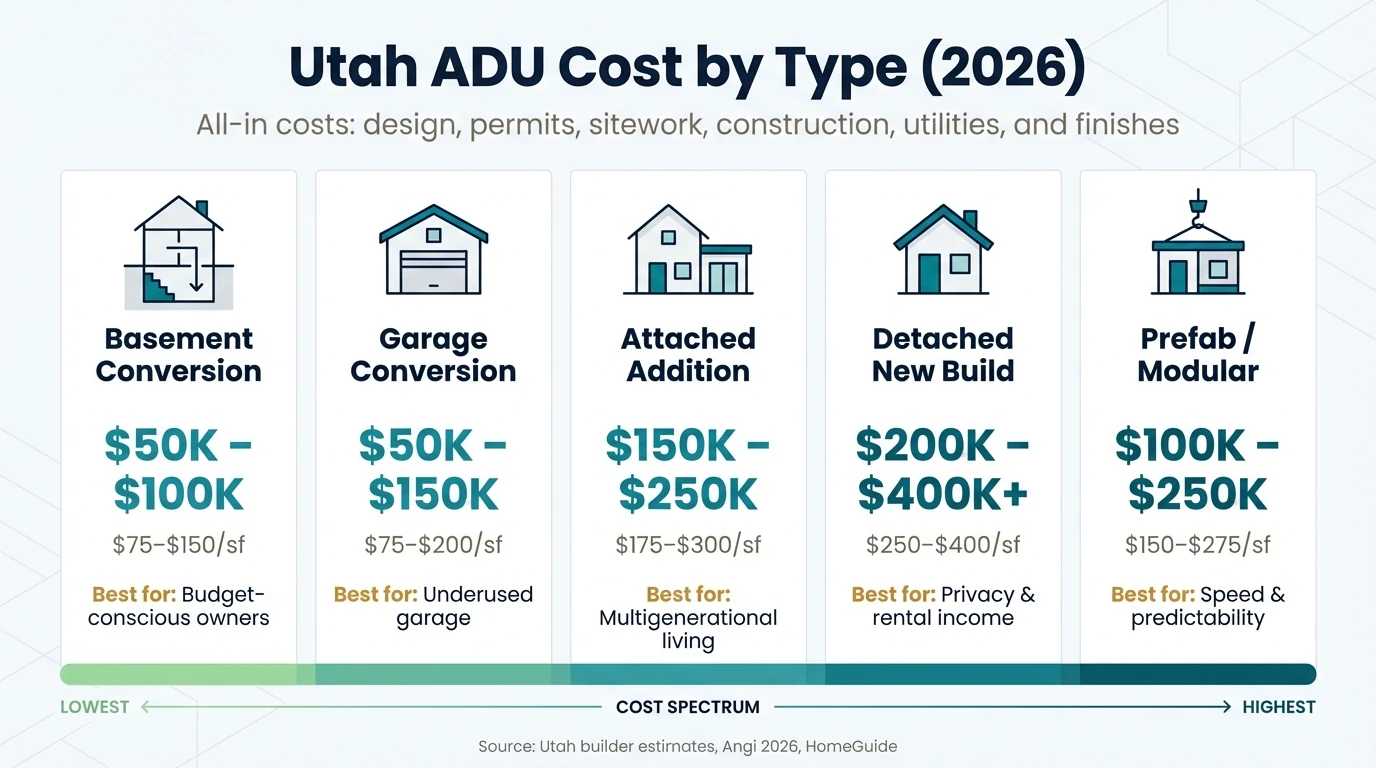
Planning cost ranges only — not quotes. Actual costs depend on site conditions, finish level, and city fees.
ADU cost by type: which one fits your property?
The type you build is the largest cost lever you control. Conversions reuse an existing shell and tend to cost less; new construction adds a foundation, utilities, and a full building envelope and tends to cost more. Here's how each plays out in Utah.
Basement or internal ADU — usually the cheapest path
Plan on roughly $60,000–$150,000. An internal ADU (a unit created inside your home's existing footprint, like a basement apartment) is often the lowest-cost option because the structure, roof, and foundation already exist. It also carries a real legal edge: under Utah law, building an internal ADU inside your existing home is not subject to impact fees — the one-time charges cities levy on new development for things like parks, roads, and utilities (Utah Code §11-36a-202). That exemption applies specifically to internal ADUs inside an existing single-family home, not to detached or attached additions.
It stops being cheap when the basement lacks legal ceiling height, safe egress (a code-compliant way out in an emergency), a separate entrance, good sewer slope, or fire separation between units. Older homes may also need an electrical panel upgrade.
Garage conversion — affordable, but rarely as simple as it looks
Plan on roughly $60,000–$175,000. Walls and a roof already exist, which helps — but garages aren't built like living space. Common surprises: an uninsulated or sloped slab, no plumbing nearby, a new HVAC system, an exterior that has to be reworked, and parking replacement. Several Utah cities require you to replace the off-street parking you lose when you convert a garage, which can erase part of the savings.
Attached addition — more separation without a separate building
Plan on roughly $150,000–$275,000. An attached ADU is new square footage built onto your home with its own entrance. It's a middle path: more privacy than a basement, less than a standalone cottage. Cost drivers are foundation work, tying a new roofline into the existing house, structural engineering, and extending utilities.
Detached backyard ADU or casita — the most expensive, and the most flexible
Plan on roughly $200,000–$400,000+. A detached ADU is a separate structure in your yard — essentially a small new house, which is why it tops the range. You're paying for a new foundation, a full envelope, separate heating and cooling, and trenching to run sewer, water, and electrical out to the unit. Those utility connections, the trenching, and the available capacity can add materially to the bill. In return you get the most privacy and a fully separate, self-contained unit.
Considering a separate backyard home? Use our detached ADU builder guide to compare project scope, site work and permit responsibilities.
Detached ADUs are also where Utah's 2026 law changes the picture — more on that below.
Concept image; actual design, cost, and approval depend on site and local rules.
Prefab or modular ADU — faster, but the sticker isn't the total
Plan on roughly $150,000–$300,000+ installed. Factory-built units can simplify design and shorten the build. The trap is comparing a factory package price to a fully installed, permitted, utility-connected total. Site prep, foundation, crane and access, utility connections, permits, and local compliance still apply — and on a tight or sloped lot they add up fast.
What a property-specific estimate actually weighs
A useful Utah ADU estimate isn't just a cost-per-square-foot figure times your size. To get close to a real range, it has to account for:
- Your city or county — rules, fees, and the 2026 detached-ADU rollout all vary by jurisdiction
- ADU type and your target size
- Whether you have an existing shell (basement, garage) or are building new
- Utility distance and capacity — how far sewer, water, and electrical are, and whether there's room on the system
- Slope and site access
- Parking you may need to add or replace
- Any HOA or recorded restrictions on the property
- Finish level and your intended use (family housing, long-term rental)
That's what our instant estimate asks about — and it's why two homes on the same street can land at very different numbers.
How ADU cost changes by Utah city
Two identical ADUs can cost very different amounts in two Utah cities, because labor, infill access, utility rules, impact fees, parking, owner-occupancy requirements, and detached-ADU eligibility all vary — and the 2026 detached-ADU law is rolling out city by city. The table below is a planning framework, not a list of official city prices.
Want a deeper look at city-by-city rules, permit fees, and lot requirements? See our dedicated guide: Utah ADU Cost by City (2026).
The specific rules noted below are examples from the named jurisdictions. Where nearby cities are grouped in one row, treat the specific rule as the named city's and verify your own city separately. Ranges are planning estimates, not bids or official city pricing. Curious how we build these ranges? Read our cost methodology.
| City / area | Internal / basement range | Detached range | What tends to push cost — and what to verify |
|---|---|---|---|
| Salt Lake City | $70k–$170k+ | $200k–$425k+ | Older homes, infill access, historic-district review, seismic soils. Verify: owner-occupancy, parking, standard-plan site review |
| Provo | $60k–$160k+ | $180k–$400k+ | Provo requires detached ADUs to have their own utility meter and address, a rental license, and impact fees. Verify: ADU overlay, parking |
| Ogden / Weber County | $60k–$150k+ | $170k–$375k+ | Older housing stock can mean sewer, foundation, and electrical upgrades. Verify: city/county rules |
| Lehi / north Utah County | $70k–$170k+ | $200k–$425k+ | Newer homes, fast-growth utilities, HOA/subdivision rules. Verify: lot size, setbacks, HOA |
| West/South Jordan / Riverton | $65k–$165k+ | $190k–$400k+ | Suburban lots help, but South Jordan prohibits separate ADU meters — the opposite of Provo. Verify: one-ADU limits, septic |
| Millcreek / Holladay | $75k–$180k+ | $220k–$450k+ | Millcreek requires an 8,000+ sq ft lot for detached, caps it at 1,000 sq ft, and bars ADUs on slopes over 30%. Verify Holladay separately. Verify: owner-occupancy, parking |
| Sandy / Draper / Cottonwood Heights | $75k–$190k+ | $220k–$475k+ | Hillside access, HOAs, and higher finish expectations. Verify: slope, engineering, HOA |
| St. George / Washington County | $65k–$165k+ | $190k–$400k+ | Heat, slab/site conditions, and water/impact fees in growth areas. Verify: utility capacity, fees |
| Park City / Summit area | $120k–$250k+ | $300k–$650k+ | High labor and material costs, snow load, topography, resort-area rules. Verify: zoning, HOA, rentals |
Here's a concrete example of why "what does an ADU cost in Utah?" has no single answer: Provo requires a detached ADU to have its own separate utility meter, South Jordan prohibits separate meters entirely, and unincorporated Salt Lake County takes a different approach still. City rules genuinely change the budget — treat your specific city's adopted ordinance as the thing you build against, not the state average.
The hidden costs that change your final price
The "hidden" costs usually aren't extras — they're the items that decide whether your ADU can legally and physically work: design, engineering, permits, utility capacity, sewer, electrical, parking, fire safety, and site work. Miss them in your budget and you get the $50,000 surprise.
Utah ADU hidden-cost checklist
| Cost item | Rough planning allowance | Shows up most when |
|---|---|---|
| Design, drafting, engineering | $5,000–$25,000+ | Detached builds, structural changes, sloped or unusual lots |
| Survey / site plan | $500–$3,000+ | Detached ADUs, tight setbacks, easements |
| Building permit, plan review, trade permits | $1,000–$5,000+ (often higher for new builds) | Any permitted construction |
| Impact fees | Varies by city and type — $0 for an internal ADU built inside an existing home; other fees still apply | Detached and attached ADUs |
| Utility connection / capacity / meters | $5,000–$50,000+ | Detached ADUs, long trenches, separate service |
| Sewer line / slope / ejector pump | $5,000–$30,000+ | Basements below sewer grade, detached units far from the main line |
| Electrical panel or service upgrade | $3,000–$15,000+ | Older homes, added kitchen/laundry, detached units — see our ADU electrical panel upgrade guide |
| Fire/life-safety separation, egress | $5,000–$40,000+ | Basement bedrooms, garage conversions, attached units |
| Foundation, grading, retaining walls | $10,000–$80,000+ | Detached builds, slopes, poor access, drainage issues |
| Parking, driveway, flatwork | $3,000–$25,000+ | Garage conversions, added stalls, long access runs |
| Contingency | 10%–20% of the project | Every ADU budget — without exception |
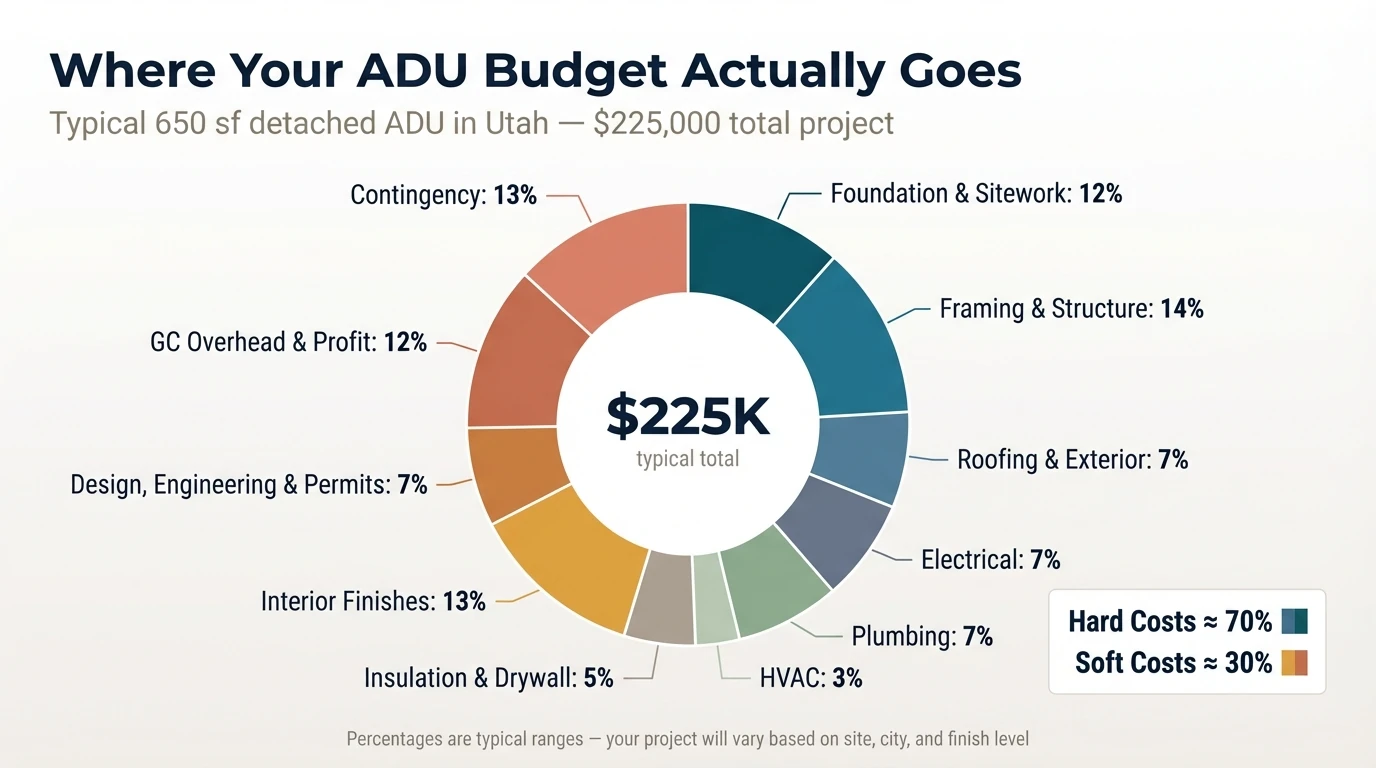
Permits, utility hookups, and site work — what to budget
The construction number is only part of an ADU budget. A serious Utah estimate separates design, permits, utilities, impact fees, site work, and construction so you can compare builder bids honestly instead of trusting one lump sum.
Use our checklist to compare Utah ADU builders on the same scope, including permit responsibilities, utility work and exclusions.
Permits. Any ADU that involves construction or remodeling requires the applicable building and trade permits (electrical, plumbing, mechanical), plus zoning review and inspections. Even when a space needs little or no remodeling, cities commonly require an ADU permit, a rental or business license, an owner-occupancy affidavit, or a recorded notice before you can legally rent it. The takeaway: there's a city process either way, and you can't skip it.
Utility hookups. A utility hookup is the work to connect your ADU to sewer, water, and electrical service. Detached units are the most exposed because they may need long trenching and new connections; even internal ADUs can need a panel upgrade or plumbing changes. Utah's detached-ADU law specifically lets a city deny a detached ADU where utilities lack adequate access or capacity — so confirming your sewer, water, and electrical situation early is one of the highest-value things you can do.
Site work. Detached ADUs cost more on sloped lots, in tight backyards, behind mature landscaping or hardscape, with long utility runs, or where retaining walls and drainage are needed. A flat lot with easy access and nearby utilities is a meaningfully cheaper project than a sloped one without.
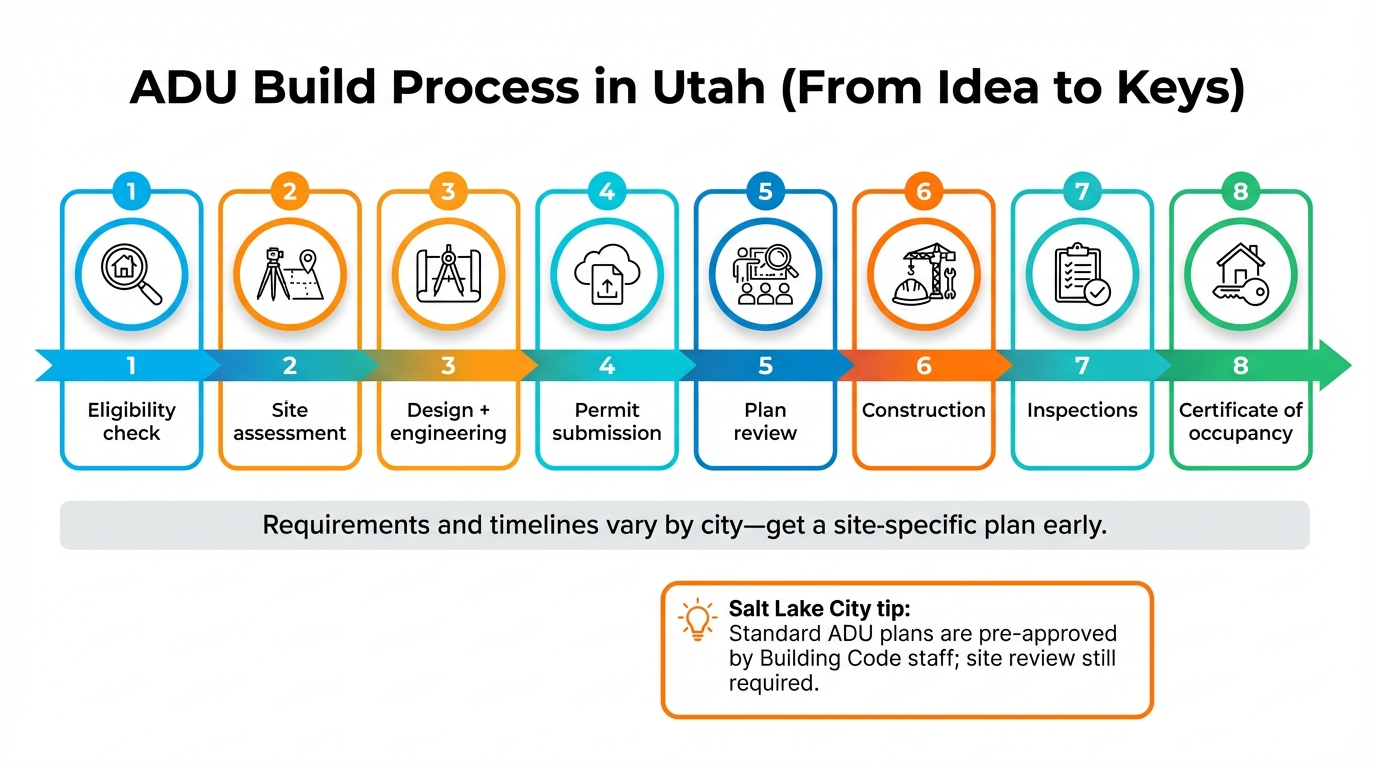
For a full timeline of the permit and construction process, see our Utah ADU permit and build timeline guide.
What Utah's ADU laws mean for your project in 2026
Utah law has made ADUs easier to pursue — but it does not make every ADU cheap, automatic, or permit-free, and it treats internal and detached units very differently. The gap between what state law guarantees and what your city still controls is where most homeowner confusion lives.
Internal ADUs are protected statewide
An internal ADU (created inside your home's existing footprint and rented for 30+ days) is generally allowed as a permitted use in areas zoned primarily for residential use under state law (Utah Code §10-21-303, formerly §10-9a-530; see the Utah Office of the Property Rights Ombudsman summary) — but it's not automatic everywhere. That protection comes with conditions. By definition it applies only when the primary home is owner-occupied — meaning the owner lives in the detached single-family house as their primary residence — so it protects owner-occupants, not someone buying a property purely to rent out both units. Cities keep meaningful control too: they can prohibit internal ADUs on lots of 6,000 square feet or smaller, designate a limited share of residential land where they aren't allowed, require a design that doesn't change the home's appearance, require extra parking, require a rental license, ban short-term rentals, and prohibit renting an internal ADU that isn't in the owner's primary residence. The unit must still meet building, health, and fire codes.
Detached ADUs: statewide requirement effective October 1, 2026
What it does not do is make detached ADUs automatic everywhere. Cities can still regulate size, height, setbacks (how far a structure must sit from your property lines), lot coverage, design, parking, owner occupancy, and rental terms — and they can deny a detached ADU where utilities lack capacity. Lots under 11,000 square feet remain up to local discretion, and some cities allow them on smaller lots. Our practical view: treat your city's adopted ordinance as the thing you actually build against, and verify it for your specific parcel before budgeting.
Short-term rentals — and minimum rental periods — are a separate question
Don't assume you can run your ADU as a nightly rental. Short-term rental (typically stays under 30 days) rules are set city by city and often differ by ADU type — and so do minimum rental periods. Internal ADUs are defined around long-term (30+ day) rental, but cities set their own limits, and the rules for detached units can be stricter still. Millcreek, for example, allows long-term rental of a detached ADU with the right approvals but prohibits short-term rental of detached units. If rental income — especially nightly rental — is part of your plan, confirm what's allowed for your ADU type in your city before anything else. It can be a dealbreaker.
Learn more: ADU rental income in Utah — what to expect
How Utah homeowners pay for an ADU
Most Utah ADUs are funded through home equity, renovation or construction financing, cash, family contributions, or — in a few cases — local programs. Financing is separate from feasibility: approval, rates, and terms are never guaranteed, so confirm what you qualify for before committing to a design.
Common paths include a HELOC or home equity loan, a cash-out refinance, a construction or renovation-to-permanent loan (some lenders underwrite these based on your home's expected value with the ADU completed — confirm current terms directly), and cash or family funds.
A local example — Salt Lake City's Backyard Keys ADU loan
For owner-occupants on Salt Lake City's west side (west of I-15), the city's Community Reinvestment Agency runs the Backyard Keys pilot ADU loan program with notably favorable terms: up to $200,000 at 3% fixed, a 5-year term with a 5-year extension option, 30-year amortization, and up to 10% loan forgiveness for rent-restricted ADUs (a $2,000 application/origination fee and a $200/year compliance fee apply). It requires using the property as your primary residence, completing the city's landlord training, and financial counseling; the 9-Line area gets funding priority.
Income affects the rental conditions. Households earning 80% or less of Area Median Income (AMI) have no program rent restriction and may live in or rent the ADU. Households above 80% AMI must rent either the main home or the ADU at a price affordable to renters earning 80% AMI or less.
It's a pilot with limited funding awarded on a rolling basis — verify current availability and terms directly with the program. Financing help tends to be local and changing, not statewide and permanent.
For a deeper look at all financing options, see our Utah ADU financing guide.
Is an ADU worth it in Utah — and when you shouldn't price one yet
For many Utah homeowners holding their property five or more years, an ADU can add usable space, optional rental income, or housing for family. But it is not a guaranteed return, and you'll see "adds 20–35% to your home value" claims online that nobody can promise for your property — value depends on legality, permits, build quality, your market, and how an appraiser treats it. Run your own numbers rather than trusting a headline percentage.
Some homeowners genuinely shouldn't price an ADU yet. Hold off and get a feasibility check first if:
- You're counting on short-term rental income but your city may not allow it.
- Your lot is too small or constrained for the detached plans you have in mind.
- You have an HOA or recorded restrictions you haven't checked.
- You can't easily replace required parking, or your utility capacity is unknown.
- Your budget is below the realistic range for the type you want.
- You're assuming you can build without permits or need guaranteed rental income or financing to make it work.
None of these means "never." They mean check before you spend on plans or bids. That's the safest, cheapest next step — and it's what a feasibility review is for.
How we put these numbers together
These are the site's editorial planning assumptions for budgeting across ADU types. A published vendor package price, a city fee schedule and a contractor's property-specific proposal describe different scopes; none alone establishes a statewide installed-cost average. Use the ranges to compare scope, then obtain a written estimate covering design, fees, site work, utilities, construction and contingency.
Utah ADU cost FAQ
What's the cheapest ADU to build in Utah?
Usually a basement or internal ADU, if the existing space already has enough ceiling height, a workable entrance, nearby plumbing, and a layout that can meet code. Internal ADUs built inside an existing home also skip impact fees by state law, which adds to the savings.
How much does a detached ADU cost in Utah?
Plan on about $200,000–$400,000+. It's the priciest type because it's a small new home — foundation, full envelope, separate utilities, and site work — and costs climb with custom design, difficult utility runs, slope, or expensive local markets.
How much does a basement ADU cost in Utah?
A realistic range is about $60,000–$150,000, depending on egress windows, a separate entrance, sewer slope, kitchen and bath work, fire separation, and finish level.
Is a garage conversion cheaper than a detached ADU?
Usually, but not always. A conversion can get expensive once you account for the slab, insulation, plumbing, HVAC, and replacing the parking you lose — which several Utah cities require.
Do I need a permit to build an ADU in Utah?
Almost always, yes. Any ADU involving construction or remodeling requires building and trade permits, plus zoning review and inspections. Even an existing space generally needs city approvals — an ADU permit, a rental or business license, or an owner-occupancy affidavit — before legal rental use. There's a city process either way.
Are impact fees required for Utah ADUs?
Building an internal ADU inside an existing home is not subject to impact fees under Utah Code §11-36a-202. Detached and attached ADUs are generally not exempt, and permit fees plus utility connection and capacity charges can still apply to any project.
Can I build a detached ADU anywhere in Utah now?
No. Utah's detached-ADU law (effective October 1, 2026) requires most cities — "specified municipalities" — to allow detached ADUs on qualifying lots of 11,000+ sq ft and prohibits a conditional-use requirement. But smaller lots and many standards (size, setbacks, parking, owner occupancy, utility capacity) remain local, and cities are still adopting rules. Always confirm your city and parcel.
Can I rent my Utah ADU as a short-term rental or Airbnb?
Don't assume so. Short-term-rental rules and minimum rental periods are set by each city and often differ by ADU type — some Utah cities allow long-term rental of a detached ADU but prohibit short-term use.
Does an ADU increase my property value?
It can, but we won't publish a guaranteed percentage. Value depends on legality, permits, quality, rental potential, buyer demand, and how an appraiser treats the unit in your market. For national and Utah appraisal-group figures, see how ADUs show up in appraisals.
How accurate is an instant ADU cost estimate?
Treat it as a planning range to orient your budget — not a contractor bid, appraisal, permit approval, or financing approval. A property-specific feasibility review gets you much closer to a real number.
Sources we checked
- Utah Office of the Property Rights Ombudsman — internal-ADU guidance and statute references: commerce.utah.gov/propertyrights.
- Utah Code — §10-21-303 / §17-80-303 (internal ADUs), §10-21-304 (detached ADUs, effective Oct 1, 2026), §11-36a-202 (impact-fee exemption for internal ADUs): le.utah.gov.
- City and county pages — Salt Lake City Building Services; unincorporated Salt Lake County (Regional Development); Provo; Millcreek; South Jordan.
- Salt Lake City Community Reinvestment Agency — Backyard Keys ADU loan program terms: cra.slc.gov.
- Public 2025–2026 Utah cost and builder sources — used to triangulate the cost ranges shown as estimates.
This page is published by Utah ADU Builders, an independent ADU planning and builder-matching resource. See our editorial standards and advertising disclosure. Nothing on this page is legal, financial, or engineering advice. Rules and costs change — confirm current details for your property before committing money.