ADU Rental Income in Utah: What You Can Make, What's Legal, and Whether It's Worth It
The short answer: Yes, most Utah homeowners can legally earn rental income from an ADU — and for many, it is one of the strongest return-on-investment home projects available. Internal ADUs (basement apartments) are the easiest legal path, with estimated long-term rents of $900–$1,500/month along the Wasatch Front. Detached backyard ADUs can command $1,400–$2,500/month but cost more to build and face stricter city-by-city rules.
Every week we hear the same questions from Utah homeowners: How much will my ADU actually rent for? Is it legal in my city? Will it be worth the cost? What are the tax implications? Can I put it on Airbnb?
That is exactly what this guide answers. We built it because we got tired of watching Utah homeowners piece together fragments from five different websites, city PDFs, and Reddit threads. Below you will find the statewide legal framework, a city-by-city rule matrix, realistic rent ranges, transparent payback math, tax implications, financing options, and every edge case we have seen kill or save a project.
Last verified: March 2026 · Written by the Utah ADU Builders team · Sources cited throughout
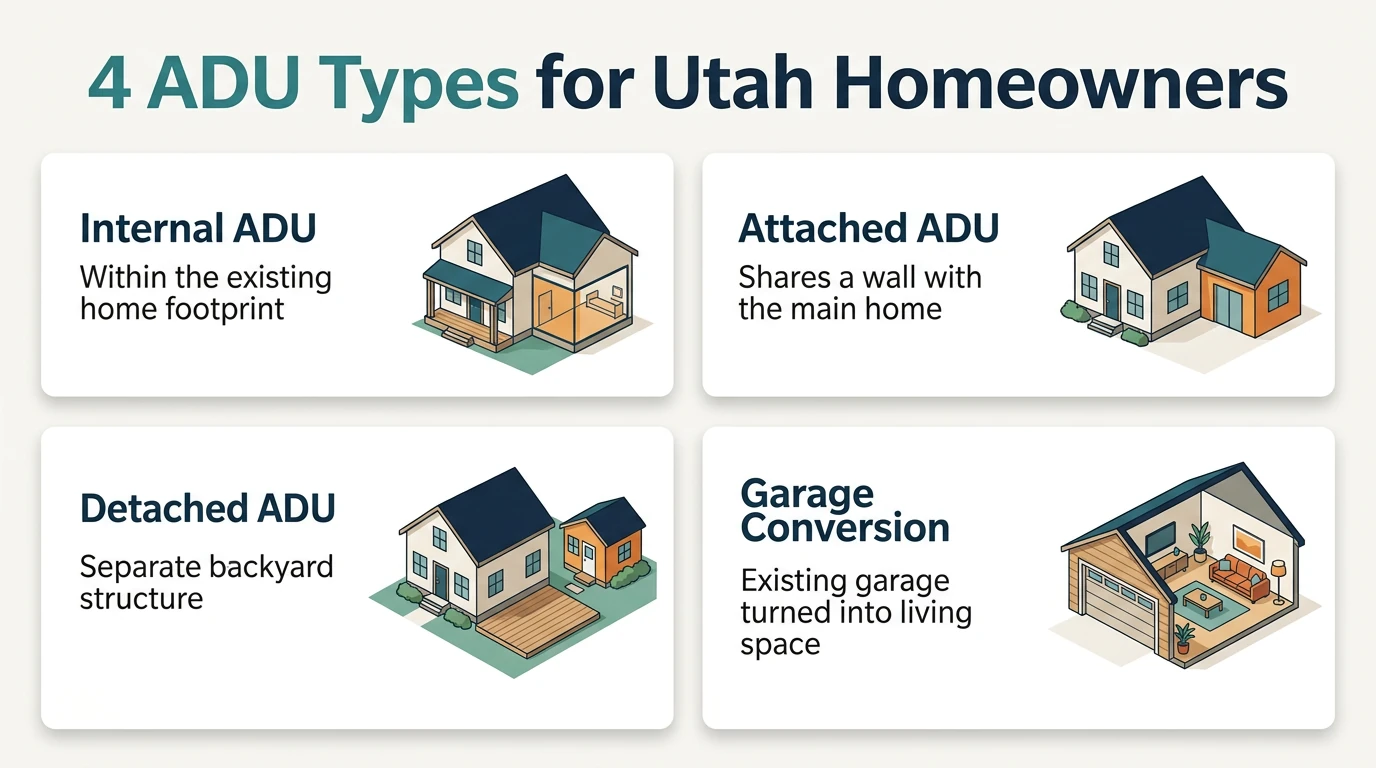
ADU Rental Income at a Glance: Compare All Four Types
If you want the quick decision, start here. The rest of the guide fills in everything the table can't cover.
ADU Type
Typical Rent (Wasatch Front)
Build Cost Range
Payback Speed
Biggest Legal Risk
Best For
Basement / Internal ADU
$900–$1,500/mo
$60,000–$150,000+
Fastest
Ceiling height, egress, septic
Fastest ROI, lowest barrier to entry
Detached Backyard ADU
$1,400–$2,500/mo
$200,000–$400,000+
Longer, but highest equity gain
City restrictions, lot size, setbacks
Maximum rent, highest property value boost
Garage Conversion / Above-Garage
$1,100–$1,800/mo
$80K–$180K
Moderate
Structural upgrades, parking replacement
Existing structure, moderate cost
Attached Addition
$1,100–$1,800/mo
$150,000–$275,000+
Moderate
Appearance rules, size caps
Multigenerational use with future rental flexibility
Four ADU types Utah homeowners can build — each with different legal protections, build costs, and rental income potential
Not sure where to start?
We'll check your zoning, evaluate your lot, estimate your build cost, and project your rental income — no obligation.
Can You Legally Make Rental Income From an ADU in Utah?
Yes. Utah is one of the most ADU-friendly states in the country — but the details matter, and they differ depending on what kind of ADU you are building.
What Utah State Law Clearly Allows
Utah legalized internal accessory dwelling units statewide effective October 1, 2021. Under Utah Code §10-21-303 (for municipalities) and §17-80-303 (for counties) — formerly §10-9a-530 and §17-27a-526, renumbered in 2025 — an internal ADU created within the existing footprint of your primary home is a permitted use in any area zoned primarily for residential use.
That is a meaningful protection. It means your city cannot treat your internal ADU application as a conditional use requiring special hearings. However, "permitted use" does not mean "zero local regulation."
Cities may still apply state-authorized restrictions, including:
• Requiring permits or licenses
• One additional parking stall
• Appearance standards
• Septic limits
• A ban on rentals under 30 days
• Owner-occupancy enforcement
The law defines an internal ADU as a unit created within the primary dwelling — which must be a detached single-family home occupied as the owner's primary residence — for long-term rental of 30 consecutive days or longer.
Additional protections under this framework:
✅HOA protection: Under Utah Code §57-8a-218 and §57-8a-209, an HOA may not restrict or prohibit the construction or rental of a compliant internal ADU, as long as the construction would not violate local land use ordinances or building, fire, or health codes. Note: CC&Rs may still contain provisions that differ — consult your specific HOA documents.
✅No impact fees: Internal ADUs are not subject to impact fees under state law — a real cost savings compared to detached units.
Source: Utah Office of the Property Rights Ombudsman (propertyrights.utah.gov); Utah Code §10-21-303, §17-80-303, §57-8a-218, §57-8a-209
What Cities Can Still Restrict
While the state sets the floor, cities retain the right to place certain restrictions on internal ADUs:
Lot size minimums — state law allows cities to prohibit internal ADUs on lots of 6,000 square feet or less
Exterior appearance — the ADU cannot change the look of the home from the street
Parking — cities can require one additional parking stall for the ADU
Rental permits and business licenses — most cities require one or both
Short-term rental prohibition — cities can (and most do) ban rentals under 30 days for ADUs
Septic limitations — relevant in parts of Utah County and unincorporated areas
Owner occupancy — the property owner must occupy either the primary dwelling or the ADU as their primary residence
These restrictions are manageable for most properties. The key takeaway is that the use itself — renting an internal ADU long-term — is protected by state law, subject to these state-authorized local conditions.
Source: Utah Code §10-21-303, §17-80-303
Why Detached ADUs Are a Separate Conversation
Detached ADUs (standalone backyard cottages) are a different legal animal. State law encourages detached ADUs as a moderate-income housing strategy (Utah Code §10-20-404, §17-79-403), but it does not mandate them as a permitted use the way it does for internal ADUs.
That means your city has much more control over detached ADUs: whether they are allowed at all, lot size requirements, height limits, setback rules, size caps, and whether they require conditional use approval. Salt Lake City, for example, allows detached ADUs up to 1,000 square feet on qualifying lots. Other cities are more restrictive. Some do not allow them at all.
Bottom line: If you are planning an internal ADU for long-term rental, Utah law is squarely in your corner. If you are planning a detached ADU, you need to check your city's specific ordinance.
Which ADU Type Is Best for Your Goals?
Before we get into the numbers, find yourself in one of these scenarios. It will shape every decision that follows.
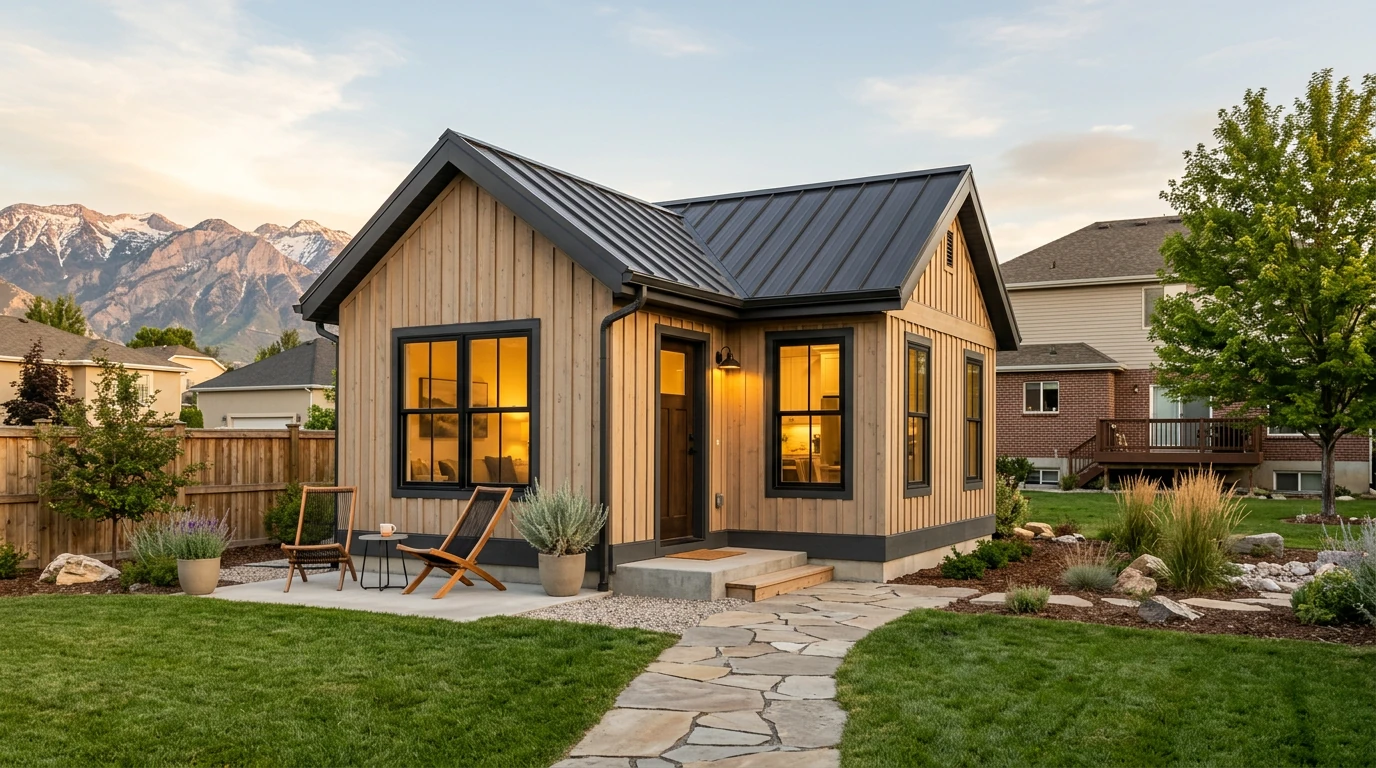
A well-built detached ADU in a Utah residential neighborhood — this style commands $1,400–$2,500/month in long-term rent
⚡
If you want the fastest payback and lowest risk:
Build an internal ADU (basement apartment). You are working within your existing footprint, the state law protections are strongest, the build cost is lowest, and most properties along the Wasatch Front already have the bones for it. This is the bread-and-butter ADU rental income play in Utah.
💰
If you want the highest rent and maximum property value increase:
Build a detached backyard ADU. Tenants pay a premium for privacy and a separate structure. These units add the most equity to your property. But they cost more, take longer to permit, and not every lot qualifies.
🏗️
If you already have a usable structure and want moderate cost:
Convert an existing garage or build above it. You are leveraging an existing shell, which saves on foundation and framing costs. Watch out for structural upgrades, fire separation requirements, and parking replacement rules.
👨👩👧
If you need family flexibility now and rental income later:
An attached addition lets you design for multigenerational living today with a separate entrance and full kitchen, then transition to a rental unit when the timing is right. Build costs are similar to detached, but the rent premium is usually lower because of shared walls.
⚖️
If you want the least legal uncertainty:
Stick with a long-term rental (12+ month lease) for any ADU type. Short-term rental rules in Utah are a minefield, and most cities restrict or ban it for ADUs.
What Rules Change by City in Utah?
This is the section that will save you the most time — and potentially the most money. Utah's ADU legal framework is not one-size-fits-all. The statewide baseline protects internal ADUs, but detached ADU rules, parking requirements, lot size minimums, owner-occupancy rules, and short-term rental policies vary dramatically from one city to the next.
We verified the following information from official city ordinances and planning department resources. Always confirm with your city's planning department before starting a project — ordinances can change.
Lot thresholds for detached; setback and height requirements
Valid ADU permit required
Ogden
Yes (permitted)
Yes (with conditions)
Yes — primary or ADU
30+ days
Verify — STR rules updated 2024
Yes
Rules vary by zone
Rental license required
Provo
Yes (permitted)
Verify by zone
Yes
30+ days
Verify with city
Yes, varies
Max 1 ADU per dwelling; architectural compatibility required; own address required
Rental dwelling license required
Lehi
Yes (permitted)
Yes (with conditions)
Yes
30+ days
Verify with city
Yes
Check current detached ADU standards
Permit required
Cottonwood Heights
Yes (6,000+ sq ft, R-1/RR-1/F-1 zones)
Conditional use (same zones)
Yes — permanent residence in primary or ADU
30+ days
No
1 extra (internal), 2 extra (detached)
Tandem/stacked parking does not count
Permit required
Sources verified March 2026: SLC ADU Handbook (slcdocs.com), Salt Lake County (saltlakecounty.gov), West Jordan ADU materials, Millcreek MKZ 18.71, Draper (draperutah.gov), Provo City Code 14.30.030, Cottonwood Heights Ordinance 19.75.
Ordinances change frequently. Several Utah cities updated their ADU ordinances in 2024 and 2025, and a 2026 state bill (SB 284) proposes broader detached-ADU allowances. Always verify with your city's planning department before committing to a project.
Not sure what your city allows?
Request a provider review of your address and project type. Confirm current zoning, lot requirements and city rules before committing; provider fit and availability need review.
How Much Can an ADU Rent For in Utah?
ADU rental income in Utah currently ranges from about $800/month for a small internal unit in a lower-cost market (Logan, parts of Ogden) to $2,500+/month for a well-finished detached ADU in a high-demand area (Salt Lake City, Sandy, Park City). Most ADU owners along the Wasatch Front land somewhere between $1,200 and $1,800/month.
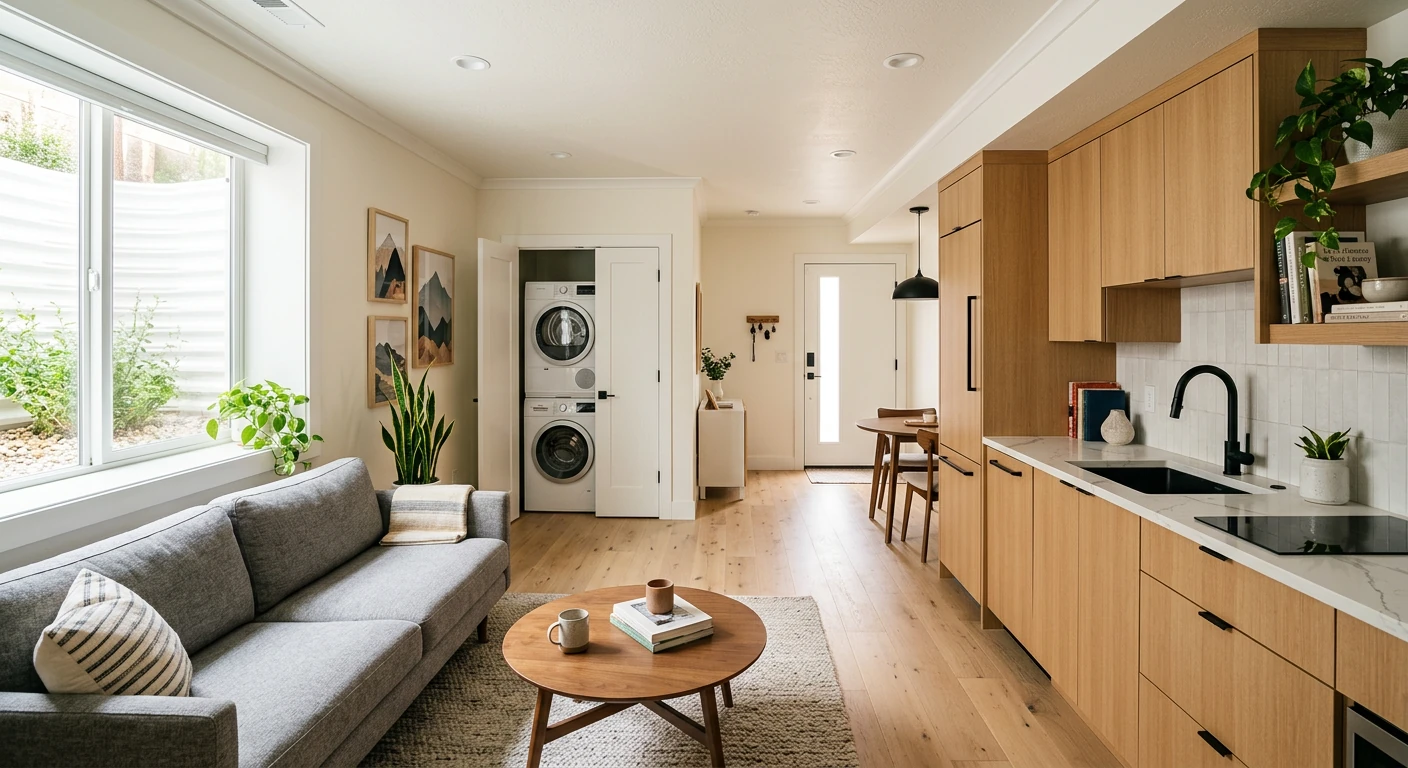
Well-finished ADU interiors — quality finishes, in-unit laundry, and a full kitchen command top-of-market rents
What Drives Rent the Most
Before you look at the city-by-city table, understand what actually moves the needle on your ADU rent:
1. Location and neighborhood — Properties near the University of Utah, BYU, downtown Salt Lake City, and major employment centers command the highest rents. Proximity to transit, walkability, and school quality all matter.
2. Privacy level — Detached ADUs generally rent for more than basement units in the same area — often 20–40% more. Tenants will pay more when they do not share walls, ceilings, or entrances with the homeowner.
3. Size and bedroom count — A 1-bedroom, 600-square-foot unit earns meaningfully more than a studio. A 2-bedroom unit (possible in detached ADUs up to 1,000 sq ft in SLC) can add $300–$500 per month over a 1-bedroom.
4. Finish quality and amenities — In-unit washer/dryer, modern kitchen, mini-split HVAC, good insulation, and quality finishes matter. Tenants compare your ADU against apartments, and a well-finished ADU wins on charm, privacy, and neighborhood quality.
5. Furnished vs. unfurnished — Furnished ADUs targeting medium-term tenants (travel nurses, relocating professionals, visiting faculty) can command a 15–25% premium over unfurnished long-term leases.
6. Utilities included or not — Including utilities simplifies management and can justify $50–$150 more per month.
Rent Ranges by City and ADU Type
Estimated ranges from 2026 rental market data (RentCafe, Zumper, Apartments.com) adjusted for typical ADU characteristics: 400–800 sq ft, private entrance, residential neighborhood. Your actual rent will depend on finish quality, specific neighborhood, and amenities.
City / Metro Area
Internal ADU (Basement)
Attached ADU
Detached ADU
Avg. 1BR Apartment Rent
Salt Lake City
$1,100–$1,500
$1,300–$1,800
$1,500–$2,200
~$1,300–$1,440
Sandy / Draper
$1,100–$1,500
$1,300–$1,800
$1,500–$2,200
~$1,400
Lehi / Eagle Mountain
$1,000–$1,400
$1,200–$1,700
$1,400–$2,100
~$1,350
Provo / Orem
$900–$1,300
$1,100–$1,500
$1,300–$1,800
~$1,200
Ogden
$800–$1,100
$1,000–$1,400
$1,200–$1,700
~$1,000
St. George
$1,000–$1,400
$1,200–$1,600
$1,400–$2,000
~$1,300
Layton / Davis County
$900–$1,200
$1,100–$1,500
$1,300–$1,800
~$1,150
West Jordan / West Valley
$900–$1,200
$1,000–$1,400
$1,200–$1,700
~$1,100
Millcreek / Holladay
$1,100–$1,500
$1,300–$1,800
$1,500–$2,200
~$1,400
Park City
$1,500–$2,000
$1,800–$2,500
$2,000–$3,000+
~$2,000+
Logan / Cache Valley
$750–$1,000
$900–$1,200
$1,100–$1,500
~$950
These are long-term rental ranges. Short-term (Airbnb) income can be higher on a per-night basis, but most Utah cities restrict or prohibit ADU short-term rentals. HUD FY2026 Fair Market Rents used as baseline sanity check; actual rents vary by neighborhood and unit.
How to sanity-check your number: Pull up comparable studio and 1-bedroom rentals on Zillow, Apartments.com, or KSL Classifieds in your specific neighborhood. ADUs with private entrances and yard access in quiet residential neighborhoods often command a slight premium over comparable apartment units because of the lifestyle difference — no shared hallways, no elevator, actual grass outside your door.
Long-Term vs. Short-Term vs. Medium-Term Income
Strategy
Monthly Income Potential
Management Effort
Legal Risk in Utah
Best For
Long-term (12+ months)
$900–$2,500/mo
Low — find a tenant, collect rent
Lowest — this is what the law is built for
Most Utah homeowners
Medium-term (1–6 months)
10–20% premium over long-term
Moderate — more turnover, furnished unit
Low if 30+ day stays
Near hospitals, universities, corporate offices
Short-term (Airbnb, under 30 days)
$100–$250+/night in tourist areas
High — cleaning, guest management, reviews
Highest — most cities restrict or ban for ADUs
Only if your city explicitly allows it
Our recommendation for most Utah homeowners: long-term rental. It is what the law supports, it is predictable, and it is the foundation of every ROI calculation on this page.
Is Building an ADU in Utah Worth It Financially?
We are not going to just tell you "ADUs are a great investment." We are going to give you the actual math so you can decide for yourself.
For most Utah homeowners with qualifying properties, an ADU is one of the stronger financial moves available — not because of rental income alone, but because of the combination of cash flow plus potential property value increase. That said, not every project pencils. A $350,000 detached ADU on a lot where you can only charge $1,200 per month will have a long, frustrating payback. The math has to work for your specific situation.
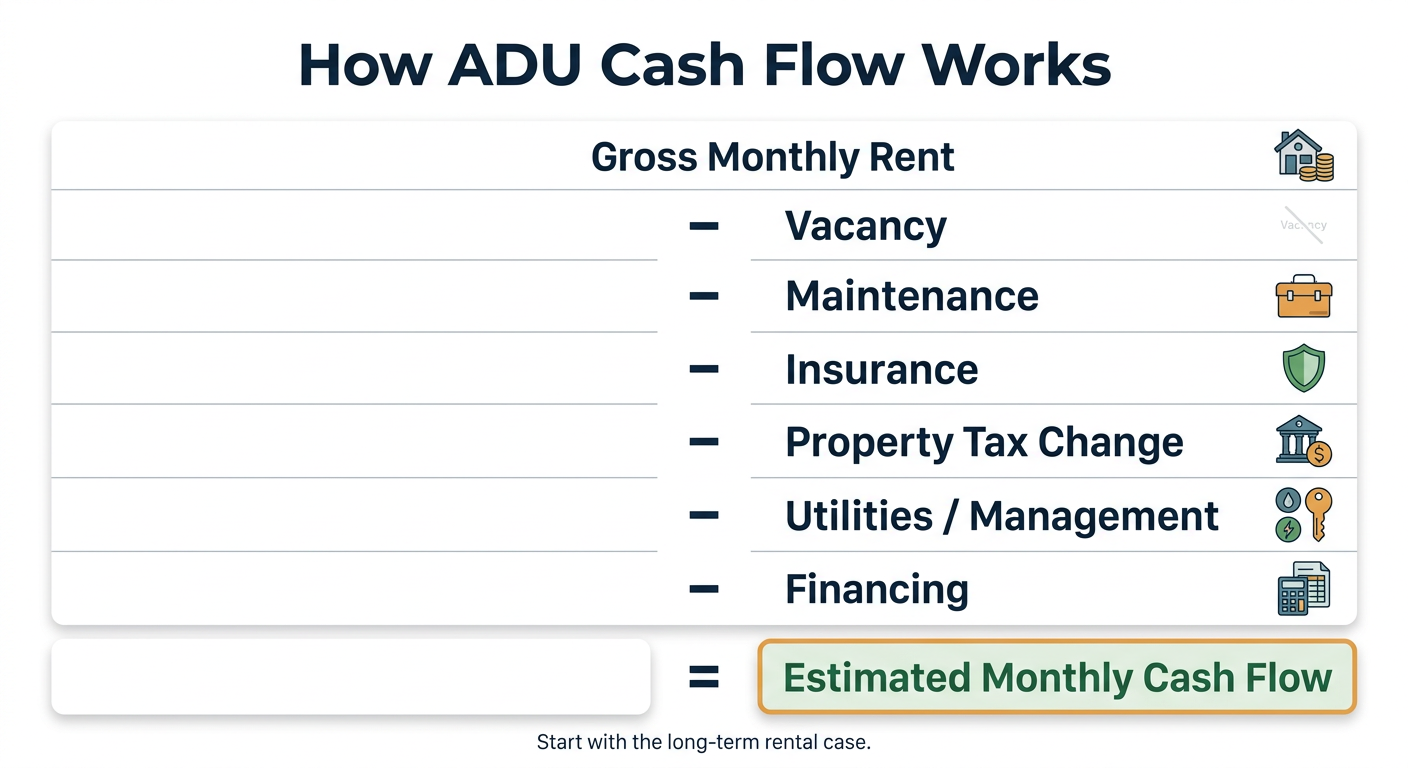
Understanding your real ADU cash flow — gross rent minus all real operating costs — before you commit to building
Three Real Utah Scenarios
Scenario 1: Basement ADU in Ogden — The High-ROI, Low-Risk Play
Build cost (finish existing basement)
$75,000
Monthly rent
$1,000
Annual gross income
$12,000
Annual expenses (insurance, maintenance, vacancy at 5%, property tax increase)
~$3,200
Annual net income
~$8,800
Simple cash-flow payback
~8.5 years
Estimated property value increase
$50,000–$80,000 (varies by market)
Effective net cost after potential equity gain
Potentially near zero — but value increase is not guaranteed
In this illustrative scenario, the modeled annual cash flow is $8,800 before any costs excluded from the model. Future rent increases are not guaranteed. Financing, vacancy, maintenance, insurance, taxes and major repairs can change the cash flow, so test the project using current local rents and realistic ongoing expenses.
Scenario 2: Detached ADU in Salt Lake City — The Premium Play
Build cost (new construction, 750 sq ft)
$250,000
Monthly rent
$1,800
Annual gross income
$21,600
Annual expenses
~$6,000
Annual net income
~$15,600
Simple cash-flow payback
~16 years
Estimated property value increase
$120,000–$180,000 (varies by market)
Effective net cost after potential equity gain
$70,000–$130,000
Payback on net cost from cash flow
Roughly 4–8 years
The sticker price looks steep until you factor in the equity. A $250,000 build that adds meaningful property value can significantly reduce your real financial exposure — and $15,600 per year in net income works to pay that down.
Scenario 3: Garage Conversion in Lehi — The Middle Ground
Build cost (convert existing detached garage)
$120,000
Monthly rent
$1,400
Annual gross income
$16,800
Annual expenses
~$4,400
Annual net income
~$12,400
Simple cash-flow payback
~9.7 years
Estimated property value increase
$80,000–$120,000 (varies by market)
Effective net cost after potential equity gain
Potentially near zero to modest
Garage conversions can be the sweet spot — you are leveraging an existing structure to get detached-ADU rent at a lower build cost.
The Formula (Do Your Own Math)
Here is the framework we use for every project we evaluate:
6. Net investment ÷ monthly net cash flow = months to payback
7. After payback: that cash flow is pure passive income, every month, for as long as you own the property
The Single Biggest ROI Mistake: Overbuilding. We see it regularly — homeowners spend $350,000 on a detached ADU with high-end finishes in a neighborhood where the rent ceiling is $1,600. The finishes do not move the rent enough to justify the cost. Build to the market, not to your personal taste. A clean, well-insulated, well-lit ADU with modern but not luxury finishes will rent within 5% of a high-end unit in the same neighborhood — and your ROI will be dramatically better.
Want to see your specific numbers?
We'll run the math for your property, your city, your lot — free. Build cost estimate, rent projection, and payback timeline — no obligation.
Which ADU Type Gives the Best Return?
Each type leads with its punchline, then the evidence.
Basement / Internal ADU
The punchline: Fastest payback, lowest risk, strongest legal protection.
If you have an unfinished basement with adequate ceiling height (most Utah homes built after 2000 do), this is the path of least resistance. You are converting space you already own. No new foundation. No new utility connections. No new roofline to worry about.
Build costs use a statewide editorial planning range of $60,000–$150,000+ in Utah, depending on how much work is needed for egress windows, separate entrance, kitchen, bathroom, sound insulation, and fire separation. Eligibility still depends on the statutory definition, applicable local requirements and permitted exceptions. Confirm zoning and HOA questions for the specific unit rather than assuming every basement conversion is protected.
The rent will not match a detached unit — $900–$1,500 per month is realistic along the Wasatch Front. But when you divide that rent by the build cost, the ROI percentage is usually the highest of any ADU type.
Watch-outs: Ceiling height must meet code (typically 7 feet minimum for habitable space). Egress windows are non-negotiable for bedrooms. Sound transfer between floors can make or break the tenant experience — invest in sound insulation. And if your property is on septic, check capacity before adding a second kitchen.
Detached Backyard ADU
The punchline: Highest rent, biggest property value increase, but most expensive and most city-dependent.
Detached ADUs command top dollar because tenants get something rare: a private, standalone home in a residential neighborhood, often with their own yard space, entrance, and parking. That privacy premium is real — expect 20–40% more rent than a comparable basement unit.
Salt Lake City now allows detached ADUs up to 1,000 square feet, which opens the door to 2-bedroom units that can command $1,800–$2,200+ per month. The property value boost is also the largest — industry estimates generally suggest 20–30% for well-built, permitted ADUs, and FHFA data from California shows properties with ADUs appreciated at a faster annualized rate than those without from 2013–2023.
The statewide editorial planning range for a detached ADU is $200,000–$400,000+, depending on size, site conditions and finish level. Compare the full installed scope. Confirm whether utility trenching, foundation work, permits, meters and any separate-address requirements are included in a proposal before adding allowances; the generic range is not a bid.
Watch-outs: Not every city allows detached ADUs. Lot size minimums (typically 7,000 sq ft in Salt Lake County), setback requirements (usually 10 feet from rear property line, 6 feet from the main house), and height limits all constrain what you can build. Get a feasibility check before you fall in love with a floor plan.
Garage Conversion / Above-Garage ADU
The punchline: Leverages an existing structure for detached-ADU rent at a lower cost.
If you have a detached garage you do not use (or could replace parking for), converting it into a living space — or building a unit above it — can be a smart middle path. You save on foundation and shell costs because the structure already exists.
Rent potential is similar to detached ADUs because the unit is physically separate from the main home. Build costs are typically $80,000–$180,000, depending on structural upgrades needed.
Watch-outs: The existing structure may need significant work — insulation, fire separation, structural reinforcement for a second story, plumbing and electrical. You need to replace the parking you are losing, as most cities require a minimum number of parking stalls.
Attached Addition
The punchline: Best for families who need the space now and want rental flexibility later.
An attached ADU shares at least one wall with the main home but has its own entrance, kitchen, and bathroom. It is a popular choice for multigenerational families — parents, adult children, or aging family members can live close while maintaining independence.
When you are ready, the same unit can become a rental. The statewide editorial planning range for an attached ADU is $150,000–$275,000+. A shared wall can reduce privacy and affect rental demand; compare current local rents for the proposed layout. Many cities cap attached ADUs at 50% of the primary dwelling's square footage.
Watch-outs: Soundproofing between the units is critical for both livability and rental appeal. The entrance must usually face away from the street. And the addition cannot alter the single-family appearance of the home.
What Are the Real Downsides of Building an ADU for Rental Income?
Building an ADU is not cheap and it is not instant. A detached ADU in Utah uses a statewide editorial planning range of $200,000–$400,000+ and may take 4–9 months to permit and build. Even a basement conversion uses a statewide editorial planning range of $60,000–$150,000+ and may take 2–6 months. The permitting process can be frustrating — timelines vary wildly by city, and you will encounter bureaucratic friction.
Here is what that friction buys you: a permitted, legal, income-producing asset that adds real equity to your property the day it is complete. Unlike almost any other home improvement, an ADU pays you back — every single month. A kitchen remodel does not send you a check. An ADU does.
The cost is real. But so is the math. Most Utah ADU projects create more in property value than they cost to build, meaning the rental income is net-positive from a wealth perspective almost immediately. And here is the part most people forget: your build cost is locked in forever, but rents go up. Every year, the ROI gets better.
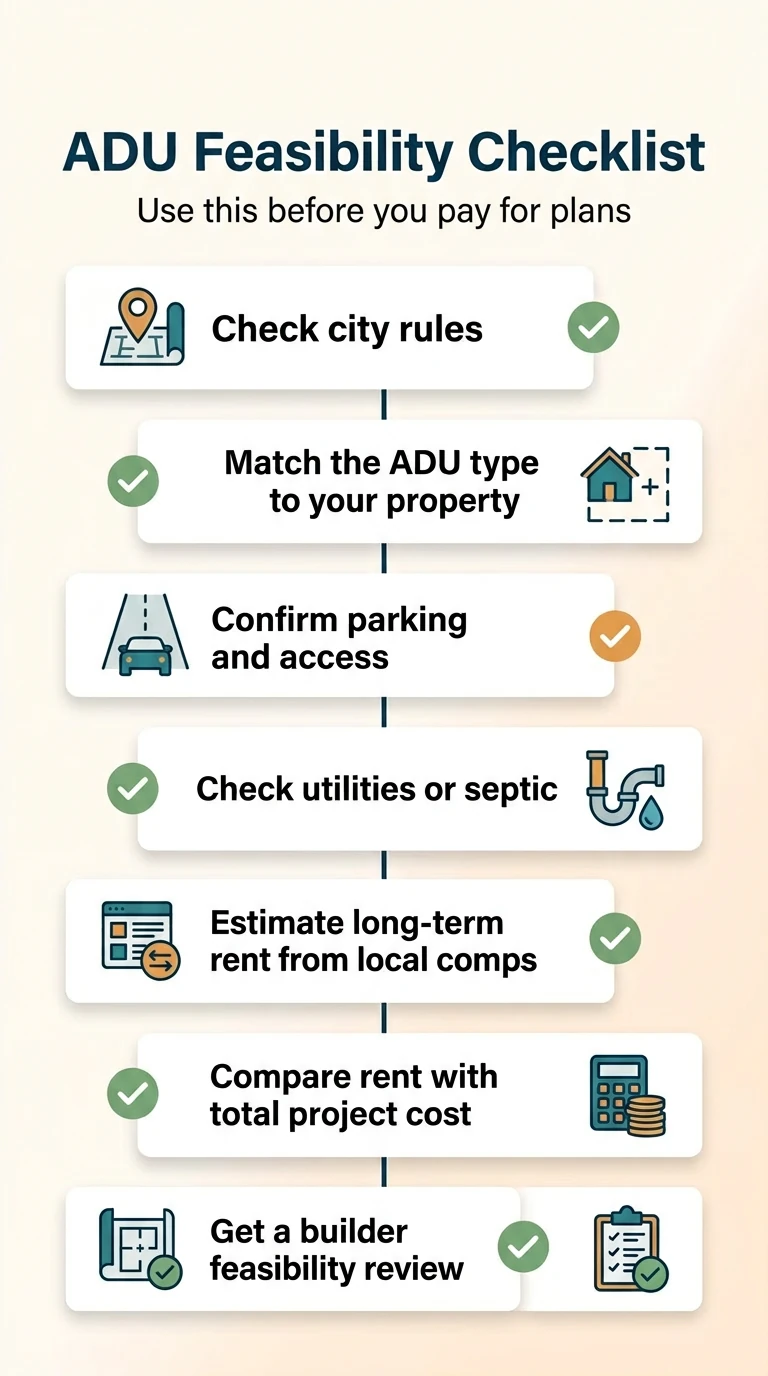
The projects that fail financially usually share one trait: the homeowner did not check the feasibility before spending money on plans. Lot too small. City does not allow detached. Parking cannot be solved. Septic at capacity. These are deal-killers — but they are all discoverable before you spend a dime on construction.
Run through this checklist before paying for plans — it's free and can save you from a costly mistake
Check Your Property's Feasibility — Free
Five minutes of verification can save you months of wasted effort. We'll confirm your lot, zoning, and project viability at no cost.
Can You Use an ADU as an Airbnb or Short-Term Rental in Utah?
For most Utah ADU owners, the answer is no — or at least not without significant risk.
Utah's internal ADU framework is built around long-term rental (30+ consecutive days). State law (Utah Code §10-21-303, §17-80-303) specifically allows cities to prohibit short-term rentals of internal ADUs, and most cities along the Wasatch Front have done exactly that.
For detached ADUs, the rules vary by city — but the trend is the same. Salt Lake City generally restricts sub-30-day ADU rentals in residential zones. Millcreek explicitly bars short-term rental use for detached ADUs (though internal and attached ADUs may qualify with a business license — verify with the city). Cottonwood Heights, Holladay, and South Salt Lake all require minimum 30-day rental terms.
A common misconception: Some homeowners assume that tourist-friendly cities like Park City or Moab are automatically more accommodating for ADU short-term rentals. That is not reliably the case. Park City's accessory apartment rules require minimum rental terms of 90 days, and Moab's ADU framework is oriented toward long-term housing, not nightly rentals. Always verify your specific city's current ordinance before planning any short-term rental strategy.
There is also a tax wrinkle: stays under 30 consecutive days trigger Utah's transient room tax, which adds reporting and compliance requirements beyond standard rental income.
Our recommendation: Build your financial projections around long-term rental income. If your project does not pencil at long-term rates, it is risky to depend on short-term rental income that your city could restrict or ban at any time. If your project works at long-term rates and your city also allows short-term use, that is upside — not the foundation of your plan.
Can ADU Rental Income Help You Qualify for Financing?
Yes — and this is one of the most underappreciated financial advantages of building an ADU in Utah. Before you commit, it helps to review the full range of Utah ADU financing options.
What Fannie Mae Allows
Fannie Mae allows existing ADU rental income to count toward qualifying income on one-unit principal-residence purchase or limited cash-out refinance transactions. ADU income is capped at 30% of total qualifying income. You will need documentation: a current lease, proof of rental history, and an appraisal that identifies the ADU.
Source: Fannie Mae Selling Guide B3-3.1-08 (selling-guide.fanniemae.com)
What Freddie Mac Allows
Freddie Mac also allows ADU rental income to be used in mortgage qualification on one-unit primary-residence purchase or no-cash-out refinance transactions, with ADU income capped at 30% of total qualifying income. The ADU must be legally permissible or legal nonconforming — income from an illegal ADU may not be used. Their February 2026 fact sheet specifically highlights ADUs as an opportunity for borrowers and lenders.
Source: Freddie Mac ADU Fact Sheet (sf.freddiemac.com)
What FHA Changed
FHA has added system fields for reporting one-unit properties with an ADU and the amount of total income derived from ADU rent, signaling growing acceptance of ADU rental income in government-backed lending (FHA INFO 2023-89). The specifics are evolving — work with a lender experienced in ADU financing for current guidelines.
Salt Lake City's Backyard Keys ADU Loan Program
Salt Lake City's Community Reinvestment Agency (CRA) currently offers the Backyard Keys ADU loan program — up to $200,000 at a 3% fixed interest rate, with up to 10% loan forgiveness if you rent the ADU to income-qualifying tenants. This is a pilot program available to qualifying homeowners, primarily in west-side Salt Lake City CRA areas, with specific eligibility, training, and rent-restriction conditions. Check current availability and eligibility with SLC's CRA at cra.slc.gov.
Source: Salt Lake City CRA (cra.slc.gov/affordable-housing/adu-loan-program)
Other Financing Options
HELOC (Home Equity Line of Credit) — The most popular option for Utah homeowners with existing equity. Use your equity to fund construction; ADU rental income covers the payments. Many Utah homeowners are sitting on significant equity after years of home price appreciation — a HELOC lets you put that equity to work generating monthly cash flow.
Cash-out refinance — Pull equity from your home to fund the build. Compare your current rate against refinance rates — if you locked in a low rate in 2020 or 2021, a HELOC may make more sense than a full refinance.
Construction loan — Specialized loan that converts to permanent financing after the ADU is complete. Some lenders allow projected rental income to help with qualification. This is a good option if you do not have enough existing equity for a HELOC.
Personal savings or cash — Most straightforward for internal ADUs in the $60,000–$150,000+ editorial planning range. Eliminates interest costs entirely and maximizes your monthly cash flow from day one.
The right financing option depends on your equity position, current mortgage rate, build cost, and risk tolerance. A builder experienced with ADU projects can often connect you with lenders who understand ADU financing — which is not every lender. ADU-specific lending is still relatively new, and working with someone who has done it before can save you time and frustration.
We can help connect you with lenders familiar with Utah ADU projects and run through your financing options as part of your free feasibility estimate.
What Costs, Taxes, and Fees Do People Miss?
The build cost is the number everyone focuses on. But there are real costs above and beyond construction that affect your true ROI. Here is what catches people off guard.
Costs Beyond Construction
Plans, engineering, and design: $3,000–$15,000 depending on complexity
Permit fees: Vary by city, typically $1,000–$5,000
Utility hookups for detached ADUs: $5,000–$20,000 for water, sewer, and electrical trenching depending on distance and slope
Impact fees: Internal ADUs are exempt under state law. Detached ADUs may face local impact fees — check with your city.
Sewer/water capacity: In some areas (especially on septic systems), you may need capacity upgrades
Separate meter installation: Some cities require (or allow) separate utility meters for detached ADUs. The property owner typically must keep meters in their name.
Separate address: Most cities require a distinct address for the ADU for mail and emergency response
Ongoing Costs That Affect Cash Flow
Insurance: Standard homeowners insurance usually does not cover rental liability or income loss. Budget $500–$1,500 per year for a landlord or rental dwelling policy. See our Utah ADU insurance guide for a full breakdown of coverage by ADU type and rental use.
Maintenance and repairs: Budget 5–10% of annual rent for upkeep
Vacancy: Even great units sit empty between tenants. Budget 5% vacancy rate for long-term rentals.
Property management: If you hire a manager, expect 8–10% of monthly rent. For a $1,500/month ADU, that is $120–$150/month.
Business license / rental permit: Annual fees, typically $25–$150 depending on city
Property tax increase: Building an ADU will increase your property taxes — but less than most people fear. See our Utah ADU property tax guide for a full breakdown including the 45% exemption and a calculation worksheet.
How ADU Rental Income Is Taxed
Federal taxes: ADU rental income is reported on Schedule E of Form 1040 and taxed as ordinary income. But you can deduct expenses — and the deductions are significant:
Depreciation: You can depreciate the ADU structure over 27.5 years. This is often the single largest deduction and can dramatically reduce your taxable rental income in the early years. On a $200,000 detached ADU, that is roughly $7,270 per year in depreciation deductions alone.
Mortgage interest on the portion used for ADU construction
Property taxes (allocated to the rental portion)
Insurance, maintenance, repairs, utilities, management fees, advertising, legal and accounting fees — all deductible against rental income
Utah state taxes: Utah has a flat 4.5% state income tax rate (reduced from 4.55% effective January 1, 2025, under HB 106). Rental income is subject to state tax, and the same federal deductions generally apply at the state level.
Property tax impact: Building an ADU will increase your assessed property value — but usually by less than most people fear. Utah's effective property tax rates are among the lowest in the nation (typically 0.5%–1.1% depending on county). As a rough example: if your ADU adds $150,000 in assessed value at a 0.9% effective rate, that is about $1,350 per year — roughly $113 per month. Compare that to $1,200+ per month in rental income and the math works.
Source: Utah State Tax Commission (tax.utah.gov/propertytax)
Depreciation recapture warning: When you sell, you will owe depreciation recapture tax (25% federal rate) on the depreciation you claimed. This is not a reason to avoid depreciation — the years of deductions far outweigh the eventual recapture. But plan for it. Work with a CPA.
This is general information, not tax advice. Consult a qualified tax professional for your specific situation.
Does an ADU Increase Property Value in Utah?
A legal, well-built ADU can meaningfully improve both marketability and appraised value — but the amount varies by city, design, rentability, and comparable sales.
A 2025 Federal Housing Finance Agency analysis found that the median appraised value for California properties with ADUs grew at an annualized rate of 9.34% from 2013 to 2023, compared to 7.65% for properties without ADUs. That data is California-specific and does not prove a fixed Utah value premium, but it illustrates the direction the market is moving as ADUs become more mainstream.
Industry estimates generally suggest a well-built ADU can increase property value by roughly 20–30%, though this varies significantly based on local market conditions. A common rule of thumb among appraisers is that a newly constructed ADU may add approximately 100 times its monthly rental income to the home's value — so a $1,500/month ADU might add roughly $150,000. But rules of thumb are not guarantees, and your actual value increase will depend on comparable sales in your neighborhood.
Source: FHFA, "Trends in Median Appraised Value for Properties with Accessory Dwelling Units" (2025, fhfa.gov)
Three Things That Maximize Value
1. Get it permitted. Unpermitted ADUs do not show up on appraisals and can create legal headaches when you sell. Always build permitted.
2. Build detached if your lot allows it. Detached ADUs generally add the most value because they add the most usable, independent square footage.
3. Quality construction with separate entrance and full kitchen/bath. Appraisers and buyers care about functional independence — the ADU should work as a complete, self-contained home.
What happens when you sell: The ADU transfers with the property. You cannot sell it separately — Utah law and most city ordinances prohibit subdividing the ADU from the primary lot. But a permitted, income-producing ADU can be a significant selling point for buyers looking for help with mortgage payments or multigenerational living.
Freddie Mac and Fannie Mae both now recognize ADU income in mortgage qualification, which can expand the pool of buyers who qualify for your property at a higher price point.
What about appraisals? New appraisal guidelines are making it easier for appraisers to include ADU value in their assessments. According to FHFA data, the share of appraisals that include an ADU has nearly doubled in recent years, reflecting broader market acceptance. A permitted ADU appears on your title report and gets factored into the appraisal — an unpermitted one does not. This distinction matters enormously when it comes time to sell or refinance.
For a detailed look at how appraisers value ADUs in Utah — including contributory value vs. construction cost, the thin-comp problem, and how county tax assessments differ from lender appraisals — see our Utah ADU appraisal guide.
What Edge Cases Should You Check Before You Build?
These are the questions that send people back to Google. We are going to answer every one of them right here.
Do I Have to Live on the Property?
Yes, in most Utah cities. Owner occupancy is required — you must live in either the primary dwelling or the ADU as your permanent residence. You generally cannot rent both the main house and the ADU to separate tenants. Some cities require recording an affidavit of owner occupancy.
Can My HOA Stop Me?
For internal ADUs: Generally no. Under Utah Code §57-8a-218 and §57-8a-209, an HOA rule may not restrict the construction or rental of a compliant internal ADU, as long as the construction would not violate local land use ordinances or building, fire, or health codes. However, CC&Rs (as distinct from rules) may contain provisions that could apply differently — review your specific HOA documents. For detached or attached ADUs: Possibly. HOAs may have CC&R restrictions on exterior modifications, new structures, or the appearance of your property.
What If My Lot Is Too Small?
Internal ADUs typically require a minimum lot size of 6,000 square feet. Detached ADUs often require 7,000 square feet or more. If your lot is below the threshold, an internal ADU (basement conversion) may still be possible — or it may not be, depending on your city. Measure your lot and check your specific city's ordinance.
What If I Have Septic?
This is a real deal-killer in some parts of Utah, particularly in parts of Utah County and unincorporated areas. Adding a second kitchen and bathroom to a septic system may exceed its capacity. Get a septic evaluation before committing to a project. In some cases, the system can be upgraded. In others, it cannot — and that ends the conversation.
Do I Need Extra Parking?
Almost always yes. Most Utah cities require at least one additional on-site parking stall for the ADU, beyond what is required for the primary dwelling. Some cities (like Cottonwood Heights) require two additional stalls for detached ADUs. Tandem or stacked parking usually does not count. Verify with your city.
Do I Need a Separate Address or Meter?
Address requirements vary by city — some require a distinct address; others use a modifier like 'Unit B.' Meter rules also vary: some cities prohibit separate meters for internal ADUs; some allow detached ADUs to be separately metered but require the meters to remain in the property owner's name; others bar separate meters entirely (Millcreek prohibits separate utility meters for all ADU types). Verify with your city before making assumptions.
Can I Rent Both the House and the ADU?
Generally no, because of the owner-occupancy requirement. You must live in one of the units. There are limited exceptions (such as military deployment or temporary relocation), but the general rule is that you cannot be an absentee landlord renting both units.
What If I Want Family There Now and Tenants Later?
This is one of the best uses of an ADU. Build it for your parents, adult child, or family member now. When the living situation changes, convert it to a rental. The key is to build it to rental-ready standards from day one — separate entrance, full kitchen and bath, meets all building codes — so the transition is seamless.
What If I Already Have an Illegal Basement Apartment?
You are not alone. Utah has thousands of unpermitted basement apartments. Many can be legalized by bringing them up to current building, fire, and health codes. The process varies by city — some have specific legalization pathways. The upgrades (egress windows, fire separation, electrical, plumbing) can cost $20,000–$60,000. But once legal, the unit appraises, the rental is above-board, and you eliminate legal and insurance risk.
What If I Am in a Historic District or on an Alley Lot?
Historic districts may have additional design review requirements for exterior changes. Internal ADUs that do not alter the exterior are usually fine. Detached ADUs may face stricter appearance and placement rules. Alley lots and corner lots have their own setback considerations. Check with your city's planning department.
How Long Do Permits Usually Take?
Varies dramatically by city and ADU type: Internal ADU: 2–8 weeks in ADU-friendly cities. Detached ADU: 2–6 months for permit review, plus construction time of 3–6 months. Total timeline (detached, start to occupancy): 6–12 months is realistic. Working with a builder who knows your city's specific process can cut weeks or months off the timeline.
How We Estimated Utah ADU Rent, Rules, and ROI
Rental income ranges are derived from 2026 rental market data published by RentCafe, Zumper, Apartments.com, and Rentometer, adjusted for typical ADU characteristics (400–800 square feet, 1 bedroom, private entrance, residential neighborhood). We cross-referenced against HUD FY2026 Fair Market Rents as a baseline sanity check. Actual ADU rents vary based on finish quality, furnishing, specific neighborhood, and amenities.
Legal information is sourced from Utah Code (Title 10, Chapter 9a; Title 10, Chapter 21; Title 17, Chapter 27a; Title 17, Chapter 80), the Utah Office of the Property Rights Ombudsman (propertyrights.utah.gov), the Utah Department of Commerce, and individual municipal ordinance pages. The city-by-city matrix was verified from official city websites and planning department resources.
Build cost estimates are based on project data from Utah ADU builders and our own construction experience along the Wasatch Front.
Property value data draws from the Federal Housing Finance Agency's 2025 study on ADU appraisal trends and industry sources.
What this guide does not do: This guide does not replace a consultation with your city's planning department, a licensed contractor, a CPA, or an attorney. Municipal codes change, tax laws evolve, and every property has unique characteristics.
Utah Code §10-21-304, enacted by SB 284, took effect October 1, 2026. It requires specified municipalities to permit a detached ADU on qualifying lots or parcels of at least 11,000 square feet containing a single-family dwelling where that dwelling is a permitted use, subject to the statute’s conditions and exceptions. Local rental, occupancy and building standards remain subject to state law. The local rental-rule table retains its July 2026 source-review date and is not a verification of every city’s current implementing ordinance.
Frequently Asked Questions About ADU Rental Income in Utah
Can you rent out an ADU in Utah?
Yes. Internal ADUs (basement apartments, attic conversions) are a permitted use for long-term rental in all residential zones under Utah state law. Detached ADUs are allowed in many cities but rules vary. Check your city's specific ordinance.
Are ADUs in Utah long-term rental only?
For internal ADUs, the state definition requires long-term rental of 30+ consecutive days. Most cities apply similar restrictions to all ADU types. Short-term rental (under 30 days) is restricted or banned for ADUs in most Utah cities.
Can I Airbnb my ADU in Utah?
In most cities, no — or not without significant restrictions. See the short-term rental section above for details. Build your financial plan around long-term rental income.
Do I have to live on the property?
Yes, in most Utah cities. Owner occupancy of either the primary dwelling or the ADU is typically required.
How much can a 1-bedroom ADU rent for in Utah?
Along the Wasatch Front, $1,000–$1,800 per month is typical for a 1-bedroom ADU, depending on city, ADU type, and finish quality. See the rent table above for city-specific ranges.
Is a basement apartment or detached ADU better for ROI?
It depends on your definition of ROI. Basement ADUs have a faster payback period because of lower build costs. Detached ADUs generate more monthly income and add more property value. For pure percentage ROI, basements usually win. For total wealth creation, detached usually wins.
Do internal ADUs pay impact fees in Utah?
No. Internal ADUs are exempt from impact fees under Utah state law. Detached ADUs may face local impact or utility-related charges.
Do I need a business license to rent an ADU?
Most Utah cities require a rental permit, business license, or both. Fees are typically modest ($25–$150 annually). Check with your city.
Can an HOA stop a legal internal ADU rental?
Generally no. Under Utah Code §57-8a-218 and §57-8a-209, HOA rules may not restrict the construction or rental of a compliant internal ADU that meets building, fire, and health codes. However, CC&Rs may contain provisions that apply differently — review your specific documents.
Can ADU income help me qualify for a mortgage?
Yes. Fannie Mae, Freddie Mac, and FHA all have pathways for counting ADU rental income toward mortgage qualification, subject to documentation and program-specific rules.
Do I need extra parking for an ADU?
Almost always yes. Most cities require at least one additional on-site parking stall for the ADU.
Can I sell the ADU separately from my house?
No. ADUs cannot be subdivided or sold separately from the primary dwelling under Utah law and most city ordinances.
What is the cheapest ADU with real rental income?
A basement conversion in an existing home can have a lower starting cost. Our statewide editorial planning range is $60,000–$150,000+; the local rent estimate shown here is $900–$1,500 per month. These are different kinds of estimates, and neither guarantees payback. Test the current bid, local rent, financing and ongoing expenses for the property.
What is the biggest mistake Utah homeowners make with ADUs?
Not checking feasibility before spending money on plans. Lot size, zoning, septic capacity, parking, and city-specific rules can all be deal-killers — but they are all discoverable with a simple feasibility check before you invest.
How much do utility hookups cost for a detached ADU?
$5,000–$20,000 in Utah, depending on the distance from your main house and the slope of your lot.
What city near Salt Lake is easiest for ADUs?
Salt Lake City itself has some of the most progressive ADU rules in the state, including detached ADUs up to 1,000 square feet and the Backyard Keys financing program. But 'easiest' depends on your specific lot and project — that is what a feasibility check determines.
If you have read this far, you know more about ADU rental income in Utah than 99% of homeowners. Here is how to turn that knowledge into action.
Step 1:
Confirm your zoning, lot size, and any city-specific rules that apply. (We can do this for you.)
Step 2:
Use the city-by-city table above to bracket your income potential.
Step 3:
Match the ADU type to your budget, lot, and goals.
Step 4:
This is the step that separates the people who think about ADUs from the people who build them.
We have helped homeowners across Salt Lake City, Provo, Ogden, Lehi, Sandy, Draper, and all along the Wasatch Front figure out exactly what their property can support. We will evaluate your lot, check your zoning, estimate your build cost, and project your rental income — completely free, no obligation.
Twelve months from now, you could be collecting $1,200–$2,500 per month in passive rental income from a building on your own property. That is $14,400–$30,000 per year. Money that covers your car payment. Funds your kids' college savings. Accelerates your retirement. The homeowners who build ADUs in Utah almost universally say the same thing: "I wish I had done this sooner."
Get My Free Utah ADU Feasibility Estimate
We'll check your zoning, evaluate your lot, estimate your costs, and project your income. No cost. No pressure. Just the numbers you need to make a confident decision.
Serving homeowners in Salt Lake City, West Jordan, Millcreek, Sandy, Draper, Holladay, Provo, Ogden, Lehi, St. George, and across Utah.