
Updated March 2026 · Utah Code + city ordinances cited · Sources: Utah Code §10-21-303, S.B. 284 (2026), municipal ordinances
Utah County ADU Builders: City Rules, Costs & How to Choose the Right One
If you want to build an ADU in Utah County, your right next step depends on your city, your lot, and the type of ADU you want. Every city from Provo to Lehi to Eagle Mountain has different rules — and a new state law (S.B. 284, signed in 2026) has provided a detached-ADU path on qualifying lots in specified municipalities since October 1, 2026.
We built this page because no single resource combined all of it: the city-by-city rules, the realistic costs, the new law, and what kind of builder you actually need based on your situation. Below you’ll find current regulations for every major Utah County city we’ve been able to verify, what’s changing this year, what projects actually cost, how permitting works, what kills projects before they start, and how to get matched with a builder who knows your city’s process inside and out.
Your Situation at a Glance
Here’s the quick-decision version before we go deep on every section:
| Your Situation | Best ADU Type | Typical Cost Range | First Step |
|---|---|---|---|
| Have a basement you could convert | Internal (basement) ADU | $50,000–$100,000 | Verify your city allows it, then get an estimate |
| Want a backyard cottage for rental income | Detached ADU | $200,000–$400,000+ | Check lot size minimums (varies by city) |
| Have a garage you’d like to convert | Garage conversion | $80,000–$150,000 | Confirm your city permits garage conversions |
| Aging parents need their own space | Attached ADU addition | $150,000–$250,000 | Get a feasibility check on your lot |
| Already have an unpermitted apartment | Legalization project | $15,000–$60,000+ | Get a code-compliance assessment first |
| Want detached but older city rules may say no | Check the state floor and current local implementation | TBD | Confirm municipal coverage and qualifying lot details |
Cost ranges are market estimates based on Utah County construction data and builder-reported figures as of early 2026. Actual costs depend on size, site conditions, finish level, and city-specific requirements.
The honest truth most builder sites won’t tell you: The hard part usually isn’t finding someone who can swing a hammer. It’s making sure your city, your lot, your parking situation, and your owner-occupancy status all line up before you spend money on plans. The good news: a qualified builder can screen all of this early, often for free.
What Is the Best Path for Most Utah County Homeowners?
For most homeowners in Utah County, the best first move is not collecting random bids from contractors. It’s getting a feasibility screen tied to your specific city’s rules and the ADU type you’re considering.
Here’s why: a builder in Orem needs to know different rules than a builder in Lehi. A basement conversion follows a completely different path than a detached backyard unit. S.B. 284 took effect October 1, 2026, so some projects that did not fit older city rules may now qualify under the state floor, subject to coverage, statutory conditions, and local standards.
Path 1: Internal or Basement ADU
This is the fastest, most affordable, lowest-friction option for most homeowners. Utah state law (H.B. 82, passed in 2021) makes internal ADUs a permitted use in residential areas, though local governments can still apply statutory conditions such as owner-occupancy, parking, lot size minimums, and rental restrictions (Utah Code §10-21-303). If you have an unfinished basement or unused interior space, this is often the simplest route.
Typical estimated cost: $50,000–$100,000. Typical timeline: 3–8 months.
Path 2: Detached Backyard ADU
This is the highest-value, highest-privacy option — but it’s also the most regulated. Right now, not every Utah County city allows detached ADUs, and those that do have varying lot size requirements. That said, S.B. 284 is about to change the landscape for lots 11,000 square feet and larger. See our Utah detached ADU lot size requirements guide for the full city-by-city breakdown.
Typical estimated cost: $200,000–$400,000+. Typical timeline: 9–18 months.
Path 3: Legalization of an Existing Unit
A lot of Utah County homes already have basement apartments or guest setups that were never formally permitted. If that’s your situation, getting it legal protects you from fines, makes the unit insurable, and lets you rent it lawfully. The process varies by city but typically involves a building inspection, code upgrades, and a permit application.
Typical estimated cost: $15,000–$60,000+. Typical timeline: 2–6 months.
Quick filter:
- ✓ If your city limits ADUs to within the home → start with an internal ADU specialist
- ✓ If you want a detached backyard unit → check your city’s lot size minimum first
- ✓ If your goal is rental income → confirm owner-occupancy and rental restrictions early
- ✓ If you already have a basement apartment → get a legalization assessment
Can I Legally Build an ADU in My Utah County City?
This is the question that matters most — and the one that’s hardest to answer, because the rules are different in every single city.
Utah state law provides a baseline: under H.B. 82 (2021), internal accessory dwelling units (IADUs) are a permitted use in areas zoned primarily for residential use (Utah Code §10-21-301 through §10-21-303). But “permitted use” doesn’t mean “no rules.” Local governments can still apply statutory conditions and carveouts, including owner-occupancy requirements, one additional on-site parking space, restrictions on rentals under 30 consecutive days, prohibitions on lots smaller than a certain size, and limited exclusion areas.
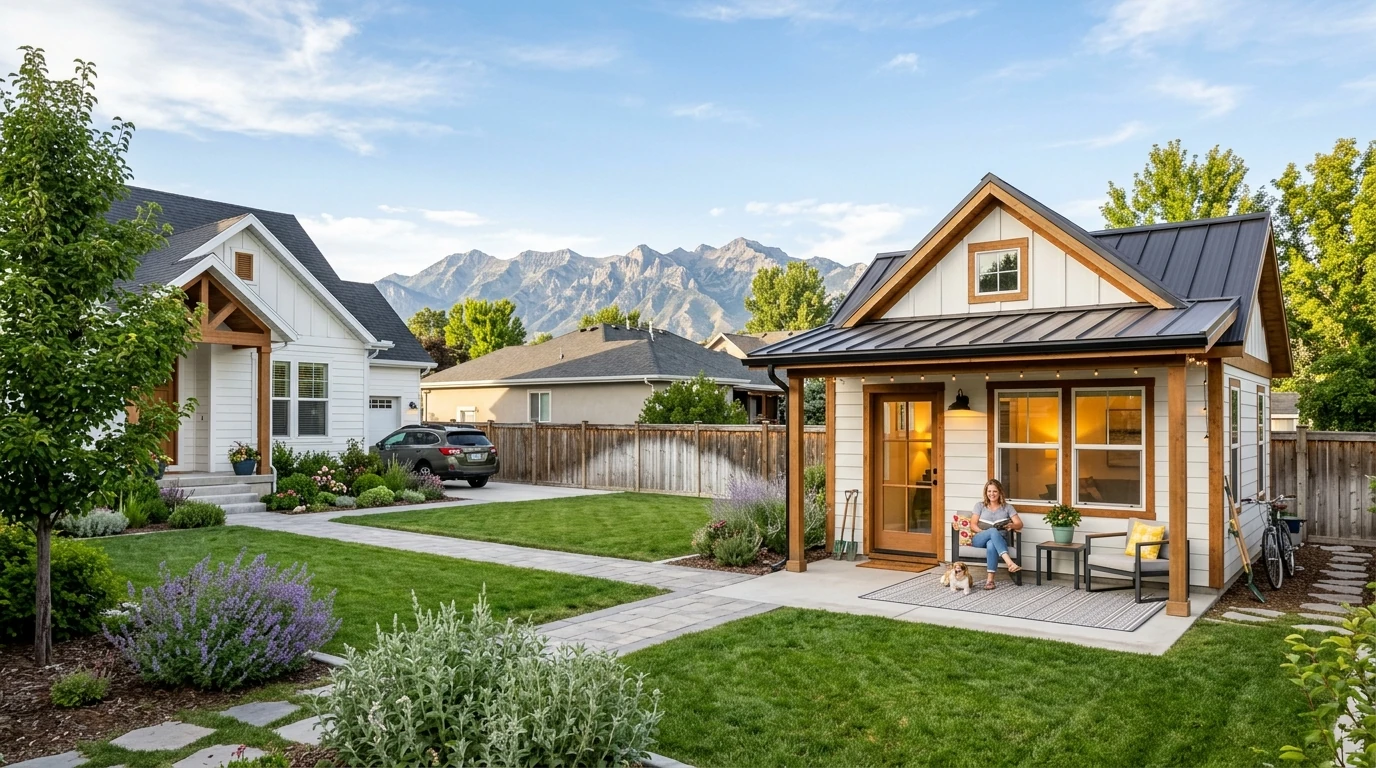
Detached ADUs — standalone backyard cottages, above-garage apartments, and similar structures — are still regulated at the city level, and the rules vary dramatically across Utah County.
Utah County ADU Rules: City-by-City Comparison
Current as of March 2026. Always confirm with your city’s planning department before making financial commitments.
| City | ADU Types Allowed | Biggest Feasibility Rule | Parking | Owner-Occ? | Rental Rule | Verified |
|---|---|---|---|---|---|---|
| Provo | Internal, over-garage, addition; detached in accessory structures (zone/map dependent) | Eligibility depends on property’s ADU-approved zone/map status; interior access between units must be maintained; 4 parking spaces required | 4 total spaces | Yes | 30+ days; rental dwelling license required | Mar 2026 |
| Orem | Internal only (within principal residential building) | Must be within the main building; university-city 67% restriction may apply | 1 additional space | Yes | 30+ days only | Mar 2026 |
| Lehi | Internal; detached (restricted) | Detached requires 22,000 sq ft lot (½ acre); internal on 6,000+ sq ft lots; $4,528 impact fee for detached | 1 additional off-street space | Yes (recorded declaration required) | 30+ days only | Mar 2026 |
| American Fork | Internal only | External/detached ADUs currently prohibited | Per ordinance | Yes | 30+ days only | Mar 2026 |
| Spanish Fork | Internal, attached, detached | Lot must be 6,000+ sq ft; detached max 1,000 sq ft; no impact fees (eliminated 2019) | 3 spaces (internal/attached); 4 spaces (detached); no tandem | Yes (exceptions for temporary absence) | 30+ days; annual renewal | Mar 2026 |
| Eagle Mountain | Internal, attached, detached (over garage or cottage/casita) where permitted by zone | Detached allowed in qualifying residential zones per EMMC 17.25.030; architectural compatibility required | 1 additional off-street space | Yes | 30+ days only | Mar 2026 |
| Saratoga Springs | Internal (IADU) — location-specific | Property must be in an approved IADU location; detached ADUs not currently allowed | Per ordinance | Yes | 30+ days only | Mar 2026 |
| Pleasant Grove | All types: detached new construction, above-garage, addition, basement conversion, internal; tiny homes allowed as detached ADU | 6 off-street parking spaces required (including garage); owner-occupancy; one ADU per property | 6 off-street spaces (includes garage) | Yes | Per ordinance | Mar 2026 |
| Highland | Internal; detached — verify with city | Larger lots common; foothill terrain may affect site work; contact city planning for current status | Per ordinance | Yes | Per ordinance | Unverified — contact city |
| Alpine | Internal; detached — verify with city | Larger lot sizes may support detached ADUs; contact city for current ordinance | Per ordinance | Yes | Per ordinance | Unverified — contact city |
| Cedar Hills | Internal; detached — verify with city | Contact planning department for current regulations | Per ordinance | Yes | Per ordinance | Unverified — contact city |
| Lindon | Internal; detached — verify with city | Contact Lindon planning for current detached ADU status | Per ordinance | Yes | Per ordinance | Unverified — contact city |
| Mapleton | Internal; detached — verify with city | Rural-suburban character; larger lots may support detached units | Per ordinance | Yes | Per ordinance | Unverified — contact city |
| Vineyard | Internal; detached — verify with city | Rapid growth area; ADU regulations evolving | Per ordinance | Yes | Per ordinance | Unverified — contact city |
| Payson | Internal; detached — verify with city | Contact Payson planning for current regulations | Per ordinance | Yes | Per ordinance | Unverified — contact city |
| Springville | Internal; detached — verify with city | Verify current ordinance — regulations have been under review | Per ordinance | Yes | Per ordinance | Unverified — contact city |
| Utah County (unincorporated) | Internal; detached — verify with county | Unincorporated areas follow county-level regulations | Per county code | Yes | Per county code | Unverified — contact county |
Key Patterns Across Utah County
- Internal ADUs are broadly allowed under state law — but with conditions. Utah law makes internal ADUs a permitted use in residential areas, but local governments can still apply statutory conditions including owner-occupancy, parking, small-lot limits, limited prohibited areas, and 30+ day rental rules (Utah Code §10-21-303).
- Detached ADUs are a patchwork. Some cities like Spanish Fork and Pleasant Grove have clear, detailed ordinances allowing them. Others like Orem and American Fork currently prohibit them. Provo allows ADUs in accessory structures but eligibility is zone/map dependent. This landscape is changing — see the S.B. 284 section below.
- Owner-occupancy is nearly universal. Almost every Utah County city requires the property owner to live on-site.
- Short-term rentals are restricted. Every city in our verified rows restricts ADU rentals to 30 or more consecutive days.
City Highlights
Provo ADU Rules
Provo allows accessory apartments in approved locations, but eligibility is zone/map dependent. The unit may be created inside the dwelling, over an attached garage, or as an addition to the dwelling. Interior access between the main living area and the accessory apartment must be maintained. Four parking spaces are required on the property. A separate address is assigned by Provo City, and a recorded ADU agreement (deed restriction) is required with Utah County. A Rental Dwelling License is required for any rented ADU. Provo’s code also allows ADUs in detached accessory structures, but with strict requirements: the structure must have a smaller footprint and height than the main dwelling, setbacks of at least 10 feet from all property lines, architectural compatibility, a permanent site-built foundation, and separate utility meters. Verify your property’s current ADU-eligible zone/map status before assuming a detached backyard cottage is permitted. (Source: Provo City Code §14.30.030; Provo ADU Requirements PDF)
Orem ADU Rules
Orem currently limits ADUs to internal units within the principal residential building. Detached ADUs are not allowed. Standard owner-occupancy and parking requirements apply. As a city with UVU’s student population, Orem may apply the 67% residential-zone restriction on IADUs under Utah Code §10-21-303. (Source: Orem City accessory apartment ordinance)
Lehi ADU Rules
Lehi allows internal ADUs on lots of at least 6,000 square feet with a $25 application fee and no impact fees. Detached ADUs require a minimum lot size of 22,000 square feet — just over half an acre — making Lehi one of the most restrictive cities in Utah County for detached units. The dwelling portion must be at least 300 square feet, and a one-time impact fee of $4,528 applies for detached ADUs. Pre-2021 existing structures may be eligible for conversion to detached ADUs with a minimum 5-foot setback from all property lines. Owner-occupancy declaration must be recorded with Utah County. (Source: Lehi City ADU FAQ; Chapter 26 Accessory Uses)
Spanish Fork ADU Rules
Spanish Fork has one of the most builder-friendly ADU ordinances in Utah County. Detached ADUs are allowed on lots of 6,000+ square feet, with a maximum size of 1,000 square feet. Spanish Fork eliminated ADU impact fees entirely in 2019 — a significant financial advantage. Parking requirements are 3 spaces for internal/attached ADUs and 4 spaces for detached units (no tandem parking allowed). Owner-occupancy is required with limited exceptions for temporary absence. Annual registration renewal is required for rentals. (Source: Spanish Fork ADU Guidebook, July 2024)
Eagle Mountain ADU Rules
Eagle Mountain allows internal, attached, and detached ADUs (including over-garage and cottage/casita types) in qualifying residential zones under EMMC 17.25.030. Architectural compatibility with the primary structure is required. One additional off-street parking space is required. Owner-occupancy is mandatory, and long-term rentals (30+ days) are the only permitted use. (Source: Eagle Mountain Municipal Code Ch. 17.70)
Pleasant Grove ADU Rules
Pleasant Grove is notable for allowing all ADU types, including tiny homes as detached ADUs. The city also explicitly offers an owner-builder pathway for qualifying projects. However, Pleasant Grove requires 6 off-street parking spaces (including garage spaces) — one of the highest requirements in the county. Only one ADU is allowed per property, and owner-occupancy is required. (Source: Pleasant Grove ADU Brochure, July 2024; Code §10-15-47)
Saratoga Springs ADU Rules
Saratoga Springs allows internal (IADU) ADUs only, and only in locations approved under the city’s map/amendment process. Detached ADUs are not currently allowed. Property must be in an approved IADU location — a preliminary check with the planning department is essential before proceeding. (Source: Saratoga Springs Title 19 Land Development Code)
S.B. 284: The 2026 Law That Changes Everything for Detached ADUs
Utah Code §10-21-304, enacted by S.B. 284, took effect October 1, 2026. If an older city source says detached ADUs are prohibited, do not treat that as the complete current rule for a qualifying lot in a specified municipality. The state provision has conditions and exceptions and does not replace the building-permit process.
What S.B. 284 Requires
- ✓ Since October 1, 2026, specified municipalities have been required to allow detached ADUs on qualifying lots of 11,000+ square feet
- ✓ These municipalities cannot require a conditional use permit for detached ADUs in primarily residential zones
- ✓ Parking requirements are capped: cities can require 1 or 2 spaces depending on unit size, but they can’t use parking as a de facto prohibition
- ✓ The law does not prohibit cities from allowing detached ADUs on smaller lots by local choice
What Cities Can Still Regulate
- • Owner-occupancy requirements
- • Rentals under 90 days
- • Building codes, fire codes, setbacks, height limits, and design consistency requirements
- • Size limits and lot coverage
- • Utility capacity — cities can prohibit detached ADUs where utility services or capacity are inadequate
Before October 1, 2026 vs. the state rule now in effect
| Before Oct. 1, 2026 | After Oct. 1, 2026 | |
|---|---|---|
| Internal ADUs | Permitted use under state law (H.B. 82), subject to local conditions | No change — still permitted with same conditions |
| Detached ADUs on 11,000+ sq ft lots | Varies by city; many prohibited | Must be allowed in specified municipalities |
| Conditional use permit for DADUs | Some cities require it | Cannot be required in specified municipalities |
| Parking for DADUs | Varies widely | Capped at 1–2 spaces |
| Owner-occupancy | Most cities require it | Cities can still require it |
| Short-term rental | Restricted in most verified cities | Cities can still restrict (<90 days) |
What to do now: If your Utah County property has a lot or parcel of at least 11,000 square feet containing a single-family dwelling where that dwelling is a permitted use, check whether the municipality is covered by §10-21-304 and whether any statutory exception applies. The state rule is already in effect. Request current city permit guidance and a parcel-specific feasibility review before committing to plans.
Source: S.B. 284, 2026 Utah General Session; Utah Land Use Institute 2026 legislative summary. The state rule took effect October 1, 2026; older municipal code pages may not reflect it. Always verify the current municipal code before submitting plans. This guide is for informational purposes and is not legal advice.
How Much Does an ADU Cost in Utah County?
Let’s skip the vague “it depends” and get into real numbers. Cost varies mainly by ADU type, site conditions, utility work, and your city’s specific fee structure.
Cost by ADU Type (Utah County, 2026 Market Estimates)
| ADU Type | Typical Total Cost | Cost Per Sq Ft | Best For | Timeline |
|---|---|---|---|---|
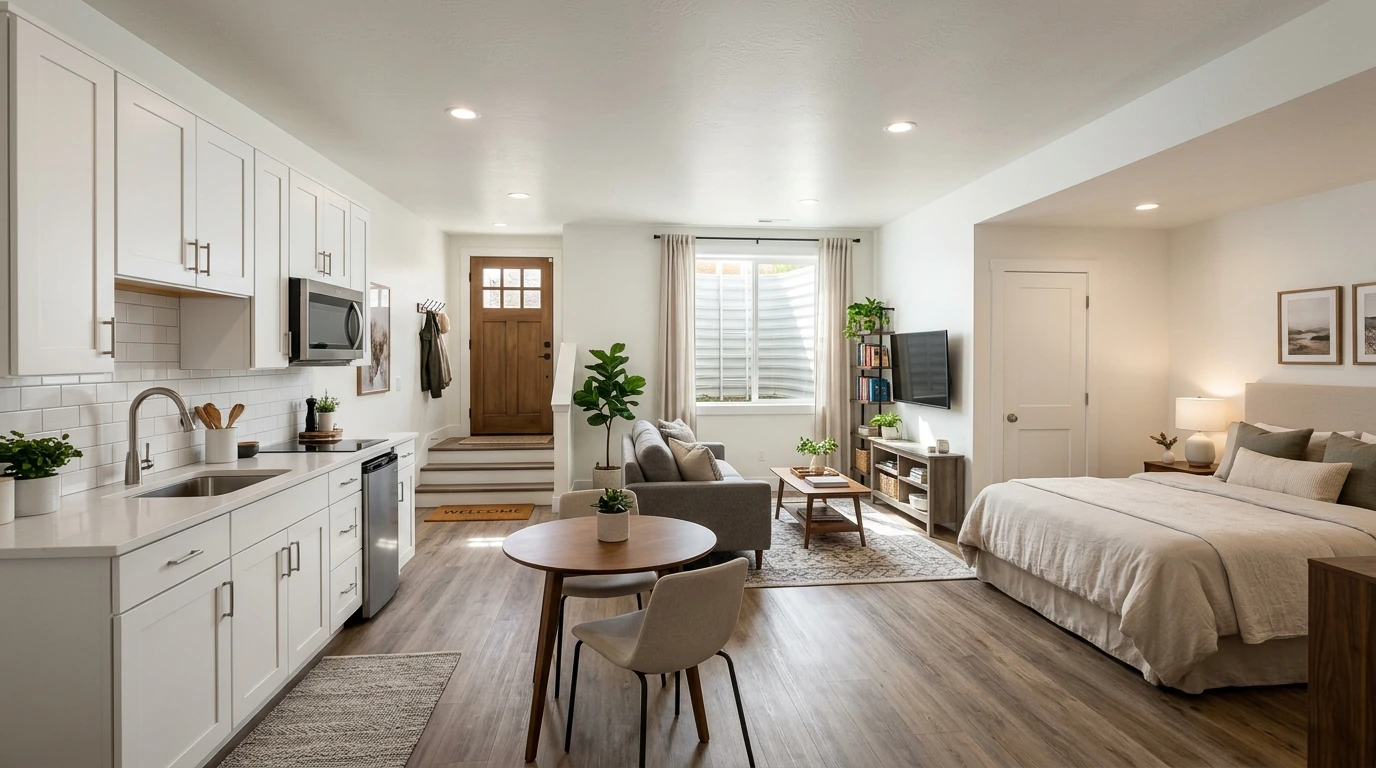
| Basement conversion (IADU) | $50,000–$100,000 | $75–$150/sq ft | Fastest ROI, lowest friction | 3–8 months |
| Garage conversion | $80,000–$150,000 | $100–$200/sq ft | Existing structure = savings | 4–9 months |
| Attached addition | $150,000–$250,000 | $200–$300/sq ft | Family use, shared wall savings | 6–12 months |
| Detached new build | $200,000–$400,000+ | $250–$350/sq ft | Max privacy, highest rental rates | 9–18 months |
| Legalization of existing unit | $15,000–$60,000+ | Varies | Unpermitted apartments | 2–6 months |
These ranges are market estimates based on Utah-specific construction data, builder-reported figures, and publicly available project cost databases as of early 2026. Actual costs depend on size, finish level, site conditions, and city-specific requirements. Always get a detailed written estimate for your specific project.
The Costs Most Homeowners Miss
The sticker price of the building itself is only part of the picture. Here’s where budgets get stretched:
Design and engineering — $5,000–$15,000
Architectural plans and structural engineering certification typically run 10–15% of total project cost. Some cities accept pre-approved standard plans, which can reduce this.
Permits and fees — $1,000–$5,000+
Each Utah County city sets its own fee structure. Impact fees can add to the total in some cities. Lehi charges $4,528 for detached ADUs, while Spanish Fork eliminated impact fees entirely in 2019. Internal ADUs within an existing primary dwelling are exempt from impact fees under Utah Code §11-36a-202.
Utility connections (detached units) — $5,000–$20,000
This is the hidden budget-buster for detached ADUs. Running water, sewer, and electrical from the main house or street to a backyard unit varies dramatically based on distance, soil conditions, and slope. Foothill cities like Highland, Alpine, and Cedar Hills tend to have rockier soil, which increases excavation costs.
Site preparation — $1,000–$8,000
Grading, leveling, clearing — more significant for detached units, especially on sloped lots.
Foundation — $5,000–$30,000 for detached units
Basement conversions and garage conversions skip this cost entirely.
Landscaping restoration — $2,000–$8,000
After construction equipment goes through your backyard, you’ll want to restore it.
Contingency (10–15% of total budget) — Build it in from the start
Construction surprises are not optional — they’re expected. Plumbing that doesn’t meet code, soil conditions that require extra work, material price fluctuations.
What Drives Price Up in Utah County
Terrain
Valley floor cities (Orem, Provo, Spanish Fork, Vineyard) generally have more accessible grading. Foothill and mountain communities (Highland, Alpine, Cedar Hills, Mapleton) mean higher excavation and site prep costs.
Utility distance
The farther your detached ADU sits from the main house or street connection, the more you’ll pay for trenching. A unit 20 feet from the house is a very different budget line than one 80 feet away.
City-specific fees
Lehi’s $4,528 impact fee for detached ADUs, Provo’s separate utility meter requirements, Spanish Fork’s annual renewal fee, and each city’s unique permit fee structure can all swing the total.
Finish level
A basic, functional ADU with standard finishes is a different project than a high-end unit with custom cabinetry, heated floors, and premium fixtures. Know which one you’re pricing.
How to avoid unrealistically low quotes: If a contractor quotes your detached ADU project at $120,000 and everyone else is quoting $250,000+, that’s not a deal — that’s a red flag. Either they’re leaving out soft costs (permits, engineering, utility hookups, site work), or they’re going to hit you with change orders once construction starts. A trustworthy ADU builder gives you a detailed line-item estimate that includes every phase of the project, not just the framing and finishes.
Which ADU Type Makes the Most Sense for Your Situation?
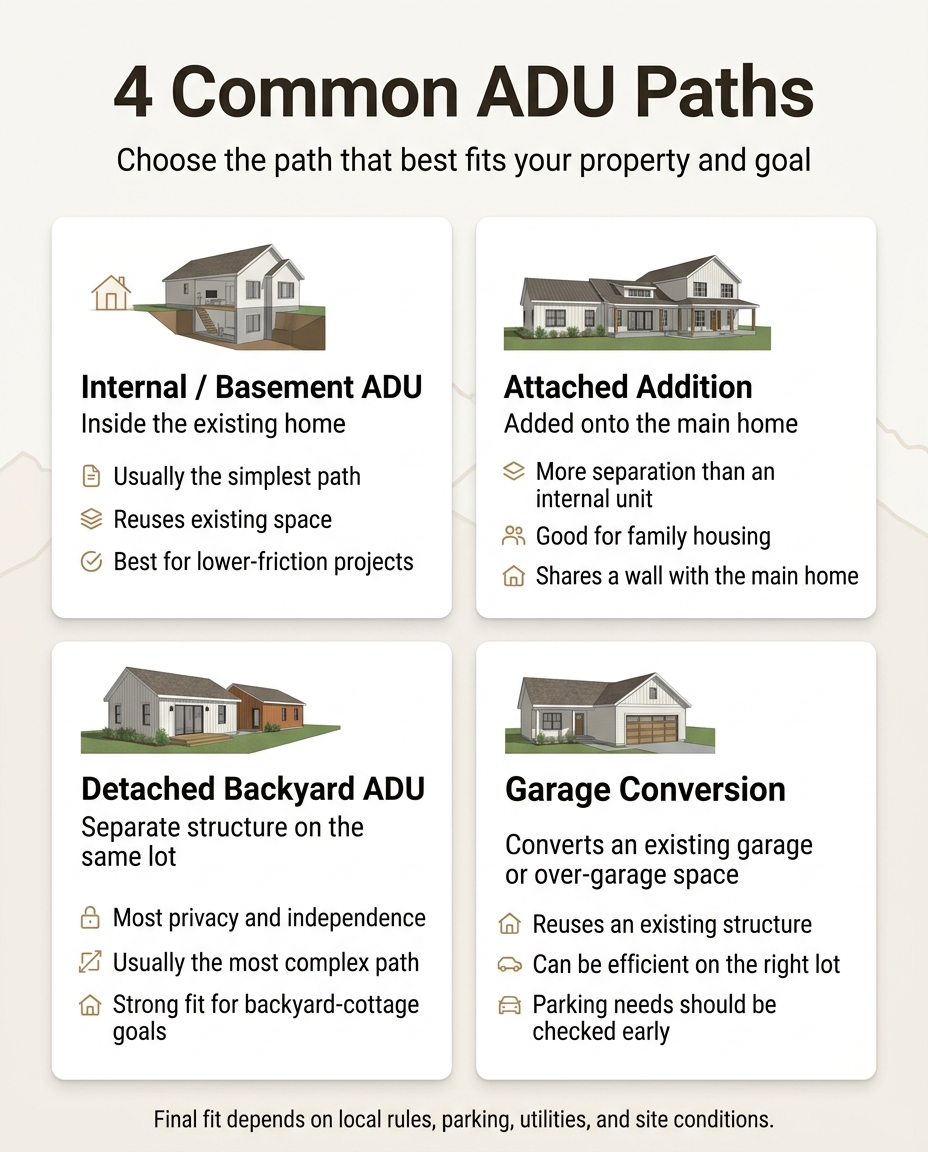
Pick a Basement ADU If…
You have underutilized space in your existing home and want the fastest, lowest-cost path to a legal ADU. You’re reusing what you already own, skipping foundation and roofing costs, and working within a system (state law) that broadly supports this type of project.
Not ideal if: Your basement has low ceilings, structural issues, or moisture problems that would require significant repair before conversion.
Pick a Detached ADU If…
You want maximum separation between living spaces, your highest rental rate potential, and you have the lot and budget to support it. Detached ADUs offer the most privacy for both the primary occupants and the ADU occupants, which makes them attractive to long-term renters willing to pay a premium.
Not ideal if: Your city doesn’t allow detached ADUs yet, your lot is under the minimum size, or your budget is below $200,000.
Pick an Attached ADU If…
You want more space than an internal conversion but don’t want the complexity of a standalone structure. Attached ADUs share a wall with the main home, which reduces foundation and utility costs. They’re great for aging parents who want their own space but still want easy access to the main house.
Not ideal if: You want full separation between living spaces, or your lot’s setback requirements don’t leave room for an addition.
Pick a Garage Conversion If…
You already have a detached or attached garage and you don’t need all that parking space. Converting an existing structure saves significantly on foundation and framing costs. Above-garage apartments can also work well on certain lots.
Not ideal if: You need covered parking, your garage doesn’t meet building code requirements, or your city’s ordinance restricts garage conversions.
Pick a Legalization Project If…
You already have an existing basement apartment or secondary living space that was never formally permitted. Getting it legal is critical — it protects you from city enforcement, makes the unit insurable and rentable, and adds legitimate value to your property. This is often the quickest and most affordable ADU project.
Not ideal if: The existing space requires extensive structural work to meet code, at which point a full renovation might make more financial sense.
ADU Type Comparison
| ADU Type | Cost Difficulty | Permit Difficulty | Typical Timeline | Best Builder Type |
|---|---|---|---|---|
| Basement/internal | Low | Low | 3–8 months | Basement finish specialist or ADU-focused GC |
| Garage conversion | Low–Medium | Medium | 4–9 months | ADU-focused GC |
| Attached addition | Medium | Medium | 6–12 months | Design-build firm or experienced GC |
| Detached new build | High | High | 9–18 months | Design-build firm with ADU + permitting experience |
| Legalization | Low–Medium | Varies | 2–6 months | Code compliance specialist or ADU-focused GC |
What Usually Kills an ADU Project Before It Starts?
We’re not going to pretend every ADU project is smooth sailing. Some hit real roadblocks. The good news: almost all of them are avoidable if you know what to watch for upfront.
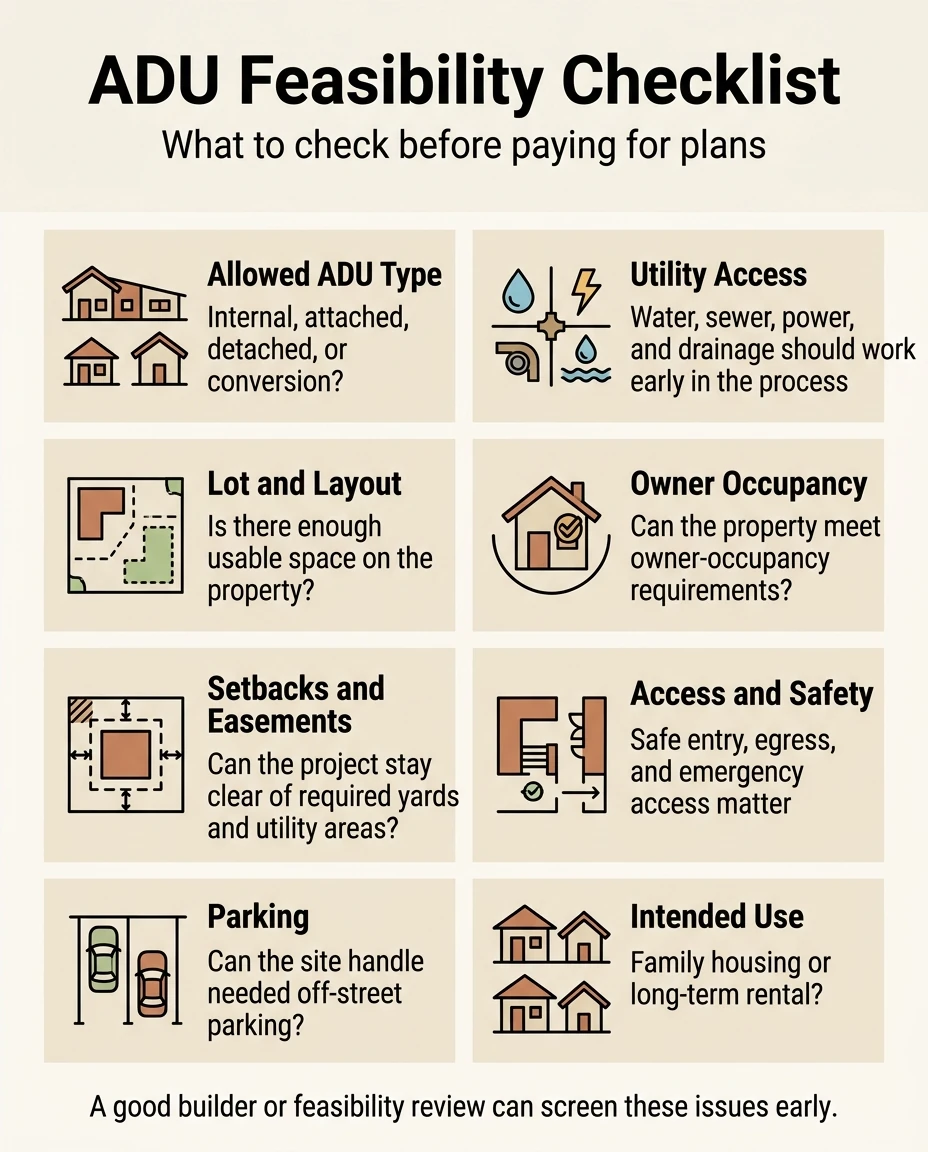
Owner-Occupancy Surprises
Nearly every Utah County city requires you to live on the property — either in the main home or the ADU itself. If you’re an investor who doesn’t plan to live there, a traditional ADU likely won’t work. There are exceptions for military deployment, medical situations, and religious missions, but they’re typically limited to two years.
The fix: Confirm owner-occupancy requirements with your city before spending money on plans. If you plan to live in the ADU and rent the main house, most cities allow that — but verify.
Lot Size Minimums
Lot size can still limit a detached project, but do not treat an older municipal minimum above 11,000 square feet as a complete current answer. Since October 1, 2026, §10-21-304 applies to qualifying lots or parcels of at least 11,000 square feet in specified municipalities, subject to its conditions and exceptions. A smaller lot may still qualify under a more permissive local ordinance. Confirm Lehi’s and any other city’s current standards before paying for plans.
The fix: Since October 1, 2026, S.B. 284's 11,000-square-foot floor has applied to qualifying lots in specified municipalities. Check the city's coverage, statutory conditions, and current local standards before assuming a parcel qualifies.
Parking Requirements
Parking requirements vary more than most homeowners expect. Pleasant Grove requires six off-street spaces. Provo requires four. Spanish Fork requires three for internal ADUs and four for detached. If your driveway and lot can’t accommodate the required count, the project stalls.
The fix: Get a site plan early that accounts for parking. Some homeowners add a small parking pad alongside the driveway — it doesn’t have to be elaborate, just compliant.
Utility and Sewer Constraints
Not every lot has the capacity for additional utility connections. Some cities require written confirmation from the water provider before issuing a building permit. Sewer grade and slope are a major upfront consideration — if your lot slopes the wrong way, connecting a detached unit to the sewer can get expensive.
The fix: Have a builder or engineer assess utility access early. This is one of the first things a good ADU builder checks during a feasibility review.
HOA or CC&R Issues
Here’s some genuinely good news: under Utah state law (H.B. 82), HOAs cannot prohibit internal ADUs that comply with local building and zoning codes. If your HOA tries to block your basement apartment, state law is on your side. The interaction between S.B. 284 and HOA restrictions on detached structures may need further legal clarification, but the trend in Utah is clearly toward more homeowner flexibility.
Short-Term Rental Assumptions
We see this misconception regularly. Homeowners assume they’ll list their ADU on Airbnb for premium nightly rates. In the Utah County cities we’ve verified, ADUs are restricted to long-term rentals of 30 or more consecutive days. Under S.B. 284, cities may restrict rentals under 90 days. Plan your financial projections around long-term rental income, not vacation rental rates.
The fix: Long-term rental income is actually more stable and predictable than short-term. You don’t deal with turnover, cleaning, and vacancy between guests. A steady monthly tenant is often more profitable over time than chasing nightly bookings with inconsistent occupancy.
What Does the Utah County ADU Permit Process Actually Look Like?
Permitting is where most homeowners feel the most lost. Here’s the actual process, step by step.
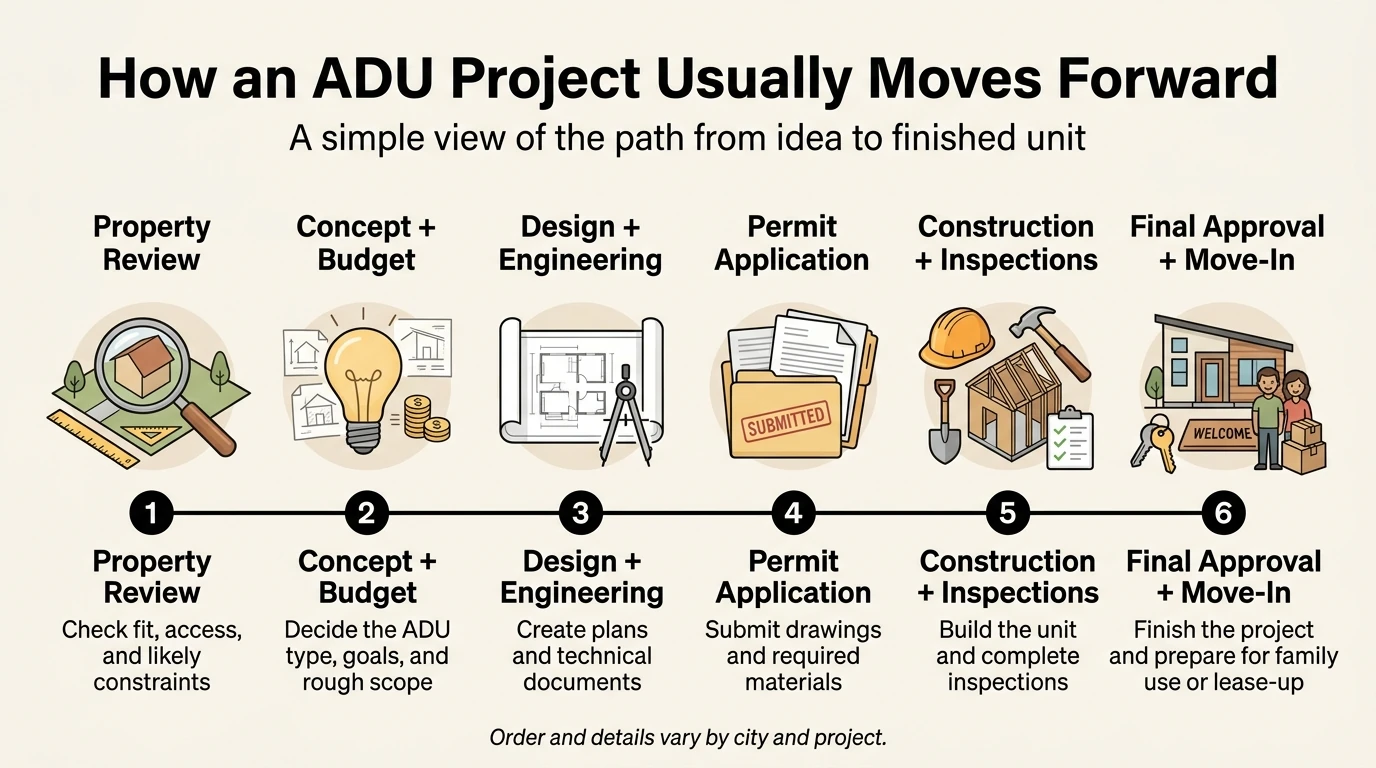
Feasibility and Zoning Check (Week 1)
Before anything else, verify that your property qualifies. This means confirming your zoning classification, lot size, and any overlay districts that might affect your project. Your city’s planning department can tell you this — or a qualified ADU builder can do it for you as part of a feasibility review.
Concept and Scope (Weeks 1–3)
Decide what you’re building: internal, attached, detached, or conversion. Determine the approximate size, layout, and whether the unit will be used for family or rental. This is where you align your goals with what’s actually possible on your lot.
Design and Engineering (Weeks 3–8)
Hire an architect, use your builder’s design team, or — in some cities like Pleasant Grove — do the work yourself as an owner/builder. The required drawings typically include a site plan, floor plans, and elevation drawings. A structural engineer must certify the plans for most projects. Budget note: Design and engineering typically costs $5,000–$15,000 for a custom ADU, or $2,500–$4,500 if using pre-designed or pre-approved plans.
Permit Application and City Review (Weeks 8–16)
Submit your application to the city’s planning and building department. Include the site plan, floor plans, elevation drawings, and any required documentation (water provider confirmation, owner-occupancy affidavit, etc.). Review timelines vary by city — some process in 4–6 weeks, others take 8–14 weeks, especially for detached units or complex projects. Note on contractor requirements: Many ADU projects require a licensed GC to pull the building permit, though Utah law also includes owner-builder exemptions (Utah Code §58-55-305).
Construction and Inspections (3–12 Months)
Once the permit is issued, construction begins. Your city’s building department will require inspections at key milestones: foundation, framing (4-way inspection), utility connections, and final inspection. The number and type of inspections vary by city.
Final Approval and Occupancy
After passing final inspection, you’ll receive a certificate of occupancy. If you plan to rent the ADU, most cities require you to record an owner-occupancy affidavit with Utah County and obtain a rental dwelling license, business license, or registration (varies by city — Spanish Fork requires annual renewal, Provo requires a Rental Dwelling License, etc.).
How Long Does a Utah County ADU Project Take?
Timelines depend heavily on project type and your city’s review process. Here are realistic expectations based on builder-reported timelines:
Fastest-case path
3–6 months
Basement conversion, simple scope. Straightforward internal ADU with minimal structural changes and a city that processes permits quickly.
Common path
8–14 months
Attached or moderate detached ADU. The typical experience for homeowners building an attached ADU or a detached unit in a city that already allows them.
Complex path
12–18+ months
Detached new build, challenging site. Large detached units, sloped lots, complex utility hookups, or cities with longer review processes.
What Delays Projects Most Often
- • Incomplete application packages that get sent back for revisions
- • City backlogs during high-volume building seasons (spring and summer in Utah)
- • Utility provider confirmation taking longer than expected
- • Engineering revisions for site-specific conditions
- • Weather delays during Utah County winters
What Speeds Projects Up
- ✓ Working with a builder who has completed ADU projects in your specific city
- ✓ Having a complete, professional application package the first time
- ✓ Getting a feasibility check done before design begins
- ✓ Making design decisions promptly so the builder isn’t waiting on you
Ready to Find Your Utah County ADU Builder?
Tell us your city, lot size, and project goal. We’ll connect you with a local builder option that fits your project and city’s process. Free, no obligation.
How Do You Compare Utah County ADU Builders Without Getting Burned?
The builder you choose is the single most important decision in this entire process. More important than the floor plan. More important than the finishes. A great builder navigates your city’s rules, manages the permit process, and delivers a project on budget and on time. The wrong builder costs you months and thousands in mistakes.
What to Look for in a Utah County ADU Builder
City-specific experience
Has this builder completed ADU projects in your city? Not just “in Utah” or “in Utah County” — in your specific municipality. A builder who knows Provo’s process inside out may have never dealt with Lehi’s 22,000-square-foot lot requirement or Spanish Fork’s parking standards.
In-house design and engineering
The best ADU builders handle design, engineering, and construction under one roof. When you split these functions between separate firms, you multiply the coordination points where things can go wrong.
Permitting track record
Ask how many ADU permits they’ve pulled in your specific city. A builder with 20 completed ADU permits knows every city reviewer, understands the common comment letters, and knows how to write an application that gets approved the first time.
References from ADU projects
Not kitchen remodels. Not bathroom renovations. Actual ADU projects. Ask to see completed work and talk to past clients.
Red Flags That Should Make You Walk Away
- ⚠ No site visit offered: If they’ll quote your project sight-unseen, they’re not serious.
- ⚠ Unrealistically low price: If everyone else quotes $250K and they quote $130K, something is being left out.
- ⚠ No permitting experience: If they say “you handle the permits” for an ADU project, find someone else.
- ⚠ Pressure to sign quickly: Legitimate builders don’t need high-pressure sales tactics.
- ⚠ Vague timeline: “We’ll get to it when we can” is not a project plan.
Builder-Fit Framework
| Your Project | Best Builder Type | What to Ask First | Biggest Red Flag |
|---|---|---|---|
| Basement conversion | Basement finish specialist or ADU-focused GC | “Have you converted basements to legal ADUs in [my city]?” | No familiarity with your city’s IADU process |
| Garage conversion | ADU-focused GC | “Can you handle structural changes and utility work for a garage conversion?” | Never done a garage-to-ADU conversion |
| Attached ADU | Design-build firm or experienced GC | “Do you handle design, engineering, and permitting in-house?” | Separate architect and contractor with no coordination |
| Detached new build | Design-build firm with ADU + permitting experience | “How many detached ADUs have you built in Utah County, and in which cities?” | Zero detached ADU experience |
| Legalization | Code compliance specialist or ADU-focused GC | “Can you do a code assessment and tell me what needs to be brought into compliance?” | Wants to start construction before assessing current code status |
Is Building an ADU in Utah County Actually Worth It?
This is the question underneath all the other questions. Let’s break it down honestly.
When an ADU Makes Strong Financial Sense
Rental Income
Based on current Utah County rental market data, ADUs generally rent for $1,200–$2,500 per month depending on size, finish level, and location. Provo and Orem tend to command higher rents due to consistent demand from BYU and UVU students and faculty. Spanish Fork and Eagle Mountain are growing markets with increasing rental demand.
Mortgage Offset
A simplified example: a $200,000 detached ADU financed through a HELOC at 7% costs roughly $1,330/month. If you rent it for $1,800/month, that’s approximately $470/month positive cash flow — and the unit is also building equity in your property. (This is illustrative. Your financing terms, insurance costs, maintenance, and vacancy rate will affect actual returns.)
Property Value
A well-built, legally permitted ADU adds meaningful value to your property. Two legal dwelling units on one lot are simply worth more than one. The exact amount depends on your local market, the ADU’s condition, and comparable sales — discuss with a local appraiser for property-specific estimates.
Property Tax Reality
Yes, your assessed value goes up. But Utah’s 45% primary residence exemption means the actual tax increase is substantially smaller than the full assessed value increase. For most homeowners, the rental income significantly exceeds the additional tax.
When an ADU Makes Sense for Family
Many Utah County homeowners are building ADUs for multigenerational living. Aging parents who want to be close but still have their own space. Adult children saving for their own home. A guest suite for extended family visits. The financial return matters, but the quality-of-life return is often what tips the decision.
When an ADU Might Not Be the Right Move
We’d be doing you a disservice if we didn’t mention this. An ADU may not be the best call if:
- • You’re planning to sell the home within 2–3 years (you may not fully recoup the investment in that timeframe)
- • Your lot genuinely can’t support it due to size, terrain, or utility constraints
- • You’re already stretched financially and can’t absorb construction surprises
- • You’re not willing to be a landlord (managing a tenant, even a good one, takes effort)
That said, for most Utah County homeowners with the right lot and the right budget, an ADU is one of the smartest property investments available right now. You’re building a real asset on land you already own, in a state where housing demand consistently outpaces supply.
What Happens When You Rent It, Use It for Family, or Sell?
Can I rent my ADU as a long-term rental?
Yes, in most Utah County cities — provided you have the required rental license or registration, you’ve recorded the owner-occupancy affidavit, and the unit was built with proper permits. “Long-term” generally means 30 or more consecutive days in the cities we’ve verified. Requirements vary: Provo requires a Rental Dwelling License, Spanish Fork requires an annual registration renewal, and other cities have their own processes.
Can I rent my ADU as a short-term rental (Airbnb)?
In the Utah County cities we’ve verified, no — ADUs are restricted to long-term rentals. Short-term rental permits are a separate application process. Under S.B. 284, cities may restrict ADU rentals under 90 days. Don’t plan your project around short-term rental income.
Do I have to live on the property?
Yes. Nearly every Utah County city requires owner-occupancy. You can live in either the main home or the ADU, but one of them must be your primary residence. Limited exceptions exist for military deployment, medical needs, and religious missions (typically up to two years).
What happens if I sell the property?
The ADU sells with the property. It cannot be subdivided or sold separately. Homes with legal, permitted ADUs are attractive to buyers who recognize the rental income potential and flexibility. In Lehi, the new owner must sign and record a new Declaration of Owner Occupancy.
Does an ADU change my insurance?
Yes. You’ll need to update your homeowner’s insurance to cover the additional structure and, if renting, add landlord liability coverage. Talk to your insurance agent before construction begins — the cost increase is usually modest relative to the rental income.
What if I build for family now and rent it later?
This is extremely common and perfectly fine. Build the ADU for your parents or adult child, and when their situation changes, transition it to a rental. As long as you maintain owner-occupancy and get the required rental license or registration from your city, you’re covered.
How We Put This Guide Together
We believe you should know how we build our content — especially when it involves regulations and money.
Research process. We pull ADU ordinance data directly from each Utah County city’s published municipal code, official planning documents (like Spanish Fork’s ADU Guidebook and Pleasant Grove’s ADU Brochure), and city websites. State law citations reference the Utah Code as published on le.utah.gov. Rows in our city table marked “Unverified” have not been independently confirmed against current published ordinances.
What we don’t do. We do not accept payment from builders to influence our rankings, and we do not guarantee the accuracy of every municipal ordinance (regulations change). Always verify requirements with your specific city’s planning department before making financial commitments.
Last updated: March 26, 2026. Author: Utah ADU Builders Research Team. Sources include Utah Code §10-21-303, S.B. 284 (2026 General Session), individual city municipal codes, and city planning department documents.
Related ADU Resources
Frequently Asked Questions About Utah County ADU Builders
Get Started — Free Utah County ADU Feasibility Check
Tell us about your property, your city, and your ADU goals. We’ll connect you with a local Utah County ADU builder option that appears to fit your project type.
Free. No obligation. No pressure.