Millcreek ADU Builders: Compare Your Options, Check Your Lot, and Estimate Costs
Yes, you can build an ADU in Millcreek. Detached ADUs are allowed on R-1 and A-zoned lots of at least 8,000 square feet, capped at the lesser of 1,000 square feet or the gross square footage of your existing main building. Internal and attached ADUs don't have a lot-size minimum — they just need to comply with your zone's underlying rules. Expect to invest anywhere from $40,000 for a basement conversion to $350,000+ for a custom detached unit.
But here's what most Millcreek homeowners don't realize until they're deep in the process: not every lot qualifies for every type of ADU, and the builder you choose matters more than the floor plan you pick. The difference between a smooth 8-month project and a 14-month headache usually comes down to whether your builder actually knows Millcreek's specific code — not just "Utah ADU rules" in general.
We put this guide together because we kept seeing Millcreek homeowners waste months and thousands of dollars on projects that started without the right information. The city's official page has the rules but reads like a legal document. Builder websites have the sales pitch but skip the details. This page combines both — cited ordinance, real costs, actual process steps — so you can make a confident decision before you write a single check.
Quick Facts About Millcreek ADUs
Zones: R-1 and A only
Detached ADU lot minimum: 8,000 sq ft
Internal/attached lot minimum: None (underlying zoning rules apply)
Max detached size: Lesser of 1,000 sq ft or gross sq ft of existing main building
Detached location: Rear yard only, ≥6 ft from main building
Max detached height: Lesser of 24 ft or existing main building height
Parking: 1 off-street stall minimum (no street parking)
Utility meters: Separate meters not allowed
Owner occupancy: Required
Detached short-term rental: Not allowed (long-term 30+ days only)
Internal/attached short-term rental: Allowed with proper licensing (verify with city)
This is the first question every Millcreek homeowner asks, and the answer depends on four things: your zone, your lot size, which type of ADU you want, and whether you live on the property.
Most homes in Millcreek's residential neighborhoods sit in R-1 zones. If yours does, you're eligible. Agriculture-zoned properties qualify too. Anything else — commercial, multi-family, mixed-use — does not. (MKZ 18.71.030)
Here's the fast eligibility check:
Your property qualifies for a Millcreek ADU if:
✅ You're in an R-1 or A zone(MKZ 18.71.030(C))
✅ You own and live on the property as your primary residence (MKZ 18.71.030(A))
✅ The property is used as a single-family residence(MKZ 18.71.030(B))
✅ You don't already have an ADU on the lot (one per lot — MKZ 18.71.060(B))
✅ The build area is not on a slope greater than 30%(MKZ 18.71.090(G))
✅ The build area is not within a recorded easement(MKZ 18.71.060(G))
Additional checks for a detached ADU:
✅ Lot is at least 8,000 square feet(Table 18.71-2)
✅ There's room in the rear yard with proper setbacks (5 ft from property lines, 6 ft from the main building)
✅ You can provide at least one off-street parking stall
If you checked every box, your property likely qualifies. If you can't meet the 8,000-square-foot threshold for detached, keep reading — internal and attached ADUs don't have that lot-size minimum.
How to check your zone: Visit the Millcreek zoning map or call Millcreek Planning & Zoning at 801-214-2700. Give them your address — they can confirm your zone and lot size in under two minutes. You can also email planner@millcreekut.gov.
Practical tip: While you're checking, ask the planner about your lot's total coverage allowance in your specific R-1 subzone. Millcreek has several R-1 subzones (R-1-6, R-1-7, R-1-8, R-1-10, R-1-21, etc.) with different lot coverage percentages. That coverage limit determines how much total building area your lot can support — which directly affects how large your ADU can be. Your builder should verify this too, but knowing it upfront helps you set realistic expectations.
Also check for easements. Your property deed or a title search will show any recorded easements. ADUs cannot be built within a recorded easement (MKZ 18.71.060(G)). If you have a utility easement running through your rear yard, that could affect where — or whether — a detached ADU can be placed.
2026 Utah detached ADU law update (SB 284)
Utah SB 284 created Utah Code §10-21-304, effective October 1, 2026. In a "specified municipality," cities must allow one detached ADU on lots or parcels of 11,000 square feet or larger where a single-family home is allowed, and cities may allow detached ADUs on smaller lots. Cities may still regulate size, height, setbacks, lot coverage, design compatibility, utility capacity, owner-occupancy, front-yard placement, short-term rental use under 90 days, and whether more than one ADU is allowed. Local permits and building, fire, utility, and health-code review still apply. Because this statewide rule interacts with local zoning, confirm the current Millcreek ordinance and permit checklist before designing around a detached ADU.
Not sure if your lot qualifies?
A free feasibility check takes 30 minutes and answers the eligibility question for your specific property — zone, lot size, setbacks, and ADU type.
Three Types of ADUs Allowed in Millcreek (Side-by-Side Comparison)
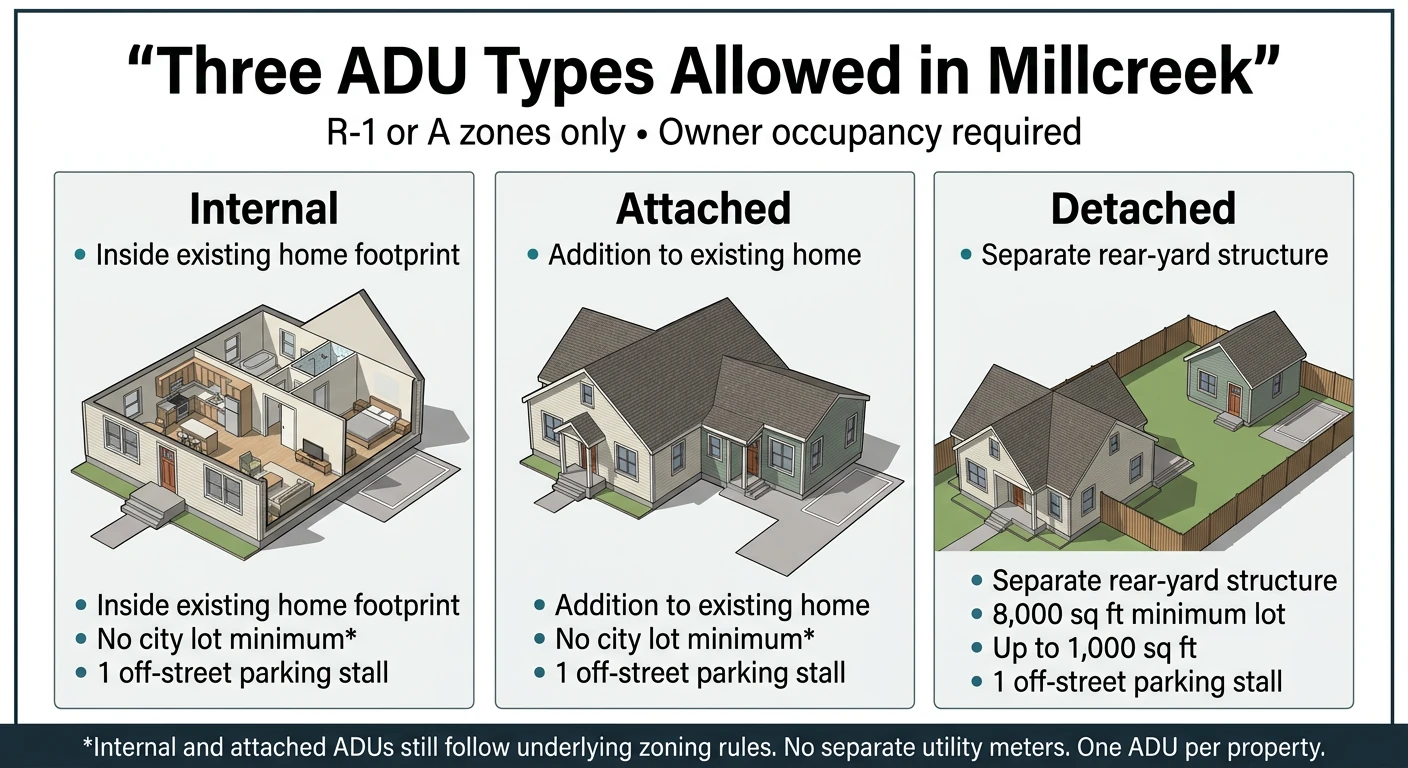
Millcreek allows three ADU types, and each one comes with its own rules, costs, and tradeoffs. Here's how they stack up:
Three ADU types allowed in Millcreek (R-1 or A zones only · Owner occupancy required)
Feature
Internal ADU
Attached ADU
Detached ADU
What it is
A unit inside your existing home (basement apartment, converted space)
An addition built onto your existing home
A separate standalone structure in your rear yard
Lot-size minimum
None (underlying zone rules apply)
None (underlying zone rules apply)
8,000 sq ft (Table 18.71-2)
Max size
Limited by existing home layout
Limited by zone lot coverage
Lesser of 1,000 sq ft or gross sq ft of existing main building
Max height
N/A (within existing structure)
Same as primary dwelling standards
Lesser of 24 ft or height of existing main building
Setbacks
N/A
Same as primary dwelling
5 ft from side/rear property lines; 6 ft from main building
Must be in rear yard?
No
No
Yes
Exterior door location
Side or rear of residence only
Side or rear of residence only
Per detached standards
Short-term rental?
Allowed (with ADU application + business license)
Allowed (with ADU application + business license)
Not allowed — long-term only (30+ days)
Long-term rental?
Yes (compliance letter + business license)
Yes (compliance letter + business license)
Yes (compliance letter + business license)
Parking
1 off-street stall
1 off-street stall
1 off-street stall
Separate utility meters?
No
No
No
Occupancy limit
N/A (state law governs)
2 adults, any number of children
2 adults, any number of children
Typical cost range
$40,000–$150,000
$100,000–$250,000
$175,000–$400,000+
Sources: Millcreek ADU page, MKZ 18.71. Cost ranges are planning-level estimates for the Salt Lake County market (2025–2026).
Which ADU Type Is Right for You?
Pick internal if you already have usable space — an unfinished basement, an unused portion of your home — and want to minimize cost. This is the fastest, cheapest path to a legal rental unit in most cases.
Pick attached if you want more square footage than your existing layout allows, or if your lot size rules out a detached build. An attached ADU lets a family member have their own entrance without being in a completely separate building.
Pick detached if you want maximum privacy and independence for tenants or family, you're prioritizing long-term rental income, and your lot is 8,000+ square feet with adequate rear yard space. This is the most expensive option, but it also adds the most value and commands the highest rents.
How Your Goal Should Drive Your Decision
If rental income is the priority, a detached ADU typically commands the highest rents because tenants value the privacy of a separate structure. But remember — you're limited to long-term tenants only (30+ days) in a detached unit. If you want the flexibility of short-term rentals, go internal or attached.
If multigenerational living is the goal, think about daily life. An aging parent who values independence but needs to be close? Detached is ideal — their own space, their own entrance, their own kitchen, steps away from you. A young adult child saving money? A basement conversion gives them independence at a fraction of the cost.
If budget is the deciding factor, internal conversions win hands-down. If you have an unfinished basement with decent ceiling height and exterior access on the side or rear, you could have a legal rental unit for $40,000–$80,000. That's a fraction of the $175,000+ for detached — and the payback through rental income is dramatically shorter.
If you want Airbnb income, go internal or attached. Millcreek prohibits short-term rentals in detached ADUs (MKZ 18.71.090(C)). If your entire financial model depends on Airbnb rates, detached won't work.
Not sure which type fits your property?
Request a provider review of your Millcreek address and project type. The provider confirms fit, assessment fees, availability and possible next steps; a site visit is not booked.
Millcreek ADU Requirements: Every Rule You Need to Know
Every rule cited here comes directly from Millcreek Municipal Code MKZ 18.71 (dated April 28, 2025) and the city's official ADU page. We've translated it into plain language. Always verify with Millcreek Planning & Zoning (801-214-2700) before starting your project — code can change.
Zoning and Eligibility
ADUs are only allowed in R-1 and A zones. The property must be owner-occupied — meaning you live there as your primary residence. The use must be single-family residential at the time you apply and any time after. You get one ADU per lot: one internal, one attached, or one detached — not a combination. (MKZ 18.71.030, 18.71.060(B))
Size Limits
A detached ADU can be up to the lesser of 1,000 square feet or the gross square footage of your existing main building, whichever is smaller. Total lot coverage in your zone may further reduce the maximum. (Table 18.71-2)
Internal ADUs are limited by your existing home's layout. Attached ADUs are governed by your zone's lot coverage requirements. (MKZ 18.71.070, 18.71.080(C))
Setback Requirements
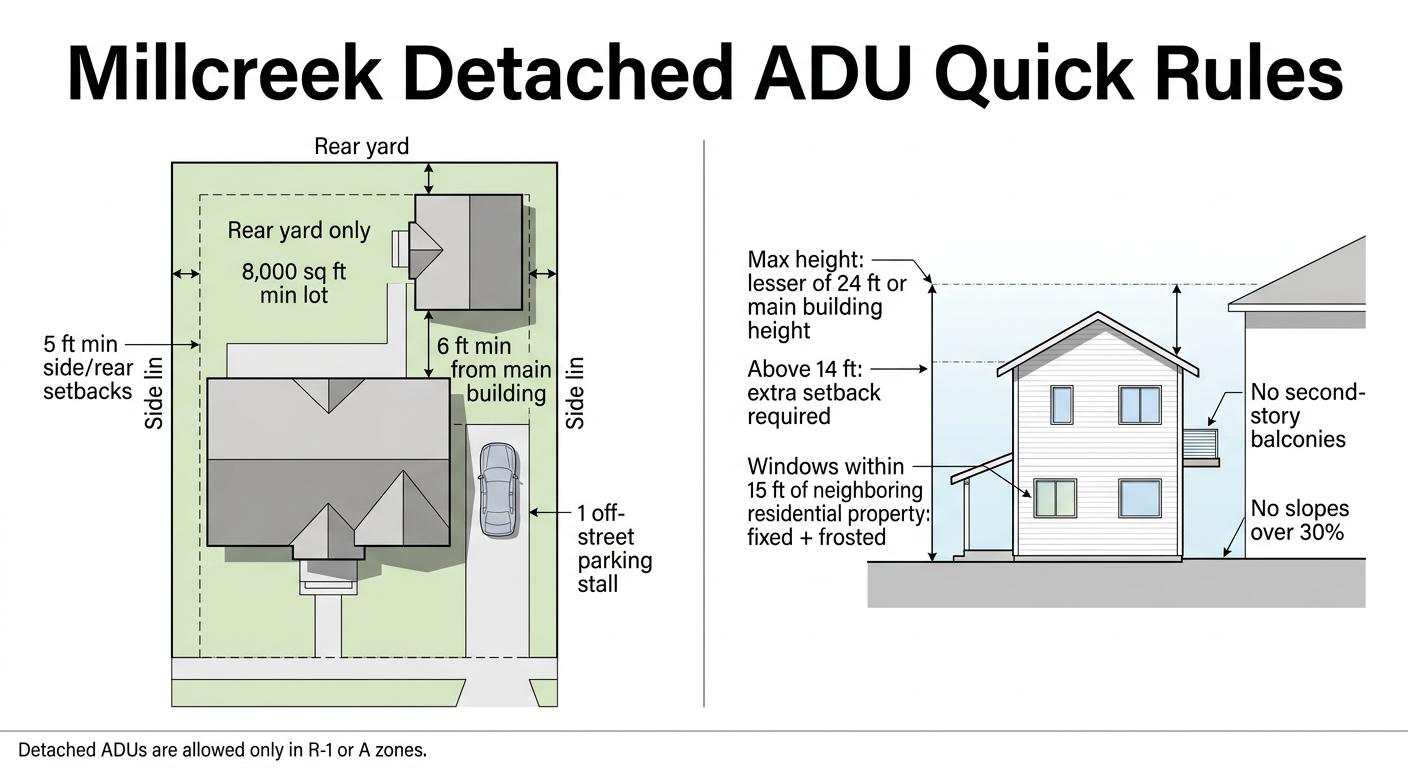
Detached ADUs need a minimum of 5 feet from side and rear property lines, and at least 6 feet from the main building. For every inch of height above 14 feet, you need an additional inch of setback. (Table 18.71-2)
Attached ADUs follow the same setback rules as your primary dwelling — whatever your zone requires for side and rear yards. (MKZ 18.71.080)
Existing structure conversions cannot reduce existing setbacks. If a detached building is already close to a property line, it can potentially be converted through the Land Use Hearing Officer process if legally established. (MKZ 18.71.130(C))
Millcreek Detached ADU Quick Rules — setbacks, height limits, and site placement requirements
Height Limits
Detached ADUs can be up to the lesser of 24 feet or the height of the existing main building. Above 14 feet, the additional setback requirement kicks in. Converting an existing nonconforming structure? You cannot increase its current height. (Table 18.71-2, MKZ 18.71.130)
Design Standards
Millcreek takes design seriously — and that's good news for your property value. The city built standards that ensure your ADU blends with your neighborhood:
Exterior materials: Your ADU must incorporate at least one exterior material from your primary dwelling on a minimum of 20% of all facades. (MKZ 18.71.060(F))
Color: Must match your primary dwelling's color on at least 50% of all facades.
Roof: Pitched roof required unless your primary dwelling has a flat roof (then flat or pitched is fine).
Windows near neighbors: Any window within 15 feet of an abutting property containing a single-household, twin home, or duplex must be fixed (non-operable) and translucent, or installed as a skylight. (MKZ 18.71.090(E))
No second-story balconies on detached ADUs. (MKZ 18.71.090(H))
Entrances, parking, and stairways within 15 feet of an abutting property must not be visible from that property — screening with fencing, dense landscaping, or positioning is required. (MKZ 18.71.090(F))
Attached ADU entrance must not be visible from the public right-of-way. (MKZ 18.71.080(A))
Interior/attached ADU exterior door must be on the side or rear of the residence. (Millcreek ADU page)
Exterior lighting must be directed downward with light sources not visible from abutting properties. (MKZ 18.71.090(D))
Exterior stairways and landings cannot encroach into required setbacks. (MKZ 18.71.090(I))
A good Millcreek ADU builder designs to all of these standards from day one. No surprises at inspection. No costly redesigns.
Why These Design Standards Actually Help You
These rules might feel restrictive at first glance, but they serve you in three ways.
First, they protect your property value. An ADU that matches your home's materials and colors looks intentional, not like an afterthought. Neighbors see a well-designed addition to the neighborhood, not a random structure that lowers their property values.
Second, they protect your relationship with neighbors. The frosted-window requirement, lighting rules, and entrance screening all address the privacy concerns that make neighbors oppose ADU projects. By designing to these standards, you're proactively addressing the objections before they become complaints.
Third, they give your builder a clear target. There's no ambiguity about what Millcreek expects. A builder who knows these standards can design around them efficiently — often incorporating them in ways that actually improve the ADU's appearance. For example, matching your home's siding and roof pitch creates a cohesive look that makes the ADU feel like it was always part of the property.
Parking Requirements
Every ADU requires at least one off-street parking stall. No ADU parking is allowed on the street.(Millcreek ADU page)
If you're converting your garage, you must: (1) replace the garage parking with at least one covered stall, and (2) add one additional off-street stall for the ADU. This is one of the most common sticking points. Plan parking into your site design before anything else.
Utility Requirements
Separate utility meters are prohibited. Your ADU must run on the same water, sewer, gas, and electrical as your primary dwelling. Secondary monitoring meters — to track usage for billing a tenant — may be allowed. Work with your utility providers on this. (MKZ 18.71.060(D), Millcreek ADU page)
Rental Rules
Long-term rentals (30+ days) are allowed for all three ADU types — internal, attached, and detached. You need an ADU compliance letter from Millcreek and a valid Millcreek business license. (Millcreek ADU page)
Short-term rentals (under 30 days) are allowed for internal and attached ADUs only, per the city's current ADU page. You need an ADU application plus a business license. Detached ADUs cannot be used as short-term rentals.(MKZ 18.71.090(C)) Verify current business-licensing and short-term-rental rules directly with Millcreek before underwriting any STR income — these rules can change.
You cannot sell an ADU separately. It cannot be subdivided or separated from your primary property. (MKZ 18.71.060(A))
Occupancy limits for attached and detached ADUs: two adults and any number of children. (MKZ 18.71.080(B), Table 18.71-2)
Separate Address
You can request a separate address for your ADU. This requires submitting a site plan review to Millcreek Planning & Zoning and paying associated fees. (MKZ 18.71.110)
Existing Structures and Nonconforming Buildings
Buildings permitted before September 17, 2021 that don't meet current ADU standards must go through a noncomplying structure application. (MKZ 18.71.130)
If you already have a guest house, you cannot add a separate detached ADU. You can convert the guest house to an ADU if it meets all detached ADU requirements. (MKZ 18.71.130(A))
Detached buildings that comply with all current requirements can be converted, provided setbacks aren't further reduced and the structure meets building and fire codes. Noncomplying buildings may go through the Land Use Hearing Officer process. (MKZ 18.71.130(C))
How Much Does It Cost to Build an ADU in Millcreek?
This is the question that keeps most homeowners up at night. We'll be as specific as we can, with the caveat that every project is different.
Cost Ranges by ADU Type
ADU Type
Typical Size
Cost Per Sq Ft
Total Cost Range
Internal (basement conversion)
400–800 sq ft
$75–$200
$40,000–$150,000
Garage conversion
400–600 sq ft
$100–$200
$50,000–$150,000
Attached ADU (addition)
400–800 sq ft
$175–$300
$100,000–$250,000
Detached ADU (new build)
600–1,000 sq ft
$200–$400
$175,000–$400,000+
Methodology: These ranges reflect estimates from Utah-based ADU builders, Angi's national ADU cost data, and ADU Utah's published construction costs for Salt Lake County ($190–$250/sq ft for building implementation, plus $25,000–$75,000 for site prep, permits, and utility connections). Ranges reviewed Q1 2026. Your actual cost will vary based on site conditions, finishes, builder, and complexity. Get detailed estimates from at least two local builders before committing to a budget.
What's Included — and What's Not
Hard costs (85–90% of budget): Foundation, framing, roofing, plumbing, electrical, HVAC, insulation, drywall, flooring, kitchen, bathroom, exterior finishing to meet Millcreek's design standards.
Soft costs (10–15% of budget): Architectural design ($5,000–$15,000 for a detached ADU), engineering, Millcreek permitting fees, surveys, soil testing.
Often-missed costs to budget for:
Utility connections from main house to detached ADU: $5,000–$25,000+
Site preparation and grading: $1,500–$10,000 (more for sloped lots)
Landscaping repair after construction: $2,000–$10,000
Structural upgrades in older homes (conversions): varies widely
Business license and inspection fees (if renting)
Furnishing a rental unit: $5,000–$15,000
Why Smaller ADUs Still Cost a Lot
Every ADU — regardless of size — needs a foundation, a kitchen, a bathroom, plumbing, electrical, HVAC, and utility connections. Those fixed costs don't scale down with square footage.
That's why the most cost-efficient approach in Millcreek is often to build as close to the maximum allowed size as your lot supports. You're already paying for the expensive parts. The marginal cost of additional square footage is relatively cheap compared to the base.
A Practical Way to Think About Costs
Think of a detached ADU as building a very small house. Because that's what it is. It needs its own foundation, walls, roof, kitchen, bathroom, plumbing, electrical, and HVAC. The only thing it shares with your main house is the lot and the utility connection point.
That's why the floor for a new detached ADU is around $175,000 even at the smallest sizes. You can't build a kitchen, bathroom, and living space for less than that once you account for foundation, framing, mechanical systems, permits, and finishes.
Get at least two or three detailed estimates. Not ballpark ranges — line-item estimates that account for your specific site conditions. The spread between bids on a Millcreek ADU project can easily be $50,000–$80,000. Some of that difference is builder overhead. Some of it is how accurately they've assessed your site. You want the most realistic builder, not necessarily the cheapest.
What Moves Your ADU Cost Up or Down
Moves cost up: Sloped lots requiring retaining walls or extra foundation work. Long utility runs from the main house to the rear yard. High-end finishes (quartz countertops, custom cabinetry, premium appliances). Complex roof lines or multi-story designs that increase the height setback requirements. Nonconforming existing structures that need the Land Use Hearing Officer process. Tight site access that requires specialized equipment.
Moves cost down: Flat, accessible rear yard with short utility runs. Standard-grade finishes that still look great (LVP flooring, stock cabinetry, solid surface countertops). Simple single-story rectangular design. Existing utility connections near the build site. Design-build approach that reduces coordination costs between separate architect and builder.
Financing Your Millcreek ADU
Most Millcreek homeowners finance their ADU through one of these paths:
Home equity loan or HELOC: Leverages the equity you've already built. Often the simplest route.
Cash-out refinance: Replaces your current mortgage with a larger one and gives you the difference.
Construction loan: Specifically designed for building projects. Can convert to a standard mortgage after completion.
Personal savings: No interest, no lender requirements.
Because ADUs cannot be sold separately, traditional home-purchase loans don't apply. Talk to a lender familiar with ADU financing in Utah.
Get a cost estimate for YOUR Millcreek property
Free, no obligation. A local builder will assess your specific site conditions and give you a realistic cost range — not a generic ballpark.
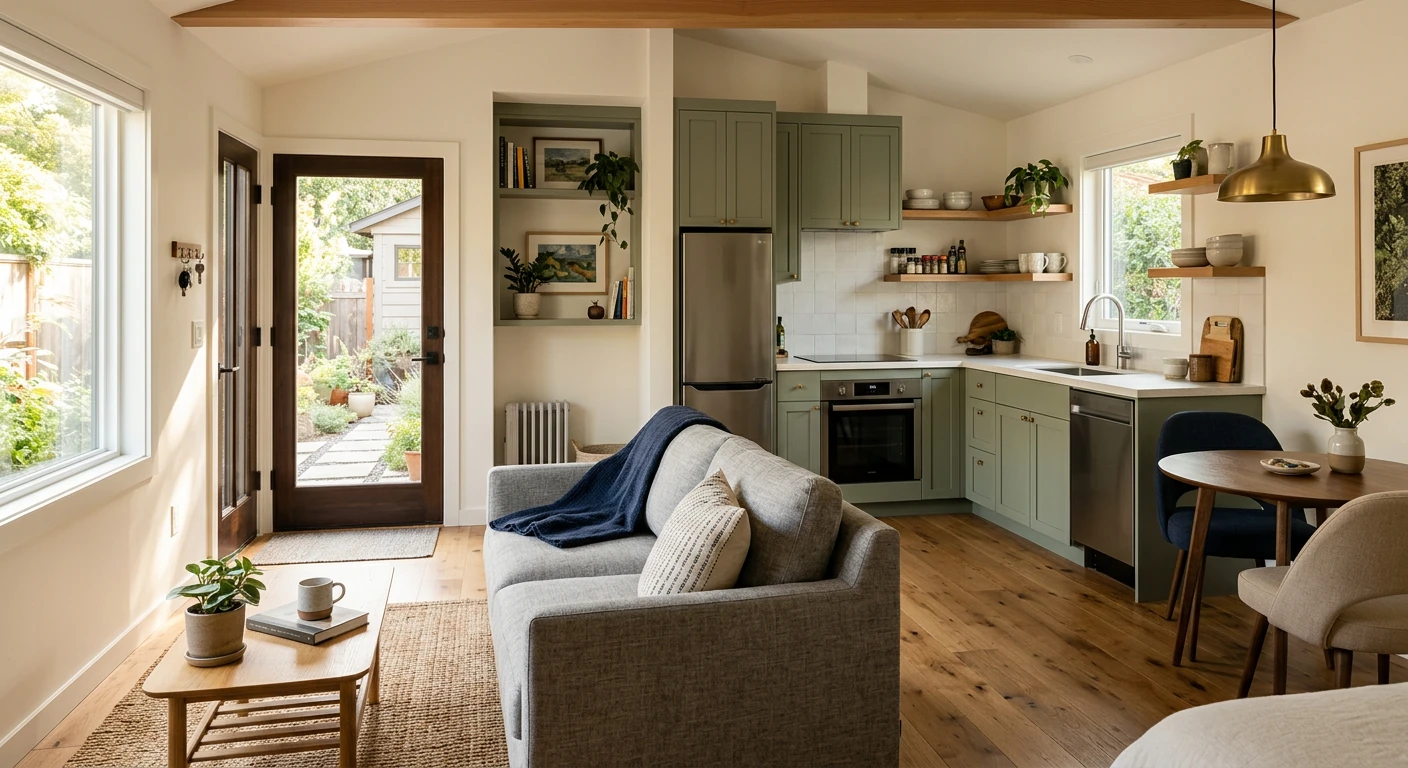
A well-finished ADU in the Salt Lake area — open kitchen, living, and dining in approximately 600 sq ft
Is It Worth It? Rental Income and ROI for Millcreek ADUs
For most homeowners, yes — especially in Millcreek's market. But let's look at the numbers honestly.
Estimated Rental Income
Millcreek sits in one of the most desirable rental corridors in Salt Lake County — central to downtown SLC, close to the University of Utah, and near the Cottonwood Canyons. That location drives strong rental demand.
Estimated long-term rental rates for the Millcreek area (based on Salt Lake County rental market data for comparable units, reviewed Q1 2026):
Your actual rent depends on finishes, exact location, and market conditions when you list. These are planning-level estimates, not guarantees.
Simple ROI Scenarios
Scenario
Build Cost
Monthly Rent
Annual Gross Income
Approx. Payback
Basement conversion (600 sq ft)
$80,000
$1,100
$13,200
~6 years
Detached ADU (700 sq ft)
$225,000
$1,400
$16,800
~13 years
Detached ADU (1,000 sq ft)
$300,000
$1,700
$20,400
~15 years
These are gross estimates before maintenance, taxes, insurance, and vacancy. Your numbers will be different. Use these for planning purposes, not underwriting.
Beyond the Spreadsheet
41% of ADU owners nationwide use them for family members, not rental income. The value of keeping your aging parent nearby instead of paying for assisted living, or giving your adult child an independent space while they save — that doesn't fit neatly in a payback table, but it's very real.
Millcreek's location, limited new housing supply (the city is largely built out), and Utah's population growth all support long-term demand for small, well-located rental units. A fully permitted, code-compliant ADU is an asset that appreciates while it pays you back.
What Makes Millcreek ADUs a Strong Investment
A few factors work specifically in Millcreek's favor:
Location. Millcreek is sandwiched between downtown Salt Lake City and the Cottonwood Canyons. It's close to the University of Utah, major employers, public transit, and world-class skiing. Renters want to be here.
Supply constraints. Millcreek is largely built out — there isn't much undeveloped land for new apartment complexes. Your ADU isn't competing with a flood of new construction. It's adding a scarce product to a market that has demand for it.
Code compliance as a competitive advantage. Millcreek's design standards, parking requirements, and permitting process create a natural barrier to entry. Not everyone will go through the effort. If you do, you're holding an asset that's harder to replicate — which supports both your rent and your resale premium.
Long-term flexibility. Use your ADU as a home office today. Convert it to a rental when you need income. House a family member when circumstances change. Sell the whole property at a premium when you're ready. A permitted ADU gives you options that a single-use property doesn't.
The bottom line on ROI: An ADU won't make you rich overnight. But it steadily builds equity, generates income, and gives you optionality that most homeowners don't have. Whether the payback period is 6 years (basement conversion) or 13+ years (detached new build), you're building something that works for you over time.
How to Build an ADU in Millcreek: Step-by-Step Process
The process is straightforward if you follow it in order. The Millcreek homeowners who hit delays are almost always the ones who jumped to design before confirming feasibility.
Step 1: Verify Your Property Qualifies
Before you hire anyone or draw anything, confirm the basics: zone (R-1 or A), lot size, owner-occupancy, slope, easements, and which ADU type is feasible.
Call Millcreek Planning & Zoning at 801-214-2700 or email planner@millcreekut.gov for a pre-application consultation. Or get a site assessment from a local builder who knows Millcreek code — they can often tell you what's realistic in a single property visit.
What a good site visit looks like: The builder walks your property, measures the rear yard, identifies utility access points, checks driveway and parking stall placement, and flags potential complications (steep slope, existing structures near property lines, drainage, large trees). This usually takes 30–60 minutes and should be free.
Step 2: Choose Your ADU Type and Hire a Design Team
Decide between internal, attached, or detached. Hire an architect or designer with Millcreek ADU experience — not just general residential experience. Millcreek's design standards (material matching, color matching, window placement, entrance screening) are specific enough that a generic architect may produce plans that need significant revision.
If your builder offers design-build services (architecture + permitting + construction under one roof), that's often the smoothest path.
Step 3: Submit Your ADU Application
Submit to Millcreek Planning and Zoning with: letter of intent, ADU affidavit, ADU checklist, property owner affidavit, site plan, building elevations, and floor plan. (Millcreek ADU page)
Any new detached ADU must apply for a site plan review. An ADU application must be completed before a building permit can be applied for.
The Planning Director reviews and issues a Compliance Determination in writing. If compliant, a notice is recorded at the Salt Lake County Recorder's Office. (MKZ 18.71.050)
Step 4: Obtain Building Permits
Most ADUs require a building permit, reviewed by three entities: City Engineer, Planner, and Fire Marshal — checking building, fire, zoning, and engineering compliance. (Millcreek ADU page)
If an existing structure doesn't comply with current setback, height, or coverage requirements, the project may need a permit from the Land Use Hearing Officer.
Step 5: Construction
Hire a licensed general contractor experienced in Millcreek ADU construction. Typical timelines:
• Internal/basement conversion: 2–4 months
• Attached ADU: 3–6 months
• Detached ADU (new build): 4–8 months
Expect inspections at key stages: foundation, framing, rough-in (electrical, plumbing, mechanical), insulation, and final.
What construction actually looks like for a detached ADU: The first few weeks are site prep — excavation, foundation work, utility trenching from your main house to the build site. Then framing goes up (you'll see the structure take shape in days). After framing, the roof goes on, followed by windows and exterior doors. The trades come through next: electricians, plumbers, HVAC installers doing rough-in work. Insulation, drywall, and finishing work fill the next several weeks. Finally, exterior finishing (siding, paint to match your home's colors per Millcreek's standards) and interior finishes (flooring, cabinetry, fixtures, appliances) bring it home.
Expect some disruption. Crews need rear-yard access, utility trenching may temporarily affect landscaping, and materials will move through your side yard or driveway. A good builder minimizes the impact, but zero disruption on a project of this scale isn't realistic. Most homeowners find it very manageable — annoying for a few months, worth it for decades.
Communication matters. Your builder should provide weekly updates at minimum. If they go quiet for two weeks, that's a red flag. Ask about their communication process before signing.
Step 6: Final Inspection and Compliance Letter
The city conducts a final inspection. Once passed, you receive your ADU compliance letter. The compliance notice is recorded at the Salt Lake County Recorder's Office — it runs with the property permanently.
Step 7: Obtain a Business License (If Renting)
All ADU rentals in Millcreek require a valid business license. This triggers building inspections to ensure the rental is maintained to code. (Millcreek ADU page)
Realistic Timeline
Phase
Estimated Duration
Feasibility check + pre-application
2–4 weeks
Design + engineering
4–8 weeks
Application + plan review
4–12 weeks
Construction
3–8 months
Final inspection + compliance
1–2 weeks
Total
6–14 months
The single biggest thing you can do to stay on the shorter end? Start with a builder who has navigated Millcreek's process before and knows exactly what the city expects in every submittal.
Talk to a Millcreek ADU builder who knows the permitting process
The right builder can cut months off your timeline. Start with someone who's already been through Millcreek's review process — not someone figuring it out on your project.
What Most Millcreek Homeowners Get Wrong About ADU Projects
We're going to be honest with you for a second, because it'll save you money.
Building an ADU in Millcreek takes longer and costs more than most people expect. The permitting process alone can run 1–3 months. Total project timelines of 9–12 months are common. A detached ADU is a six-figure investment. There's no shortcut around that reality.
But here's what we see over and over: the projects that blow budgets and timelines almost always started wrong. Wrong builder. Wrong sequence. Wrong assumptions.
The Mistakes That Actually Cost Money
Starting design before checking feasibility. If your lot doesn't meet the 8,000-square-foot minimum for detached and you've already paid $8,000 for architectural plans, that money is gone. Always confirm feasibility first. A 30-minute call with Millcreek Planning & Zoning (801-214-2700) can save you thousands.
Drawing plans that ignore Millcreek's design standards. We've seen homeowners arrive with plans that don't account for frosted-window requirements, entrance screening, or parking stall placement. The architect designed a beautiful ADU — just not one that complies with MKZ 18.71. Redesigns are expensive and demoralizing. Make sure whoever designs your ADU has read the actual Millcreek code, not just a generic "Utah ADU guide."
Underestimating conversion costs in older homes. Basement and garage conversions look cheap on paper — until you discover the foundation needs waterproofing, the electrical panel needs upgrading, fire separation requires structural work, or the ceiling height doesn't meet code without lowering the floor. Get a thorough assessment of the existing space before committing to a budget. The worst surprises come after demolition starts.
Counting on Airbnb income from a detached ADU. Millcreek prohibits short-term rentals in detached units. If your financial model depends on Airbnb-level nightly rates, you need internal or attached — or you need to rerun the numbers at long-term rental rates. This isn't a minor detail; it fundamentally changes the economics.
Hiring a builder who sells the dream before screening the lot. A beautiful 3D rendering means nothing if the builder hasn't checked your setbacks, verified lot coverage, confirmed parking works, and measured the distance from your main building (remember: 6-foot minimum). The best builders start with site feasibility, not sales presentations.
Ignoring utility distance. Running water, sewer, gas, and electrical to the far end of a large rear yard can cost $20,000+ on its own. If a builder's estimate doesn't explicitly line-item utility connections, ask. This is one of the biggest sources of budget surprises on detached ADU projects.
Skipping the pre-application consultation. Millcreek Planning & Zoning offers pre-application consultations. Take advantage of this. A planner can flag issues with your property that would otherwise surface weeks into the application process — saving you revision time and potentially redesign costs.
The good news: Every one of these mistakes is avoidable with the right builder. A contractor who has already navigated Millcreek's process, who designs to the city's standards from day one, and who does a real site assessment before quoting — that builder saves you months and tens of thousands.
Start with a builder who knows Millcreek code
Free feasibility review. A builder who's done this before will flag the issues that cost homeowners money before you've committed to anything.
How to Choose the Right ADU Builder in Millcreek
Not all contractors are equal when it comes to ADUs, and not all ADU builders know Millcreek's specific requirements. Here's what to evaluate.
The Builder Checklist
1. Have you built ADUs specifically in Millcreek? Not just Salt Lake County. Each city has its own code, review process, and planning staff. Millcreek experience matters.
2. Are you a licensed general contractor in Utah? Verify at dopl.utah.gov.
3. Can you show me completed ADU projects? Photos, addresses, and references from past Millcreek clients.
4. Will you give me a detailed written estimate? Not a vague range. A line-item estimate for your specific site — including utilities, parking, and site prep.
5. Do you handle design, permitting, AND construction? Design-build firms are often more efficient because the architect and builder coordinate on code compliance from the start.
6. Do you know MKZ 18.71? Ask them to explain Millcreek's design standards. If they can't describe the material-matching, frosted-window, and entrance-screening rules, they haven't done enough Millcreek work.
7. Will you commit to a timeline in writing? A project schedule with milestones, not "roughly 6–8 months."
8. Do you carry general liability insurance and workers' comp? Non-negotiable.
Red Flags
• No Millcreek-specific experience
• Won't provide a written estimate before you commit
• Pressure to sign quickly or large upfront deposit
• Unfamiliar with Millcreek's current ADU ordinance
• No portfolio of local ADU work
Questions to Ask on Your First Call
1. "Walk me through the last Millcreek ADU you completed — from application to final inspection."
2. "What's the most common reason Millcreek ADU permits get delayed, and how do you prevent it?"
3. "How do you handle the material-matching and color-matching design standards?"
4. "What do you budget for utility connections on a detached rear-yard ADU?"
5. "Can I talk to a Millcreek homeowner you've built for?"
A confident builder answers these without hesitation. If they stumble, they might be excellent elsewhere — but you want someone who's been through Millcreek's process, not someone figuring it out on your project.
Design-Build vs. Separate Architect + Contractor
Both approaches work. But for ADUs specifically, design-build tends to be more efficient because the designer and builder coordinate on Millcreek's requirements from the start. There's one point of accountability for code compliance, budget, and schedule. And you avoid the common scenario where an architect designs something the builder can't build within budget, or that doesn't account for a Millcreek-specific design standard.
If you hire separately, make sure your architect has Millcreek ADU experience. The design standards (material matching, entrance screening, window treatment near property lines) are specific enough that a general residential architect may produce plans that need revision — and revisions cost time and money.
What a Good Builder Conversation Feels Like
The right builder will ask you more questions than you ask them on the first call. They'll want to know your lot size, your zone, what you want to use the ADU for, whether you've checked for easements, what your driveway situation looks like for parking, and what your budget range is. They'll be honest about what your property can and can't do before they try to sell you on a design.
If a builder leads with glossy renderings and monthly payment calculations before they've even looked at your lot, that's a sign they're selling a product, not solving your problem.
Get connected with a Millcreek ADU builder
Free estimate, no pressure. We match Millcreek homeowners with builders who know the local code, have done this before, and will give you straight answers about what's feasible on your property.
What Happens After Your ADU Is Built?
When Millcreek approves your ADU, a compliance notice is recorded at the Salt Lake County Recorder's Office. That notice runs with the property permanently — if you sell, the next owner inherits the ADU rights and obligations, including the owner-occupancy requirement.
You cannot sell the ADU separately. It's tied to the primary property. But a fully permitted, code-compliant ADU is a premium selling point — it's a legal income-producing asset that's already built, approved, and ready to rent.
If you're renting, remember that Millcreek requires a valid business license for all ADU rentals, with periodic building inspections to ensure the unit stays to code. Stay current on your license and address repairs promptly. Budget roughly 1–2% of the ADU's construction cost per year for ongoing maintenance — HVAC servicing, exterior upkeep, appliance replacement, and routine repairs. Your rental income will cover that many times over.
Finding tenants in the Millcreek area is typically straightforward given the location's desirability. Most ADU owners list on platforms like KSL Classifieds, Zillow Rental Manager, and Facebook Marketplace. A well-photographed listing with clear details about the space, parking situation, and utilities will attract interest quickly.
Managing the rental: For a single ADU on your own property, self-management is simple — you're right there. If you'd rather be hands-off, local Salt Lake County property management companies handle ADU rentals. Just make sure they understand Millcreek's business license and compliance requirements.
How We Research and Verify This Page
We believe you should know where our information comes from.
Utah Code §10-21-304 — Detached ADUs (SB 284, effective October 1, 2026)
Cost data is sourced from Utah-based ADU builders, Angi's national ADU cost database, and ADU Utah's published construction cost data for Salt Lake, Davis, Weber, and Utah counties. Ranges were reviewed in Q1 2026.
Update policy: We review this page whenever Millcreek amends their ADU ordinance, and at minimum quarterly. The ADU code has been updated several times since the original 2021 ordinance. If you spot anything outdated, let us know.
Disclosure: Utah ADU Builders is a lead-generation and builder-matching resource. We connect Millcreek homeowners with local ADU builders. Builders are not paying to be ranked or listed on this page. When you request an estimate through our site, we connect you with builders who serve the Millcreek area and have experience with local ADU projects.
How much does it cost to build an ADU in Millcreek, Utah?
Detached ADUs typically cost $175,000–$400,000+ depending on size and finishes. Basement conversions are more affordable at $40,000–$150,000. New detached construction in Salt Lake County averages $200–$400 per square foot. Additional costs for permits, site prep, and utility connections can add $25,000–$75,000. See our cost section above for full methodology.
What is the maximum size for an ADU in Millcreek?
A detached ADU can be up to the lesser of 1,000 square feet or the gross square footage of the existing main building. Lot coverage requirements in your zone may further reduce the maximum. (Table 18.71-2)
Do I need a permit to build an ADU in Millcreek?
Yes. Most ADUs require a building permit. You also need to submit an ADU application to Millcreek Planning & Zoning and receive a Compliance Determination before construction. Detached ADUs require site plan review. (MKZ 18.71.050, Millcreek ADU page)
Can I rent out my ADU in Millcreek?
Yes. Long-term rentals (30+ days) are allowed for all ADU types with a compliance letter and Millcreek business license. Short-term rentals are allowed for internal and attached ADUs per the city's current guidance — verify current STR rules with Millcreek before planning around short-term rental income. Detached ADUs cannot be used as short-term rentals. (MKZ 18.71.090(C), Millcreek ADU page)
Does every Millcreek ADU need an 8,000-square-foot lot?
No. The 8,000-square-foot minimum applies to detached ADUs only. Internal and attached ADUs do not have a lot-size minimum, though they must comply with underlying zoning rules (lot coverage, parking, etc.). (Millcreek ADU page)
Can I Airbnb my Millcreek ADU?
Only if it's internal or attached. Detached ADUs are prohibited from short-term rental use. You'll need an ADU application and Millcreek business license. Verify current short-term rental rules with the city before underwriting STR income.
What zones allow ADUs in Millcreek?
R-1 (single-family residential) and A (agriculture) zones only. (MKZ 18.71.030(C))
How tall can a detached ADU be?
The lesser of 24 feet or the height of the existing main building. Above 14 feet, additional setback is required — one additional inch for each inch of height above 14. (Table 18.71-2)
How close can a detached ADU be to my house and property lines?
A detached ADU must be at least 5 feet from side and rear property lines, and at least 6 feet from the main building. Heights above 14 feet increase the property line setback. (Table 18.71-2)
Can I convert my garage into an ADU?
Yes, with conditions. You must provide at least one additional off-street parking stall for the ADU and replace the garage parking with at least one covered stall. The converted space must meet all current building and fire codes. (Millcreek ADU page)
Do I need a business license to rent my ADU?
Yes. Every ADU rental in Millcreek requires a valid Millcreek business license, and the rental is subject to building inspections. (Millcreek ADU page)
Can I sell my ADU separately from my house?
No. ADUs cannot be subdivided or sold separately from the primary property. (MKZ 18.71.060(A))
Does my ADU need a separate utility meter?
No. Separate meters are prohibited. All utilities must run through your primary dwelling. Secondary monitoring meters may be allowed — work with your utility providers. (MKZ 18.71.060(D), Millcreek ADU page)
Can I get a separate address for my ADU?
Yes. You can request a separate address through a site plan review application with Millcreek Planning & Zoning, with associated fees. (MKZ 18.71.110)
How long does it take to build an ADU in Millcreek?
Plan for 6–14 months from initial planning to move-in. Permitting typically takes 1–3 months. Construction is 3–8 months depending on ADU type and complexity.
What if my existing structure doesn't meet current codes?
Older buildings that don't comply with current setback, height, or coverage requirements may be convertible through the Land Use Hearing Officer process. Structures permitted before September 2021 may need to go through a noncomplying structure application. (MKZ 18.71.130)
Can I live in the ADU and rent out my main house?
No. Millcreek requires owner occupancy of the primary dwelling. You cannot occupy the ADU and rent the main house. (MKZ 18.71.030(A))
Can I use a mobile home or trailer as an ADU?
No. A detached ADU must be a permanent structure. Trailers, mobile homes, and portable structures — especially those with wheels — are not permitted. (MKZ 18.71.090(A))
What if I already have a guest house?
A lot with an existing guest house does not qualify for an additional detached ADU. You may convert the guest house to a compliant ADU if it meets all applicable detached ADU requirements. A guest house, by definition, may not be rented out or leased. (MKZ 18.71.130(A))
How do I check my zoning and lot size?
Call Millcreek Planning & Zoning at 801-214-2700 or email planner@millcreekut.gov with your address. You can also use the Millcreek zoning map at maps.millcreekut.gov to look up your property yourself. They can confirm your zone, lot size, and basic eligibility in minutes.
Does building an ADU increase my property taxes?
Adding livable square footage to your property will likely increase its assessed value, which can increase property taxes. The specific impact depends on your county assessor's valuation. Many homeowners find the rental income and property value increase outweigh the additional tax, but consult with a tax professional for your specific situation.
Can I build an ADU above my garage?
Potentially, if the resulting structure meets all detached ADU requirements — 8,000 square foot lot minimum, rear-yard location, height limits (lesser of 24 feet or your main building's height), setbacks, parking, and design standards. The existing garage structure may need structural reinforcement to support a second-story unit. This is one of those projects where engineering assessment is essential before committing to a design.
Start Your Millcreek ADU Project
You've seen the rules. You've seen the costs. You know the process. The only question left: is your specific property a good fit?
That's what a free feasibility check answers. And for most homeowners, it's the conversation that takes this from "I've been thinking about it" to "here's the plan."
Here's what happens when you reach out:
1. You share your property address and what you're thinking (rental income, family space, home office, etc.)
2. A local Millcreek ADU builder reviews your property for zoning, lot size, setbacks, parking, and ADU type eligibility
3. You get a no-obligation conversation with honest answers — whether an ADU makes sense, which type fits, and a realistic cost range for your lot
4. If you decide to move forward, they handle design, permitting, and construction
No pressure. No generic sales pitch. Just straight answers about what's feasible on your property.
Most Millcreek homeowners who reach out have been thinking about this for months. The feasibility question that felt overwhelming from the outside usually gets answered in a single conversation with the right builder. A 30-minute site visit can tell you whether detached works, whether internal or attached is the better path, and approximately what you're looking at for cost and timeline.
If you've been researching Millcreek ADUs, the fastest way to move from wondering to knowing is a conversation with someone who has already built on lots like yours.
Get Your Free Millcreek ADU Feasibility Check & Cost Estimate
A local Millcreek builder reviews your property — zone, lot size, setbacks, ADU type eligibility — and gives you a realistic cost range. Free. No obligation.
Or call Millcreek Planning & Zoning directly at 801-214-2700 to ask about your property's eligibility.
This guide is published by Utah ADU Builders and updated regularly to reflect the latest Millcreek ordinance changes. We are an ADU builder-matching resource for homeowners across Utah. The information on this page is for educational purposes and does not constitute legal, financial, or building advice. Always verify regulations with Millcreek Planning & Zoning and consult licensed professionals before beginning your project.
Prefer to talk through your Millcreek ADU project?
Calls begin with Utah ADU Builders, an independent planning and matching resource—not a city office or contractor. If you request an introduction, we may connect you with one independent local provider that appears to fit your project. A match is not an endorsement.