
ADU Builders in Provo & Utah County: Costs, Local Rules, and How to Get Started
Last reviewed: June 27, 2026 · Sources: Utah Code §10-21-303 — Internal ADUs; §10-21-304 — Detached ADUs (SB 284, effective Oct 1, 2026); Provo City Code & Development Services. Local rules can change after state legislation or city ordinance updates. Always verify final eligibility with the city before purchasing plans, ordering prefab units, or applying for financing.
Building an ADU in Provo or Utah County typically costs $150,000–$350,000 for a detached unit, or roughly $150–$350 per square foot. Basement conversions can start closer to $40,000. Both Provo and Orem allow accessory dwelling units on residential lots, but the rules differ by city — and getting the zoning wrong before you hire a builder is the most expensive mistake you can make. This guide covers exact costs, city-by-city regulations, the full permitting timeline, how to vet contractors, and what kind of rental income you can realistically expect in Utah County.
Written by Utah ADU Builders, ADU Project Advisors · Last updated: June 27, 2026 · Sources: Provo City Code, City of Orem, Utah Legislature (§10-21-303, formerly §10-9a-530), Utah DOPL, Angi, HUD Fair Market Rents
What's on this page:
- Can I actually build an ADU on my property?
- Provo vs. Orem vs. other Utah County cities — rules at a glance
- How much does an ADU cost in Utah County?
- Garage conversion costs (the budget path)
- The full building process and timeline
- How to choose the right builder (and avoid bad bids)
- How to verify a contractor's license in Utah
- Rental income and ROI — is an ADU worth it here?
- How to finance your ADU
- Permits and inspections — what to expect
- Prefab ADUs vs. custom build
- Common mistakes that blow budgets and timelines
- Frequently asked questions
Can I Actually Build an ADU on My Property?
Short answer: probably, but it depends on your city and your zone.
Utah state law (Utah Code §10-21-303, formerly §10-9a-530) requires municipalities to allow internal accessory dwelling units — the kind built inside an existing home, like a basement apartment — in areas zoned for residential use. That's statewide. Every city in Utah County has to comply with that baseline.
Detached ADUs — standalone backyard structures — are a different story. Those are governed by local city ordinances, and the rules vary quite a bit between Provo, Orem, Lehi, and other Utah County cities.
Here's a quick way to figure out where you stand before you spend a dollar.
The 60-Second Feasibility Check
Before you call a builder, before you call an architect, answer these five questions:
- Which city is your property in? Provo, Orem, Lehi, Spanish Fork, Springville, and other Utah County cities all have different rules. Don't assume — verify.
- What type of ADU do you want? Internal (basement apartment), attached addition, garage conversion, or detached new build? Internal ADUs have the fewest regulatory hurdles statewide. Detached units face more city-specific restrictions.
- Do you live on the property? Both Provo and Orem require owner occupancy. In Provo, the property owner must live in either the main dwelling or the ADU. This isn't optional — it's a requirement for the accessory apartment to be legal.
- Do you have enough parking? Provo requires at least four parking spaces that conform to city standards. Two of those can be tandem on a driveway if the driveway leads to a carport or garage. Other cities have their own parking minimums.
- What's your rental plan? Under Utah law, internal ADUs are defined as long-term rentals of 30 or more consecutive days. If you're dreaming of Airbnb income, you'll need to check your city's short-term rental policy separately — it's a different conversation.
If you answered "yes" to owner occupancy, have a reasonable parking situation, and your city allows the ADU type you want, you're likely in good shape to move forward. The next step is calling your city's Development Services or Building Department to confirm your specific zoning.
Provo residents: Call 801-852-6427 (Development Services) to confirm your zone allows ADUs.
Orem residents: Call 801-229-7000 or visit the city's accessory apartment page for the official checklist.
Provo vs. Orem vs. Other Utah County Cities — Rules at a Glance
This is where most people get stuck. Every Utah County city has its own version of the rules, and digging through municipal code isn't most people's idea of a good time.
We compiled the key details. Here's what you need to know.
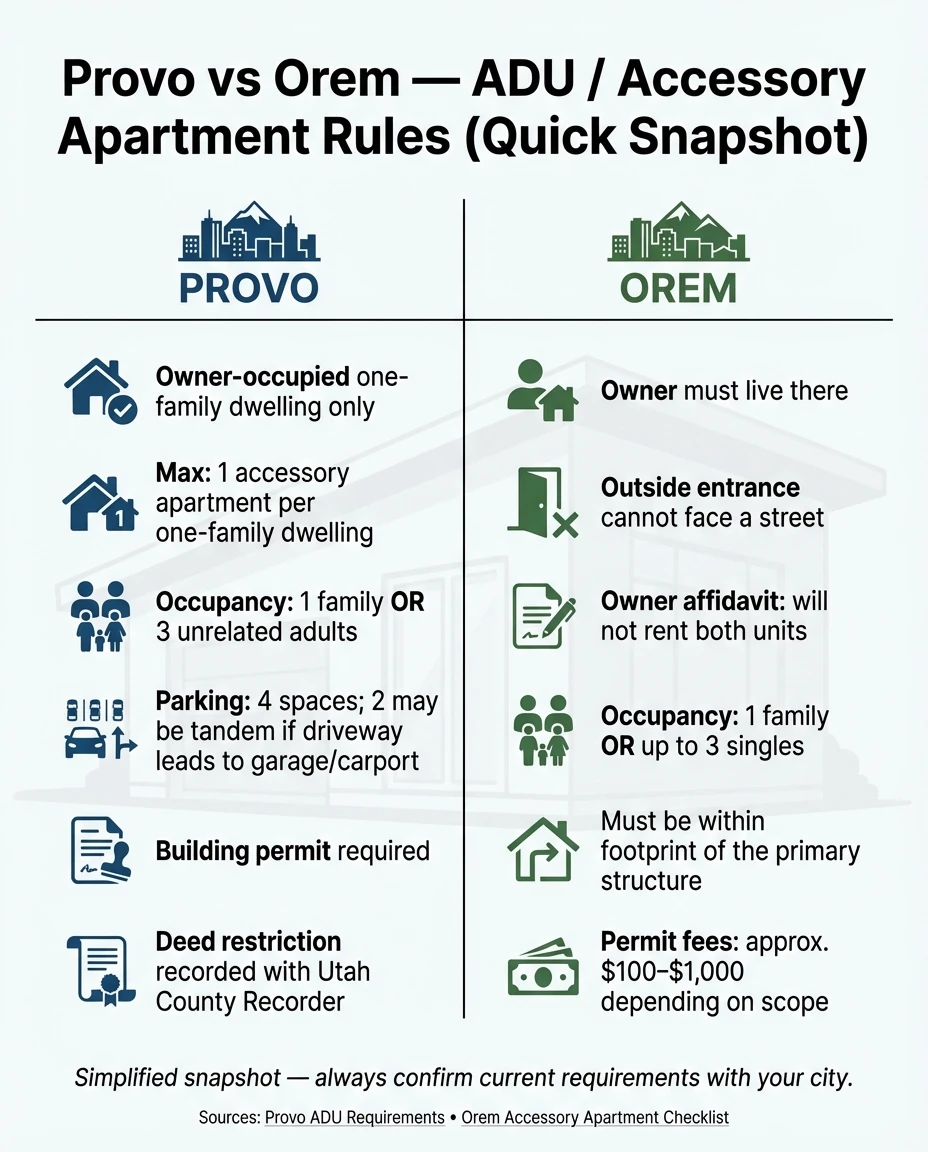
Provo ADU Rules (Detailed)
Provo's ADU regulations are found in Provo City Code §14.30.030, and they're more detailed than most cities in the county. Here are the key requirements, cited directly from the city's published rules:
| Rule | What Provo Requires | Source |
|---|---|---|
| Where allowed | Most residential zones: RA, R1, R2, LDR, MDR, HDR, CMU, VLDR, RM, RC, and several overlay zones | Provo City Code §14.30.010 |
| Internal ADUs | Allowed in zones listed above | §14.30.010 |
| Detached ADUs | Allowed where internal ADUs are permitted | §14.30.010(4) |
| Owner occupancy | Required — owner must live in either the main dwelling or the ADU | §14.30.030 |
| One ADU per lot | Only one accessory dwelling per one-family dwelling | §14.30.030(1) |
| Appearance | Must not alter appearance of single-family dwelling from street view. No second front door visible from front yard. New entrances on side or rear only. | §14.30.030(3) |
| Interior access | Interior access between main dwelling and internal ADU must be maintained | Provo ADU Requirements PDF |
| Setbacks (detached) | 10 ft from property line or existing setback of main dwelling, whichever is less | §14.30.030(2)(b)(ii) |
| Parking | At least 4 spaces conforming to Provo standards. Two may be tandem on driveway if leading to covered parking. | §14.30.030(5) |
| Utility meters | Internal: 1–2 meters max, in owner's name. Detached: separate meter required, in owner's name. | §14.30.030(6) |
| Separate address | Required — assigned by Provo City | §14.30.030(7) |
| Deed restriction | Must be recorded with Utah County Recorder | §14.30.030 |
| Rental license | Required — annual business license for rental dwelling | Provo City Code §6.26.020 |
| Occupancy limit | ADU limited to one family or three unrelated adults | Provo ADU Requirements PDF |
| Foundation (detached) | Must be permanently affixed to site-built foundation | §14.30.030(2)(b)(iv) |
| Shipping containers | Only if they meet all building codes AND are clad with materials compatible with main dwelling | §14.30.030(2)(b)(vi) |
| Building permit | Required, plus interior inspection for compliance | §14.30.030 |
The BYU factor: Provo is a university city with over 10,000 students (BYU alone enrolls 30,000+). Under Utah Code §10-21-303 (formerly §10-9a-530), cities with universities of this size can prohibit internal ADUs in up to 67% of their residential zones, compared to the standard 25% for other cities. That means where in Provo you're building matters a lot. Check your specific zone.
Provo contacts:
Development Services (zoning questions): 801-852-6427
Building Division: provo.gov/200/Building
Orem ADU Rules
Orem calls them "accessory apartments" rather than ADUs, but the concept is the same. Key differences from Provo:
| Rule | Orem Requirement | Source |
|---|---|---|
| Terminology | "Accessory apartment" (subordinate dwelling within main residential building) | Orem City accessory apartments page |
| Owner occupancy | Required — owner must live in either main dwelling or accessory apartment | Orem City ordinance |
| Official checklist | Orem publishes a specific checklist and maintains a list of legal accessory apartments | orem.gov/accessory-apartments/ |
| Permit fees | Range from approximately $100–$1,000 depending on scope | Orem plan submittal checklist PDF |
| Sewer connection | If sewer main is within 300 ft, connection may be required (per checklist) | Orem checklist document |
UVU factor: Orem is home to Utah Valley University (40,000+ students), creating strong rental demand similar to Provo's BYU market.
Orem contacts:
General: 801-229-7000
Official checklist: orem.gov/accessory-apartments/
Other Utah County Cities — Quick Reference
Utah state law requires all municipalities to allow internal ADUs in residential zones. Detached ADU rules vary by city. Here's a quick reference for the rest of Utah County:
| City | Internal ADU | Detached ADU | Contact Phone | Notes |
|---|---|---|---|---|
| Provo | ✅ Most zones | ✅ Where internal allowed | 801-852-6427 | See detailed table above |
| Orem | ✅ State law | Check city ordinance | 801-229-7000 | Called "accessory apartments" |
| Lehi | ✅ State law | Check city ordinance | 385-201-1000 | Fast-growing; high demand |
| Spanish Fork | ✅ State law | Check city | City offices | |
| Springville | ✅ State law | Check city | City offices | |
| American Fork | ✅ State law | Check city | 801-763-3060 | |
| Pleasant Grove | ✅ State law | Check city | City offices | |
| Saratoga Springs | ✅ State law | Check city | City offices | |
| Eagle Mountain | ✅ State law | Check city | City offices | |
| Lindon | ✅ State law | Check city | 801-785-5043 | |
| Mapleton | ✅ State law | Check city | 801-489-5655 | |
| Payson | ✅ State law | Check city | City offices |
Important: "Check city" doesn't mean "probably no." It means the detached ADU rules are set locally, and you need to call to confirm. Many of these cities do allow detached ADUs — but the size limits, setbacks, and requirements vary. Always call before assuming.
What Utah State Law Says (The Baseline for Every City)
Regardless of which city you're in, Utah Code §10-21-303 (formerly §10-9a-530) establishes these statewide rules:
- Internal ADUs are a permitted use in areas zoned primarily for residential use.
- The owner must occupy the property as their primary residence.
- Rentals must be long-term (30+ consecutive days) for internal ADUs.
- Internal ADUs are not subject to impact fees — that's a real cost savings.
- HOAs cannot block internal ADUs that would otherwise be permitted by local zoning. This is a big deal. If your HOA tells you no, state law says otherwise for internal units.
- Cities can require: maintaining single-family appearance, one additional parking space (with some exceptions), no separate utility meter (for internal), and recording a notice with the county recorder.
Sources: Utah Code §10-21-303 (formerly §10-9a-530) (le.utah.gov); Utah Property Rights Office (propertyrights.utah.gov)
2026 Utah detached ADU law update (SB 284)
Utah SB 284 created Utah Code §10-21-304, effective October 1, 2026. In a "specified municipality," cities must allow one detached ADU on lots or parcels of 11,000 square feet or larger where a single-family home is allowed, and cities may allow detached ADUs on smaller lots. Cities may still regulate size, height, setbacks, lot coverage, design compatibility, utility capacity, owner-occupancy, front-yard placement, short-term rental use under 90 days, and whether more than one ADU is allowed. Local permits and building, fire, utility, and health-code review still apply. Because this statewide rule interacts with local zoning, confirm the current Provo ordinance and permit checklist before designing around a detached ADU.
How Much Does an ADU Cost in Utah County? (2026 Numbers)
This is the question that drives most of the searches we see — "Provo ADU cost," "ADU cost per square foot Utah," "how much to build an ADU in Utah." Let's answer it directly. For a broader look at statewide pricing, see our complete Utah ADU cost guide.
Cost by ADU Type
Not all ADUs are created equal, and the type you choose is the single biggest factor in what you'll spend:
| ADU Type | Typical Size | Total Cost Range (Utah County) | Approx. Cost per Sq Ft | Timeline |
|---|---|---|---|---|
| Basement conversion (internal) | 400–1,000 sq ft | $40,000–$120,000 | $100–$200 | 2–4 months |
| Garage conversion | 200–600 sq ft | $50,000–$150,000 | $150–$250 | 2–5 months |
| Attached addition | 300–800 sq ft | $100,000–$250,000 | $175–$300 | 4–8 months |
| Detached new build | 400–1,000 sq ft | $150,000–$350,000 | $200–$350 | 6–12 months |
| Prefab / modular | 400–800 sq ft | $100,000–$250,000 | $175–$300 | 3–6 months |
These ranges are based on Utah-specific construction costs. National benchmarks from Angi report that most homeowners spend between approximately $40,000 and $360,000, with an average around $180,000 and a per-square-foot range of $150–$300. Utah County falls within these ranges, with some variation based on site conditions, finishes, and utility complexity.
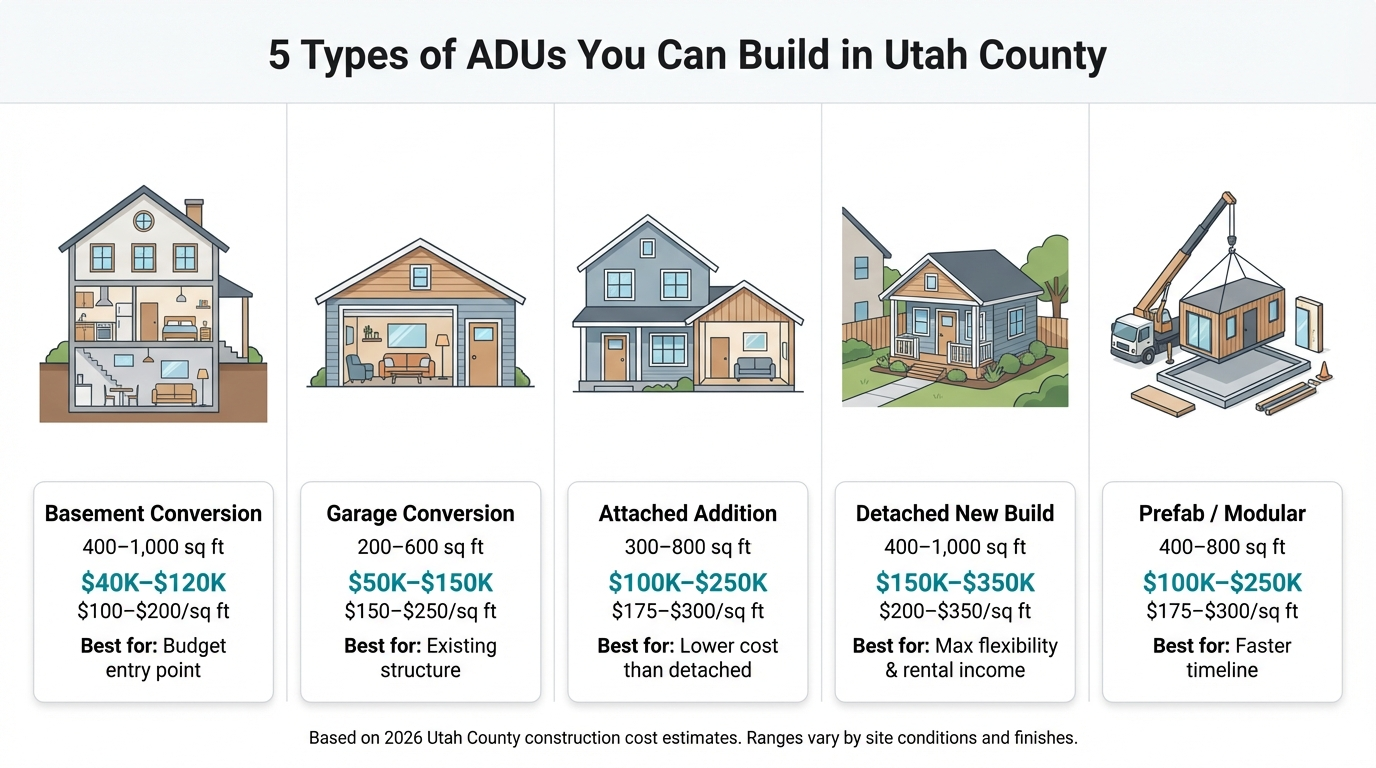
Why the range is so wide: A 400-square-foot basement conversion with basic finishes and existing plumbing is a fundamentally different project than a 1,000-square-foot detached cottage with a full kitchen, separate utilities, and custom finishes. Both are "ADUs." That's why anyone who gives you a single number without knowing your situation isn't giving you useful information.
Where Your Money Actually Goes
Here's a realistic breakdown of where the dollars go on a typical detached ADU project in Utah County:
| Cost Category | % of Total Budget | Estimated Range |
|---|---|---|
| Design and architecture | 5–15% | $7,500–$45,000 |
| Permits, plan review, and fees | 2–5% | $3,000–$15,000 |
| Site preparation and foundation | 8–15% | $12,000–$45,000 |
| Framing and structural | 15–20% | $22,500–$60,000 |
| Mechanical systems (plumbing, electrical, HVAC) | 15–20% | $22,500–$60,000 |
| Insulation, drywall, interior finishes | 10–15% | $15,000–$45,000 |
| Kitchen and bathroom | 8–15% | $12,000–$45,000 |
| Flooring, paint, and trim | 5–8% | $7,500–$24,000 |
| Exterior and landscaping | 3–8% | $4,500–$24,000 |
| General contractor fee | 10–20% | $15,000–$60,000 |
| Contingency (always budget this) | 10–15% | $15,000–$45,000 |
Sources: Angi ADU cost data (angi.com); DC Structures Utah ADU estimates (dcstructures.com); local contractor estimates
The Costs Nobody Warns You About
These are the line items that surprise people. Budget for them from the start:
Utility meter separation. Provo requires detached ADUs to have their own separate utility meter (§14.30.030(6)). That means a new meter installation for water, gas, and electric — which can run $5,000–$15,000+ depending on your property and the distance to existing connections.
Deed restriction recording. Provo requires recording a deed restriction with the Utah County Recorder. It's not expensive (usually under $100), but it's a legal step that affects your title and you should understand it before signing anything.
Rental dwelling license. If you plan to rent the ADU in Provo, you need a business license for a rental dwelling (Provo City Code §6.26.020). This requires annual renewal and an interior inspection.
Driveway and access modifications. If you need to meet Provo's four-parking-space requirement, you may need to expand your driveway or reconfigure your parking layout.
Landscaping restoration. Heavy equipment tears up yards. Budget $2,000–$5,000 to restore landscaping after construction.
Snow load engineering. Utah County gets real winter weather, and your ADU's roof needs to handle it. Structural engineering for snow loads is a standard requirement, but it adds to design costs — especially at higher elevations.
ADU Cost Per Square Foot in Provo — Why This Number Is Misleading
People search for "Provo ADU cost per square foot" because they want a simple number to multiply. We get it. But here's why per-square-foot numbers can steer you wrong:
A basement conversion and a detached new build can both be 600 square feet, but the basement might cost $100/sq ft while the detached build costs $300/sq ft. The "average" of those two ($200/sq ft) describes neither project accurately.
If you want a number: For new detached construction in Utah County with standard finishes, plan for $200–$350 per square foot as of 2026. For conversions and internal ADUs, $100–$200 per square foot is more realistic.
If you want accuracy: Get three bids for your specific project from contractors who've built ADUs in your city. That's the only number that matters.
Three Example Scenarios
To make these numbers concrete:
Scenario 1 — Basement conversion in Orem (budget path)
600 sq ft basement, basic finishes, existing plumbing stack nearby. Estimated cost: $60,000–$90,000. Timeline: 2–3 months of construction after permits.
Scenario 2 — Garage conversion in Provo (mid-range)
450 sq ft single-car garage, full kitchen and bath, new utility connections. Estimated cost: $80,000–$130,000. Timeline: 3–5 months.
Scenario 3 — Detached backyard cottage in Provo (full build)
800 sq ft, 1-bed/1-bath, full kitchen, separate utilities, standard finishes. Estimated cost: $200,000–$280,000. Timeline: 8–12 months including design and permits.
Garage Conversion ADU: The Budget-Friendly Path
Garage conversions are the most searched ADU cost question in the Provo area — and for good reason. If you already have a garage you're not fully using, converting it is usually the most affordable way to add a living unit to your property.
What Makes Garage Conversions Cheaper (and What Doesn't)
The savings come from having a structure already standing: walls, roof, and foundation are already there. What you're paying for is turning an unfinished shell into a livable space.
What you can usually reuse:
- Existing slab foundation (if in good condition and level)
- Roof structure (if it meets code for occupied space)
- Exterior walls (with added insulation)
What you'll almost certainly need to add or upgrade:
- Insulation (walls, ceiling, and potentially under the slab)
- Plumbing for kitchen and bathroom
- Electrical panel upgrade or subpanel
- HVAC (mini-split systems are the most common choice for ADU conversions)
- Egress windows or doors (required for bedrooms)
- Fire separation between ADU and main dwelling (if attached garage)
- Drywall, flooring, and interior finishes
- A separate entrance (Provo requires new entrances to be on the side or rear)
What Drives Garage Conversion Costs Up Fastest
If you want to control your budget, focus on these high-impact decisions:
- Moving plumbing — Adding a bathroom where no plumbing exists is the single most expensive variable. If you can locate the bathroom near an existing sewer line, you'll save thousands.
- Electrical service upgrade — If your home's electrical panel can't support the additional load, a panel upgrade runs $1,500–$4,000.
- Foundation work — If the garage slab is cracked, sloped, or not rated for living space, you may need remediation or even replacement. This can turn a budget project into an expensive one fast.
- Ceiling height — Many garages have low ceilings. If yours doesn't meet code height for habitable space (typically 7 feet minimum), you have a problem that's expensive to solve.
Garage Conversion Readiness Checklist
Before you commit to the garage conversion path, check these items. If you fail on the bolded ones, a garage conversion may not be your cheapest option after all:
- ☐ Slab is level, uncracked, and in good structural condition
- ☐ Ceiling height meets or exceeds 7 feet
- ☐ Existing sewer line is within reasonable distance (under 50 feet)
- ☐ Electrical panel has capacity or space for a subpanel
- ☐ Roof is in good condition and doesn't need replacement
- ☐ Walls are plumb and structurally sound
- ☐ No evidence of water intrusion or moisture problems
- ☐ Property has enough parking even without the garage (remember Provo's 4-space requirement)
- ☐ Garage is not in a flood zone or drainage path
- ☐ Access for a separate entrance exists on the side or rear
The Full ADU Building Process and Timeline
Building an ADU isn't a weekend project. Understanding the timeline upfront prevents frustration and helps you plan your life around the disruption. Here's how the process typically unfolds in Utah County.
Step 1 — Confirm Zoning and Feasibility (Week 1–2)
Call your city's Development Services department. Tell them your address and the type of ADU you want to build. Ask:
- "Is my property zoned for an ADU?"
- "What are the size and setback limits for my zone?"
- "Are there any known restrictions on my specific lot?"
In Provo, call 801-852-6427. In Orem, call 801-229-7000.
Also check for HOA restrictions — but remember that under Utah state law, HOAs cannot prohibit internal ADUs that are otherwise permitted by local zoning.
Step 2 — Define Your Goals and Set a Budget (Week 2–3)
What is this ADU for? The answer drives every design decision:
- Student rental (near BYU/UVU): efficiency layout, durable finishes, maximum bedrooms within size limits
- Aging parents or in-law suite: accessibility features, ground floor, proximity to main house
- Home office or studio: open floor plan, good lighting, fewer plumbing requirements
- Long-term rental income: full kitchen and bath, separate entrance, privacy from main dwelling
- Future flexibility: design it so it can serve multiple purposes over time
Set a budget range using the cost tables in this guide, and add 10–15% contingency. Always.
Step 3 — Hire an Architect or Designer and Create Plans (Week 3–10)
Your architect or designer will create the drawings your city requires for permitting. This includes:
- Site plan showing ADU location on your lot
- Floor plans and elevations
- Structural engineering (especially important in Utah for snow loads and seismic requirements)
- Energy compliance documentation
Design fees typically run 5–15% of the total project cost. For a $200,000 project, that's $10,000–$30,000.
Some design-build firms include design in their overall bid, which can streamline the process.
Step 4 — Apply for Building Permits (Week 10–24+)
This is the longest wait in the process. Plan for it.
Permitting in Provo frequently takes 3 months or more. You'll submit your completed plans to the Building Department, and they'll go through plan review — structural, fire, zoning compliance, utilities.
Once approved, you'll receive your building permit, and construction can begin.
Do not start any construction before permits are issued. Unpermitted work can result in fines, required demolition, and problems when you try to sell the property.
Step 5 — Hire Your Contractor and Break Ground (Month 5+)
With approved plans in hand, get bids from at least three licensed contractors. (We cover how to vet them in the next section.)
Construction phases for a typical detached ADU:
- Site preparation and excavation
- Foundation pour
- Framing
- Roofing and exterior shell
- Rough mechanical (plumbing, electrical, HVAC)
- Insulation and drywall
- Interior finishes (flooring, cabinets, fixtures)
- Exterior finishes and landscaping
Step 6 — Inspections Throughout Construction
Your city will require multiple inspections during construction:
- Foundation inspection (before pouring)
- Framing inspection
- 4-way inspection (mechanical — plumbing, electrical, HVAC, insulation)
- Final inspection (everything complete and code-compliant)
Each inspection must pass before the next phase of construction proceeds. Failed inspections mean rework and delays.
Step 7 — Certificate of Occupancy and Rental License
After the final inspection passes, you'll receive a certificate of occupancy. In Provo, if you plan to rent the ADU, you'll also need:
- A rental dwelling business license (Provo City Code §6.26.020)
- The recorded deed restriction with Utah County Recorder
- A separate address assigned by the city
Realistic Timeline Summary
| Phase | Duration | What Can Delay It |
|---|---|---|
| Zoning confirmation | 1–2 weeks | Unclear zone, lot restrictions |
| Budget and planning | 1–2 weeks | Indecision on goals or scope |
| Design and engineering | 4–8 weeks | Complex sites, multiple revisions |
| Permitting | 8–16+ weeks | Plan review backlogs, revisions required |
| Construction (detached) | 12–24 weeks | Weather, material delays, change orders |
| Inspections and licensing | 2–4 weeks | Failed inspections, corrections needed |
| Total | 6–14 months | Varies significantly by city, type, and complexity |
Basement and garage conversions are typically faster — 3–6 months from permit to completion. Detached new builds take longer.
How to Choose the Right ADU Builder in Utah County
This is where most homeowners feel the most anxiety, and for good reason. An ADU is a $100,000+ investment, and the contractor you choose determines whether the project comes in on time, on budget, and built to last — or becomes a horror story.
Here's how to do it right.
The ADU Builder Scoring System
When you're comparing bids, don't just look at the bottom-line price. Use a structured evaluation. Here's a scoring framework you can adapt:
| Evaluation Criteria | Weight | What to Look For |
|---|---|---|
| Local ADU permit experience | High | Have they pulled ADU permits in your specific city? Ask for permit numbers. |
| License and insurance verification | Must-pass | Active Utah GC license + general liability + workers' comp. No exceptions. |
| Detailed written estimate | High | Line-item breakdown, not a lump sum. Shows allowances for finishes. |
| Clear change order policy | High | Written policy for how changes are priced and approved. |
| Realistic timeline | Medium | If one bid promises half the time of the others, that's a red flag, not a feature. |
| References from ADU projects | High | Not just any references — ADU-specific ones you can actually call. |
| Warranty policy | Medium | Workmanship warranty (typically 1–2 years) + manufacturer warranties on materials. |
| Communication style | Medium | Do they return calls? Explain things clearly? Seem organized? |
| Payment schedule | High | Tied to milestones, not front-loaded. Never pay more than 10% upfront. |
| Subcontractor quality | Medium | Who does their electrical, plumbing, HVAC? Are they licensed? |
The 12 Questions to Ask Every ADU Builder
Before you sign with anyone, ask these:
- "How many ADUs have you built in [my city]? Can I see them or talk to the owners?"
- "Who pulls the permits — you or me?"
- "What's your realistic timeline, and what could delay it?"
- "What's included in your bid and what's excluded?"
- "What are the allowances in your bid? What happens when I pick materials that cost more?"
- "How do you handle change orders? What's the markup?"
- "What's your payment schedule? What triggers each payment?"
- "What's your warranty on workmanship?"
- "Who are your subcontractors for plumbing, electrical, and HVAC? Are they licensed?"
- "What happens if you go over budget or over schedule?"
- "Do you carry general liability insurance and workers' compensation?"
- "Can you provide your Utah contractor license number right now?"
A good contractor will answer all of these without hesitation. A bad one will get evasive or annoyed.
Red Flags — Walk Away If You See These
- No verifiable Utah contractor license. This is non-negotiable.
- Demands a large payment upfront (more than 10% before any work starts).
- "We don't really need permits for this." Yes, you do. Always.
- Cannot show you a single completed ADU project.
- Vague scope of work — if the bid is one page with a lump sum, you'll be arguing about what's "included" for the next six months.
- No written change order process. Change orders are where budgets explode. If there's no written process, you're vulnerable.
- The bid is dramatically lower than others. The cheapest bid usually means something is missing from the scope, or the contractor is planning to make it up in change orders.
How to Compare Three Bids (Apples to Apples)
When you get three bids, they'll probably look different — different line items, different categories, different levels of detail. Here's how to compare them fairly:
- Create a master list of every line item from all three bids combined.
- Fill in the gaps — if Contractor A includes landscaping but Contractor B doesn't, note that.
- Compare allowances — if one bid has a $5,000 kitchen allowance and another has $15,000, those aren't comparable without knowing what each gets you.
- Add back anything that's "excluded" to get the real total.
- Weight the non-price factors from the scoring table above.
The goal isn't finding the cheapest bid. It's finding the best value from a contractor you trust who can actually deliver.
How to Verify a Contractor's License in Utah
This takes five minutes and could save you from a six-figure mistake.
Utah's Division of Professional Licensing (DOPL) maintains a public Licensee Lookup & Verification system. Here's how to use it:
Step-by-Step License Verification
- Go to secure.utah.gov/llv/search/index.html (this is the official state site).
- Enter the contractor's name or business name.
- Look for license type: General Building Contractor (for ADU construction).
- Check that the status shows "Active" — not expired, revoked, or suspended.
- Check for any disciplinary actions in their history.
- Verify the business name matches what's on the contract they're asking you to sign.
If a contractor can't or won't give you their license number, or if their license doesn't check out on the state system, do not hire them. It doesn't matter how good their price is.
Source: Utah DOPL Licensee Lookup & Verification (secure.utah.gov/llv)
ADU Rental Income and ROI in Utah County
Let's talk about whether the numbers actually work. Because an ADU is an investment, and investments need to pencil out.
What Can You Charge for an ADU Rental in Provo and Orem?
Rental rates in Utah County depend on size, location, condition, and proximity to BYU or UVU. Here's what the data shows:
| ADU Size/Type | Estimated Monthly Rent | Annual Gross Income | Data Source |
|---|---|---|---|
| Studio / efficiency (300–450 sq ft) | $800–$1,100 | $9,600–$13,200 | Local listings, Utah rent averages |
| 1-bedroom (450–700 sq ft) | $1,000–$1,400 | $12,000–$16,800 | HUD FMR + Apartments.com data |
| 2-bedroom (700–1,000 sq ft) | $1,200–$1,700 | $14,400–$20,400 | HUD FMR Utah County: $1,355 (2-bed) |
Sources: HUD Fair Market Rents for Provo-Orem MSA (ushousingdata.com); Apartments.com Utah rent trends; Zillow Rental Manager
The BYU and UVU Rental Advantage
Utah County has something most ADU markets don't: two major universities creating year-round rental demand.
BYU enrolls over 30,000 students, and UVU enrolls over 40,000. That's 70,000+ students who need housing, and neither university can house all of them on campus. Off-campus student housing in Provo typically runs $400–$1,200 per person per month, depending on the arrangement.
This means:
- Demand is consistent. It's not seasonal like tourist markets.
- Vacancies are low. Student housing near campus rarely sits empty for long.
- Tenant turnover is predictable. Leases align with academic semesters.
- Provo's 30-day minimum rental requirement aligns perfectly with semester-length leases.
An ADU within walking or biking distance of either campus is a particularly strong rental asset.
A Simple ROI Framework
Here's how to think about the financial return. This is simplified — your actual numbers will depend on your specific costs, rent, financing, and tax situation.
Example: Detached 1-bed ADU, $200,000 total cost
| Line Item | Monthly | Annual |
|---|---|---|
| Gross rental income | $1,300 | $15,600 |
| Less: property taxes (incremental) | -$150 | -$1,800 |
| Less: insurance (incremental) | -$75 | -$900 |
| Less: maintenance and repairs | -$100 | -$1,200 |
| Less: vacancy allowance (5%) | -$65 | -$780 |
| Net operating income | $910 | $10,920 |
- Cash-on-cash return (if paid cash): ~5.5%
- Simple payback period: ~18 years
- But that's not the whole story. Property value increase from an ADU is estimated at 20–35% of the ADU's construction cost. On a $200,000 ADU, that's $40,000–$70,000 in added home value — equity you gain immediately.
The real math: When you factor in property appreciation, rental income, tax benefits (depreciation, mortgage interest deduction if financed), and the long-term value of having a flexible space, most Utah County ADU investments pay for themselves well within the mortgage period.
Disclaimer: This is an illustration, not financial advice. Actual returns depend on your specific situation. Consult a financial advisor or CPA for investment decisions.
Beyond Rental Income — Other Ways ADUs Create Value
Not every ADU is about monthly rent checks:
- Multi-generational housing: Keep aging parents nearby without giving up anyone's independence.
- Boomerang kids: Adult children returning home get their own space (and everyone stays sane).
- Home office or studio: Separate workspace on your property — no commute, potential tax deductions.
- Future downsizing: Move into the ADU and rent the main house, or vice versa.
- Property value floor: Even if you never rent it, the ADU adds appraisal value.
How to Finance Your ADU
ADUs aren't cheap, and most people don't have $150,000–$300,000 sitting in a savings account. Here are the realistic financing paths:
| Financing Option | Typical Rates | Pros | Cons | Best For |
|---|---|---|---|---|
| Home equity loan / HELOC | 7–10%+ | Use existing equity; relatively lower rates | Puts your home at risk; need sufficient equity | Homeowners with 20%+ equity built up |
| Cash-out refinance | 6–8%+ | Lower rate than HELOC; lump sum | Replaces existing mortgage; closing costs | Owners with a low existing rate (compare carefully) |
| Construction loan | 7–12%+ | Designed for building projects; converts to permanent | Higher rates; more paperwork; draws process | New detached construction |
| Personal loan | 8–15%+ | No collateral; fast approval | Higher rates; lower limits ($50K–$100K typical) | Smaller projects like garage conversions |
| ADU-specific lending | Varies | May use after-renovation value of property | Limited availability | Check Utah credit unions |
| Cash / savings | 0% | No interest; no approval process | Depletes reserves | Those with sufficient liquid assets |
Utah-Specific Financing Notes
- Utah credit unions often offer more competitive construction loan terms than national banks. Shop locally.
- No impact fees for internal ADUs under state law — that's direct cost savings that improves your financing math.
- RenoFi-style loans can use the projected after-renovation value of your home, which means you may qualify for more than traditional equity-based loans allow.
- Talk to your CPA about depreciation deductions and other tax benefits of rental ADUs before you finalize your financing structure.
Permits and Inspections — What to Expect
Nobody loves the permitting process, but understanding it prevents surprises.
What You'll Need for Your Permit Application
Most Utah County cities require:
- Completed application form from the city's Building Department
- Site plan showing ADU location, setbacks, parking, and utility connections
- Architectural plans (floor plans, elevations, cross-sections)
- Structural engineering stamped by a licensed Utah engineer
- Energy compliance documentation
- Utility confirmation (water and sewer availability)
- Application fees (vary by city — Orem's checklist shows a range of approximately $100–$1,000)
Provo-Specific Permit Notes
From Provo's published requirements:
- Building permit is required before any work begins
- An interior inspection verifies code compliance
- The city will issue corrections if needed — you fix them, then pass final inspection
- The deed restriction (ADU Agreement) must be notarized and recorded with Utah County Recorder
- The rental dwelling license is a separate application once the ADU passes final inspection
How to Avoid Permit Rejections
The most common reasons permits get kicked back:
- Plans don't show required setbacks clearly. Double-check your measurements.
- Missing engineering. Structural, and sometimes civil engineering, is typically required.
- Incomplete utility plans. Show where water, sewer, electric, and gas connect.
- Parking doesn't meet the code. In Provo, four spaces are required.
- Energy code non-compliance. Utah has adopted energy code requirements — your designer needs to address them.
A good architect or designer who's worked in your city before will know what the Building Department wants to see and can save you rounds of revisions.
Prefab ADUs vs. Custom Build in Utah County
Prefab promises faster timelines and more predictable costs. Here's the honest comparison.
Four Paths to an ADU
| Path | Cost Predictability | Timeline | Design Flexibility | Complexity |
|---|---|---|---|---|
| Traditional (architect + GC) | Medium — depends on bids and change orders | Longest (8–14 months) | Highest — fully custom | You coordinate architect + GC |
| Design-build firm | Higher — one contract covers everything | Moderate (6–10 months) | High — custom within their process | Simplest for homeowner |
| Prefab kit + local contractor | Higher — kit price is fixed; site work varies | Faster (4–7 months) | Limited to manufacturer's models | Need a GC for site work, foundation, utilities |
| Factory-built modular | Highest — factory pricing | Fastest (3–5 months) | Limited to available models | Crane delivery; site work still needed |
Companies Shipping Prefab ADUs to Utah
Several companies serve the Utah County market:
- DC Structures — prefab ADU kits with delivery to Utah (dcstructures.com)
- Nest Tiny Homes — local Utah builder (801-903-2219)
- IronTown Modular — modular construction, factory-built (877-849-1215)
The Hidden Costs of Prefab
The kit or module price is never the final number. You'll still need to budget for:
- Site preparation and foundation (the ADU has to sit on something)
- Utility connections (water, sewer, electric, gas)
- Crane or equipment delivery access
- Permits and inspections (same as site-built)
- Interior finishes (some kits are shell-only)
- Snow-load engineering (critical in Utah)
DC Structures advises homeowners that total turnkey costs typically run 3–5 times the kit price. So a $50,000 kit becomes a $150,000–$250,000 project.
Provo's Rule on Shipping Containers
This comes up a lot: "Can I use a shipping container as an ADU?"
Provo's code specifically addresses this. Shipping containers are permitted only if they meet all building codes and are clad with materials that are architecturally compatible with the main dwelling (Provo City Code §14.30.030(2)(b)(vi)). In practice, this means a bare shipping container won't pass — it needs to be finished to look like it belongs in a residential neighborhood.
Common Mistakes That Blow Budgets and Timelines
We've seen these patterns over and over. Every one of them is avoidable.
1. Not confirming zoning before spending money on design. If your zone doesn't allow what you want, all the design fees are wasted. Make one phone call first.
2. Skipping the contingency budget. Things go wrong. Materials get backordered. The plumber finds something unexpected behind the wall. Budget 10–15% contingency and hope you don't need it.
3. Hiring a contractor without ADU experience. General remodeling contractors don't always understand ADU-specific code requirements — separate utilities, parking compliance, deed restrictions. Hire someone who's done this in your city.
4. Underestimating the permitting timeline. People budget for construction time but forget that permits alone can take 3–4 months in Provo. Build this into your planning.
5. Forgetting about utility connection costs. Separate meters, sewer hookups, and electrical service can add $5,000–$15,000+ to your budget.
6. Building too small. This seems counterintuitive, but the marginal cost per square foot drops as the ADU gets larger. The fixed costs (permits, foundation, utility connections, design) are roughly the same whether you build 400 sq ft or 800 sq ft. If your lot allows it and your budget has room, building toward the maximum size gives you more rental income for minimal additional cost.
7. Not getting a rental dwelling license in Provo. Operating a rental without the required business license is a code violation that can result in license revocation for the ADU.
8. Assuming your HOA can stop you. For internal ADUs, Utah state law overrides HOA restrictions. Know your rights.
9. Paying too much upfront. A payment schedule should be tied to construction milestones. Never pay more than 10% before work begins, and never pay the final 10–15% until the punch list is complete.
10. Not planning for the long term. Your ADU's purpose may evolve. The rental you build today might become your mom's apartment in ten years, or your home office in twenty. Design with flexibility in mind.
Frequently Asked Questions
Provo ADU Questions
Can I build an ADU in Provo?
Yes, in most residential zones. Provo allows both internal and detached ADUs in zones including RA, R1, R2, LDR, MDR, HDR, and others. However, it depends on your specific zone — Provo's Development Services (801-852-6427) can confirm your property's eligibility.
Do I need to live on the property to have an ADU in Provo?
Yes. The property owner must occupy either the main dwelling or the ADU. This is a firm requirement under Provo City Code.
How many parking spaces do I need for an ADU in Provo?
At least four spaces that comply with Provo's parking standards. Two of those may be tandem on a driveway if the driveway leads to covered parking.
Can I put a second front door on my house for the ADU entrance?
No. Provo requires that the home continue to look like a single-family dwelling from the street. There can only be one front door visible from the front yard. New entrances for the ADU must be on the side or rear of the home.
Do I need to record something with the county?
Yes. Provo requires a deed restriction (ADU Agreement) to be notarized and recorded with the Utah County Recorder. This runs with the land.
Do I need a rental license to rent out my ADU in Provo?
Yes. Under Provo City Code §6.26.020, you need a business license for a rental dwelling. It requires an interior inspection and annual renewal.
Orem ADU Questions
What does Orem call an ADU?
Orem uses the term "accessory apartment" for a subordinate dwelling within a main residential building.
Does Orem require owner occupancy?
Yes. The property owner must live in either the main dwelling or the accessory apartment.
Where can I find Orem's official ADU checklist?
Visit orem.gov/accessory-apartments/ for the official checklist, requirements, and the city's list of legal accessory apartments.
What are Orem's permit fees?
Per the city's published checklist, permit fees range from approximately $100 to $1,000 depending on the scope of the project.
Cost Questions
What's the average cost to build an ADU in Utah?
National data from Angi shows most homeowners spend between approximately $40,000 and $360,000, with an average around $180,000. In Utah County, detached new builds typically run $150,000–$350,000, while conversions start as low as $40,000.
What's a realistic cost per square foot for an ADU in Provo?
For detached new construction with standard finishes: $200–$350 per square foot. For conversions (basement, garage): $100–$200 per square foot. These are estimates — get multiple bids for your specific project.
Is a garage conversion cheaper than a detached ADU?
Usually, yes. Garage conversions typically cost $50,000–$150,000 because you're starting with an existing structure. However, issues like low ceiling height, slab condition, or plumbing distance can close that gap.
Builder and Licensing Questions
How do I verify a Utah contractor's license?
Use the state's official Licensee Lookup at secure.utah.gov/llv/search/index.html. Search by contractor name or business name, confirm the license is active, and check for disciplinary actions.
Should I hire a design-build firm or separate architect and contractor?
Both work. Design-build is simpler (one contract, one point of contact) and often faster. Separate architect + GC gives you more control over design and the ability to bid the project competitively. For most ADU projects, design-build is the more efficient path.
What payment schedule is normal for ADU construction?
A typical schedule: 10% at contract signing, then payments tied to milestones (foundation, framing, mechanical rough-in, drywall, substantial completion). Final 10–15% held until the punch list is complete. Never pay the full amount before the work is done.
Legal and Rental Questions
Can I use my ADU as an Airbnb in Provo?
Internal ADUs under Utah state law are defined as long-term rentals (30+ consecutive days). Short-term rental rules are set by individual cities. Contact Provo's Development Services for current short-term rental policies.
Can my HOA prevent me from building an internal ADU?
No. Under Utah Code §10-21-303, HOAs cannot prohibit internal ADUs that are otherwise permitted by local zoning. This applies to CC&Rs and HOA rules. Detached ADUs may still be subject to HOA restrictions.
Do I need a separate address for my ADU?
In Provo, yes. The city assigns a separate address for the ADU (§14.30.030(7)).
What's the minimum rental term for an internal ADU in Utah?
30 consecutive days, as defined by Utah Code. This applies to internal ADUs statewide.
Can I sell my ADU separately from my main house?
No. ADUs are part of the same lot and cannot be subdivided or sold independently.
Why Build an ADU in Utah County Right Now?
If you've made it this far, you're serious. Here's the context that makes this a particularly good time to act:
Utah's population growth is among the fastest in the nation. The state is projected to grow from 3.6 million to 5.6 million by 2065, according to the Kem C. Gardner Policy Institute. That means sustained housing demand for decades.
The legislature is actively encouraging ADUs. Utah has passed increasingly favorable ADU legislation, requiring cities to allow internal ADUs and limiting the ability of HOAs to block them. The regulatory environment is moving in your favor, not against you.
University-driven rental demand isn't going away. BYU and UVU aren't shrinking. Between them, 70,000+ students need housing every year. An ADU near either campus is as close to a guaranteed tenant base as residential real estate gets.
Interest rates and construction costs will fluctuate, but property values in Utah County have a strong long-term trajectory. Building an ADU now means locking in today's construction costs while benefiting from future appreciation.
Provo's own General Plan identifies ADUs as a strategy for increasing housing supply. The city recognizes the need and has signaled support at the planning level.
Next Steps — Get Your ADU Project Moving
You now have more information about building an ADU in Provo and Utah County than 95% of homeowners who start this process. Here's how to put it to work:
Step 1: Confirm your zoning. Call your city. This takes 10 minutes and it's free.
- Provo: 801-852-6427
- Orem: 801-229-7000
- Other cities: see the contact table above
Step 2: Set your budget range. Use the cost tables in this guide. Add 10–15% contingency.
Step 3: Get three bids from licensed contractors. Use the vetting checklist and questions from this guide. Verify every license at secure.utah.gov/llv.
Or, if you want to skip straight to a local builder:
Sources
This guide cites the following primary and authoritative sources:
- Provo City Code §14.30.010 and §14.30.030 — ADU permitted uses and development standards (provo.municipal.codes)
- Provo Accessory Dwelling Unit Requirements PDF — Official city requirements checklist (provo.gov/DocumentCenter/View/874)
- Provo City Code §6.26.020 — Rental dwelling license requirements
- City of Orem Accessory Apartments page — Official regulations and checklist (orem.gov/accessory-apartments/)
- Orem Accessory Apartment Checklist PDF — Plan submittal requirements and fees (orem.gov)
- Utah Code §10-21-303 (formerly §10-9a-530) — State requirements for accessory dwelling units (le.utah.gov)
- Utah Code §10-21-303 — Internal accessory dwelling unit regulations
- Utah Code §10-21-304 — Detached ADUs (SB 284, effective October 1, 2026)
- Utah Property Rights Office — ADU legal topic overview (propertyrights.utah.gov)
- Utah DOPL Licensee Lookup & Verification — Contractor license verification (secure.utah.gov/llv)
- Angi — ADU cost benchmarks and national data (angi.com)
- HUD Fair Market Rents — Provo-Orem MSA rental data (ushousingdata.com)
- DC Structures — Utah prefab ADU cost estimates (dcstructures.com)
- ADU Utah — Utah ADU regulation directory (aduutah.com)
- Kem C. Gardner Policy Institute — Utah population projections
Methodology
Cost ranges in this guide are based on published national benchmarks (Angi), Utah-specific builder estimates (DC Structures, ADU Utah), and regional construction cost data. We've adjusted for Utah County conditions where possible. All regulatory information is cited to official city and state sources.
Verify contractor licensing through Utah's DOPL system and obtain current insurance documentation before hiring.
Cost and regulatory information is reviewed and updated quarterly. Rental income estimates are based on HUD Fair Market Rents and current listing data.
Disclosures
This website is an ADU project matching service. We connect homeowners with licensed local contractors and may receive compensation when a match results in a project. We are not the builder.
This guide is for informational purposes. It is not legal, engineering, or financial advice. Zoning, building codes, and regulations change — always verify current requirements with your city before starting a project.
All cost estimates are approximate and based on available data. Your actual costs will depend on your specific project, site conditions, and the contractors you hire. Get multiple bids for accurate pricing.