
ADU Financing Utah: How to Pay for a Basement, Garage, or Detached ADU
Most Utah homeowners shouldn't start by shopping for "an ADU loan." Start by matching the financing to the project: a HELOC or home equity loan if you have usable equity, a construction or renovation loan for larger permit-driven builds, or cash or family funds for simplicity.
This guide on ADU financing in Utah is for homeowners who've decided an ADU is possible and now need to pay for one. It's not for anyone counting on a grant to cover it — there's no broad statewide grant program in Utah as of 2026. It's a decision tool, not a loan offer.
Last verified: June 2026. Figures are estimates and national averages, not loan offers; rates and program terms change — confirm current details before you rely on them. This is general education, not financial or tax advice.
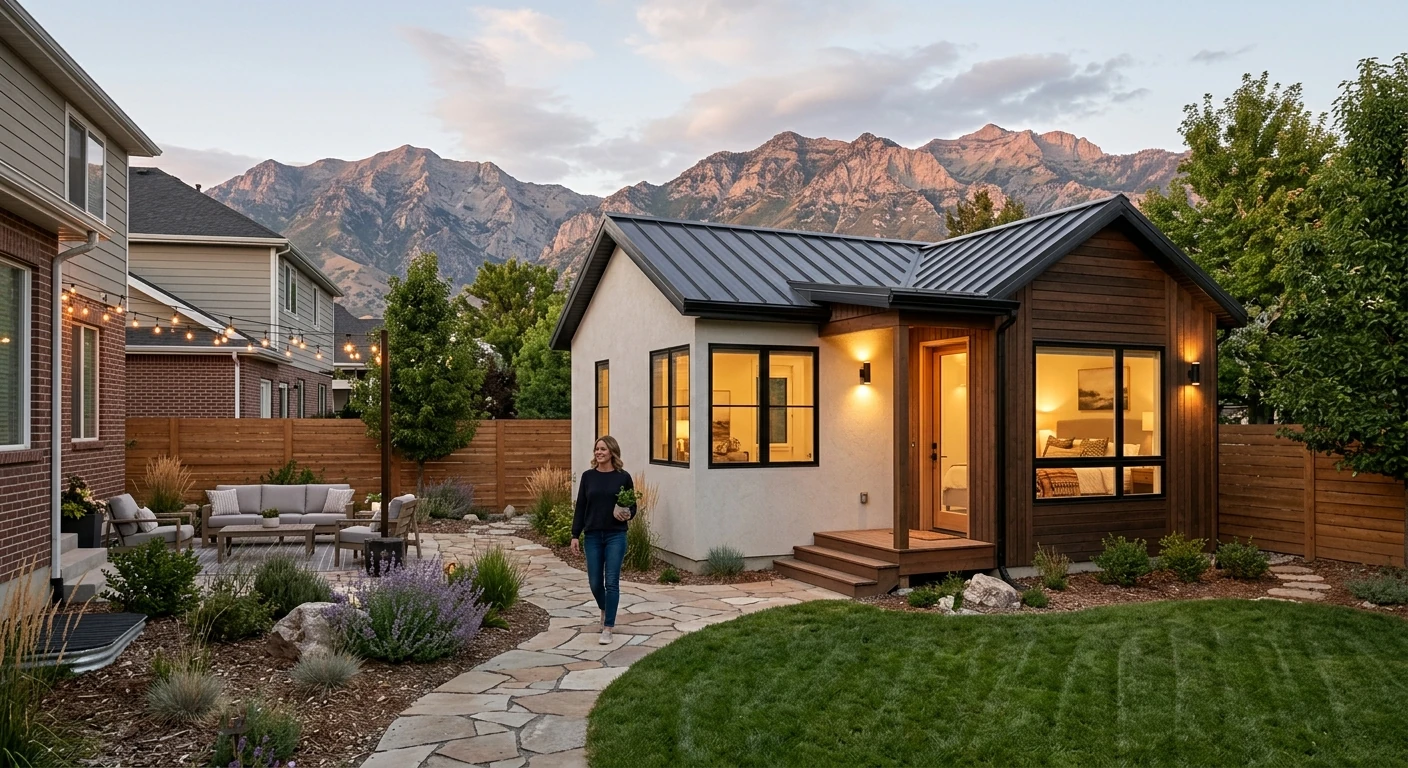
Concept image; actual design, cost, and approval depend on site and local rules.
How this guide works. Utah ADU Builders is a Utah-focused ADU planning, feasibility, and builder-matching resource. We are not a lender, bank, mortgage broker, financial advisor, city office, law firm, architect, engineer, or contractor. We may receive compensation when homeowners request a feasibility review or estimate, or are connected with local professionals. That compensation does not control how we explain Utah ADU rules, costs, financing options, or permitting risks.
What we verified for this page (June 2026)
- • Consumer-loan basics and risks — Consumer Financial Protection Bureau (CFPB), Federal Trade Commission (FTC)
- • ADU renovation/construction mortgage rules — Fannie Mae (HomeStyle Renovation), Freddie Mac (CHOICERenovation), HUD/FHA (203(k); Mortgagee Letter 2023-17)
- • Using ADU rental income to qualify — Fannie Mae Selling Guide, HUD/FHA, Freddie Mac
- • Utah ADU law (internal vs. detached) — Utah Code Title 10, Chapter 21; Utah Property Rights Ombudsman; 2026 legislative session
- • Local program details — Salt Lake City Community Reinvestment Agency (CRA) and Community Development Corporation of Utah (CDCU)
- • Rate context — Bankrate national averages
Specific source links are listed at the end of this guide.
Which ADU type are you financing?
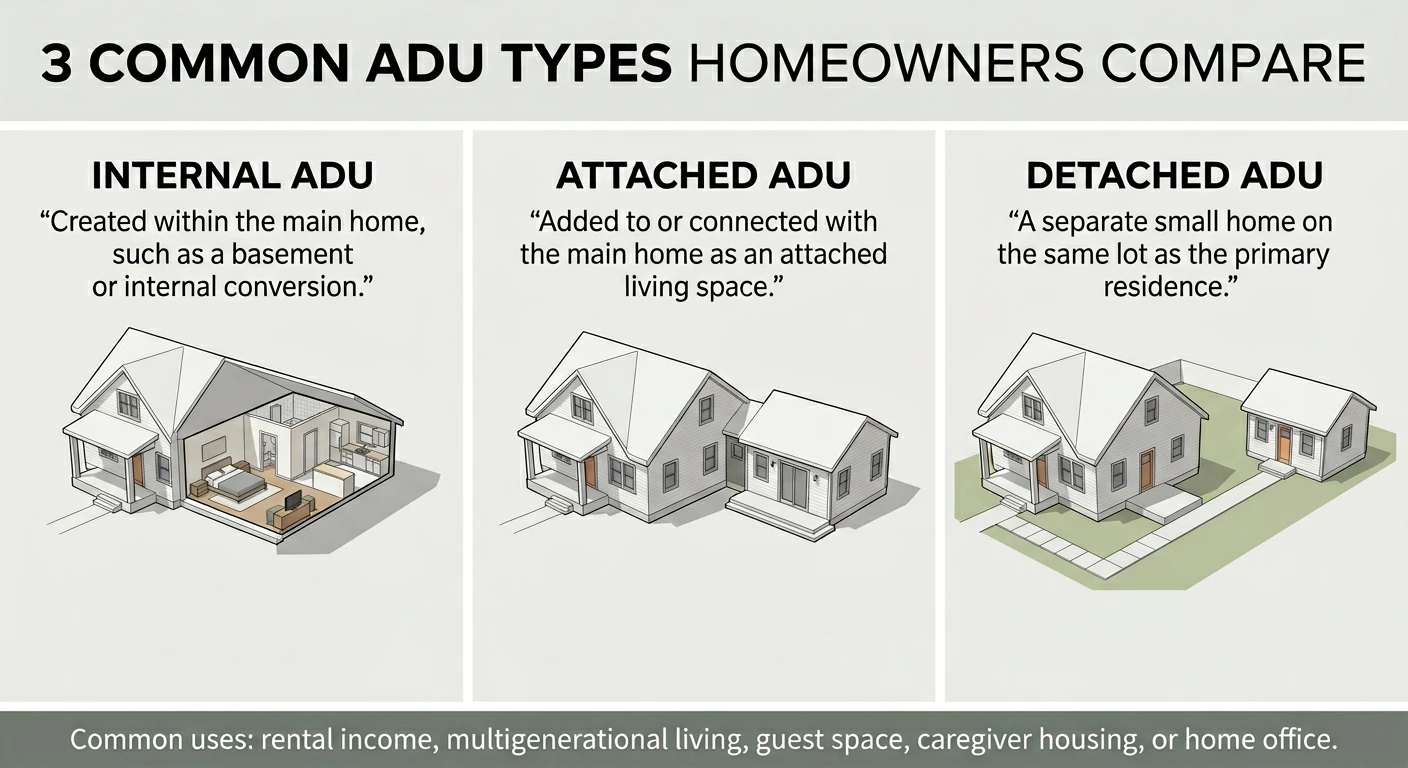
An ADU (accessory dwelling unit) is a second, self-contained living space — its own kitchen, bathroom, and entrance — on the same lot as your main home. The type you build changes the cost, the permit path, the appraisal, and the rental rules, so it also changes your financing:
- Internal ADU — created inside your existing home (a basement or attic conversion).
- Attached ADU — an addition connected to the house with its own entrance.
- Detached ADU — a standalone structure in the yard, including a new backyard cottage or a detached garage conversion.
Garage conversion isn't always "detached." Converting a detached garage usually falls under detached-ADU rules, while converting an attached garage may be treated more like an internal or attached ADU, depending on your city's code and your design. That affects setbacks, parking replacement, and the documents a lender will want.
What's the fastest way to find your ADU financing option?
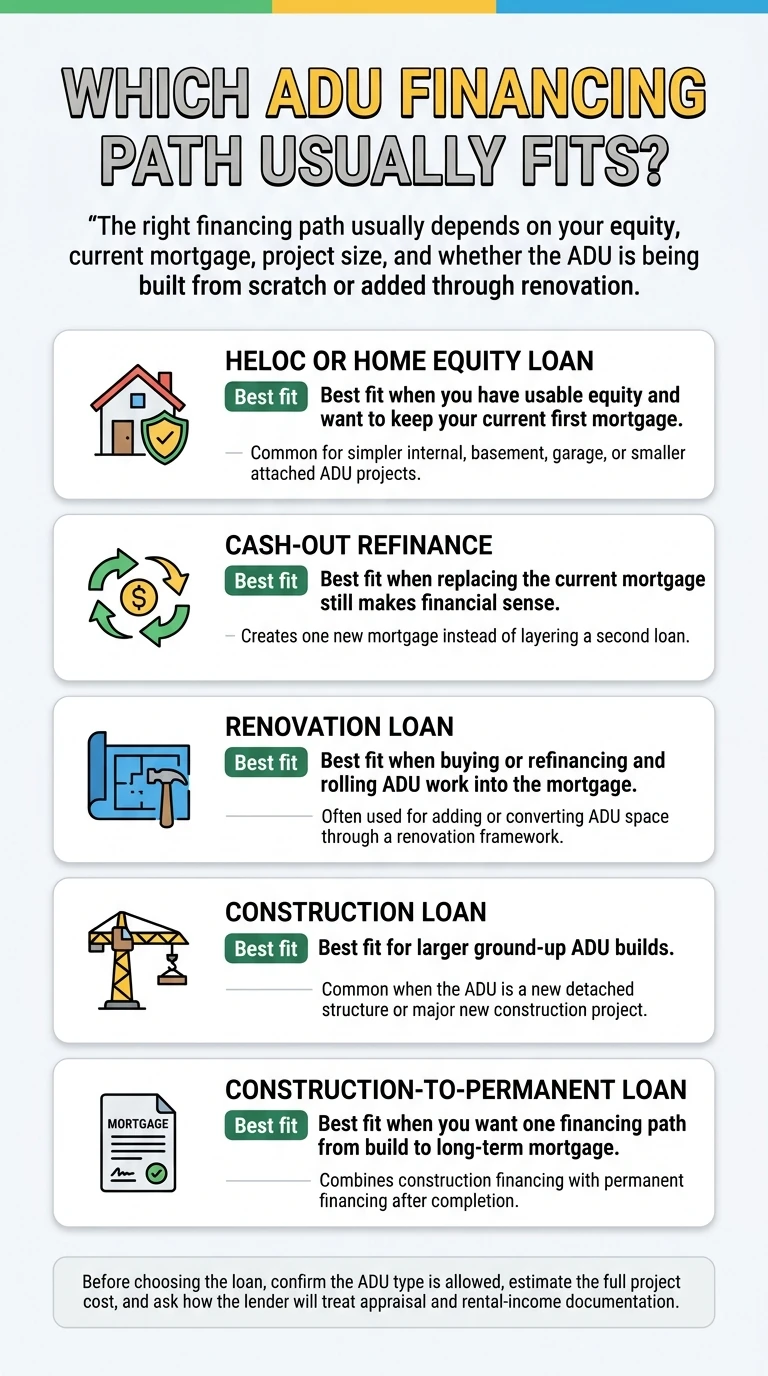
The quickest way to narrow it down is to start with two questions: do you have usable home equity, and do you want to keep your current (probably low) mortgage rate? From there, what you'll use the ADU for — family housing, rental income, or resale flexibility — points to one or two realistic paths.
Match your situation to the first option worth comparing:
| Your situation | First option to compare |
|---|---|
| Strong equity, low current mortgage rate you want to keep | HELOC |
| Equity plus a clearly defined budget | Home equity loan |
| You'd rather have one new mortgage | Cash-out refinance |
| Building a larger detached ADU | Construction (construction-to-permanent) loan |
| Buying or refinancing and renovating | Renovation loan (HomeStyle, FHA 203(k), CHOICERenovation) |
| Owner-occupant west of I-15 in Salt Lake City | Backyard Keys program |
| You have cash or family support | Cash / family funds |
The big lever for most people right now: whether to keep your existing low first-mortgage rate or give it up. HELOCs, home equity loans, and Backyard Keys leave your first mortgage alone. Cash-out refinances and many construction-to-permanent loans replace it. If you locked a rate in the 2–4% range, replacing it to fund an ADU is usually the most expensive route.
Before you choose financing, get three things straight: (1) is your ADU type actually allowed on your lot, (2) what's the realistic all-in cost with a contingency, and (3) do you want to keep your first mortgage? A feasibility and cost check answers the first two quickly.
A path is far easier to compare once you know what your property can support and what budget range is realistic.
Why feasibility comes before the loan
Financing isn't only about your credit and equity — it's also about whether the ADU is legal, permit-ready, and rentable as you intend. In Utah, the project has to clear local feasibility before a lender's answer is reliable, because legality affects the appraisal, any rental-income assumptions, insurance, and resale.
See also: ADU insurance in Utah — how coverage by type, rental use, and construction phase works, including the detached-ADU "other structures" gap. And: ADU appraisal in Utah — how contributory value is determined, when ADU rent counts toward qualifying, and how the county assessment differs from a lender's appraisal.
How Utah's rules differ by ADU type
Utah treats internal and detached ADUs differently, and this is where most confusion lives.
Internal ADUsSince October 1, 2021
Have had statewide protection as a permitted use since October 1, 2021 — but it's narrow. Cities can still:
- • Require an extra off-street parking space (and replacement parking when a garage is converted)
- • Apply building, fire, and health codes (egress, fire separation)
- • Require a rental license
- • Limit internal ADUs on the smallest lots (roughly 6,000-square-foot threshold)
- • Restrict them to long-term rental of 30 days or more
- • Require owner-occupancy in either the main home or the ADU
- • Prohibit them in detached garages (detached garage conversions often fall under detached-ADU rules)
Detached ADUsIn Effect Since October 1, 2026
Utah’s detached-ADU requirement took effect October 1, 2026. In specified municipalities, Utah Code §10-21-304 requires a local regulation allowing detached ADUs on qualifying lots of at least 11,000 square feet that contain a single-family dwelling where that use is permitted. Covered cities are defined by city and county class in §10-21-101; this is not a rule for every Utah municipality or county. Municipalities may allow smaller lots. Building codes, permitted local development standards, utilities, permits, and private restrictions still affect the project.
For a financing plan, confirm the local rules for setbacks, structure size, owner occupancy, utility capacity, and rental duration. Section 10-21-304 permits a municipality to prohibit rentals shorter than 90 consecutive days; that is separate from the internal-ADU rules.
A note on "setbacks" and "owner occupancy." A setback is the minimum distance a structure must sit from your property lines. Owner occupancy means you must live in either the main home or the ADU — many Utah cities require it for ADU approval, sometimes recorded as a covenant on the property. Both can affect whether your plan is buildable and rentable.
Salt Lake County example: The ADU ordinance requires a minimum lot of 6,000 sq ft for an internal ADU and 7,000 sq ft for a detached ADU (with a narrow zone exception), allows only one ADU per lot, prohibits selling or subdividing the ADU, and requires written confirmation of water/sewer capacity before issuing a permit. Your city or county may set different numbers. (Source: Salt Lake County Office of Regional Development.)
What can break a financing plan
| Potential blocker | Why it matters for financing |
|---|---|
| ADU not allowed as you've designed it | The loan, appraisal, insurance, and rental assumptions can all fail |
| No realistic, all-in budget | Easy to under-borrow and stall mid-project |
| No plans or contractor bid yet | Construction and renovation lenders may not have enough to underwrite |
| Unknown utility upgrades | Sewer, water, electrical, trenching, or capacity can move the budget a lot |
| Parking or owner-occupancy gap | Affects legal use, and therefore appraisal and rental income |
| A short-term-rental assumption | Many Utah ADU rules restrict or prohibit nightly rentals |
| HOA or private covenant | City approval doesn't erase private restrictions on your lot |
| Appraisal gap | If the finished value doesn't support the cost, you cover the difference |
A feasibility check helps you avoid comparing loans for a project your lot can't carry as planned.
Utah ADU Financing Fit Matrix
Here's the same financing question cut a different way — by what you're actually building. Use it to see the realistic options for your project type, what to confirm first, and the trap that most often derails that path in Utah.
| What you're building | Financing to compare first |
|---|---|
| Basement / internal ADU | HELOC, home equity loan, renovation loan, cash |
| Attached addition | Home equity loan, renovation loan, construction-to-permanent, cash |
| Attached garage conversion | HELOC, home equity loan, renovation loan, cash |
| Detached garage conversion | HELOC, home equity loan, renovation loan, cash |
| New detached ADU (backyard cottage) | Construction-to-permanent, renovation loan, home equity, cash |
| Buying a home + adding/renovating an ADU | FHA 203(k), Fannie HomeStyle, Freddie CHOICERenovation, construction-to-permanent |
| Owner-occupant west of I-15 in SLC | Backyard Keys, then equity options or cash |
| Have cash or family help | Cash / family funds, possibly a small loan |
Tell us your property and project type, and we'll help you see what's feasible and roughly what it costs before you compare financing.
HELOC vs. home equity loan for a Utah ADU
Both let you borrow against the equity you've built, and both keep your existing first mortgage in place — which is why they're so popular right now. The difference is structure: a HELOC is a revolving line you draw from as the project unfolds, while a home equity loan is a fixed lump sum. Both use your home as collateral, so missed payments carry foreclosure risk.
A HELOC (home equity line of credit) is an open-end line secured by your home, with a draw period when you borrow and pay interest on what you use, followed by a repayment period when payments can rise (CFPB). That flexibility suits a phased basement or garage project where the final number isn't fixed. The catch: most HELOCs carry variable rates tied to the prime rate, and some lenders now require a large minimum draw at closing, which can erase the "borrow as you go" benefit.
A home equity loan is secured by your home and usually delivers a fixed lump sum with predictable payments; if you don't repay, you can lose the home (FTC). It fits a project with a clear, scoped budget. It's less forgiving if costs run over, since you borrowed a set amount. For a deeper walkthrough of using a HELOC specifically for an ADU — draw strategy, timing the draws to construction phases, and where it goes wrong — see our HELOC for a Utah ADU guide.
Rate context (mid-June 2026): Bankrate reported national averages near 7.5% for HELOCs and 8.1% for fixed home equity loans. Your rate depends on credit, equity, and lender — and these move, so treat any figure as a starting point and verify current rates. This is general information, not a loan recommendation.
| Factor | HELOC | Home equity loan |
|---|---|---|
| Best for | Phased or uncertain spending | A clear, fixed budget |
| How you get the money | Draw as needed | Lump sum up front |
| Payment behavior | Variable; can rise after the draw period | Predictable if fixed-rate |
| Main ADU risk | Easy to under-budget | Less flexible for overruns |
| Keeps your first mortgage? | Yes | Yes |
| Smart first move | Confirm feasibility and a rough cost before drawing | Confirm the full budget and a contingency before borrowing |
Should you use a cash-out refinance to build an ADU?
A cash-out refinance replaces your current mortgage with a larger one and gives you the difference in cash to build. It can make sense if your current rate isn't much better than today's, or you genuinely want everything in one payment. It's usually the wrong move if you're sitting on a low rate, because you'd be re-pricing your entire mortgage balance just to fund the ADU.
Weigh it honestly: refinancing resets your rate, term, and closing costs on the whole loan. If your existing mortgage is in the low-rate range many Utah homeowners locked in, the math rarely favors a cash-out refi over a second loan that leaves that rate untouched. One detail worth knowing for later: when lenders allow ADU rental income to help you qualify, it's typically on a purchase or a limited cash-out refinance, not a large cash-out — more on that below.
When construction or renovation loans make more sense
For a ground-up detached ADU, or when you don't have enough equity to cover the project, a construction or renovation loan is often the realistic path. These are underwritten to the home's as-completed value — what it will be worth after the ADU is built — so they can fund projects a simple equity loan can't. They also involve more documentation, inspections, and a draw process.
Construction loans and construction-to-permanent loans
A construction loan funds the build in stages (draws) with interest-only payments during construction. Some construction-to-permanent loans then convert to a permanent mortgage automatically when the ADU is finished (a "one-time close"); a standalone construction loan may instead need to be paid off or refinanced once the build is done. Because lenders underwrite to the finished value, this route can work without large existing equity, which suits ground-up detached units. Expect more scrutiny: plans, a builder, a budget, inspections, and solid credit and reserves. Fannie Mae references construction-to-permanent financing for ADU scenarios.
Renovation mortgages (the "limited-equity" path)
Renovation loans roll the cost of building or converting an ADU into a single mortgage based on the after-completion value. The three main programs each have their own ADU rules:
| Program | Can it fund an ADU? |
|---|---|
| Fannie Mae HomeStyle Renovation | Yes, including detached |
| FHA 203(k) | Yes — convert, add, or renovate an ADU (eligibility depends on the project and lender) |
| Freddie Mac CHOICERenovation | Yes — add or renovate an ADU |
Sources: Fannie Mae HomeStyle Renovation FAQ; HUD/FHA 203(k) and Mortgagee Letter 2023-17; Freddie Mac CHOICERenovation and Guide.
These programs are powerful but rule-bound: they require an eligible property, an approved contractor, an appraisal, and a renovation that complies with local code. And as always in Utah, the ADU has to be legal for the financing math to hold.
Can future ADU rent help you qualify?
Sometimes — and the rules changed recently, so don't assume "the rent will cover it" automatically makes a loan work. The unit must be legal, the income has to be documented or appraised in an acceptable way, and Utah's rental restrictions can change the answer. Each program treats it differently.
| Program | What it allows |
|---|---|
| Fannie Mae | Rental income from one existing ADU; do not assume a not-yet-built unit qualifies |
| FHA (incl. 203(k)) | Use a portion of projected rent |
| Freddie Mac (CHOICERenovation) | Use projected ADU rent |
Sources: Fannie Mae Selling Guide (Rental Income, B3-3.8-01); HUD/FHA Mortgagee Letter 2023-17; Freddie Mac Guide (ADU FAQ).
Two honest caveats. First, using projected rent never guarantees approval — underwriting still tests your full debt-to-income picture, and you can't assume the rent will actually materialize. Second, if you're building for a parent or family member and not charging documented rent, these rules generally won't help; the payment needs to work on its own.
And because internal ADUs in Utah are limited to long-term rental (30+ days), banking on nightly short-term-rental income is risky.
Are there ADU grants or special loan programs in Utah?
Don't count on a broad, easy statewide grant. We did not find an active broad statewide ADU construction grant for Utah homeowners as of June 2026. Utah's help is local, narrow, and sometimes time-sensitive.
Salt Lake City's "Backyard Keys" program (westside SLC only)
For owner-occupants west of I-15 within Salt Lake City, the city's Community Reinvestment Agency (CRA) funds, and the Community Development Corporation of Utah (CDCU) administers, a below-market ADU construction loan. Per the CRA's program page (terms confirmed June 2026):
| Feature | Detail |
|---|---|
| Maximum loan amount | $200,000 |
| Interest rate | 3% fixed |
| Term | 5 years, with a 5-year extension option |
| Amortization | 30 years |
| Loan forgiveness | Up to 10% for rent-restricted ADUs |
| Application + origination fee | $2,000 (may be rolled into the loan) |
| Compliance fee | $200/year for affordability verification |
| Household income | Rental requirement |
|---|---|
| At or below 80% of area median income (AMI) | No rent restrictions — live in or rent the ADU at any price |
| Above 80% AMI | Rent either the main home or the ADU at a price affordable to renters earning 80% AMI or less |
Important structure note: The loan is amortized over 30 years but carries a 5-year term with a 5-year extension option — plan for a renewal or refinance rather than assuming a locked 30-year payoff. Properties in the 9-Line area receive priority. This is a limited pilot with capped funding and loans awarded on a rolling basis, so availability isn't guaranteed and terms can change. Eligibility requires owner-occupancy and a primary residence west of I-15, completing Salt Lake City's Good Landlord training, and participating in financial counseling. (Source: Salt Lake City CRA; CDCU.)
A state pilot that has been repealed
Utah created a state-level low-income ADU loan guarantee pilot (Utah Code §35A-8-504.5), but it has been repealed effective July 1, 2026. Treat it as no longer available going forward rather than an evergreen option. (Source: Utah Code / 2026 legislative session.)
A proposed federal change for rural Utah
The USDA has proposed allowing its rural single-family guaranteed loan program to finance homes with income-producing ADUs. As of mid-2026 this is a proposed rule, not final, but it's worth watching if your property is in a USDA-eligible rural area. (Source: Federal Register, RHS-26-SFH-0100.)
What about Utah Housing Corporation?
Utah Housing Corporation is the state's housing finance agency, focused on mortgages and down-payment assistance for homebuyers. Its programs are generally geared to buying a home (which can include a home that already has an ADU) rather than financing ADU construction for someone who already owns their house — so confirm directly with the agency or a participating lender if you think it might apply to you. (Source: Utah Housing Corporation program materials.)
Local programs are narrow. A feasibility and budget check helps you compare a program against realistic private financing.
How your goal — family, rental, or resale — changes the path
The reason you're building changes the smart financing decision, even when the loan product is the same.
Building for parents or family
The payment should be comfortable without rental income, since you may never charge rent. Cash, a home equity loan, or a renovation loan are common. Don't over-invest in a unit that doesn't need to perform as an investment.
Building for rental income
Long-term rental legality matters, short-term assumptions are risky, and lender treatment of future rent is program-specific. Budget realistically for vacancy and maintenance — rent may not cover the full payment, especially in the first year.
Building for resale flexibility
Value impact isn't guaranteed and depends on your market and the appraisal. A legal, well-documented ADU is easier for a future buyer's lender and appraiser to credit than an undocumented conversion.
What belongs in your ADU financing number
Your financing target should cover far more than the visible build. A common reason Utah ADU budgets rise is leaving out design, utilities, site work, and contingency.
| Cost to include |
|---|
| Design and plans |
| Engineering |
| Permits and plan review |
| Utility upgrades |
| Site work |
| Code upgrades |
| Parking changes |
| Appliances and fixtures |
| Contingency (10–15%) |
| Carrying costs |
For Utah cost ranges by ADU type, see our Utah ADU cost guide. Treat any single quote with caution.

A quick payment reality check
A simple illustration, not an offer: a $150,000 ADU loan at roughly 8% over 15 years runs about $1,430 a month. The Backyard Keys program's 3% rate would produce a much lower monthly payment for those who qualify — but remember its 5-year term means it isn't a fully-amortizing 30-year loan, so don't compare it head-to-head with a 30-year private loan.
The lesson isn't the exact figure; it's that the financing structure can swing your monthly cost by hundreds of dollars. Your actual payment depends on the product, rate, term, credit, and lender, and rates change.
A note on taxes
This isn't tax advice — confirm with a tax professional. In general, interest on a home equity loan or HELOC may be deductible only when the money is used to buy, build, or substantially improve the home that secures the loan, and only if you itemize and stay within overall mortgage-debt limits. Whether building an ADU qualifies is fact-specific — review your situation with a professional (IRS).
One honest admission: an ADU is not automatically a smart project just because Utah has become more ADU-friendly. The right project depends on your lot, your city's rules, your utilities, your budget, and your use case. The point of a feasibility and cost check first is to find out whether your project pencils — before you take on debt secured by your home.
Before you talk to a lender or builder: a readiness checklist
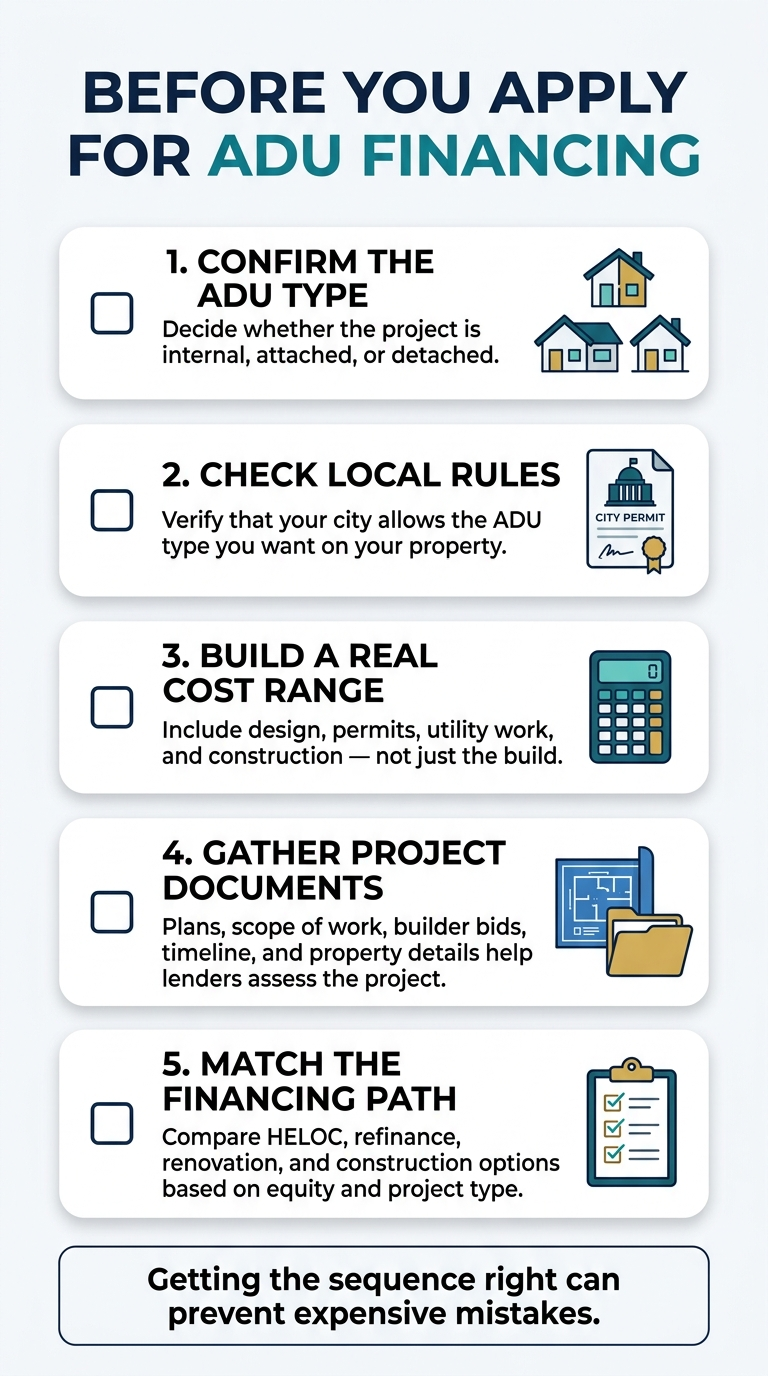
The more specific your ADU type, use case, property constraints, and cost range are, the less time you'll waste comparing the wrong loan. Get these in order first.
- Confirm feasibility — Is your ADU type allowed on your lot, and is it permit-realistic?
- Get a realistic all-in cost range — Including a 10–15% contingency
- Estimate your usable equity — Current value minus mortgage balance
- Check your credit — And gather income/tax documents
- Decide: keep your first mortgage or refinance? — HELOC/home equity/Backyard Keys leave it alone; cash-out refi and many construction loans don't
- If you'll use rental income — Line up a lease or comparable-rent support and confirm local rental rules
- Know your city's owner-occupancy, parking, and short-term-rental rules — These affect legal use and appraisal
- Note whether you already have plans, bids, or a contractor — Lenders often need these to underwrite
Start with feasibility and a rough cost path, then compare financing with a clearer picture.
Frequently asked questions
Sources & how we verified this
Last verified June 2026. At that time, our re-check schedule for time-sensitive items was: rates monthly; Backyard Keys and other programs quarterly or sooner; Utah ADU law after each legislative session and around the October 2026 detached-ADU effective date; federal mortgage program rules about twice a year. If something here looks out of date, that's on us to fix.
- CFPB — What is a HELOC
- FTC — Home Equity Loans and HELOCs
- Fannie Mae — Accessory Dwelling Units
- Fannie Mae — HomeStyle Renovation FAQ
- Fannie Mae Selling Guide — Rental Income (B3-3.8-01)
- Freddie Mac — Accessory Dwelling Units
- Freddie Mac Guide — ADU FAQ
- HUD / FHA — 203(k) Rehabilitation Mortgage Insurance
- FHA Mortgagee Letter 2023-17 — ADU policy
- Utah Code — Title 10, Chapter 21 (ADU provisions)
- Utah Legislature H.B. 68 (2026) — repeal of former §35A-8-504.5 effective July 1, 2026
- Official repeal/recodification crosswalk
- Utah Property Rights Ombudsman — ADU legal overview
- Salt Lake County — ADU requirements
- Salt Lake City CRA — Backyard Keys ADU Loan Program
- CDCU — Finance ADU construction
- Federal Register — USDA proposed rule on ADUs (RHS-26-SFH-0100)
- IRS — Home mortgage interest (Publication 936)
- Bankrate — HELOC rate averages
- Bankrate — Home equity loan rate averages
We are an independent resource, and this page is not paid to recommend any specific loan product or lender. We may be compensated when homeowners request a feasibility review or estimate, or are connected with local professionals.
Ready to check what your property can actually support?
Before you call a lender or a builder, run a quick feasibility and cost check. It takes a few minutes and gives you the specific numbers you need to compare financing options confidently.
Start Your Free ADU Feasibility Check →No address, no credit check, no commitment required.