Independent ADU Planning Resource801-441-4365

Logan Utah ADU Builder Guide for Cache Valley Homeowners

By Utah ADU Builders Editorial Team · Last Updated March 2026 · Rules verified against Logan City ADU Factsheet (v10.08.2024), Logan Land Development Code §17.37.070, Cache County ordinance, and Utah state ADU law

Disclosure: Utah ADU Builders connects homeowners with local builder options. If you request an estimate through this page, we may receive a referral fee. Verify licensing, insurance, and references before hiring. This never influences our editorial content.

Logan is more ADU-friendly than it has ever been. In October 2024, the Logan Municipal Council overhauled the city's ADU ordinance — and for the first time, Logan now allows all ADU types citywide, including detached backyard units, with no minimum lot size requirement for external ADUs. The old USU exclusion zone is gone. The ADU-specific ban on short-term rentals has been removed. If you own and live in a detached single-family home in Logan, you may well be eligible to build right now.

That does not mean every project is simple. Owner occupancy is required. Detached units are capped at 1,000 square feet. Height, setback, and parking rules still apply. And if your property is in Cache County outside Logan city limits, you are under a completely different set of rules.

This guide covers everything: verified Logan regulations, Cache County rules, realistic costs for Cache Valley construction, the full permit process, which ADU type fits your property, rental income potential, and how to choose a builder who will not waste your time or money. We built it because nothing like it existed — and Cache Valley homeowners deserve better than a government PDF or a generic contractor sales page.
Logan Utah ADU builder guide for Cache Valley homeowners — detached ADU with mountain backdrop in Logan Utah

What Kind of ADU Makes Sense for Your Property? (Start Here)

Before you dive into regulations and cost breakdowns, figure out which path you are probably on. This decision shapes everything else — budget, timeline, permits, and who you hire.

Your SituationBest ADU PathWhy It FitsTypical Difficulty
Older Logan home with an unfinished basementInternal / basement ADULowest cost, no new foundation, fastest timelineEasiest
Owner-occupied lot with side or rear yard roomDetached backyard ADUHighest rental value, most privacy, biggest property value boostModerate
Need family housing fast with minimal exterior changeInternal addition or attached ADULess permitting complexity than detached, keeps everyone closeModerate
Property is outside Logan city limitsCounty rules review firstCache County has different requirements — do not assume Logan rules applyVaries
Property is not owner-occupiedLikely not eligible in LoganLogan requires the owner to live in the primary dwelling as their primary residenceN/A

Not Sure Which Path Fits Your Property?

That is exactly what a feasibility check answers. We look at your lot, your city, and your goals — and tell you which path works and what it will realistically cost.

Why Are Cache Valley Homeowners Building ADUs Right Now?

Something shifted in Cache Valley, and it was not just the ordinance change.

Logan is the economic and housing center of Cache Valley. Utah State University drives enormous rental demand — according to Logan's own Moderate Income Housing Plan, nearly 6 out of 10 housing units in Logan are renter-occupied, and renters face higher housing cost burdens than homeowners. The average apartment rent in Logan reached $1,752 per month as of early 2026 (RentCafe, citing U.S. Census data). Meanwhile, housing prices have risen faster than most local incomes, and the October 2024 ordinance change made detached ADUs legal for the first time.

That is the backdrop. Now add the personal triggers. The real reasons people search for a Logan Utah ADU builder are usually not abstract:

👴

Aging parents

You want them close — but not in the guest bedroom. An ADU gives them independence and proximity at the same time.

💰

Mortgage relief

$1,000 to $1,500 a month in rental income would change your financial picture overnight.

🏠

Adult child returning home

After college or a life transition, everyone needs their own space.

🏔️

Stay in your neighborhood

Building out is cheaper and less disruptive than trading up to a bigger home.

📋

October 2024 ordinance change

Detached ADUs are finally legal on your property — and many homeowners are moving quickly.

🔑

House-hacking

Younger homeowners are using ADU rental income to offset their mortgage. In Logan's rental market, this math increasingly works.

Can You Build an ADU on Your Property in Logan?

Short answer for most Logan homeowners: probably yes. But "allowed" and "easy" are not the same thing. Here is exactly what determines whether your property qualifies.

What Logan Allows Right Now

Since the October 2024 ordinance update, Logan permits ADUs in all zones citywide — but only in conjunction with a detached, owner-occupied, single-family residential dwelling. The prior exclusion zone around Utah State University has been eliminated. The prior 6,000-square-foot minimum lot size for external ADUs has been removed. Both internal and detached ADUs are now on the table.

Which Homes Qualify

Your property is likely eligible if all of the following are true:

  • You own the home and live in it. Owner occupancy is not optional. Your primary dwelling must be your primary residence.
  • Your home is a detached single-family dwelling. Townhomes, duplexes, multi-family units, mobile homes, and manufactured homes are not eligible.
  • You do not already have an ADU on the property. Logan allows one ADU per property, regardless of type.

Which Homes Usually Do Not Qualify

You are probably not eligible if any of these apply:

  • You do not live in the home (it is a rental property you own but do not occupy)
  • The property has a townhome, duplex, multi-family dwelling, mobile home, or manufactured home
  • You already have an ADU on the lot
  • You want to sell the ADU as a separate property (not allowed)

Why Owner Occupancy Matters So Much

This is the single biggest eligibility requirement. Logan requires the owner to live in the primary dwelling as their primary place of residence. You cannot build an ADU on a property you rent out to someone else. You cannot move into the ADU and rent out the main house — the owner must occupy the primary dwelling specifically. And if you sell the property, the new owner has to apply for a new ADU landlord license and prove their own occupancy.

Not Sure Whether Your Property Qualifies?

Don't guess. A free property eligibility check gives you a clear answer before you invest time or money in plans.

Logan's Current ADU Rules: Everything Verified in One Place

We pulled these directly from the official Logan City ADU Factsheet (version 10.08.2024) and the Logan Land Development Code §17.37.070. This is the most complete plain-English translation of Logan's ADU regulations available anywhere online.

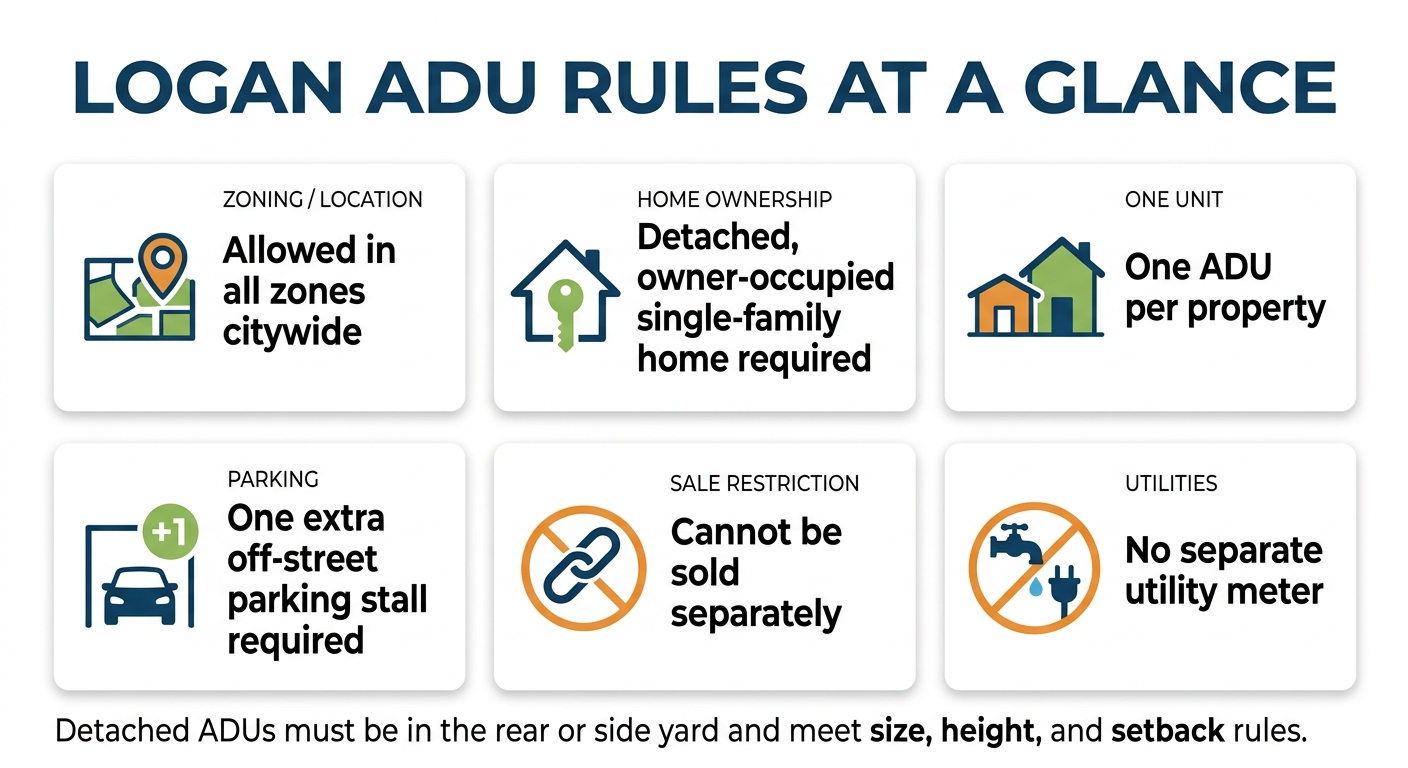
Logan ADU rules at a glance — allowed in all zones citywide, owner-occupied single-family home required, one ADU per property, one extra parking stall, cannot be sold separately, no separate utility meter
Logan ADU rules at a glance — verified against Logan City ADU Factsheet v10.08.2024. Detached ADUs must meet size, height, and setback rules.

Eligibility and General Rules

RuleWhat It Means
Eligible areasAll zones citywide, but only in conjunction with a detached, owner-occupied single-family dwelling
Owner occupancyRequired — must be your primary residence
Home typeDetached single-family dwelling only
ADUs per propertyOne, regardless of type
ADU saleCannot be sold separately from primary dwelling
Separate utility metersProhibited — one meter for both units
Utility billingTwo fixed-rate charges (flats) assessed — one for primary, one for ADU
Additional parkingOne extra off-street stall required (3 total: 2 for primary + 1 for ADU)
ADU entranceCannot be placed on the street-facing façade
ADU designMust not change the appearance of the primary dwelling as a single-family residence

Source: Logan City ADU Factsheet v10.08.2024, Section I: Eligibility

Detached (External) ADU Standards

If you are building a standalone backyard unit, these are the constraints:

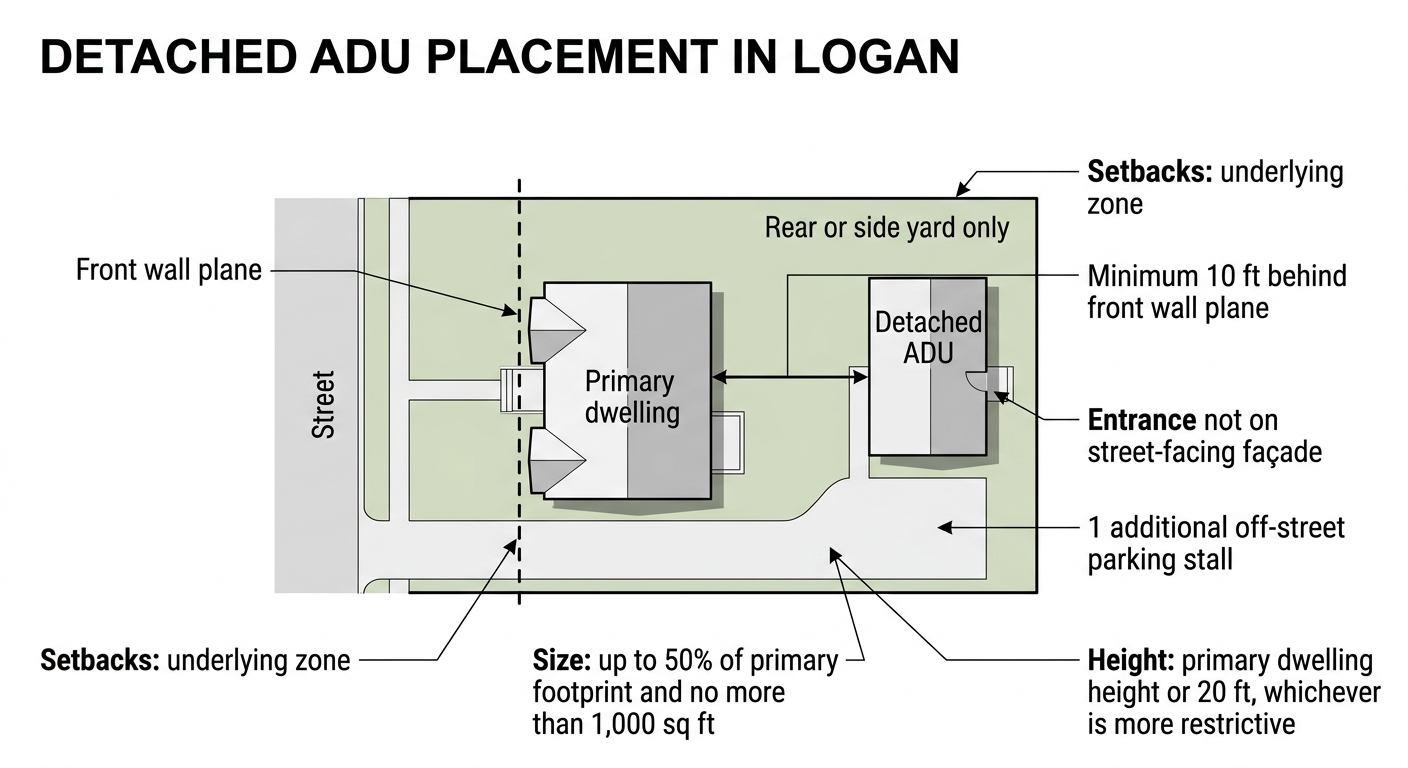
Detached ADU placement diagram in Logan Utah — rear or side yard only, minimum 10 feet behind front wall plane, size up to 50% of primary footprint or 1000 sq ft, height limited to primary dwelling or 20 feet
Logan detached ADU placement requirements — rear or side yard only, entrance not on street-facing façade, plus size, height, and setback constraints.
StandardRequirement
Location on lotRear or side yard only
Distance from front of homeMust be at least 10 feet behind the front wall plane of the primary dwelling
Maximum sizeCannot exceed 50% of the primary dwelling's footprint OR 1,000 square feet — whichever is less
Lot coverageExternal ADU cannot cover more than 50% of the rear and/or side yard area
Maximum heightCannot exceed the height of the primary dwelling OR 20 feet — whichever is more restrictive
SetbacksMust meet minimum building setbacks of the underlying zone

What the size cap means in practice:

  • • If your home's footprint is 1,800 sq ft, your max detached ADU is 900 sq ft (50% of 1,800).
  • • If your home's footprint is 2,400 sq ft, your max is 1,000 sq ft (the hard cap).
  • • If your home's footprint is 1,600 sq ft, your max is only 800 sq ft.

Source: Logan City ADU Factsheet v10.08.2024, Section I: External ADUs

Licensing, Occupancy, and Building Code

RequirementDetails
ADU landlord licenseRequired — $75 application fee
License transferabilityNot transferable — new owner must apply for a new license
Building permitRequired for all new construction, remodels, and finish work
Building permit feeMinimum $100 (varies by project scope)
Occupancy limitFamily plus one, or no more than 3 unrelated individuals
AbandonmentADU considered abandoned if landlord license lapses 12 months, ADU is unoccupied 12 months, or property is no longer owner-occupied
Short-term rentalsADU-specific ban removed Oct 2024 — but must comply with Logan's separate STR ordinance (§17.37.130), which has distance, density, and licensing requirements

Building Code Basics Your ADU Must Meet

These are not suggestions — they are inspection requirements. If your ADU fails any of these, construction stops until it is fixed:

  • Every ADU must have a living space or bedroom, kitchen, bathroom, and shower.
  • Egress windows required for each bedroom — minimum opening of 5.7 sq ft when windowsill is 44 inches or more below grade.
  • Smoke detectors in each bedroom plus the hallway leading to each bedroom, with at least one on every floor.
  • Carbon monoxide detectors required on each level.
  • GFCI outlets in bathrooms, outside areas, garages, unfinished basements, and kitchen countertops.
  • Separate HVAC for the ADU is strongly preferred — minisplit systems are the standard.

When evaluating builders, ask specifically about egress window sizing, GFCI placement, and smoke detector requirements. If they cannot answer confidently, that tells you something.

Sources: Logan City ADU Factsheet v10.08.2024, Logan Land Development Code §17.37.070, Cache Valley Daily (Oct 2, 2024)

What If Your Property Is Outside Logan City Limits?

This is one of the most common points of confusion in Cache Valley, and getting it wrong can cost you months and thousands of dollars.

Critical: Logan City rules only apply within Logan city limits.

If your property is in unincorporated Cache County, North Logan, Smithfield, Providence, Nibley, Hyde Park, Hyrum, or any other surrounding community, you are under a different set of regulations.

Cache County (Unincorporated Areas)

Cache County allows ADUs in certain zones, but the rules are more structured than Logan's and differ in several important ways:

Owner occupancy required

Similar to Logan — the property owner must live in the primary dwelling.

Short-term rentals prohibited

Both the ADU and primary dwelling must be rented for periods of 30 consecutive days or longer. This is a significant difference from Logan's current policy.

Deed restriction required

A legal document must be recorded against your property title before the county will even process your application.

Utilities matter more

You will need to demonstrate that water and sewer infrastructure can handle the additional unit. In rural parts of Cache County, this can be a real constraint.

Different approval path

Cache County routes ADU applicants through a zoning-clearance step before the building-permit step, which adds a layer Logan does not require.

Sources: Cache County ordinance and zoning-clearance procedures, Cache County Planning and Development Office

Other Cache Valley Cities

Utah state law (Utah Code §10-21-303) requires all municipalities to allow internal ADUs in residential zones, with some restrictions. Detached ADUs are governed by each city's local ordinance.

CityInternal ADUDetached ADUWhat to Do
LoganAllowed in all zones citywideAllowed in all zones citywide (as of Oct 2024)Use this guide
North LoganState law creates an IADU pathway — verify local restrictionsCheck local ordinanceContact city planning
SmithfieldState law creates an IADU pathway — verify local restrictionsCheck local ordinanceContact city planning
ProvidenceState law creates an IADU pathway — verify local restrictionsCheck local ordinanceContact city planning
NibleyState law creates an IADU pathway — verify local restrictionsCheck local ordinanceContact city planning
Hyde ParkState law creates an IADU pathway — verify local restrictionsCheck local ordinanceContact city planning
HyrumState law creates an IADU pathway — verify local restrictionsCheck local ordinanceContact city planning
River HeightsState law creates an IADU pathway — verify local restrictionsCheck local ordinanceContact city planning
MillvilleState law creates an IADU pathway — verify local restrictionsCheck local ordinanceContact city planning
WellsvilleState law creates an IADU pathway — verify local restrictionsCheck local ordinanceContact city planning
Cache County (unincorporated)Allowed in certain zones with restrictionsVaries by zone — verify with countyContact county planning

Several of these cities — including Nibley, Providence, and North Logan — have mentioned ADU expansion in their moderate-income housing plans. Regulations across Cache Valley are evolving.

Not Sure If You're in Logan City Limits or Cache County?

We will figure it out for you and route you to the right path — free, no obligation.

Which ADU Type Should You Build?

The right answer depends on your property, your budget, and what you are trying to accomplish. Here is how each option stacks up in the real world.

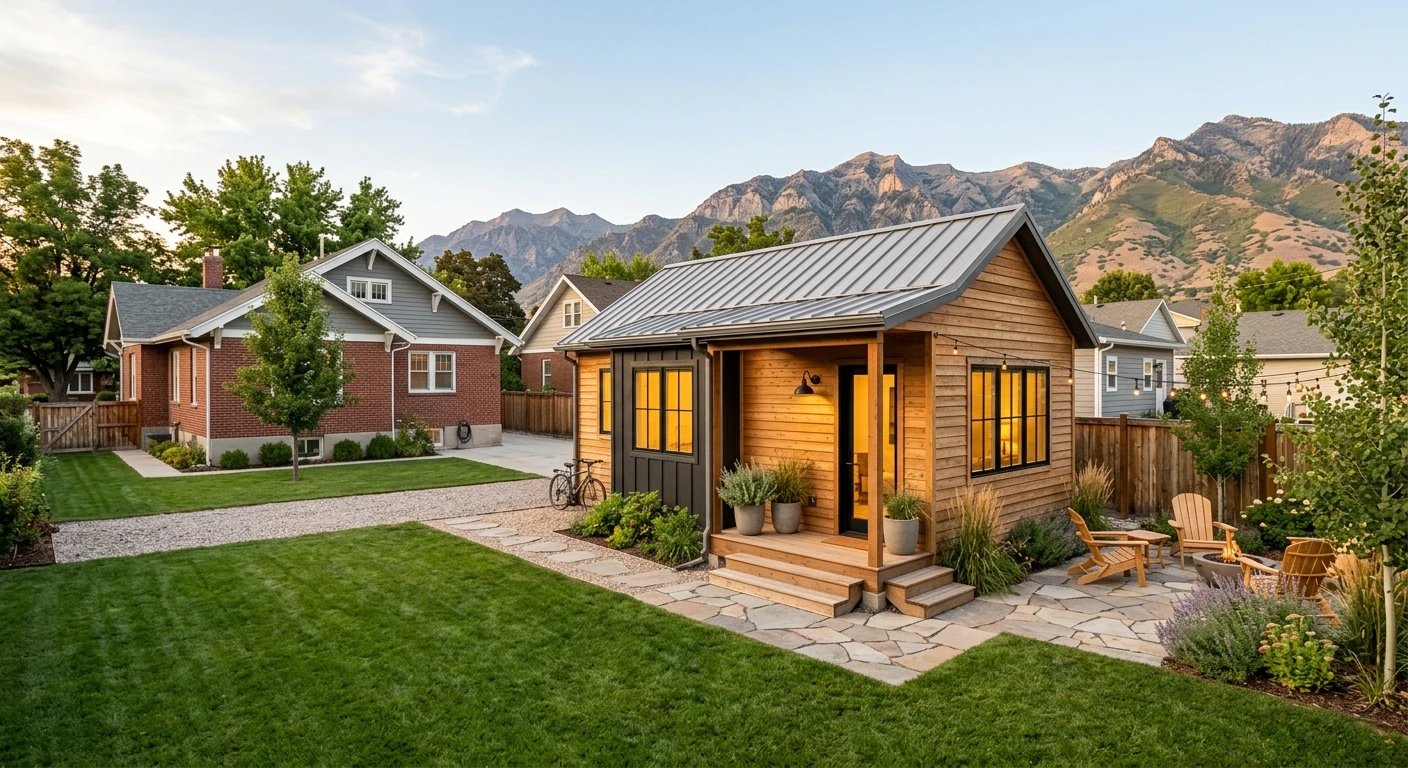
Detached backyard ADU in Logan Utah Cache Valley — wood siding cottage with covered porch, landscaping, mountain backdrop at dusk
A well-designed detached ADU in Cache Valley delivers the highest rental income and biggest property value increase — but also the most complexity and highest cost.
Easiest path

Internal / Basement ADU

Best for: Homeowners with an existing unfinished basement and decent ceiling height (7 feet minimum, ideally 8+).
Biggest advantage: Cost. A well-planned basement conversion typically runs $50,000 to $100,000 in Cache Valley. No excavation. No new foundation. No utility trenching across your yard.
Main watchout: Existing ceiling height and layout. If your basement ceilings are too low, or the mechanical systems leave no room for a livable floor plan, the conversion may not be practical. Also, older homes may need significant electrical panel upgrades.
Choose this if: You want the lowest-risk, lowest-cost entry into ADU ownership and your basement cooperates.
For family proximity

Attached Addition ADU

Best for: Homeowners who want family housing with proximity — aging parents, adult children — and do not have a usable basement.
Biggest advantage: Keeps family close without requiring a separate structure in the backyard. Utility hookups are simpler since you are extending the existing systems.
Main watchout: You still need to meet setback requirements, and the addition changes the exterior of your home. Logan requires that the ADU design not change the appearance of the primary dwelling as a single-family residence.
Choose this if: Family proximity is the priority and a detached unit feels like more project than you need.
Highest ROI

Detached Backyard ADU

Best for: Homeowners who want maximum rental income, maximum privacy (for you and tenants), and the biggest property value increase.
Biggest advantage: Tenants have their own space entirely separate from your home. This commands the highest rents and the best tenant quality. It also adds the most to your property's appraised value.
Main watchout: Cost and site logistics. You need a foundation, utility trenching from the main house or street, adequate yard space, and compliance with Logan's placement, height, and size rules. Cache Valley's clay soil and deep frost line (48+ inches) mean foundation work is more involved than in milder climates.
Choose this if: You want the highest ROI, you have adequate yard space, and your budget can support $150,000 to $300,000+.
Existing structure advantage

Garage Conversion

Best for: Homeowners with a detached garage they rarely use.
Biggest advantage: Existing structure reduces some cost compared to building from scratch.
Main watchout: Structural limitations. Not every garage can support habitable conversion without significant upgrades to the foundation, insulation, and mechanical systems. And you lose your garage.
Choose this if: You have a solid detached garage you do not use and the inspection and engineering numbers make sense.

When an ADU Might Not Be the Right Move

We would rather tell you the truth now than waste your time. An ADU is probably not worth it if you are planning to sell the home within two to three years and cannot recoup the investment through equity increase alone. It is also a poor fit if your lot has serious drainage problems, your electrical panel is maxed out with no room for a subpanel, or your yard geometry simply cannot accommodate the setback, coverage, and placement requirements for a detached unit.

But here is the thing: those situations are less common than people fear. And even when a detached ADU does not work, a basement conversion or attached addition often does. The answer is rarely "no" — it is usually "not that type, but this type instead."

Get a Free ADU Feasibility Check — Find Out What Works on Your Lot

A good builder will tell you what works and what does not before you spend a dollar on plans.

How Much Does an ADU Cost in Cache Valley?

Let us be honest upfront: an ADU is a real construction project, and it costs real money. Even a straightforward basement conversion rarely comes in under $50,000 once you account for permits, egress windows, HVAC separation, plumbing, electrical, and code compliance. A detached ADU is essentially building a small house from scratch. That is the truth, and we are not going to sugarcoat it.

But here is the other truth: the return on that investment, in this market, with Cache Valley's rental demand, is significant.

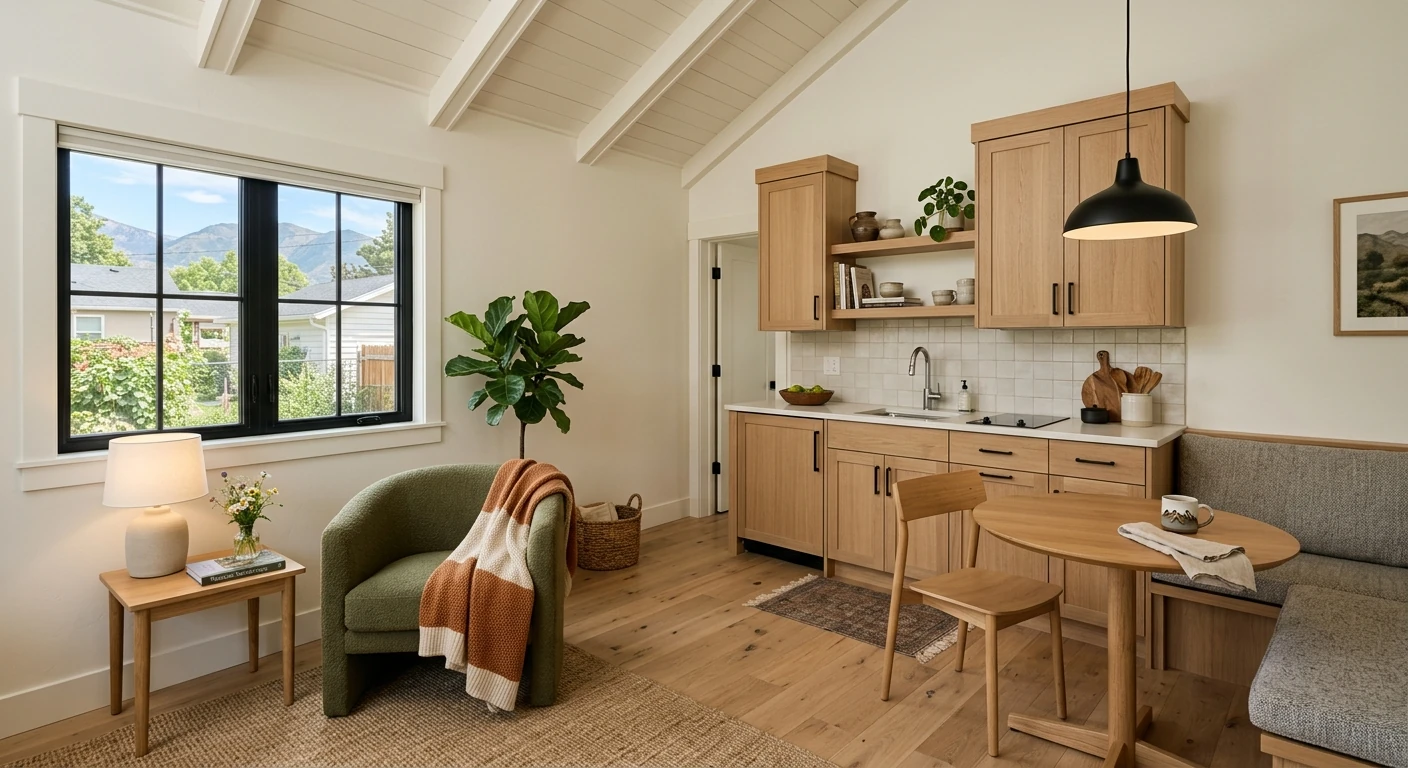
Logan Utah ADU interior — open plan living and kitchen with vaulted ceiling, mountain view window, and modern finishes in Cache Valley ADU
A well-finished ADU interior in Cache Valley commands $1,100–$1,500/month in rent and adds significant appraised value to your property.

Typical Cache Valley ADU Cost Ranges

ADU TypeTypical Cost RangeCost Per Square FootWhat Drives the Price
Basement conversion$50,000 – $100,000$80 – $150Ceiling height, existing plumbing access, egress window installation, electrical panel capacity
Garage conversion$60,000 – $120,000$100 – $175Foundation condition, insulation needs, HVAC installation, structural upgrades
Attached addition$80,000 – $180,000$150 – $250Size, foundation work, roof tie-in, exterior finish matching
Detached new construction$150,000 – $300,000+$200 – $350Size, foundation complexity, utility trenching distance, finish level

These ranges are estimates based on published Utah ADU cost data adjusted for Cache Valley's construction conditions. They are not quotes. Your actual cost depends on your specific property and builder.

What Drives ADU Costs Up or Down in Cache Valley

Cache Valley construction challenges other markets don't have:

  • • Frost line runs 48 inches or deeper — foundations must go below that depth
  • • Clay soil often requires engineered footings and soil testing
  • • Snow load requirements (40+ lbs/sq ft ground snow load) affect roof design and framing
  • • Seismic design requirements add structural engineering considerations

The finish level matters more than most people expect. The difference between standard finishes (builder-grade cabinets, vinyl plank flooring, basic fixtures) and mid-range finishes (soft-close cabinets, tile showers, upgraded lighting) can swing the total project cost by 25 to 40 percent. For rental units, standard finishes usually make the most financial sense.

Costs People Miss

Utility trenching

$5,000 – $20,000

The biggest hidden cost for detached ADUs. Running water, sewer, and electrical lines from the main house or street to a backyard unit. Depends on distance and what's in the way.

Architectural and engineering plans

$2,500 – $5,000

A complete construction drawing package with the structural engineering stamp Logan requires.

Permit and licensing fees

$175+ (varies by scope)

Logan's ADU landlord license is $75 and building permits start at $100, but total fees vary by project scope.

Electrical panel upgrades

$2,000 – $4,000

Common on older Logan homes. Adding an ADU's load may require a panel upgrade or subpanel.

Site work

$3,000 – $10,000

Grading, drainage, landscaping restoration — adds up depending on your yard's current condition.

Where to Spend and Where to Save

Spend on: the foundation, framing, plumbing, and electrical — these are inspected, and cutting corners causes delays and expensive rework. Spend on insulation — Cache Valley winters are serious, and a poorly insulated ADU will be miserable to live in and expensive to heat.

Save on: cosmetic finishes if this is a rental. Durable, clean, and neutral beats high-end every time. Get at least two detailed estimates — not verbal ballparks — with written scopes and line-item breakdowns.

Want a Real Number for Your Specific Property?

Every lot is different. Get a free estimate that accounts for your Cache Valley site conditions and project scope.

What Is the ROI on an ADU in Cache Valley?

Rental Income Potential

Cache Valley's rental market is strong and getting stronger. According to RentCafe (citing U.S. Census data), the average monthly apartment rent in Logan is approximately $1,752. One-bedroom units in Cache County range from roughly $766 to $1,697 per month.

For a well-built ADU in Logan, realistic long-term rental income is estimated at $900 to $1,500 per month, depending on size, finish level, and location. A 600-square-foot one-bedroom unit with a separate entrance in a good Logan neighborhood can realistically command $1,100 to $1,300 per month based on current market comparables.

Property Value Increase

An ADU does not just generate income — it adds equity. Published estimates suggest a well-built ADU can add $100,000 to $200,000 in property value, though actual increases depend on your local market, unit quality, and appraisal. That equity increase happens upon completion, before you collect a single rent check.

The Math, Three Ways

ScenarioBuild CostMonthly RentAnnual Gross IncomeSimple PaybackEstimated Equity Added
Basement conversion$75,000$950$11,400~6.5 years$80,000 – $120,000
Detached, 500 sq ft$175,000$1,200$14,400~12 years$130,000 – $180,000
Detached, 800 sq ft$250,000$1,500$18,000~14 years$170,000 – $220,000

These are simplified estimates. Actual returns depend on your financing costs, vacancy rate, maintenance, insurance, property management fees, and property tax increases. Net operating income will be lower than gross.

Beyond the Money

Not every ADU is about rental income. Some of the best returns are non-financial:

Aging parent care

vs. $4,000–$8,000/mo for assisted living

Adult child space

A dignified, private space during a transition

Home office or studio

Dedicated space away from the main house

Built-in flexibility

Rent now, use for family later, or vice versa

How to Build an ADU in Logan: The Step-by-Step Process

The permit process is not as painful as people fear — but it does have specific steps that need to happen in order. Here is the sequence from first idea to move-in day.

1

Confirm Your Jurisdiction

Before anything else, determine whether you are inside Logan city limits or in Cache County (or another municipality). The rules are different, and applying under the wrong jurisdiction wastes time. If you are not sure, we can look it up for you during a feasibility check.

2

Screen Your Property

Check the basics: Is the home owner-occupied? Is it a detached single-family dwelling? Is there room on the lot for a detached unit (if that is your preferred path), or does the existing layout support an internal conversion? Contact the Logan Planning Division at the city's Community Development office to get a preliminary property review before you invest in plans.

3

Choose Your ADU Type and Get a Design

Decide whether internal, attached, or detached makes the most sense. Then hire an architect or designer who knows Logan's building codes and Cache Valley's construction requirements. Plans must include a site plan drawn to scale, interior floor plan, and structural engineering. For detached units, you will also need street-facing elevations if exterior changes are proposed. Typical design cost: $2,500 to $5,000.

4

Apply for Your Building Permit and ADU Landlord License

Logan's review involves three departments: Planning Division (property eligibility, design compliance, parking, setbacks, size, height, lot coverage, exterior changes), Building Division (structural, electrical, plumbing, mechanical), and Business Licensing (issues the ADU Landlord License and verifies owner occupancy). Application processing times range from a few days to six weeks. Plan for at least one round of back-and-forth.

5

Construction

Once your permit is issued, construction begins. Typical timelines in Cache Valley: Basement conversion: 2–4 months. Attached addition: 3–5 months. Detached new construction: 4–8 months. Cache Valley seasonal note: Ground freezing between November and February can extend timelines for any project involving foundation work. Plan to start foundation work in spring or early fall. Change orders are normal — to a point. Get the change-order process in writing before construction starts.

6

Inspections

Building inspections happen at key milestones: foundation, framing, rough mechanical (plumbing, electrical, HVAC), insulation, and final inspection. Your builder should coordinate these. Common inspection stages: foundation, framing, rough mechanical, insulation, final.

7

Final Approval and Move-In

After passing final inspection, you receive your Certificate of Occupancy. Your ADU Landlord License activates. Utility billing adjusts to assess two fixed-rate charges. Your ADU is ready for a tenant or family member.

What Documents Will Logan Require?

This is the kind of practical detail that saves you a trip back to the city office. Here is what you need to have ready:

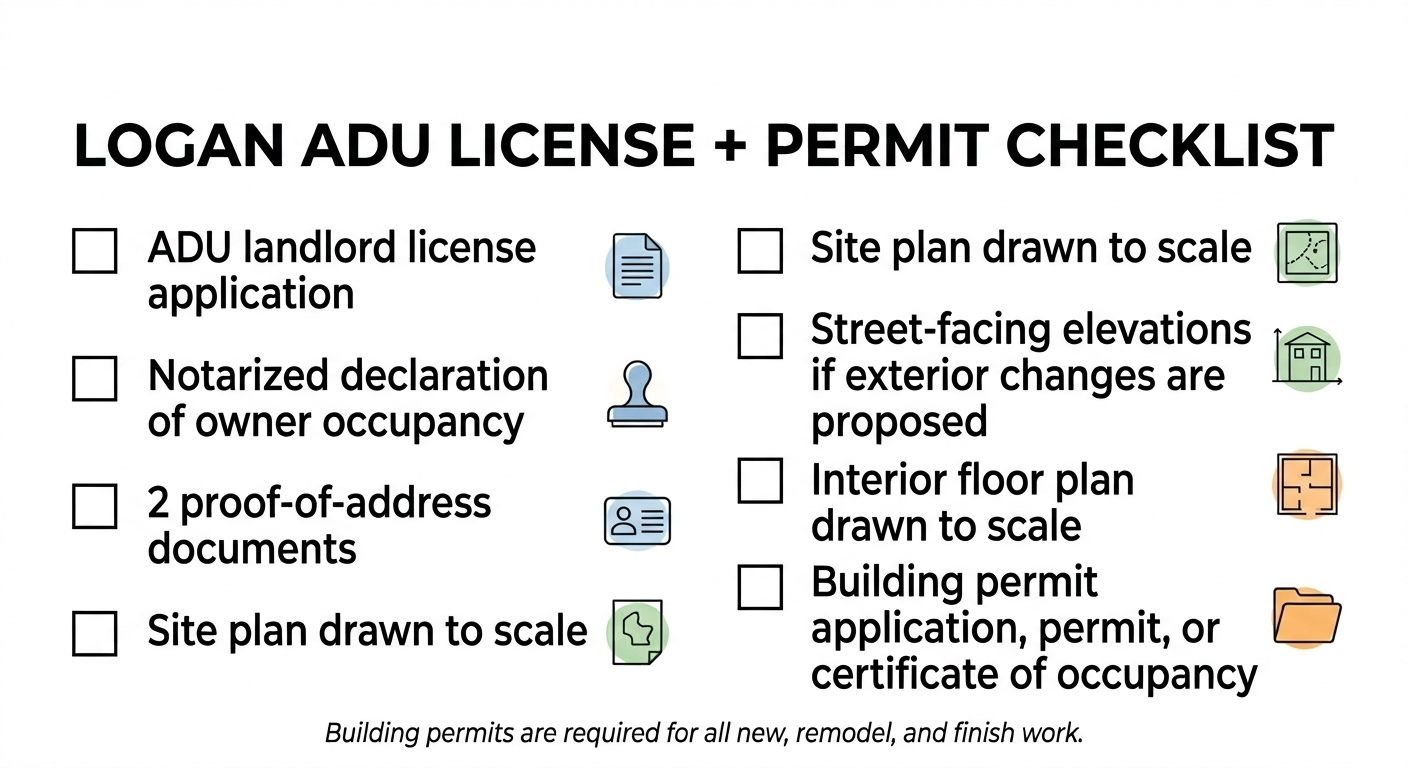
Logan ADU license and permit checklist — ADU landlord license application, notarized declaration of owner occupancy, proof of address, site plan, floor plan, building permit
Logan ADU license and permit checklist — building permits are required for all new construction, remodel, and finish work.

For the ADU Landlord License

  • Completed ADU Landlord License Application
  • Signed and notarized Declaration of Owner Occupancy
  • Two documents verifying your address (driver's license, property tax receipt, utility bill, or mortgage statement)
  • Site plan drawn to scale showing property lines, setbacks, structures, entrances, walkways, and parking areas
  • Street-facing elevations drawn to scale if you are proposing exterior changes
  • Interior floor plan for the ADU drawn to scale showing rooms, doors, windows, ceiling height, new and existing construction, and locations of smoke and carbon monoxide detectors

For the Building Permit

  • Building permit application with a project description, parcel and address information, and contractor or project-manager details
  • Construction documents as required for framing, electrical, plumbing, and mechanical work
  • Engineering stamps as required

Fees

ADU Landlord License application: $75

Building permit: minimum $100 (varies by scope)

Source: Logan City ADU Factsheet v10.08.2024, Sections III and IV

How Parking, Utilities, and Site Access Affect Your Project

These are the hidden variables that kill ADU projects or inflate budgets when homeowners do not think about them early enough. Let us surface them now.

🚗 Parking

Logan requires one additional off-street parking stall for an ADU, on top of the two stalls required for the primary dwelling — three total. If your current parking situation is tight, you may need to create a new parking area. Factor that into your site plan and budget.

💧 Utilities

Logan prohibits separate utility meters for ADUs. Both units run on one meter. Two fixed-rate charges are assessed — one per dwelling. Most ADU landlords include utilities in the rent or use a sub-metering arrangement to estimate the ADU's share. For detached ADUs, utility trenching is one of the biggest hidden costs.

📍 Site Access and Placement

For detached ADUs, Logan requires placement in the rear or side yard, at least 10 feet behind the front wall plane of the main home. The ADU entrance cannot face the street. The unit cannot cover more than 50% of the rear or side yard area. Your builder needs to walk the property before drawing plans.

Not Every Property Is a Perfect Fit (And That Is Okay)

We want to be straight with you. Not every Logan property is an ideal candidate for a detached backyard ADU. The most common reasons a detached project gets scaled back or redirected:

  • • The yard geometry does not leave enough room after setbacks and coverage limits are applied
  • • The utility infrastructure — especially sewer — cannot support an additional unit without expensive upgrades
  • • The primary dwelling's height is low, which restricts the ADU height to a point where the design does not work
  • • The homeowner expected to sell the ADU separately or install a separate meter, neither of which Logan allows

But here is what we have found: in the vast majority of cases, when one ADU type does not work, another does. The homeowner who cannot fit a detached unit often has a perfect unfinished basement. The lot that is too narrow for a side-yard ADU might have rear-yard space for a smaller unit. The project that seems dead on arrival just needs a different approach. That is why feasibility comes before plans. A 30-minute property review can save you $5,000 in architectural drawings for a project that needs to be redesigned anyway.

Get a Free Feasibility Check — Know Before You Invest

The best builders will tell you honestly what works and what does not — before you spend anything. Let us match you with one.

How to Choose a Cache Valley ADU Builder

The builder you choose is the single most important decision in this entire process. A great builder navigates permits, catches site problems early, manages the budget, and delivers a unit that passes inspection the first time. A bad one costs you months and tens of thousands of dollars in delays, rework, and change orders.

What to Look For

Logan-specific experience

Building an ADU is not the same as building a custom home or a commercial remodel. You want a contractor who has navigated Logan's ADU permitting process before, knows the Planning and Building Division reviewers, and understands Cache Valley's unique construction requirements — clay soil, deep frost line, heavy snow loads, seismic considerations.

A detailed written estimate

Not a verbal ballpark. A real scope of work that specifies what is included and what is excluded. If the estimate does not address utility trenching, site prep, permit fees, and inspections, it is incomplete.

An on-site property visit before quoting

Any builder who gives you a number without walking your lot does not understand what they are bidding on. Period.

Clear communication about change orders

Ask how they handle unexpected costs. Get it in writing. The number-one source of builder-client conflict is unexpected charges that were never discussed.

Verifiable references from Cache Valley ADU projects

Not custom homes. Not commercial builds. ADU projects, specifically. Ask to see completed work and talk to past clients.

Proper insurance and warranty

General liability insurance and workers' compensation coverage are non-negotiable. If a worker is injured on your property and the contractor does not carry workers' comp, you could be liable. Also ask about their warranty on workmanship — a reputable builder stands behind their work for at least one year.

Red Flags

  • A contractor who is not licensed in Utah (verify at dopl.utah.gov)
  • Someone who will not provide references or show past ADU work
  • A quote without a site visit
  • Pressure to sign immediately or 'lock in pricing'
  • An unusually low bid that is missing obvious scope items
  • Any builder who does not mention the permitting process as part of their service

Questions to Ask Before Signing

  1. "How many ADUs have you completed in Cache Valley?"
  2. "Are you familiar with Logan's current ADU ordinance and permitting process?"
  3. "Do you handle the permit application, or do I?"
  4. "What is included in your estimate, and what is excluded?"
  5. "How do you handle change orders?"
  6. "What is your typical timeline for this type of project?"
  7. "Can I see a completed ADU project you have done locally?"

Let Us Do the Screening for You

We vet Cache Valley ADU builders on licensing, experience, references, and local code knowledge so you do not have to.

How to Finance an ADU in Cache Valley

The cost is real, but so are the financing options. Here are the most common paths Cache Valley homeowners use:

Home equity line of credit (HELOC)

The most popular method. Uses the equity you have built in your primary home. Variable interest rate. Flexible draw schedule that matches construction milestones.

Cash-out refinance

Replace your current mortgage with a larger one and use the difference to fund the ADU. Gives you a fixed rate on the entire amount. Best when interest rates are favorable relative to your existing rate.

Construction-to-permanent loan

Some Utah credit unions now offer renovation-to-permanent loans that factor in the future appraised value of your home with the ADU included. Powerful if you have limited current equity but the post-construction value supports the loan.

401(k) loan

Some homeowners borrow against retirement accounts. This avoids a credit check and has relatively low interest (you pay yourself back), but it reduces your retirement balance and has repayment risks if you leave your job.

Family funding

When the ADU is for aging parents, parents often contribute to or fund the project entirely. It is an investment in their own housing that avoids assisted-living costs.

Important cost savings to know

Under Utah Code §11-36a-202, internal ADUs are not subject to impact fees. Depending on your municipality, this exemption can save you several thousand dollars.

A note on timing your financing

Talk to your lender before you talk to a builder, not after. Knowing your approved amount and loan terms shapes every decision downstream — ADU type, size, finish level, and timeline.

When you tell a lender "I am adding a self-contained rental unit that will generate $1,200 a month in income and add $150,000 in appraised value," that is a very different conversation than "I want a home improvement loan."

Property taxes: Yes, adding an ADU increases your assessed property value. But your primary residence still qualifies for Utah's 45% residential property tax exemption, and for most homeowners, the annual tax increase is a fraction of what the ADU generates in rental income.

For more detail, see our Utah ADU Financing Guide.

Utah State ADU Law: What Cache Valley Homeowners Should Know

Understanding the state framework helps you know your rights — especially if you are dealing with an HOA or a city that is slow to update its rules.

Utah distinguishes between general ADUs (governed by local ordinance) and internal ADUs (governed by state law). Under Utah Code §10-21-303, an internal ADU — one created within a primary dwelling for long-term rental of 30 consecutive days or longer — is a permitted use in any area zoned primarily for residential use.

Cities can place certain restrictions on internal ADUs: they can prohibit them on lots smaller than 6,000 square feet, require that the ADU not change the home's appearance, require additional parking, require a permit or license, and prohibit short-term rental. But they cannot ban internal ADUs entirely across more than a limited percentage of residential acreage (25% for most cities, or 67% for cities like Logan that have a university with 10,000+ students).

The HOA question

This comes up constantly. Under Utah law, an HOA or homeowners' association cannot prohibit an internal ADU that complies with local ordinance and building, health, and fire codes. If your HOA tells you that you cannot build a basement apartment, and your project meets all city and code requirements, they may not have the legal standing they think they do. For detached ADUs, HOA restrictions may still apply — check your CC&Rs carefully.

The Utah Property Rights Ombudsman's office (propertyrights.utah.gov) is a free resource for homeowners navigating ADU disputes with cities or HOAs.

Sources: Utah Code §10-21-303, Utah Code §11-36a-202, Utah Property Rights Ombudsman (propertyrights.utah.gov)

How We Verified This Guide

  • Logan City ADU Factsheet (version 10.08.2024) — reviewed line by line and translated every requirement into plain English
  • Logan Land Development Code §17.37.070 — the operative ordinance governing ADUs in Logan
  • Logan Land Development Code §17.37.130 and Logan STR Factsheet — the separate STR ordinance and licensing requirements
  • Logan Municipal Council meeting minutes (October 2, 2024) — documenting the adoption of the updated ADU ordinance
  • Cache County ordinance and planning documents — ADU rules for unincorporated areas outside Logan city limits
  • Utah Code §10-21-303 and §11-36a-202 — state-level legislation governing internal ADUs and impact fee exemptions
  • Utah Property Rights Ombudsman guidance — state's official resource for ADU rights and HOA conflicts
  • RentCafe and Apartments.com market data (2025–2026) — for Cache Valley rental rate estimates

Logan ADU Frequently Asked Questions

Get a Logan or Cache Valley ADU Feasibility Review

You have done the research. You understand the rules, the costs, the process, and the tradeoffs. Now there is one question left: does this work on your specific property?

STEP 1

Tell us about your property — your address, what you are thinking, and what you want the ADU for.

STEP 2

We connect you with a local Cache Valley ADU builder option that appears to fit your project type and permitting area. Verify licensing and insurance before hiring.

STEP 3

They assess your property and give you real answers — what works, what does not, what it would realistically cost, and what the timeline looks like.

If the project makes sense, you have a builder ready to go. If it does not, you saved thousands of dollars and months of frustration by finding out now instead of halfway through an architectural drawing package.

No obligation. No pressure. Just clarity on what is possible, what it will cost, and how long it will take.

This guide is published and maintained by the Utah ADU Builders editorial team. We are not attorneys, financial advisors, or city officials. This content is for informational purposes and should not replace professional advice or official permit review. When in doubt, verify current regulations with Logan City Community Development or your local planning department. Last updated: March 2026. Rules last verified: March 2026.