Independent ADU Planning Resource801-441-4365

Guest House Builder Utah: What It Really Costs, Which Rules Apply, and How to Choose the Right Builder

By Utah ADU Builders Research Team · Last Updated: June 27, 2026 · Last Verified: June 27, 2026

Disclosure: Utah ADU Builders is an independent resource that connects homeowners with licensed local builders. We may earn a referral fee at no cost to you. This does not influence our research or recommendations.

A detached guest house in Utah is often a $200,000–$400,000 project once design, permits, site work, utilities, and construction are included — though simpler builds can land lower and premium markets run higher. A garage conversion starts around $80,000. A basement ADU can come in under $100,000. But the number that matters most isn't any of those — it's whether your specific lot, in your specific city, with your specific goals, actually qualifies.

We built this guide because we kept hearing the same thing from Utah homeowners: "I want to build a guest house, but I don't know if I can, what it'll cost, or who to trust." If that sounds familiar, you're in the right place. Below you'll find verified cost ranges, a comparison of key city rules, a builder vetting checklist, and the full process from idea to move-in.
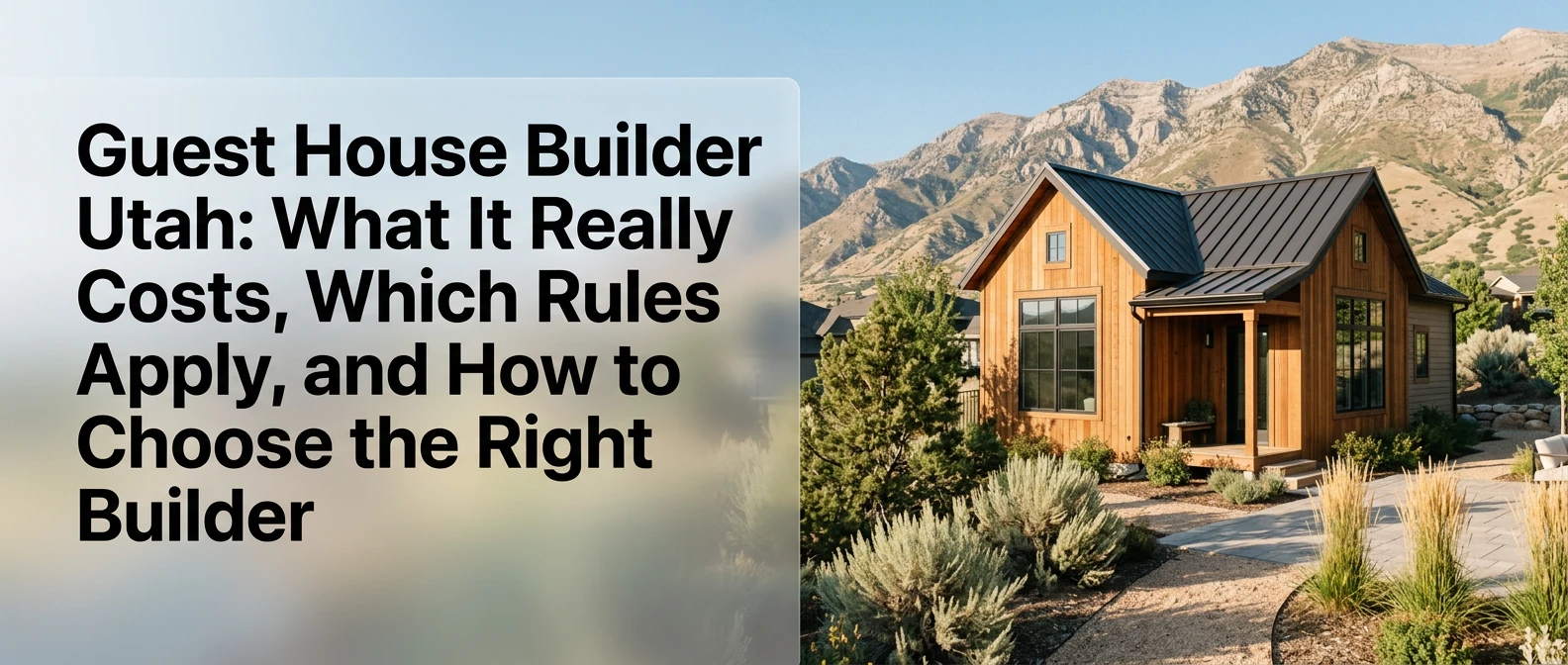
Guest house builder Utah — detached ADU with mountain views showing costs, rules, and how to choose the right builder

At a Glance: Utah Guest House Costs by Type

Before we go deep, here's the table that saves you thirty minutes of searching.

Guest House TypeCost per Sq FtTypical Total (600 sq ft)Typical Total (1,000 sq ft)Timeline
Detached custom build$200–$350$120,000–$210,000$200,000–$350,0008–14 months
Attached ADU (addition)$150–$250$90,000–$150,000$150,000–$250,0006–10 months
Garage conversion$80–$200$48,000–$120,000$80,000–$200,0003–6 months
Prefab / modular (installed)$100–$200$60,000–$120,000$100,000–$200,0003–5 months
Basement conversion (internal ADU)$50–$150$30,000–$90,000$50,000–$150,0002–4 months

Provider-stated pricing based on published estimates from ADU Utah, Steve Austin Homes, Marshall Homes Utah, and DC Structures (2025–2026). Premium finishes, difficult lots, or high-cost areas (Park City, Draper hillside) push costs higher. Permit fees, site prep, and utility connections can add $25,000–$75,000+ to detached builds.

Why Utah Homeowners Are Building Guest Houses Right Now

Behind every "guest house builder Utah" search, there's a real situation. Here are the most common ones we hear:

👨‍👩‍👧

Aging parents

Your parents are getting older and you want them close — but not sharing a kitchen. A detached guest house gives them independence and you peace of mind, without the awkwardness of a full move-in.

🏠

Adult children

Your adult kid can't find affordable rent in Utah's housing market. A backyard guest house lets them save for a down payment without moving to another state.

💵

Passive rental income

You want passive income from your property — a long-term tenant paying $1,200–$1,800/month in Salt Lake City or $1,000–$1,500/month in Provo helps cover your mortgage.

🏡

Multigenerational living

The era of shipping parents to assisted living at the first sign of aging is giving way to a new model: keep family close, give everyone their own space, and manage care from next door rather than across town.

Whatever your reason, the math increasingly works. Utah's housing shortage means rental demand is strong. ADU-friendly legislation is expanding your options. And the state has one of the highest rates of multigenerational living interest in the country.

The builders worth your time are the ones who understand both worlds — who can talk to you in plain English about what you want and then translate that into the exact permit language, zoning classification, and building code requirements your city needs to see before they'll approve it.

What Type of Guest House Should You Build?

This is the first real decision — and it changes everything: your cost, your timeline, your city's rules, and what your property looks like when it's done.

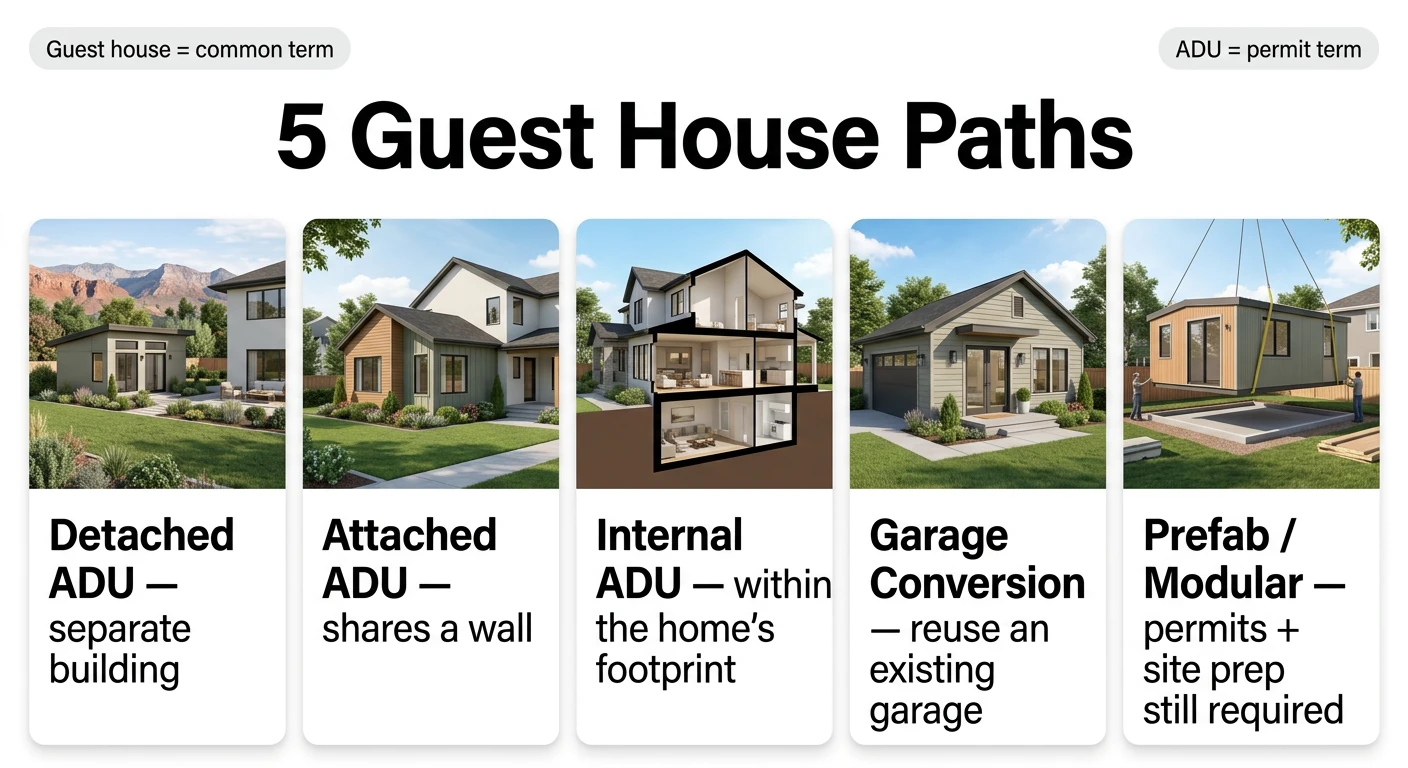
5 Utah guest house paths: detached ADU, attached ADU, internal ADU, garage conversion, prefab modular — with permit requirements for each
Each path has different costs, timelines, and permit requirements — choosing the right one for your situation matters most.

🏡 Detached Guest House (DADU) — Maximum Privacy and Rental Income

This is what most people picture: a standalone structure in the backyard with its own entrance, kitchen, bathroom, and living space. It's the most versatile option and typically the strongest for rental income and property value.

Best for

Aging parents, rental income, adult children, real separation between spaces

Budget range

$200,000–$400,000+ depending on size, finish, and city

Reality check

Most expensive path. You're building a small home from scratch — foundation, framing, separate utilities, the works.

🚗 Garage Conversion — Best Value If You Have an Existing Garage

Converting an existing garage is typically the most cost-effective way to add a guest house. The structure already exists — you're upgrading it rather than building from scratch.

Best for

Budget-conscious homeowners, faster timelines, properties where detached won't fit

Budget range

$80,000–$150,000 (sometimes less for basic conversions)

Reality check

You lose your garage. Code upgrades (insulation, egress windows, fire separation) add up faster than expected.

🏗️ Prefab or Modular — Speed and Predictability

Factory-built ADUs arrive partially or fully assembled and can cut months off your timeline. Several prefab providers serve the Utah market.

Best for

Speed-focused homeowners, standard floor plans, straightforward lot access

Budget range

$100,000–$250,000 installed (the "installed" part matters)

Reality check

Not a permit shortcut. DC Structures states turnkey costs run 3–5x the materials package price. Plan accordingly.

🏠 Internal ADU (Basement) — Lowest Cost, State-Protected

This is the lowest-cost, lowest-friction path — and Utah state law is on your side. Under Utah Code §10-21-303, municipalities must treat internal ADUs as a permitted use in residential zones. Internal ADUs are also exempt from impact fees under Utah Code §11-36a-202.

Best for

Lowest budget, easiest permitting, rental income without building new

Budget range

$50,000–$100,000 depending on basement condition. Complex renovations run higher.

Reality check

Less privacy than detached. But the economics are hard to beat and permitting is genuinely simpler.

🔗 Attached Addition — Connected Living with Some Separation

An attached ADU shares a wall with your main home but functions as a separate living space with its own entrance, kitchen, and bathroom.

Best for

Multigenerational families, insufficient yard for detached, shared utility savings

Budget range

$150,000–$250,000

Reality check

Less independence than fully detached. Construction will temporarily disrupt your living space.

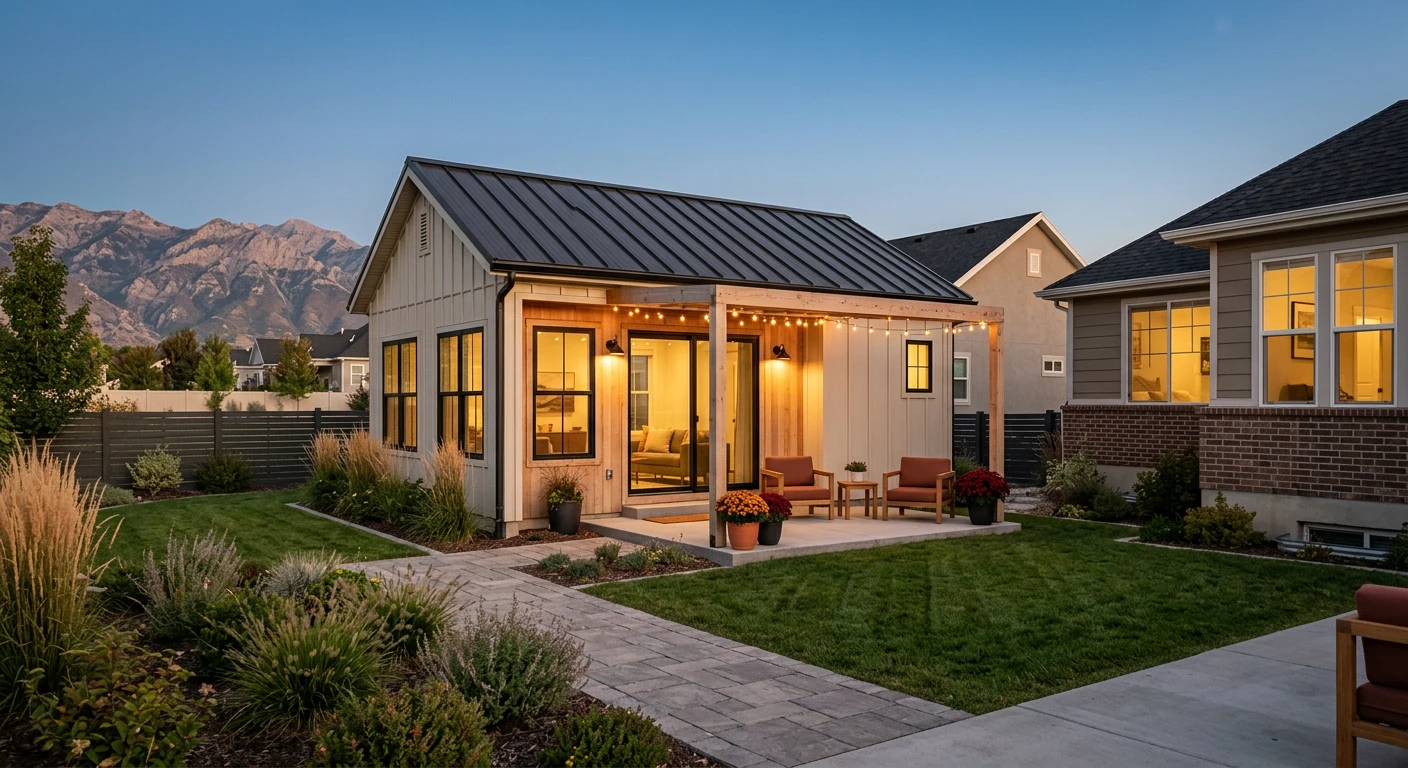
Utah guest house exterior at dusk — completed detached ADU with patio lights, landscaping, and mountain backdrop
A finished Utah guest house with outdoor lighting and landscaping — built to complement the main home's style and maximize rental appeal.

Not Sure Which Type Fits Your Property?

A local builder can walk your property in 30 minutes and tell you which option makes sense for your lot, your city, and your budget.

Is a "Guest House" the Same as an "ADU" in Utah?

Yes — and understanding this saves you confusion at every step.

When Utah homeowners say guest house, they usually mean a separate living space on their property for family, friends, or tenants. You might also hear casita, granny flat, in-law suite, mother-in-law apartment, or backyard cottage. These are all everyday names for the same thing.

When you call your city's planning department, they'll use the legal term: Accessory Dwelling Unit (ADU). That's what appears in zoning codes, permit applications, and state law. Draper's official ADU page explicitly notes that ADUs are often referred to as mother-in-law apartments, granny flats, or guest homes. Salt Lake County says ADUs are also known as in-law suites, basement apartments, or granny flats.

The distinction matters:

If you search for "guest house permits" on your city's website, you probably won't find anything. Search for "ADU" or "accessory dwelling unit" instead. That's the language the permit system uses.

Internal ADU

A separate living unit inside the existing home (typically a basement apartment). Regulated under state law (Utah Code §10-21-303).

Attached ADU

An addition to the main home that functions as a separate unit. Treatment varies by city.

Detached ADU

A standalone structure — this is what most people picture when they say 'guest house.' Regulated by individual city ordinance.

Garage conversion

An existing garage remodeled into living space. Rules vary by city; may count as detached ADU in many jurisdictions.

Tiny homes are not automatically ADUs. The Utah Office of the Property Rights Ombudsman (OPRO) notes that tiny homes are generally considered to be 400 square feet or less, and local land use rules still determine whether one can legally function as an ADU. "Tiny home" is a building style — "ADU" is a legal classification.

Can You Build a Guest House on Your Property in Utah?

In many cases, yes — but the honest answer depends on your city, your lot, and what type you want to build.

What State Law Guarantees

Under Utah Code §10-21-303, municipalities must allow internal ADUs as a permitted use in areas zoned primarily for residential use. Cities can only prohibit internal ADUs in up to 25% of their residential zones. Internal ADUs are also exempt from impact fees under Utah Code §11-36a-202.

Where Detached Guest Houses Stand

They're regulated at the city level, and rules vary sharply. Most Utah cities along the Wasatch Front now allow detached ADUs, but each sets its own requirements for lot size, structure size, height, setbacks, parking, owner occupancy, and rental use.

2026 Utah detached ADU law update (SB 284)

Utah SB 284 created Utah Code §10-21-304, effective October 1, 2026. In a "specified municipality," cities must allow one detached ADU on lots or parcels of 11,000 square feet or larger where a single-family home is allowed, and cities may allow detached ADUs on smaller lots. Cities may still regulate size, height, setbacks, lot coverage, design compatibility, utility capacity, owner-occupancy, front-yard placement, short-term rental use under 90 days, and whether more than one ADU is allowed. Local permits and building, fire, utility, and health-code review still apply.

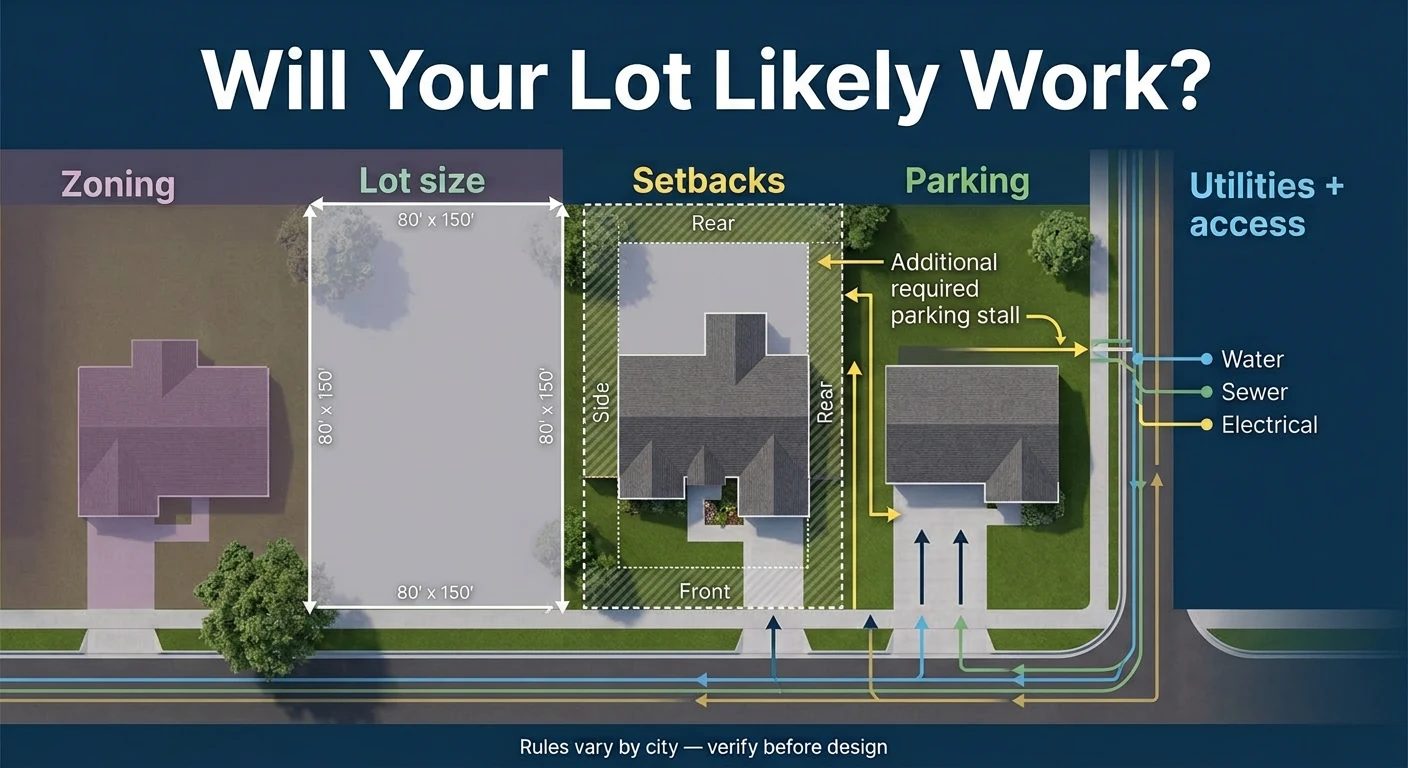
The 7 Questions That Decide If You Can Build

  1. 1

    Is your property in the right zoning district?

    Most single-family residential zones allow ADUs, but verify with your city — not all zones qualify.

  2. 2

    Does your city allow detached ADUs, or only internal/attached?

    Most Wasatch Front cities do, but rules differ significantly between them.

  3. 3

    Is your lot big enough?

    Minimums range from no minimum (Salt Lake City) to 12,000 sq ft (Draper) depending on the city.

  4. 4

    Can you meet setback and height requirements?

    Detached ADUs usually need 3–10 feet from property lines and have height caps between 17 and 25 feet.

  5. 5

    Can you satisfy parking requirements?

    Most cities require at least one additional off-street parking space for the ADU.

  6. 6

    Does your city require owner occupancy?

    In most Utah cities, the property owner must live in either the main house or the ADU.

  7. 7

    Can utilities and site access support the build?

    This is the one that surprises people — utility connections and site conditions can add $25,000–$75,000+ to your budget.

Will your lot work for a Utah guest house? Diagram showing zoning, lot size, setbacks, parking, and utility access requirements
Rules vary by city — always verify your specific parcel before committing to design.

The 5-Minute Lot Check (Before You Call Anyone)

  1. Pull up your city's zoning map online and find your property's zoning district
  2. Search your city's website for "ADU" or "accessory dwelling unit" and read the summary
  3. Check your lot size (your county assessor's website shows this)
  4. Estimate your rear yard space — do you have room for a structure plus the required setbacks?
  5. Check your HOA's CC&Rs — even if your city says yes, your HOA may say no

Important HOA note: For internal ADUs, Utah state law provides that where an internal ADU would not violate a local land use ordinance or building, health, or fire code, renting it may not be prohibited by any private community association by CC&R or HOA rule. But that state protection does not extend to detached ADUs — your HOA can still restrict those. Check your CC&Rs before investing in design.

One more thing: If your lot borders a steep slope, is in a flood zone, or sits on fill soil, those conditions may not disqualify your project but they will affect costs and engineering requirements. A builder who's worked on your type of lot before will know exactly what to look for.

Don't Want to Navigate This Yourself?

Our builders verify lot eligibility as part of the free estimate process — they'll check zoning, setbacks, utility access, and city-specific rules for your property.

Utah Guest House Rules by City (Verified Comparison)

This is the section we wish existed when we started researching. Every Utah city handles ADUs differently. The table below covers the cities where we've verified current rules against official sources.

City / AreaDetached Allowed?Min. Lot SizeMax ADU SizeOwner Occupancy?Short-Term Rental?Official Source
Salt Lake CityYesNo minimum1,000 sq ftYes (limited exceptions)No — 30+ day onlySLC Municipal Code §21A.40.200
Salt Lake County (unincorp.)Yes7,000 sq ft (detached); 6,000 sq ft (internal)Per zoneYes (2-year exceptions)Check area rulesSLC ADU Ordinance, June 2024
OgdenYesPer zone300–800 sq ftYesOnly if primary dwelling owner-occupiedOgden City Code §15-33
MillcreekYes (R-1 and A zones)8,000 sq ft1,000 sq ft (or primary dwelling, whichever less)YesNo (detached); limited (internal)Millcreek Code §19.89
DraperYes12,000 sq ft50% of primary dwellingYesNo — 30+ day onlyDraper City ADU Permit Page
West JordanYes (eligible lots)10,000 sq ft (platted)Per zoneYes (unified tenancy)No — 30+ day onlyWest Jordan ADU Application
MurrayYesCheck zoningPer zoneYesNo — prohibitedMurray City ADU Page
North Salt LakeYesPer zone300–1,200 sq ft (2-bed max)Yes (with exceptions)Check local rulesNSL Code §10-19-17

Cities we plan to add: Sandy, Provo, Layton, South Salt Lake, St. George, Park City, and Lehi. We're verifying current official sources for each. If your city isn't listed, contact your planning department or request a free feasibility check.

⚠️ Rules change.

Utah's ADU landscape is actively evolving. Utah's HB88 (2025), which would have required urban cities to broadly allow all ADU types, stalled in committee — meaning detached ADU rules still vary by city. Cities also update ordinances regularly. Always verify current rules before committing to design work. Last verified: March 2026.

What Utah State Law Actually Says About Internal ADUs

Under Utah Code §10-21-303, municipalities must treat internal ADUs as a permitted use in residential zones. Key provisions:

  • • Cities can only prohibit IADUs in up to 25% of their total residential-zoned area (67% for university cities with 10,000+ students)
  • • IADUs are exempt from impact fees (Utah Code §11-36a-202)
  • • Cities may require: lots of at least 6,000 sq ft, that the IADU not change the primary dwelling's appearance, additional parking, a rental permit, and/or prohibition of short-term rental (30 days or less)
  • • Where an IADU complies with local ordinances and codes, it cannot be prohibited by HOA CC&Rs

Source: Utah OPRO, commerce.utah.gov/propertyrights/find-the-law/legal-topics/adu/

What Does a Guest House Actually Cost in Utah? (The Full Breakdown)

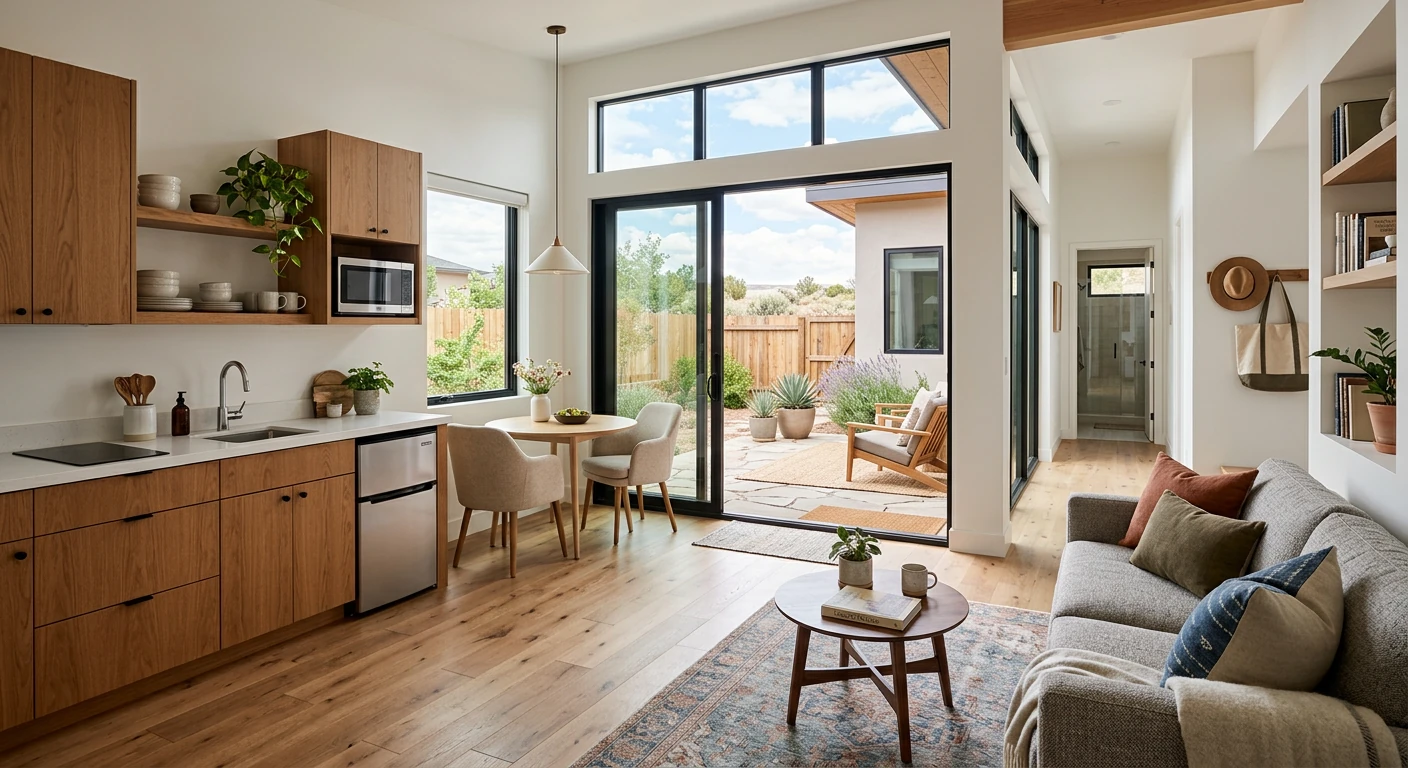
Utah guest house interior — open plan kitchen, living, and dining area with high ceilings, natural light, and outdoor patio access
Inside a well-designed Utah guest house — open layout, natural light, full kitchen, and private outdoor access are the features that command premium rents.

Understanding the full cost picture is critical. We've seen homeowners budget $200,000 based on a per-square-foot estimate, only to discover that utility connections, permitting, and site work added another $50,000+ they hadn't planned for.

Hard Costs: What You See on the Invoice

For a typical 600–800 sq ft detached guest house in the Salt Lake Valley or Utah County area:

Line ItemTypical RangeNotes
Foundation (concrete slab)$10,000–$30,000Basement foundation: $35,000–$60,000. Rocky or difficult soil increases excavation costs.
Framing & roofing$20,000–$55,000Snow-load requirements in northern Utah add structural cost
Electrical rough-in & finish$8,000–$20,000Separate panel for detached units
Plumbing rough-in & finish$10,000–$25,000Sewer trenching is often the single most expensive surprise — local forums consistently flag this as the cost that kills budgets
HVAC$5,000–$15,000Utah's temperature swings require real heating and cooling
Interior finishes$15,000–$60,000+Flooring, cabinets, countertops, fixtures, paint. Standard vs. custom finishes can differ by $30,000+
Exterior finishes$10,000–$30,000Siding, windows, doors. Many cities require the ADU to match the primary home's style

Soft Costs: What Catches People Off Guard

Line ItemTypical RangeWhy It Matters
Architectural / design plans$3,000–$15,000Required for building permit
Building permits$1,000–$5,000+Varies by city — SLC tends to be higher
Impact fees$0 (internal) to $2,000–$10,000+ (detached)State law exempts internal ADUs from impact fees
Utility connections$8,000–$18,000Water, sewer, electric. Sewer trenching alone can run $5,000–$12,000.
Site prep & grading$2,000–$15,000Clearing, leveling, access for construction equipment
Survey & engineering$1,000–$5,000Required for most detached ADU permits
Landscaping restoration$2,000–$10,000Construction equipment damages yards — budget for this upfront
General contractor fee15–25% of total projectThey manage the entire project

The Costs Nobody Talks About

Property tax increase

Adding a guest house increases your assessed property value. This isn't a dealbreaker — the rental income and resale value typically justify the increase — but don't let it surprise you.

Insurance premium adjustment

Your homeowner's insurance will increase. Discuss your ADU plans with your agent before construction, not after.

HOA friction

Even in cities that allow ADUs, some HOAs restrict detached units through CC&Rs. Checking this before you invest in design saves thousands in wasted fees.

Financing costs: Construction loans carry higher interest rates than traditional mortgages. Fannie Mae now allows ADUs to be financed with any standard Selling Guide loan product, including renovation and construction-to-permanent loans (source: singlefamily.fanniemae.com). FHA guidelines also allow projected ADU rental income to count toward qualification, capped at 30% of total monthly effective income (source: HUD Mortgagee Letter 2023-17). Talk to a lender before you talk to a builder — knowing your budget range upfront makes every other conversation more productive.

How Costs Differ Across Utah

RegionTypical Cost/Sq Ft (Detached)What Drives the Difference
Salt Lake City metro$200–$350Highest demand, more permitting complexity
Utah County (Provo, Orem, Lehi)$190–$300Rapid growth, strong builder availability
Davis County (Layton, Bountiful)$180–$280Moderate costs, growing ADU adoption
Weber County (Ogden)$170–$270Lower labor costs
Southern Utah (St. George)$180–$300Lower land costs, higher material transport
Park City / Summit County$300–$500+Luxury market, strict design standards

Provider-stated: Compiled from ADU Utah published estimates, Marshall Homes published SLC pricing ($300–$350+/sq ft), and general Utah construction market data.

Want to Know What YOUR Project Would Actually Cost?

Every property is different. Lot conditions, city fees, utility access, and design choices can swing the total by $50,000 or more. The only way to get a real number is a site-specific estimate.

How to Choose a Guest House Builder in Utah (Without Getting Burned)

This is the section that could save you the most money and headache.

The best guest house builder isn't the biggest company or the cheapest bid. It's the one who has built ADUs in your city, can explain the permitting process without Googling it, and gives you a transparent line-item estimate — not a vague "per square foot" number. ADU permitting varies dramatically by city. A builder who's pulled fifteen permits in Salt Lake City may have never dealt with Millcreek's requirements or Draper's 12,000 sq ft lot minimum.

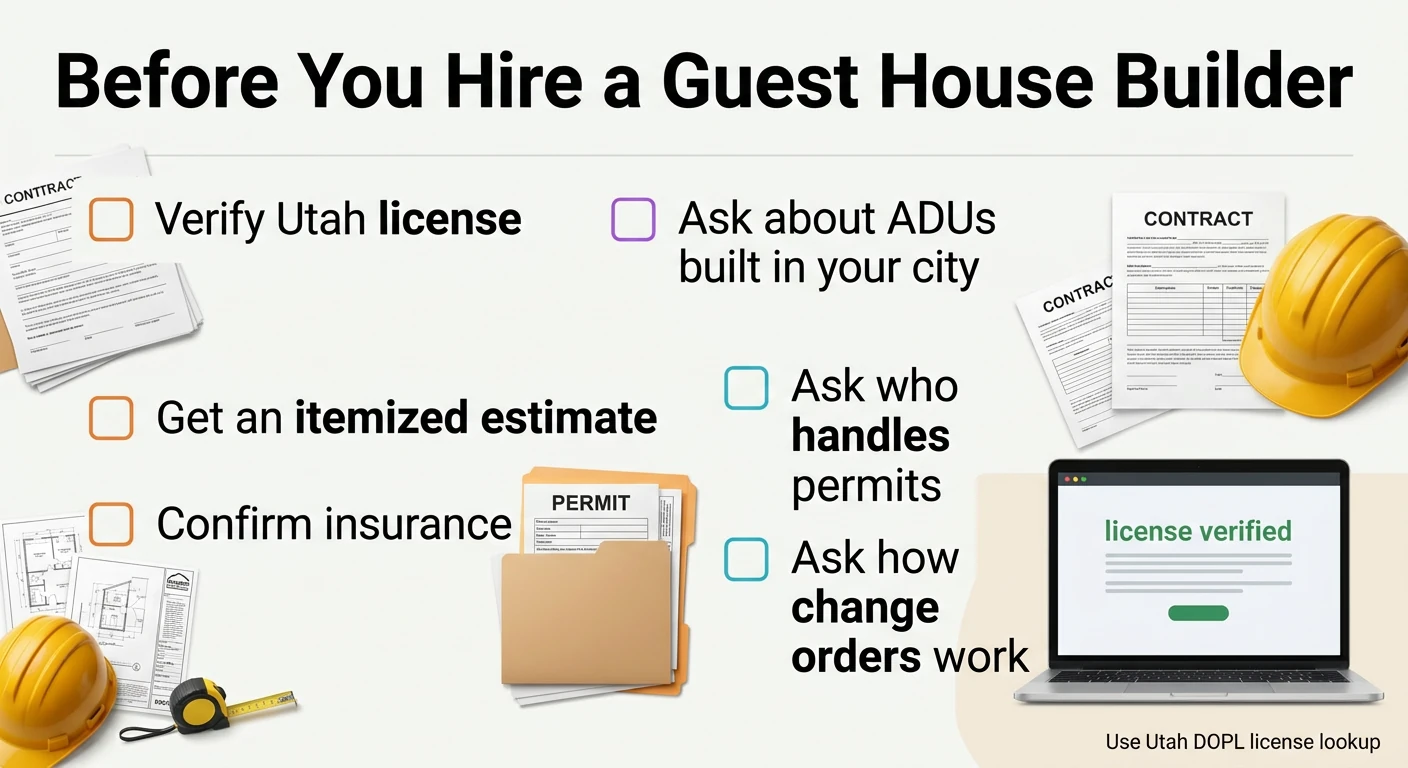
Before you hire a Utah guest house builder — checklist: verify license, get itemized estimate, confirm insurance, ask about ADUs in your city, who handles permits, change order process
Use the Utah DOPL license lookup before you sign anything — every general contractor must be actively licensed.

The Utah Guest House Builder Vetting Checklist

Before you sign anything, verify all ten:

  1. 1

    Licensed with Utah DOPL

    Every general contractor in Utah must be licensed through the Division of Occupational and Professional Licensing. Verify at dopl.utah.gov. Look for a General Building (B100) or Residential & Small Commercial (R100) license. No license = walk away, full stop.

  2. 2

    Insured

    General liability ($1M minimum) and workers' compensation. Ask for current certificates. If a worker gets hurt on your property and the builder doesn't carry workers' comp, you could be liable.

  3. 3

    ADU-specific experience

    'We've built custom homes for 20 years' is not the same as 'We've built ADUs.' Ask to see 3+ completed ADU projects, not just general construction work.

  4. 4

    Experience in YOUR city

    This is non-negotiable. Ask: 'How many ADU permits have you pulled in [your city]?' A builder who knows your city's planning department will save you months.

  5. 5

    Transparent, itemized estimate

    If the estimate is one number with no breakdown — that's not an estimate, it's a guess. You should see separate line items for foundation, framing, electrical, plumbing, HVAC, finishes, permits, site prep, utility connections, and GC fee.

  6. 6

    They handle permitting end-to-end

    A good ADU builder manages the entire permit process: site plan, planning review, building permit application, revisions, and inspections. If they say 'you handle the permits,' that's a red flag.

  7. 7

    Written contract with fixed timeline and change-order process

    No handshake deals. The contract should specify start date, estimated completion date, payment schedule tied to milestones, and exactly what happens when costs change. Change orders require your written approval.

  8. 8

    References you can actually contact

    Ask for phone numbers of 2–3 past ADU clients. Call them. Ask what went well, what didn't, and whether they'd hire the builder again.

  9. 9

    Reasonable deposit structure

    Industry standard: 10–15% deposit, then progress payments tied to milestones (foundation complete, framing complete, etc.). Anyone asking for 50%+ upfront is a risk you don't need to take.

  10. 10

    They ask YOU questions first

    A quality builder asks about your goals, budget, timeline, intended use, and city before quoting. If they throw out a number in the first phone call without understanding your project, they're guessing — and you'll pay for those guesses later.

Red Flags That Should End the Conversation

  • No DOPL license (or expired/suspended license)
  • Can't show you completed ADU projects
  • Pressures you to sign quickly or offers a 'limited time' discount
  • Won't provide a written contract
  • Asks for more than 30% upfront
  • Can't explain the permitting process for your specific city
  • Quotes significantly below the ranges in this guide (lowball bids become change-order nightmares)
  • No workers' compensation insurance

What a Real Utah Guest House Proposal Should Include

Site assumptions (access, grading, soil conditions)
Permit assumptions (which city, expected timeline, fee estimates)
Utility assumptions (water, sewer, electric — new vs. shared)
Detailed line-item pricing (not just $/sq ft)
Clear distinction between fixed costs and allowances
Explicit exclusions (what's NOT included)
Payment schedule tied to milestones
Construction timeline with key dates
Inspection schedule
Warranty terms
Who handles city comments, revisions, and re-submissions
What happens if the lot fails feasibility during permitting

Questions to Ask Every Builder Before Hiring

  1. 1

    How many ADUs or guest houses have you built in [my city]?

  2. 2

    What's your typical timeline from design to move-in for a project like mine?

  3. 3

    What's included in your estimate, and what's NOT included?

  4. 4

    How do you handle change orders? Do I approve them in writing before work proceeds?

  5. 5

    Will you manage the entire permitting process, or is that on me?

  6. 6

    Can I visit a completed project or talk to a past ADU client?

  7. 7

    What happens if the project goes over budget or over schedule?

  8. 8

    What's your warranty, and what does it cover?

  9. 9

    Who on your team will be my main point of contact during construction?

  10. 10

    What's your experience with my city's planning department specifically?

Want Help Finding a Vetted Builder?

We connect Utah homeowners with DOPL-licensed, experienced ADU builders who have city-specific experience. No guesswork, no cold calls.

The Process: From "I Want a Guest House" to Move-In Day

Knowing the process removes the anxiety. Here's what actually happens.

Phase 1

Feasibility & Planning (Weeks 1–4)

  • Verify your lot's zoning, size, and setback eligibility
  • Define your goals: who is this for, and what do you need the space to do?
  • Set a realistic budget using the cost data in this guide
  • Interview 2–3 builders (use our vetting checklist above)
  • Choose your builder and sign a contract
Pro tip: The best builders will do a basic feasibility check before you commit. They'll look at your lot, check your city's requirements, and tell you honestly whether the project makes sense. A 30-minute site visit now can save you thousands in wasted design fees later. Also the right time to talk to your lender — knowing your budget prevents falling in love with a $350K plan when your financing supports $200K.
Phase 2

Design & Permitting (Months 1–4)

  • Architectural drawings and floor plan finalization
  • Structural engineering (required for building permit)
  • Site plan preparation
  • Submit permit application to your city's planning and building departments
  • City review, potential revision requests, and approval
  • Utility coordination (water, sewer, electric connections)
What to expect: Permitting in Utah typically takes 2–4 months depending on the city and whether the application is complete on first submission. An experienced ADU builder who's worked with your city before can cut this timeline significantly by submitting clean, complete applications.
Phase 3

Construction (Months 4–10)

  • Site preparation, excavation, foundation
  • Framing, roofing, exterior sheathing
  • Rough electrical, plumbing, HVAC (followed by inspection)
  • Insulation, drywall, interior framing
  • Interior finishes: flooring, cabinets, countertops, fixtures, paint
  • Exterior finishes: siding, windows, doors
  • Final mechanical connections and testing
  • Landscaping restoration
Construction typically takes 4–7 months for a detached guest house. Garage conversions and prefab installations are faster (2–4 months). Inspections happen throughout — foundation, framing, rough electrical/plumbing, insulation, and final. These are your quality assurance. If an inspector flags an issue, it gets fixed before it's buried behind drywall. That's the system working in your favor.
Phase 4

Closeout & Move-In (Month 10–12)

  • Final inspections (building, fire, electrical, plumbing)
  • Certificate of occupancy — the official green light your guest house is legal and livable
  • Final walkthrough with your builder — bring a checklist, test every fixture
  • Utility activation (separate meter if required by your city)
  • Record owner-occupancy affidavit (required in most Utah cities)
  • Obtain a rental business license if you plan to rent the unit
  • Move in — or welcome your first tenant
After move-in: Keep all permit documents, inspection records, and the certificate of occupancy in a safe place. You'll need them if you ever sell the home, refinance, or need to prove the ADU is legally permitted. These documents protect your investment for years to come.

Will a Guest House Pay for Itself?

In many Utah markets, yes — though the timeline depends on your build cost, rental market, and ongoing expenses. Utah's housing market features strong rental demand in most populated areas.

Rental Income Potential (Estimated Market Ranges)

Utah RegionEst. Monthly Rent (1BR ADU)Est. Monthly Rent (2BR ADU)
Salt Lake City$1,200–$1,800$1,500–$2,200
Provo / Orem$1,000–$1,500$1,300–$1,800
Ogden$900–$1,300$1,100–$1,600
St. George$1,100–$1,600$1,400–$2,000
Park City$1,800–$3,000+$2,500–$4,000+

Estimated market ranges based on comparable rental listings. Actual rents vary by unit quality, location, and market conditions. Most Utah cities restrict ADU rentals to long-term tenants (30+ consecutive days).

The ROI logic: A permitted, well-built ADU can contribute to property value and generate rental income — but the actual financial impact depends on your local market, comparable sales, and appraisal evidence. Work with a local appraiser or real estate agent who can evaluate your specific property. What we can say: a code-compliant guest house adds usable square footage and flexibility. In a market where housing demand outpaces supply, that flexibility is valuable — whether you use it for family, rental income, or increased appeal at resale. Even if you never rent it, a well-built guest house serves your family now and adds optionality later.

The Honest Part: What Could Go Wrong (and Why It Usually Doesn't)

We'd be doing you a disservice if we pretended building a guest house is friction-free.

⏱ Permitting takes longer than you expect

Most homeowners budget 2–4 weeks for permits. The real timeline in many Utah cities is 2–4 months. City review involves multiple departments — planning, building, fire, sometimes utilities — and any revision request sends your application back in line.

Here's why this isn't a dealbreaker: it's a timing issue, not a viability issue. The permit process makes sure your guest house is safe, legal, and well-built. An experienced builder who's navigated your city's process before can dramatically reduce friction by submitting complete, clean applications.

💰 Utility and site work costs catch people

Foundation, sewer trenching, water connections, and electrical service to a detached guest house often add $25,000–$75,000 that isn't reflected in simple "per square foot" estimates.

On Utah forums, homeowners consistently flag sewer trenching and site access as the costs that caught them off guard. A builder who's done this before in your area will know what to expect and include those costs upfront — not as a surprise change order later.

The good news: once you know these realities, they're manageable. They just need to be planned for, not discovered mid-project. That's why builder selection is the highest-leverage decision you'll make.

How to Finance a Guest House in Utah

You have more options than you might think.

Home Equity Loan or HELOC

If you have significant equity in your primary home, this is often the simplest path. Rates are typically lower than construction loans, and the process is faster. A HELOC lets you draw funds as needed during construction.

Cash-Out Refinance

Replace your existing mortgage with a larger one and use the difference for construction. Makes sense when rates are favorable and you have substantial equity built up.

Construction Loan

A short-term loan specifically for building. Higher interest rates, but designed for the draw-schedule reality of construction. Many convert to a permanent mortgage after completion.

Fannie Mae ADU Financing

Fannie Mae now allows ADUs to be financed with any standard Selling Guide loan product — including renovation loans, construction-to-permanent loans, and the HomeReady program. Source: singlefamily.fanniemae.com.

FHA with ADU Rental Income

HUD's FHA guidance allows projected ADU rental income to count toward borrower qualification, capped at 30% of total monthly effective income. Source: HUD Mortgagee Letter 2023-17.

Our Recommendation

Talk to a lender before you talk to a builder. Knowing your actual borrowing capacity makes every subsequent conversation — with builders, designers, and your family — more productive.

For more detail, see our complete Utah ADU Financing Guide.

Is Prefab Cheaper Than Site-Built in Utah?

Since "prefab ADU Utah" and "prefab tiny homes Utah" show up heavily in search, let's address this directly.

Sometimes — but not as often as the marketing suggests. The sticker price on a prefab unit looks attractive. But the sticker price is not the project price.

Add-On CostTypical Range
Foundation$10,000–$25,000
Utility connections$8,000–$18,000
Site prep$2,000–$15,000
Delivery and crane fees$3,000–$10,000
Permits$1,000–$5,000
Finishing workVaries
Total installed cost$100,000–$250,000 (right in site-built range)

DC Structures, which sells prefab ADU kits in Utah, openly states that turnkey costs typically run 3–5x the design and materials package price. That's honest — and it's the number you should plan against.

Where prefab genuinely wins

Speed, quality control (built in a controlled environment), and predictability. If timeline is your top priority and you have accessible lot access, prefab is worth considering.

Where it doesn't win

Customization (limited floor plans), site flexibility (crane/flatbed access required), and permitting (you still need the same approvals as a site-built ADU). See our full Prefab ADU Utah guide.

Can You Rent Out a Guest House in Utah?

Yes — but with important restrictions that vary by city.

Long-Term Rental (30+ days): Yes

Most Utah cities allow ADUs to be rented as long-term rentals. You'll need a rental business license and most cities require the owner to live on-site. Once those boxes are checked, you can start accepting tenants.

Short-Term Rental (Airbnb, VRBO): Mostly No

Many Utah cities prohibit or restrict short-term ADU rentals:

  • Salt Lake City: Not allowed for ADUs — 30+ day only
  • Millcreek: Prohibited in detached ADUs
  • Ogden: Only if primary dwelling is owner-occupied
  • Draper: 30+ days required
  • West Jordan: 30+ day rentals only
  • Murray: Short-term rentals prohibited

If short-term rental income is your primary goal: Verify your city's rules before you design the unit. Building a guest house expecting Airbnb income only to discover your city prohibits it is an expensive mistake.

Utah OPRO defines internal ADUs specifically around long-term rental of 30 consecutive days or longer (Utah Code §10-21-303). For more detail on rental income potential across Utah, see our ADU Rental Income Guide.

What Happens If You Sell?

The ADU conveys with the property — it cannot be sold or subdivided as a separate lot. The new owner inherits the same rules: owner occupancy, rental restrictions, and code compliance.

A permitted, code-compliant guest house

Adds usable space and flexibility that buyers increasingly value. In a market where housing demand outpaces supply, income-producing properties sell faster and for more. Keep all permit documents and the certificate of occupancy — they protect your investment.

An unpermitted ADU

Is the opposite: a liability that can complicate your sale and create legal issues. Appraisers may discount or ignore it entirely. Lenders may refuse to finance the purchase. Always build with proper permits.

How We Built This Guide

  • Regulatory data (code-verified): Official municipal codes accessed through American Legal Publishing (Salt Lake City, Ogden), city websites (Millcreek, North Salt Lake, Draper, West Jordan, Murray, Salt Lake County), and Utah state code via the Utah Legislature website. State-level ADU guidance from the Utah OPRO at commerce.utah.gov/propertyrights.
  • Cost data (provider-stated): Published pricing from ADU Utah, Steve Austin Homes, Marshall Homes Utah, Built By Design Construction, and DC Structures. Supplemented with national ADU cost research from HomeGuide, HomeAdvisor, and Angi. All figures are estimates and not guarantees.
  • Financial data (source-verified): Fannie Mae Selling Guide (ADU financing), HUD Mortgagee Letter 2023-17 (FHA ADU guidance).
  • Builder vetting framework: Based on Utah DOPL licensing classifications and Utah State Construction Registry guidelines.
  • Update schedule: We review and update this guide quarterly. Cost data is re-checked against active builder pricing. Regulatory data is re-verified against official city sources.

Last Updated: June 27, 2026 · Last Verified: June 27, 2026

Frequently Asked Questions

Ready to Build Your Guest House in Utah?

You've done the research. You know what it costs, what your city likely requires, how to vet a builder, and what the process looks like from start to finish. The next step: find out if your specific property qualifies.

Check your lot's eligibility — zoning, lot size, setbacks, utility access
Recommend the best ADU type for your property, goals, and budget
Provide a detailed, itemized estimate — not a vague per-square-foot number
Explain the permitting process for your specific city
Answer your questions with zero pressure and zero obligation

This is a free feasibility check. No commitment. No sales pitch. Just a clear answer on what's possible for your property.

Utah ADU Builders is an independent research and builder-matching resource. We connect Utah homeowners with local builder options. We may earn a referral fee at no cost to you. Verify licensing, insurance, and references before hiring. This does not influence our research, recommendations, or the cost data presented in this guide.