
ADU Builders in Layton, Utah: Costs, Zoning Rules, Permits + Free Estimates (2026 Guide)
Last updated: February 2026 · Sources: Layton City Municipal Code 19.06.300, Utah Code § 10-21-303 (formerly 10-9a-530, HB 82), Layton City Consolidated Fee Schedule (Jan 2026), Davis County construction data · See full source list
Layton homeowners can legally build an ADU (accessory dwelling unit) in every single-family residential zone in the city. Utah state law requires it for internal ADUs, and Layton goes further by also allowing detached backyard units. A building permit is required. Costs in Davis County typically range from $50,000 for a basement conversion to $350,000+ for a new detached build, depending on size, type, and finishes.
This guide covers Layton's specific ADU rules, real cost numbers, rental income potential, the exact permit process, and how to find a qualified builder — all in plain English, all sourced from official city and state documents. No generic Utah advice. Just Layton.
Can You Build an ADU in Layton, Utah?
Short answer: yes.
ADUs are permitted in all single-family residential zones in Layton, which covers the vast majority of homes in the city. This isn't optional for the city, either — Utah state law (HB 82, passed in 2021) requires every municipality to allow internal ADUs in residential zones. Layton actually goes beyond the state minimum by also permitting detached ADUs.
Here's a quick summary of the major rules before we get into the details:
Layton ADU Rules at a Glance
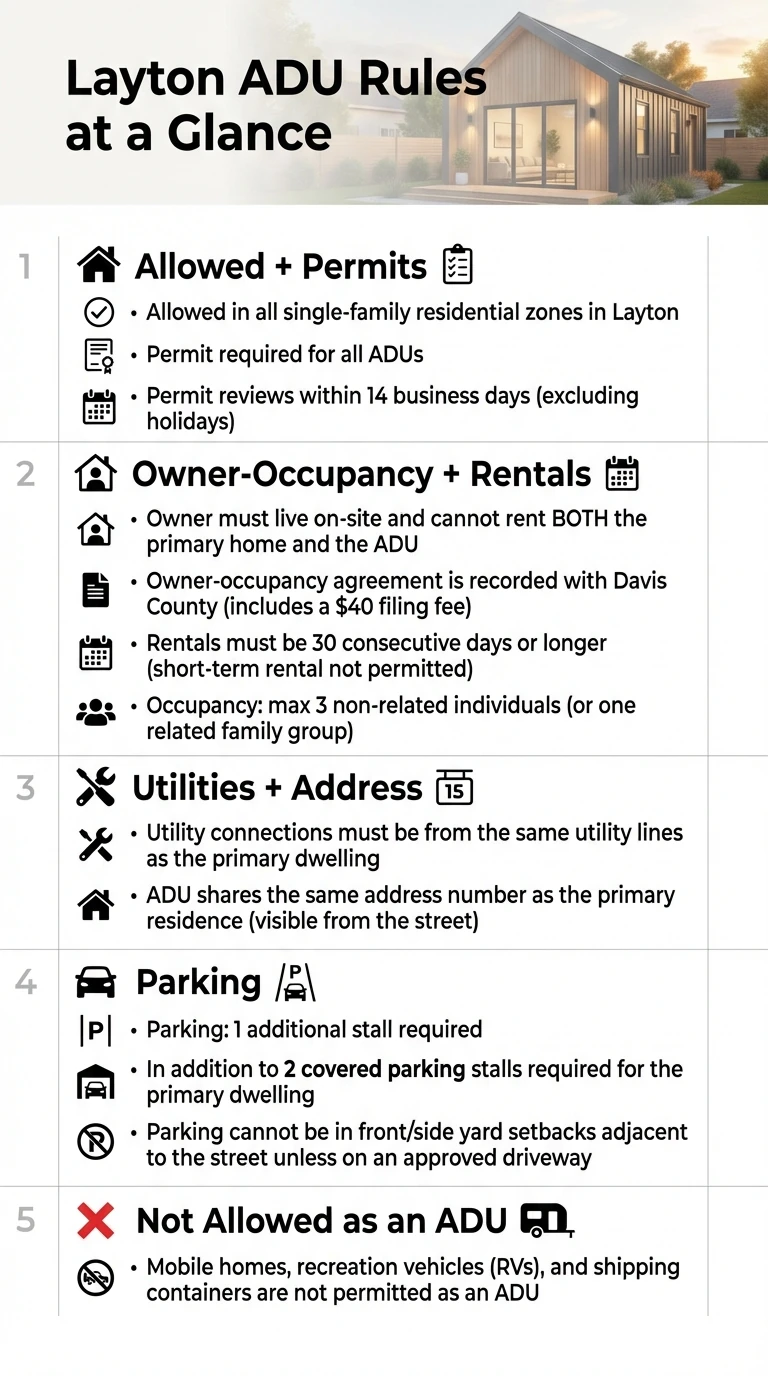
| Rule | What It Means in Plain English | Source |
|---|---|---|
| Permitted zones | ADUs allowed in all single-family residential zones (R-1-6, R-1-8, R-1-10, R-S, A) | Layton City Municipal Code 19.06.300 |
| One per lot | Maximum of 1 ADU per single-family property | Layton City Municipal Code |
| Owner occupancy | You must live in either the main home or the ADU. An owner-occupancy agreement gets recorded with Davis County ($40 filing fee) | Layton City ADU Handout |
| Rental rules | Long-term rentals allowed (30+ consecutive days). Short-term rentals (Airbnb, VRBO) are not permitted | Layton City ADU Handout |
| Detached lot size | Detached ADUs allowed on lots ≥ 6,000 sq ft | Layton City ADU Handout |
| Max detached size | 50% of primary dwelling floor area, up to 1,200 sq ft maximum | Layton City ADU Handout |
| Parking | 1 additional off-street parking space required beyond what the primary home needs | Layton City Municipal Code |
| Building permit | Required before any ADU construction begins | Layton City |
A few things that trip people up early:
You cannot Airbnb your ADU. Layton specifically prohibits short-term rentals for accessory dwelling units. The minimum rental period is 30 consecutive days. This is one of the most common misconceptions, and it matters for your financial projections.
Your HOA probably can't block an internal ADU or restrict renting it. Utah law (Utah Code § 57-8a-209 and § 57-8a-218) limits an HOA's ability to restrict or prohibit both the construction and rental of a code-compliant internal ADU within an owner-occupied, detached single-family home. This applies to CC&Rs and HOA rules alike. However, HOA rules may still affect detached structures, exterior modifications, or other aspects of your property — and not every neighborhood is governed the same way. Read your CC&Rs, and if it's unclear, get legal advice before spending money on plans.
You have to actually live there. The owner-occupancy requirement means you can't buy a house in Layton, build an ADU, and rent out both units while living somewhere else. You or a co-owner must reside in one of the two dwellings.
How quotes work (no cost to you): When you request an estimate, we share your project details with a local Utah builder who serves Layton. You'll get an estimate, review it, and choose — no obligation. Verify licensing, insurance, and references before hiring. We may be compensated by builders for introductions. See our Privacy Policy.
ADU Builders in Layton, Utah: Compare Your Options
If you searched for "ADU builders Layton Utah," you probably want to know who can actually build this thing. Here's how the main builder types compare — and which makes sense depending on your project.
Builder Type Comparison
| Builder Type | Best For | Typical Timeline | Budget Range (Estimate) | Handles Permits? |
|---|---|---|---|---|
| Design-build firm | Detached ADUs, full-service projects | 6–10 months | $180K–$350K+ | Yes — design through CO |
| General contractor + architect | Custom designs, complex lots | 7–12 months | $150K–$350K+ | Usually (architect designs, GC builds) |
| Basement conversion specialist | Internal ADUs, budget projects | 2–4 months | $50K–$150K | Yes |
| Prefab/modular installer | Standard footprints, faster timelines | 4–7 months | $180K–$280K installed | Varies — confirm before signing |
Budget ranges are estimates based on 2025–2026 Davis County construction data. Your project may be higher or lower depending on site conditions, finishes, and scope.
How to check Layton ADU builders before hiring
Not every contractor who says they build ADUs has actually pulled an ADU permit in Layton. Before hiring, check for:
- Active Utah contractor's license (verifiable at dopl.utah.gov)
- General liability and workers' comp insurance (current certificates)
- ADU-specific experience in Davis County — not just general remodeling
- Familiarity with Layton's permit process, setback rules, and inspection sequence
- References from previous ADU clients you can actually call
What Types of ADUs Can You Build in Layton?
There are three categories, and which one makes sense depends on your budget, your lot, and what you're trying to accomplish.
Internal ADUs (Basement Apartments, In-Home Conversions)
This is the most common type in Layton and the most affordable. You're converting existing space inside your home — usually an unfinished basement — into a separate living unit with its own entrance, kitchen, and bathroom.
Internal ADUs are protected by Utah state law (HB 82), which means the city must allow them in residential zones. They also qualify for certain construction code modifications under HB 82, which adjusted the State Construction Code to include provisions for wall thickness, ventilation, and other requirements specific to internal ADUs. That said, internal ADUs must still comply with all applicable building, fire, and health codes as modified — confirm the specific requirements with Layton City during plan review, because code details change and your situation may have unique conditions.
The typical cost for an internal conversion in Layton runs $50,000 to $150,000, depending on how much work the existing space needs. If your basement already has rough plumbing, you're starting ahead.
Attached ADUs (Home Additions)
An attached ADU is built as an addition to your existing home — it shares at least one wall with the main structure. Think of it as adding a self-contained apartment onto the side or back of your house.
Attached ADUs follow the same setback rules as any home addition in Layton, and they need a building permit and full plan review. They cost more than internal conversions because you're adding new square footage: typically $150,000 to $250,000.
Detached ADUs (Backyard Cottages, Granny Flats)
A detached ADU is a separate, standalone building on your property. This is the option that gives you (and your tenant or family member) the most privacy. It's also the most expensive and has the most regulatory requirements.
In Layton, detached ADUs must meet specific standards:
- Your lot must be at least 6,000 square feet
- The ADU can be no larger than 50% of the primary dwelling's floor area, up to a 1,200 sq ft maximum
- The ADU's height cannot exceed the height of your primary home
- The roof pitch must complement the primary dwelling's architecture
- The exterior must use complementary materials and design to the main house
- Window restrictions may apply depending on proximity to side and rear property lines (referenced in Layton's Table 6-4 setback standards)
- Utility connections must come from the same lines as the primary dwelling — no separate meters
- The ADU must share the same address number as the main house, visible from the street
Detached ADUs in Layton/Davis County typically cost $200,000 to $350,000+ for new construction, running about $190 to $300 per square foot.
ADU Type Comparison
| Feature | Internal ADU | Attached ADU | Detached ADU |
|---|---|---|---|
| Typical Cost | $50K–$150K | $150K–$250K | $200K–$350K+ |
| Cost per Sq Ft | $80–$200 | $150–$250 | $190–$300 |
| Privacy Level | Low to Medium | Medium | High |
| Construction Timeline | 2–4 months | 4–6 months | 5–8 months |
| Permit Complexity | Simplest | Moderate | Most complex |
| Adds Square Footage? | No (uses existing space) | Yes | Yes |
| Rental Income Potential | $800–$1,200/mo | $1,000–$1,400/mo | $1,200–$1,500/mo |
| Best For | Budget-conscious, basement conversion | Growing family, suite addition | Maximum rental income, aging parents |
| HOA Can Restrict? | Generally no (state law limits HOA restrictions on construction + rental) | Possibly | Possibly |
Cost ranges based on 2025–2026 Davis County construction data. Actual costs vary by project scope and site conditions.
What's NOT Allowed as an ADU in Layton
Before you get too creative, Layton does not permit the following as accessory dwelling units:
- Mobile homes or manufactured homes — not permitted as an ADU in Layton, regardless of foundation type
- Recreational vehicles (RVs) — you cannot park an RV on your property and call it an ADU
- Shipping container conversions — not permitted under Layton's ADU standards
- Tents, yurts, or temporary structures — the ADU must be a permanent, code-compliant building
If you've seen photos of trendy shipping container homes on Instagram and thought "that could work in my backyard," unfortunately Layton's code doesn't agree. The ADU must meet all local building standards for a permanent residential structure.
Layton ADU Zoning Requirements in Plain English
This is the section that doesn't exist anywhere else online. Layton's municipal code is dense, so here's what it actually says in language you can use.
Which Zones Allow ADUs
ADUs are permitted in all single-family residential zones in Layton. Here's the zone-by-zone breakdown:
| Zone Code | Zone Name | Min. Lot Size | ADU Types Allowed |
|---|---|---|---|
| R-1-6 | Residential | 6,000 sq ft | Internal + Detached |
| R-1-8 | Residential | 8,000 sq ft | Internal + Detached |
| R-1-10 | Residential | 10,000 sq ft | Internal + Detached |
| R-S | Residential Suburban | Varies (larger lots) | Internal + Detached |
| A | Agriculture | Varies (largest lots) | Internal + Detached |
Source: Layton City Municipal Code Title 19, Layton City Planning & Zoning
The R-1-6 zone is the most common in Layton, covering the majority of single-family neighborhoods. If you live in a typical Layton subdivision, you're almost certainly in one of these zones. You can verify your specific zone using Layton City's online zoning map at laytoncityutah.gov/LC/PlanningZoning/Maps or by calling Planning & Zoning at 801-336-3780.
Setback Requirements — Read This Before You Design
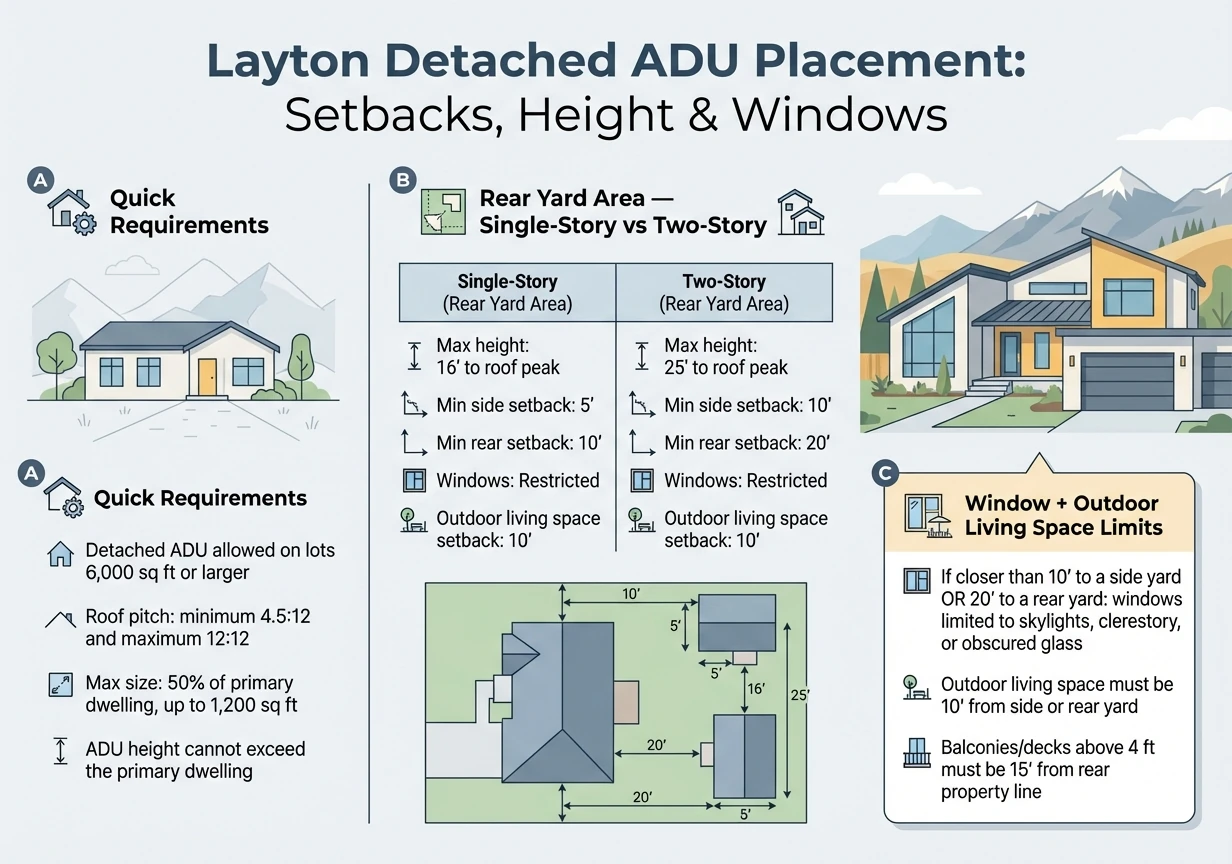
Setbacks determine how close your ADU can sit to your property lines. This is often the factor that makes or breaks a detached ADU project.
Here's what you need to know: Layton City Council was actively reviewing yard and setback definitions as recently as August 7, 2025. During that meeting, council members discussed the definitions of front, side, and rear yards — particularly for corner lots — and how those definitions affect where homeowners can place accessory structures, including ADUs. The council tabled the proposed changes for further discussion.
What this means for you: setback rules in Layton may be evolving. The existing code references Table 6-4 for detached ADU placement standards, which specifies different setback distances depending on whether your ADU is one or two stories and whether it's near a side yard or rear yard. Window placement, outdoor living space, and door locations are all affected by proximity to property lines.
Do not design your ADU before confirming current setback requirements for your specific lot. Call Layton Planning & Zoning at 801-336-3780 or visit them at 437 N Wasatch Dr. They can pull up your parcel and tell you exactly what applies. This one phone call can save you thousands in redesign costs.
Key Regulations That Affect Every ADU
Owner Occupancy. You must live in either the primary home or the ADU. Layton requires you to sign an owner-occupancy agreement that gets recorded with the Davis County Recorder. There's a $40 recording fee (per the Davis County Recorder's standard document recording fee schedule). This is not optional — it's a condition of the ADU permit.
Rental Duration. Your ADU must be rented for 30 or more consecutive days. No short-term rentals. No weekend stays. No vacation rentals. If someone tells you they're renting their Layton ADU on Airbnb, they're either in a different city or they're breaking the rules.
Occupancy Limits. A maximum of 3 unrelated individuals can occupy the ADU. Families or related groups are not subject to this numerical cap.
Parking. You must provide 1 additional off-street parking space for the ADU, in addition to whatever parking is already required for your primary home. There are restrictions on where this space can go — not all areas of your lot are eligible. Check with the city.
Separate Entrance. Every ADU needs its own dedicated entrance. For internal ADUs, the entrance should be on the side or rear of the home and subordinate to the primary entrance. The ADU must also have its own kitchen and bathroom.
A note on interior access (state law vs. local practice): Utah state law (now codified in Utah Code § 10-21-303, formerly § 10-9a-530) limits municipal restrictions on internal ADUs, including restrictions on "internal connectivity" — meaning the state generally protects your ability to maintain an interior connection between the ADU and the main home. However, fire and life safety requirements may affect how interior access works in practice. Confirm with Layton Planning & Zoning how these provisions apply to your specific project before finalizing design.
Utilities. Utility connections (water, sewer, gas, electric) must come from the same service lines as the primary dwelling. The city does not allow separate utility meters for ADUs. This means your ADU's utility usage will show up on your existing bills.
Address. The ADU must share the same address number as the main house. The address must be visible from the street.
How Much Does an ADU Cost in Layton, Utah?
This is the question everyone asks first, and it deserves an honest answer: it depends, but we can get you a lot closer to a real number than the "$60K to $400K" range you see in generic articles.
For most Layton homeowners, here's what to expect:
- Internal conversion (basement apartment): $50,000 to $150,000
- Attached addition: $150,000 to $250,000
- Detached new construction (600–1,000 sq ft): $200,000 to $350,000+
These ranges reflect Davis County construction costs in 2025–2026, where per-square-foot costs typically run $190 to $300 for new residential construction, depending on the complexity and finish level.
Where the Money Actually Goes
Here's a detailed cost breakdown for a typical detached ADU build in Layton. Use this as a budgeting framework — your actual numbers will depend on your specific project.
| Cost Category | Typical Range | What This Covers |
|---|---|---|
| Design & Architecture | $5,000–$20,000 | Architectural plans, engineering stamps, site planning |
| Permits & Fees | $3,000–$8,000 | Building permit, plan review, inspections, $40 owner-occupancy recording |
| Site Preparation | $5,000–$25,000 | Excavation, grading, utility trenching, access for equipment |
| Foundation | $8,000–$25,000 | Concrete slab (most common) or crawlspace |
| Framing & Structure | $20,000–$50,000 | Wood frame construction, standard in Utah |
| Roofing | $5,000–$15,000 | Must complement primary residence per Layton code |
| Plumbing | $8,000–$20,000 | Kitchen, bathroom, water heater, sewer connection |
| Electrical | $6,000–$15,000 | Panel, wiring, lighting, outlets, code-required safety items |
| HVAC | $5,000–$15,000 | Mini-split systems are the most popular choice for ADUs |
| Insulation & Drywall | $5,000–$12,000 | Utah climate demands quality insulation |
| Flooring | $3,000–$10,000 | LVP (luxury vinyl plank) is the most popular for ADUs |
| Kitchen | $8,000–$25,000 | Cabinets, countertops, appliances, backsplash |
| Bathroom | $5,000–$15,000 | Fixtures, tile, vanity, shower/tub |
| Exterior Finishes | $5,000–$15,000 | Siding, paint, trim (must match or complement main house) |
| Utility Connections | $5,000–$20,000 | Tying into existing water, sewer, gas, electrical lines |
| Landscaping & Restoration | $3,000–$10,000 | Restoring your yard after heavy equipment tears it up |
| Total (Detached New Build) | $150,000–$350,000+ | Typical range for 600–1,000 sq ft |
Sources: Davis County builder estimates, Utah construction cost indices (2025–2026), ADU Utah construction data. These are common quoted ranges — your project may be higher or lower depending on site conditions, design complexity, and material selections. Get itemized bids from multiple builders before committing.
What Makes the Number Go Up (or Down)
Five things move the needle more than anything else:
Size. Every additional 100 square feet adds roughly $15,000 to $30,000 to a new build. A 600 sq ft ADU and a 1,000 sq ft ADU are very different projects financially.
Site conditions. Is your backyard flat with easy equipment access? Good — that's the baseline. Sloped lots, rocky soil, narrow side yards, or properties where a crane can't reach add real money to site prep.
Finish level. Builder-grade cabinets and LVP flooring versus custom tile and quartz countertops can swing your total cost by 30–50%. Be honest about what matters. A rental unit doesn't need the same finishes as your dream kitchen.
Utility distance. If your existing sewer and water lines are close to where the ADU will sit, connections are straightforward. If they're on the far side of the property, trenching and piping costs climb fast.
Conversion vs. new build. A basement conversion that starts with existing walls, a roof overhead, and rough plumbing already in place can save $50,000 to $150,000+ compared to building from scratch.
Costs People Forget to Budget For
Your ADU's sticker price isn't the full story. Plan for these ongoing costs:
- Property tax increase. Adding an ADU increases your home's assessed value. Expect an additional $1,000 to $3,000+ per year in property taxes, depending on the value added.
- Insurance. Your homeowner's policy will need updating. Budget an extra $200 to $600 per year for the additional coverage.
- Utilities. Since Layton doesn't allow separate meters, you'll absorb the ADU's utility costs (unless you work out a flat-rate arrangement with your tenant). Expect $100 to $200 per month.
- Maintenance. Appliances break. Pipes leak. Budget $1,000 to $3,000 per year for upkeep.
ADU Rental Income in Layton — Is It Worth the Investment?
The math is what matters here, so let's use real numbers.
A well-built ADU in Layton can generate $1,000 to $1,500 per month in rental income based on current market rates. That's $12,000 to $18,000 per year going toward your mortgage, savings, or cash flow.
Current Layton Rental Market Data (2025–2026)
| ADU Type | Typical Size | Monthly Rent Range | Annual Gross Income |
|---|---|---|---|
| Studio / Efficiency | 350–500 sq ft | $830–$1,000 | $9,960–$12,000 |
| 1-Bedroom | 500–700 sq ft | $1,080–$1,300 | $12,960–$15,600 |
| 2-Bedroom | 700–1,000 sq ft | $1,450–$1,675 | $17,400–$20,100 |
Data compiled from Apartments.com, Rent.com, RentCafe, Zumper, and Apartment List (2025–2026). Private ADU rentals often command a small premium over apartment complexes because tenants value the privacy of a standalone or separate-entrance unit.
It's worth noting that the average rent across all apartment types in Layton is approximately $1,458 per month, and the median sits around $1,249. One-bedroom units — the sweet spot for most ADUs — consistently rent between $1,080 and $1,300.
A Real-World ROI Scenario
Let's walk through the numbers on a typical detached 1-bedroom ADU in Layton:
The Build:
- Construction cost: $200,000
- Financing: Home equity loan at 8% interest
- Monthly loan payment: ~$1,467 (30-year term)
The Income:
- Monthly rent: $1,200
- Annual gross: $14,400
- Annual expenses (extra taxes, insurance, maintenance): ~$4,000
- Annual net operating income: ~$10,400
The Payback:
- Simple payback on construction cost: ~19 years
- But here's what changes the math: a permitted ADU can meaningfully increase your property value. Industry estimates suggest a 10–30% value bump is common for well-built, permitted ADUs, though actual appreciation depends on your property, the local market, and the quality of the build. On a $530,000 home (roughly the Layton median as of late 2025), that range would represent $53,000 to $159,000 in added equity.
When you factor in the equity gain, the effective payback period drops substantially. You're not just building a rental unit. You're building an asset that generates monthly income and increases the value of your property.
When an ADU Does NOT Make Financial Sense
Honesty matters more than hype. An ADU isn't always the right move:
If your lot makes construction unreasonably expensive. A tiny lot with poor access, steep slopes, or problematic soil can push your build cost well above $350,000 — at which point the rental income doesn't justify the investment.
If you're financing the entire cost at today's rates. At 7–8% interest, a $250,000 loan costs over $1,800 per month in principal and interest alone. If your ADU only rents for $1,200, you're cash-flow negative every month. Run the numbers with your actual financing terms before committing.
If you don't want to be a landlord. Owning a rental unit means dealing with tenants, maintenance calls, lease agreements, and occasional vacancies. Property management companies charge 8–12% of monthly rent. If that sounds exhausting, factor that cost in or reconsider.
If Airbnb was your plan. Layton's prohibition on short-term rentals means you can't charge $150 per night. Your ceiling is the long-term rental market, which is solid but not explosive.
If your financing requires zero equity. If you're already stretched on your mortgage and don't have substantial equity, adding $200K+ in debt may not be wise regardless of the rental income potential.
What About Property Value?
Beyond the monthly rental income, there's a second financial benefit that often gets overlooked: the impact on your home's resale value. Industry estimates suggest a permitted, well-built ADU can add roughly 20–35% of its construction cost directly to the property's appraised value, though results vary widely by market and property.
In Layton's housing market, where the median home price hovers around $530,000 (as of late 2025, per local MLS data), a quality ADU could plausibly add $50,000 to $150,000+ in value to your property. That means even if you never rent the unit — even if you build it exclusively for an aging parent or adult child — you're likely to recover a significant portion of your investment when you eventually sell.
The caveat: the ADU must be properly permitted and inspected. An unpermitted ADU can actually hurt your property value because buyers and their lenders won't trust it.
How to Get an ADU Permit in Layton (Step by Step)
The permit process is one of the biggest sources of anxiety for homeowners considering an ADU. It sounds bureaucratic and slow, and it can be — but it's also predictable once you understand the steps.
Layton City reviews ADU permit applications within approximately 14 business days (per the city's ADU handout), though revisions can extend the timeline. From start to finish, plan on 4 to 12 weeks for permitting, depending on the complexity of your project and how quickly you respond to any correction notices.
Here's the process:
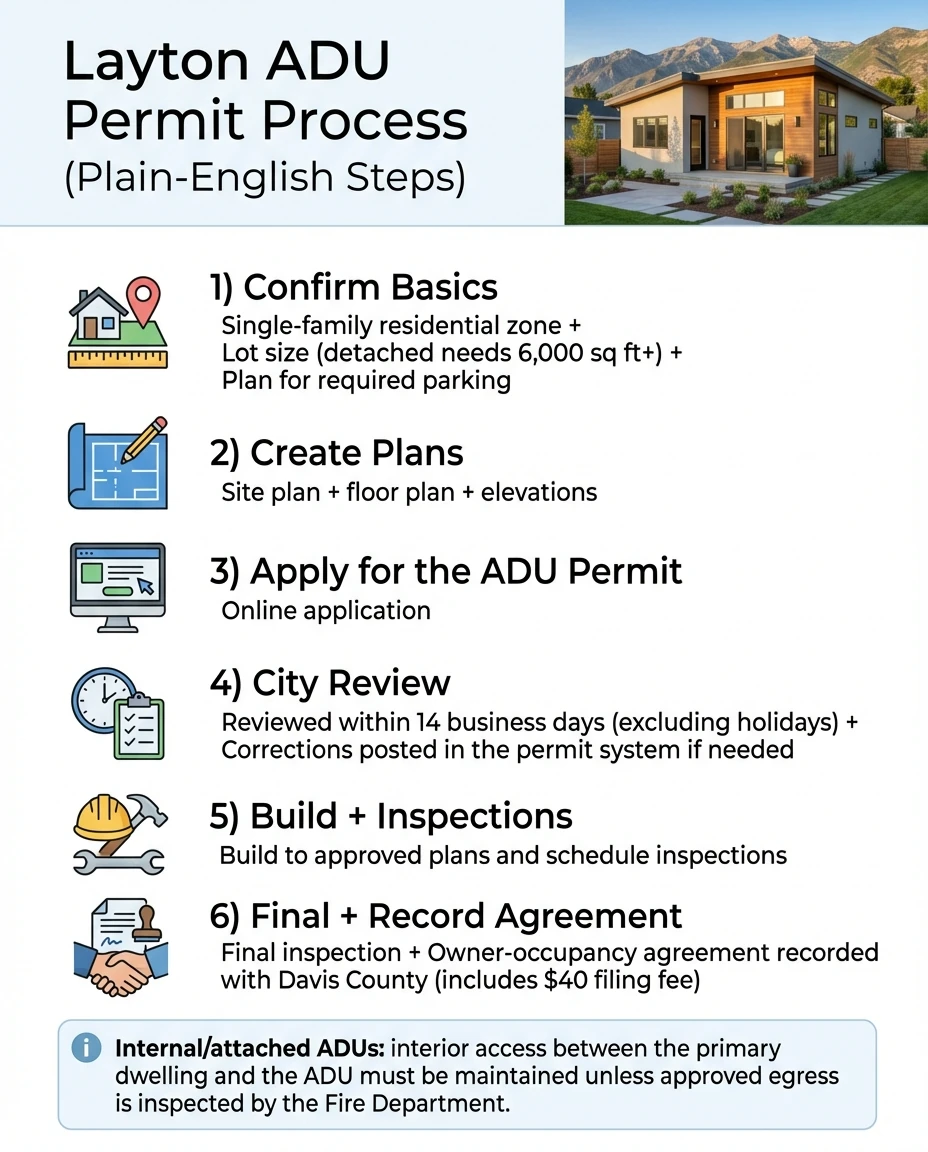
Step 1: Verify Your Property Qualifies
Before you spend a dollar on design, confirm the basics:
- Check your zoning. Use Layton's online zoning maps at laytoncityutah.gov/LC/PlanningZoning/Maps or call 801-336-3780.
- Confirm your lot size meets the minimum for your zone (especially relevant for detached ADUs — you need at least 6,000 sq ft).
- Check for easements or deed restrictions that could limit where you build.
- Review your HOA covenants if applicable (state law limits HOA restrictions on internal ADUs, but detached may be different).
- Confirm you'll maintain owner occupancy.
Step 2: Get Design & Engineering Plans
You'll need construction documents stamped by a licensed engineer or architect. These typically include a floor plan, site plan showing setback distances, structural details, and exterior elevations.
Many ADU builders in the Layton area include design as part of their service package, which simplifies this step. If you hire an architect separately, expect to spend $5,000 to $20,000 depending on the complexity of the design.
Tip: If you're building a detached ADU, make sure your site plan clearly shows the ADU's footprint relative to all property lines. Setback compliance is the most common reason permits get sent back for revision.
Step 3: Submit Your Application to Layton City
- Where: Community & Economic Development Department, 437 N Wasatch Dr, Layton, UT 84041
- What to submit: Completed land use application, stamped construction plans, site plan, property owner affidavit
- Fee: Building permit fees are based on project valuation per Layton's Consolidated Fee Schedule (effective January 5, 2026). Plan check fees are calculated as a percentage of the building permit fee.
- Contact: Planning & Zoning at 801-336-3780
Layton also offers an online permit portal for submissions, tracking, and scheduling inspections. You can access it through the Building Division page.
Step 4: Plan Review
Once submitted, the city reviews your plans for zoning compliance, building code compliance, fire safety, and structural adequacy. The ADU handout states a review timeline of approximately 14 business days.
You may receive correction notices asking for changes to your plans. Respond to these quickly — delays in responding add weeks to your timeline.
Step 5: Permit Issued — Begin Construction
Once your plans are approved, Layton issues the building permit. Display it visibly on-site during the entire construction process. As your builder works, they'll need to schedule inspections at key phases: foundation, framing, mechanical (plumbing, electrical, HVAC), insulation, and final.
Step 6: Final Inspection & Certificate of Occupancy
After construction wraps, schedule a final inspection with the city. The inspector verifies everything was built according to the approved plans and meets life-safety standards (smoke detectors, CO detectors, proper egress, etc.).
Once you pass, the city issues a certificate of occupancy. If you plan to rent the ADU, Layton requires a business license — this is not optional for rental units. And don't forget to complete the owner-occupancy agreement recording with the Davis County Recorder ($40 recording fee).
Total timeline from "I want to build an ADU" to "someone is living in it": plan for 6 to 12 months. Permitting accounts for 1 to 3 months, and construction fills the rest.
How to Choose an ADU Builder in Layton
This is where you're spending $50,000 to $350,000 of your money. The builder you choose will determine whether this project goes smoothly or becomes a nightmare. Here's how to evaluate them.
Questions to Ask Every ADU Builder
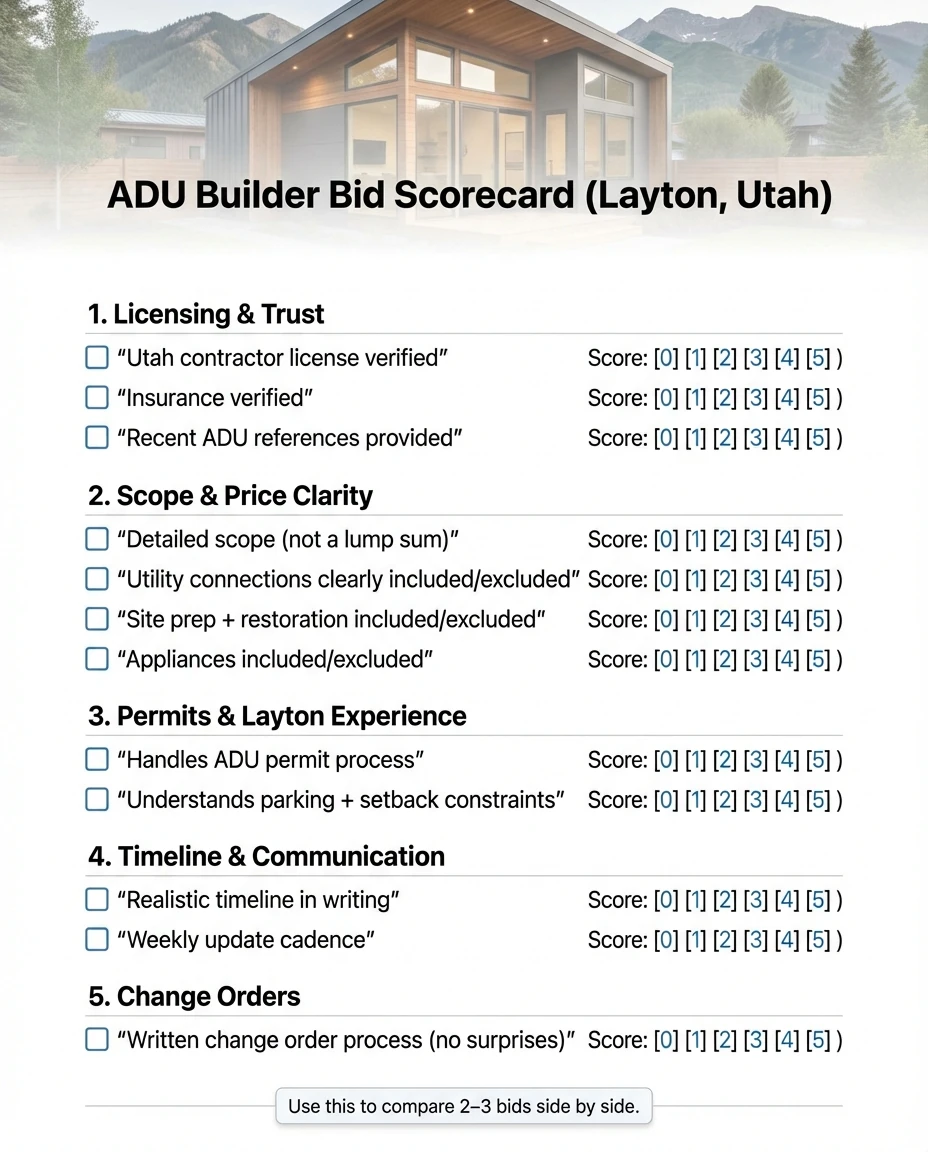
"Are you licensed and insured in Utah?" Verify their contractor license at dopl.utah.gov. If they hesitate or can't provide a license number, walk away.
"How many ADUs have you built in Davis County?" General remodeling experience is not the same as ADU experience. ADUs have specific permitting requirements, setback calculations, and inspection sequences. A builder who's navigated the Layton permit process before will save you time and frustration.
"Do you handle design, permitting, and construction — or just construction?" Full-service builders manage the entire scope from architectural plans through final inspection. If you have to coordinate your own architect, engineer, and permit applications, that's more work and more risk for you.
"What's included in your bid?" Get an itemized breakdown, not a lump sum. You need to know what's in and what's out. Ask specifically about: permits, site prep, utility connections, landscaping restoration, and appliances. These are the items that most often get left out of bids and show up as surprise charges later.
"What's your change order process?" Every construction project hits surprises. What matters is how the builder handles them. You want a written process: proposed change, cost impact, your written approval required before work proceeds. If the builder says "we'll figure it out as we go," that's not a process — it's a blank check.
"What's your realistic timeline from design to move-in?" Get a specific answer in months, not vague assurances. Ask what could delay it and how they handle schedule slippage.
"Can you provide references from previous ADU clients?" And actually call them. Ask about communication, budget accuracy, timeline adherence, and whether they'd hire the builder again.
Red Flags to Watch For
- No Utah contractor's license. Full stop.
- Won't provide a detailed written contract with scope, timeline, payment schedule, and change order terms.
- Asks for more than 10% upfront before any work begins. Progress-based payments tied to milestones are standard.
- Has never built an ADU. Remodeling a kitchen and building a 700 sq ft detached residence are fundamentally different projects.
- Can't explain your setback or zoning requirements. If your builder doesn't understand Layton's code, they shouldn't be pulling your permit.
- "We'll figure the permit out later." The permit process drives the design. A builder who doesn't start with permitting is building a plan that might not be approvable.
Why Local Layton Experience Matters
Layton's ADU regulations are not identical to Salt Lake City's, Ogden's, or any other Utah city. Specific reasons local experience matters:
- Layton's yard and setback definitions were a specific point of City Council discussion in August 2025, and these definitions directly affect ADU placement. Builders who work here know the nuances.
- Davis County has specific soil conditions, drainage patterns, and utility connection requirements that differ from Salt Lake County.
- Builders with existing relationships at Layton City's Building Division understand the review process, the inspectors' expectations, and common reasons applications get sent back.
A builder from another county who's never pulled a permit in Layton will learn these things on your dime.
Financing Your Layton ADU
Most homeowners don't pay cash for a $200,000 construction project. Here are the financing options that make the most sense for ADU builds, along with what to watch for.
| Financing Option | How It Works | Best For | Typical Rates (Early 2026) |
|---|---|---|---|
| Home Equity Loan (HELOAN) | Lump-sum loan against your home equity | Homeowners with 20%+ equity, fixed-rate preference | 7–9% fixed |
| Home Equity Line of Credit (HELOC) | Revolving credit line, draw as needed | Phased construction, flexible spending | 7–10% variable |
| Cash-Out Refinance | Refinance your mortgage and pull equity out | Large equity, favorable existing rate | 6–7.5% fixed |
| Construction Loan | Short-term loan for the build, converts to a permanent mortgage | New detached ADU construction | 8–10% during construction |
| Personal Loan | Unsecured loan, no collateral | Smaller projects (basement conversion under $75K) | 8–15% |
| 401(k) Loan | Borrow from your own retirement savings | Avoiding traditional lenders, quick access | ~Prime + 1% |
| Family Funding | Parents or family members contribute funds | Multigenerational housing (parents fund the ADU they'll live in) | N/A |
Rates reflect early 2026 market conditions. Always get multiple quotes from local Davis County lenders.
Utah-Specific ADU Financing Notes
Utah's HB 82 included provisions for state-backed loan programs for internal ADUs. Availability changes — check with the Utah Division of Housing for current programs.
Some local credit unions in Davis County offer ADU-specific loan products. These are worth investigating because community lenders sometimes offer more flexible terms than national banks for this type of project.
FHA 203(k) loans can include ADU construction in a home purchase or refinance. If you're buying a home in Layton and want to add an ADU, this can roll both costs into a single mortgage.
The financing structure you choose has a major impact on whether your ADU is cash-flow positive from day one. A $200,000 build financed at 8% over 30 years costs about $1,467 per month. If your ADU rents for $1,200, you're negative $267 per month — but gaining equity. If you can put 40% down (from existing equity) and finance only $120,000, your payment drops to ~$880 per month, and you're cash-flow positive immediately.
Run the numbers at your specific terms before committing.
How to Talk to Your Lender About an ADU Loan
Banks and credit unions in Davis County handle ADU financing regularly at this point, but you'll get better results if you walk in prepared. Bring a clear idea of your project scope (type, estimated size, and target budget), your current home's estimated value, your remaining mortgage balance, and your income documentation. Lenders want to see that the equity math works — meaning your home's value minus what you owe leaves enough room to borrow against.
If you're considering a construction loan specifically, know that these work differently from a standard mortgage. The lender typically disburses funds in stages as the build progresses, not as a lump sum upfront. Your builder needs to be comfortable working with a draw schedule, and the lender will want to see your approved building permit and construction plans before funding.
One more thing: tell your lender this is for an ADU, not a general home improvement project. ADU-specific loans sometimes have different terms, and some lenders have programs designed specifically for accessory dwelling units that you won't see advertised on their website.
Internal ADU vs. Detached — Which Is Right for Your Property?
This is the biggest design decision you'll make, and it comes down to five questions.
The 5-Question ADU Decision Framework
1. What's your budget? Under $150K → Internal ADU is your likely path. Over $150K → Either option is viable.
2. What's your primary goal? Maximum rental income → Detached (private units command $200–$400/month more). Family housing → Either works. Home office or flex space → Internal is simpler.
3. How much yard are you willing to lose? None → Internal. Some → Detached.
4. How important is privacy — for you and the occupant? Very → Detached (separate building, separate entrance, separate life). Not a priority → Internal.
5. How quickly do you need it done? Fast → Internal (simpler permits, shorter construction, 2–4 months). Can wait → Either option.
When Internal ADUs Win
You have an unfinished basement that's already the right size. Your budget is under $150K. You want the fastest possible path to rental income. Your lot is small (under 6,000 sq ft) or has difficult access for heavy equipment. You don't want to sacrifice any outdoor space.
When Detached ADUs Win
You want the highest possible rental income from a private, standalone unit. Privacy matters — whether for aging parents, adult children, or long-term tenants. Your lot is large enough (10,000+ sq ft is ideal) with good access. You're thinking long-term and want the property value boost of added livable square footage.
Garage Conversions — The Middle Ground
Converting an existing garage into a living space sits between internal and detached in both cost and complexity. You already have the structure — walls, roof, foundation — which saves substantial money. Typical conversion costs run $100,000 to $200,000, depending on the existing condition and how much work the plumbing and electrical need.
The trade-off is obvious: you lose your garage. In Layton's climate, with cold winters and significant snowfall, that's a real consideration. Also remember that Layton's parking requirement means you still need off-street parking for both the main home and the ADU. Losing a garage while adding a parking requirement can be a squeeze.
Garage conversions follow the same permit process as any ADU. If the garage is detached, it must meet detached ADU standards. If it's attached, it follows attached ADU rules.
Designing an ADU for Layton's Climate
Nobody else online talks about this, but it matters more than most homeowners realize. Layton sits at about 4,400 feet in Davis County, with weather that swings from 20°F winters to 95°F+ summers. Snowfall is significant. UV exposure is intense at elevation. If your ADU isn't designed for this climate, your tenant will be uncomfortable and your energy bills will be painful.
Insulation. Aim for R-38 in ceilings and R-21 in walls at minimum. Utah's energy code requires specific performance levels, and going beyond code is cheap insurance against high heating bills. Spray foam insulation, while more expensive upfront, performs exceptionally well in Utah's temperature swings and also helps with air sealing.
HVAC. Mini-split heat pump systems have become the go-to for ADUs in Utah. They handle both heating and cooling efficiently in a single system, don't require ductwork, and allow zone-by-zone temperature control. A quality mini-split system runs $3,000 to $8,000 installed.
Snow Load. Your roof must be engineered for local snow loads per Layton's building code. This isn't something to cut corners on. Davis County gets real snow, and a roof designed for a lighter load can fail.
Foundation Depth. The frost line in Davis County requires foundations to extend below the frost depth to prevent heaving. Your builder and engineer will know the specific requirement, but this is one reason you can't just drop a prefab building on a gravel pad and call it done.
Windows. High-efficiency double or triple-pane windows are worth the investment in Layton. South-facing windows provide passive solar heating in winter but can overheat in summer without proper overhangs or shading. Low-E coatings are a smart default.
Exterior Materials. Whatever you choose needs to handle freeze-thaw cycles, intense UV, and occasional hail. Fiber cement siding is popular in Utah for good reason — it's durable, fire-resistant, and holds up to the climate. Layton also requires that the exterior complement the primary residence, so coordinate materials and colors.
Common ADU Mistakes in Layton (and How to Avoid Them)
Learning from other people's expensive mistakes is free. Here are the ones that come up most often.
Designing a detached ADU on a lot under 6,000 sq ft. Layton's code requires at least 6,000 square feet for a detached ADU. If your lot is smaller, your only option is an internal or attached ADU. Surprisingly often, homeowners spend money on detached ADU plans before checking this basic requirement.
Forgetting the parking requirement. You need one additional off-street parking space for the ADU, and there are restrictions on where it can go. Don't assume your existing driveway is enough. Don't assume your street has enough curb space. Verify with the city before you finalize your site plan.
Assuming you can rent on Airbnb. We've said it three times in this guide because people keep making this mistake. No short-term rentals in Layton. Period. Build your financial projections around long-term rental rates, not nightly rates.
Underestimating the cost of utility connections. If your existing sewer line is 60 feet from where the ADU will sit, that's 60 feet of trenching, piping, and connections. Utility tie-in costs can range from $5,000 for a simple, close connection to $20,000+ for complex, distant runs. Get a utility assessment before you finalize your ADU's location on the lot.
Skipping the pre-design zoning check. It's free to call Layton Planning & Zoning at 801-336-3780 and ask about your specific property. It's not free to discover your ADU plan doesn't comply after you've paid for architectural drawings.
Choosing a builder who's never worked in Layton. Every city's permitting process has quirks. Layton's yard definitions and setback rules were actively being discussed by City Council as recently as August 2025. A builder without local experience is learning on your project and your budget.
Underestimating plan revision time. Most ADU permit applications in Layton don't sail through on the first try. Correction notices are common. Budget extra time (and patience) for at least one round of revisions. If your builder handles permitting, this is their problem to manage. If you're doing it yourself, plan for it.
Building bigger than you need. Every square foot costs $190–$300. A well-designed 600 sq ft one-bedroom ADU can rent for nearly as much as a poorly designed 900 sq ft unit. Focus on efficient floor plans, good natural light, and quality finishes rather than sheer size.
Not budgeting for vacancy. Even in Layton's solid rental market, you should expect some vacancy between tenants. Budget for at least one month of vacancy per year in your financial projections. That means your "annual income" estimate should use 11 months of rent, not 12. Also budget for turnover costs — cleaning, minor repairs, touch-up paint — which typically run $500 to $1,500 between tenants.
Prefab ADUs in Layton — When They Make Sense (and When They Don't)
Prefab and modular ADUs have gotten a lot of attention nationally. Companies ship factory-built units to your property, crane them into place, and connect them to utilities. The promise is faster timelines and lower costs. Here's the reality in Layton.
When Prefab Works
Prefab can make sense if your site has good access for crane delivery, you want a streamlined construction process with less on-site disruption, and the prefab model fits within Layton's design requirements. Factory-built quality control can be excellent — consistent materials, less weather exposure during construction, and efficient assembly.
Some prefab companies have pre-engineered plans that are already designed to meet common building codes, which can speed up the permitting process.
When Prefab Doesn't Work
Here's what the marketing materials don't tell you:
The ADU still needs a permanent foundation. You can't just drop a prefab unit on your lawn. Foundation work, site prep, and utility connections are still required — and these are often the most expensive parts of the project.
Layton's design requirements still apply. The ADU must complement the primary residence in architecture, roof pitch, and materials. A generic prefab box that doesn't match your home's style may not get approved.
Setback rules don't change for prefab. Your lot still needs to meet the 6,000 sq ft minimum. The unit still needs to clear all setback distances. Crane access may require additional permitting.
Total installed cost often isn't cheaper. By the time you add foundation, site prep, utility connections, delivery, crane rental, and local code modifications, prefab ADUs often cost $180–$280 per square foot installed — comparable to traditional construction in many cases.
Prefab is a viable option in Layton, but it's not a shortcut. Treat it the same way you'd treat any ADU project: verify zoning, confirm setbacks, get the permit, and make sure the final product meets code.
Utah ADU Laws You Should Know
Understanding the legal landscape protects you and gives you leverage when talking to builders, lenders, and the city.
Utah HB 82 — The State Law That Started It All
In 2021, Utah passed HB 82 (Single-Family Housing Modifications Act), which fundamentally changed ADU policy across the state. The relevant provisions are now codified in Utah Code § 10-21-303 (for municipalities) and § 17-80-303 (for counties), after a statutory renumbering from the original § 10-9a-530. Here's what it does:
- Requires all Utah municipalities to allow internal ADUs in residential zones. Cities cannot ban them (except in up to 25% of residential-zoned area).
- Limits HOA restrictions on internal ADUs. Utah law (§ 57-8a-209 and § 57-8a-218) prevents HOAs from restricting or prohibiting the construction or rental of code-compliant internal ADUs in owner-occupied, detached single-family homes.
- Allows cities to require: a building permit, one additional parking space, a business license for rental, owner occupancy, and bedroom window egress.
- Allows cities to prohibit: separate utility meters and short-term rentals.
- Modified the State Construction Code to include provisions for internal ADUs related to wall thickness, ventilation, and other standards. Internal ADUs must still comply with all applicable building, fire, and health codes as modified.
- Applies to internal ADUs only. Detached ADU rules are set city by city.
- Exempts internal ADUs from impact fees (Utah Code § 11-36a-202).
The critical distinction: HB 82 guarantees your right to build an internal ADU. Everything about detached ADUs — whether they're allowed, what size, where they can go — is decided by Layton City's local ordinance.
Layton's Local Ordinance (Municipal Code 19.06.300)
Layton has chosen to go beyond the state minimum by allowing both internal and detached ADUs. The local code sets all the specific standards we've discussed throughout this guide: lot size requirements, setbacks, size limits, parking, design standards, and rental rules.
The complete code is found in Layton Municipal Code Section 19.06.300. The city also publishes an ADU Handout through the Planning & Zoning department that summarizes the requirements in a more readable format.
Davis County Considerations
While the ADU itself is governed by Layton City, a few county-level factors can come into play:
- Davis County Recorder: The owner-occupancy agreement must be filed with the county recorder ($40 fee).
- Utility districts: Depending on your location within Layton, sewer service may involve coordination with a broader utility district.
- Property assessment: Davis County assesses property values for tax purposes. Your ADU will be reflected in the next assessment cycle.
Frequently Asked Questions About ADUs in Layton
Can I build an ADU in Layton, Utah?
Yes. ADUs are permitted in all single-family residential zones in Layton (R-1-6, R-1-8, R-1-10, R-S, and A zones). You need a building permit from Layton City Planning & Zoning.
How much does it cost to build an ADU in Layton?
Expect $50,000–$150,000 for an internal conversion (like a basement apartment) and $200,000–$350,000+ for a new detached ADU. Costs depend on type, size, finish level, and site conditions. Davis County construction costs run $190–$300 per square foot.
Can I rent out my ADU in Layton?
Yes, but only as a long-term rental. The minimum rental period is 30 consecutive days. Short-term rentals (Airbnb, VRBO, nightly or weekly stays) are not permitted for ADUs in Layton.
Do I have to live on the property if I build an ADU?
Yes. Layton requires owner occupancy — you must reside in either the primary home or the ADU. You'll sign an owner-occupancy agreement that gets recorded with Davis County.
Can my HOA prevent me from building an ADU?
For internal ADUs (within your home's existing footprint), Utah law significantly limits your HOA's ability to restrict construction or rental of a code-compliant unit in an owner-occupied, detached single-family home. For detached ADUs, your HOA may have restrictions in the CC&Rs — check before you build. When in doubt, get legal advice.
What's the maximum size for a detached ADU in Layton?
50% of the primary dwelling's floor area, up to a maximum of 1,200 square feet. The ADU also cannot be taller than the primary residence.
What's the minimum lot size for a detached ADU?
6,000 square feet. If your lot is smaller, you can still build an internal ADU.
How long does the Layton ADU permit review take?
The city's ADU handout states approximately 14 business days for plan review. Allow additional time for any correction notices and revisions. Total permitting timeline: 4 to 12 weeks.
Where do I apply for an ADU permit in Layton?
Community & Economic Development Department at 437 N Wasatch Dr, Layton, UT 84041. Phone: 801-336-3780. Layton also has an online permit portal accessible through the Building Division webpage.
Do ADUs pay impact fees in Layton?
Layton's Consolidated Fee Schedule (effective January 5, 2026) includes impact fee tables for various utilities and services. Whether specific impact fees apply to your ADU project can depend on the project type and scope. Confirm with the city before budgeting.
Are shipping container ADUs allowed in Layton?
No. Shipping containers, mobile homes, RVs, and temporary structures are not permitted as ADUs in Layton. The ADU must be a permanent, code-compliant residential structure.
Are prefab or modular ADUs allowed?
Yes, as long as the prefab unit meets all local building code requirements, sits on a permanent foundation, complies with zoning and design standards, and goes through the standard permit process.
What is Utah HB 82?
It's a 2021 state law (Single-Family Housing Modifications Act), now codified in Utah Code § 10-21-303, that requires all Utah cities to allow internal ADUs in residential zones, limits HOA restrictions on internal ADU construction and rental, and modified the State Construction Code with provisions specific to internal ADUs. Internal ADUs are also exempt from impact fees.
Will building an ADU increase my property taxes?
Yes. An ADU increases your property's assessed value, which increases your tax bill. Budget for an additional $1,000 to $3,000+ per year depending on the value added.
Can I have more than one ADU on my property?
No. Layton permits a maximum of one ADU per single-family lot.
Can I sell my ADU separately from my main house?
No. ADUs are part of the same lot and cannot be subdivided or sold independently.
Your Layton ADU Checklist — A Complete Action Plan
Print this out. It'll keep you organized from first question to first tenant.
Phase 1: Research & Planning (Weeks 1–4)
- ☐ Confirm your property's zoning at laytoncityutah.gov/LC/PlanningZoning/Maps
- ☐ Verify your lot size (especially if planning a detached ADU — need 6,000+ sq ft)
- ☐ Read Layton's official ADU Handout from Planning & Zoning
- ☐ Check your HOA CC&Rs for detached structure restrictions
- ☐ Decide: internal, attached, or detached?
- ☐ Set your budget (include 15–20% contingency for surprises)
- ☐ Talk to 2–3 local lenders about financing options
- ☐ Call Layton Planning & Zoning (801-336-3780) to ask about your specific property's setbacks
Phase 2: Design & Permitting (Weeks 4–12)
- ☐ Get quotes from at least 3 licensed ADU builders
- ☐ Compare bids on scope, timeline, and what's included vs. excluded
- ☐ Select your builder and sign a detailed contract
- ☐ Complete architectural and engineering plans
- ☐ Submit permit application to Layton City (437 N Wasatch Dr)
- ☐ Respond to any correction notices promptly
- ☐ Receive building permit
Phase 3: Construction (Months 3–9)
- ☐ Site preparation and utility trenching
- ☐ Foundation poured and inspected
- ☐ Framing complete and inspected
- ☐ Mechanical rough-in (plumbing, electrical, HVAC) inspected
- ☐ Insulation and drywall installed
- ☐ Interior finishes: kitchen, bathroom, flooring
- ☐ Exterior finishes: siding, paint, trim, roofing
- ☐ Landscaping and yard restoration
Phase 4: Completion & Move-In (Months 9–12)
- ☐ Pass final inspection with Layton City
- ☐ Obtain certificate of occupancy
- ☐ Record owner-occupancy agreement with Davis County ($40 fee)
- ☐ If renting: obtain Layton business license (required — not optional)
- ☐ Update homeowner's insurance to cover the ADU
- ☐ Set rental price based on current Layton market data
- ☐ Screen tenants and sign a lease (minimum 30-day term)
- ☐ Welcome your first tenant — or family member
Sources & Methodology
This guide was researched and compiled using the following primary sources:
- Layton City Municipal Code 19.06.300 — Layton's ADU ordinance governing all local standards
- Layton City ADU Handout (Updated January 2025) — Summary of rules, setbacks, lot size requirements, rental rules, and permit process
- Layton City Consolidated Fee Schedule (Effective January 5, 2026) — Building permit fees, plan check fees, and impact fee tables
- Layton City Building Division / Online Permit Portal — laytoncityutah.gov/LC/CD/BuildingDivision
- Layton City Planning & Zoning Maps — laytoncityutah.gov/LC/PlanningZoning/Maps
- Layton City FAQ — laytoncityutah.gov/LC/City/FAQ
- Utah Code Ann. § 10-21-303 (formerly § 10-9a-530) — Internal ADU provisions, originally enacted as HB 82 (2021 Legislative Session), renumbered in subsequent code reorganization
- Utah Code Title 57, Chapter 8a, §§ 209 and 218 — HOA limitations on internal ADU construction and rental restrictions
- Utah Property Rights Ombudsman — propertyrights.utah.gov/find-the-law/legal-topics/adu/ — State summary of ADU and Internal ADU legal framework
- Layton City Council Meeting Records — August 7, 2025 session regarding proposed yard definition and setback regulation changes
- Davis County Recorder — Standard recording fee schedule ($40 document recording fee)
- Rental Market Data — Apartments.com, Rent.com, RentCafe, Zumper, and Apartment List (2025–2026 Layton data)
- Davis County Construction Cost Data — 2025–2026 builder estimates and construction cost indices
- ADU Utah (aduutah.com) — Davis County ADU construction cost references
- Rock Top Construction — Utah ADU cost benchmarking
- UpDwell Homes — Layton-area builder insights
Last updated: February 2026 Last verified: February 2026
This guide is for informational purposes only and does not constitute legal, financial, or construction advice. Zoning regulations, fees, and building codes can change. Always verify current requirements directly with Layton City Planning & Zoning (801-336-3780, 437 N Wasatch Dr, Layton, UT 84041) before beginning any ADU project.
Ready to Build Your ADU in Layton? Get Started Today.
You've read the rules. You know the costs. You understand the process.
The next step is talking to a builder who knows Layton.
Get matched with licensed, experienced ADU builders serving Layton, Utah. Free estimates, no obligation, no spam.
Here's what happens when you request a quote:
- Tell us about your project — your address, what type of ADU you're considering, your budget range, and your timeline
- We connect you with a local builder option that appears to fit your Layton ADU project — verify licensing and Layton permit experience before hiring
- Ask about a written estimate — the provider confirms scope, fees and timing after reviewing your request
- You compare and decide — no pressure, no obligation
How quotes work (no cost to you): We share your project details with a local Utah builder who serves Layton. You get an estimate, review it, and choose — no obligation. Verify licensing, insurance, and references before hiring. We may be compensated by builders for introductions. Your information is never sold to third parties. See our Privacy Policy.
Licensed Utah contractors · Layton building experience · Free property assessment
© 2026 Utah ADU Builders · utahadubuilders.com