
ADU Builders in Salt Lake City, UT: Compare Contractors, Costs & Permits (2026)
Compare the builder path for your Salt Lake City ADU, then request a review of your address and project type. Detached cottages, basement apartments, garage conversions and attached additions can need different expertise.
The provider reviews your address, project type and availability before confirming possible next steps.
Read Salt Lake City's ADU requirementsIndependent referral resource. We may receive a referral fee. The provider confirms project fit, availability and final pricing.
Nest Tiny Homes — a Utah ADU option to evaluate
Salt Lake City's standard-plan catalog includes Nest's 775-square-foot, two-bedroom 2B-775 model. Nest publishes detached, attached and garage-conversion services. Your address, project type and current availability still need provider review.
View the city's standard-plan listingThe plan listing is not a city endorsement of the contractor; site review, permits and fees still apply.
Read our Nest Tiny Homes reviewSalt Lake City ADU builders and plan providers to compare
Salt Lake City’s standard-plan catalog offers this starting shortlist. Compare providers by project type; plan listing does not establish construction availability or current credentials.
| Company / plan provider | City-listed option | Ask before proceeding | Provider source |
|---|---|---|---|
| Built By Design Construction | A3: 650 sq ft, 1 bedroom | Ask about construction scope and site-specific costs. | ADU A3 |
| Brach Design Architecture (architecture/design) | Detached garage conversion | Ask who designs the conversion and who builds it. | ADU design services |
| Nest Tiny Homes (publishes design/build services) | 2B-775: 775 sq ft, 2 bedrooms | Ask about model availability, exclusions, and total project cost. | Nest Tiny Homes |
| LMnt Architecture (architecture/design) | Second-story detached garage conversion | Ask about design scope and a separate construction contractor. | LMnt Architecture |
| ADU America (city-listed model provider) | Unit 800: 800 sq ft, 2 bedrooms | Confirm current Utah service before requesting a proposal. | Unit 800 model page |
Salt Lake City standard-plan catalog checked October 3, 2026. Site review and permit fees still apply; the city does not endorse these providers. Verify licensing, insurance, references, and written scope independently.
Page updated: October 3, 2026 · Sources: Utah Code §10-21-303 — Internal ADUs; §10-21-304 — Detached ADUs (SB 284, effective Oct 1, 2026); Salt Lake City Planning ADU FAQ (slc.gov). Local rules can change after state legislation or city ordinance updates. Always verify final eligibility with the city before purchasing plans, ordering prefab units, or applying for financing.
Building an ADU in Salt Lake City costs most homeowners between $150,000 and $300,000 for a detached unit, with construction running $200–$350 per square foot depending on size, site conditions, and finish level. ADUs are allowed in Salt Lake City residential zones, but Salt Lake City ADUs still require local zoning and building review. Detached ADU height, setbacks, parking, design, and rental-use limits can affect whether a specific lot works, even when ADUs are broadly allowed. Salt Lake City eliminated conditional use permits for detached ADUs in 2023, which cut months off the approval timeline. But the single biggest factor in whether your project stays on budget and on schedule isn't the permit process — it's the builder you choose.
This guide exists because no other resource puts everything a Salt Lake City homeowner needs in one place. Whether you're in the early stages of planning Salt Lake City ADU construction or you're ready to compare builders and get bids, we cover current zoning rules (with citations to the actual city code), real cost ranges by ADU type, a builder vetting scorecard you can print and use, the step-by-step permit process, financing options including SLC's own "Backyard Keys" loan program, and rental income projections based on local market data.
We're an independent resource — we don't build ADUs. If you request quotes through this site, we may connect you with local builders and may receive a referral fee. This doesn't affect the guidance in this article.
Get Started in 60 Seconds
Free eligibility walkthrough based on SLC's rules
Request a builder site assessmentYour address, project type, and availability need provider review. This request does not book a site visit or guarantee a bid.
On this page:
- Salt Lake City ADU builders and plan providers to compare
- What It Costs (Real Numbers)
- Can You Build on Your Property?
- SLC Zoning Rules in Plain English
- How to Vet a Builder (10-Point Scorecard)
- Custom vs. Prefab vs. Design-Build
- The Permit Process Step by Step
- Financing Options (Including City Loans)
- Rental Income & ROI Projections
- Design Considerations for SLC
- Common Mistakes That Cost Homeowners Thousands
- FAQs
- Official Resources & Sources
What It Actually Costs to Build an ADU in Salt Lake City
Let's get to the number everyone wants first.
Costs vary a lot depending on whether you're converting a basement, converting a garage, or building a brand-new structure in the backyard. Here's what real projects in the Salt Lake City area are running in 2026, based on builder quotes, SLC Redevelopment Agency data, and local contractor reporting:
| ADU Type | Typical Size | Total Cost Range | Cost Per Sq Ft | Typical Timeline |
|---|---|---|---|---|
| Basement / internal conversion | 400–800 sq ft | $60,000–$150,000 | $120–$200 | 2–4 months construction |
| Garage conversion | 400–600 sq ft | $80,000–$160,000 | $150–$250 | 3–5 months construction |
| Detached new build (standard finishes) | 500–800 sq ft | $150,000–$250,000 | $200–$300 | 5–9 months construction |
| Detached new build (custom / high-end) | 600–1,000 sq ft | $225,000–$375,000+ | $275–$375+ | 6–12 months construction |
| Prefab / modular ADU | 400–800 sq ft | $100,000–$200,000 | $175–$275 | 3–6 months total |
These ranges include design, permits, site preparation, utility connections, and construction. You already own the land, so that's not a factor.
A few notes on these numbers. The SLC Redevelopment Agency has noted that ADUs in Salt Lake City can cost $100,000 to $250,000, which is consistent with most detached new builds. ADU Utah reports construction costs of approximately $190–$210 per square foot for standard designs with standard finishes. For higher-end or more complex projects, local builders have quoted $300–$350+ per square foot. The wide range is real — it depends on your project.
What Pushes Your Cost Up
Several factors can push a project toward the higher end of these ranges. Sloped or difficult lots require more site work and engineering. Long utility runs (when the ADU sits far from your existing water, sewer, gas, and electrical connections) can add $15,000–$30,000 on their own. Custom architectural design costs more than using pre-approved plans. High-end finishes — quartz countertops, hardwood floors, premium fixtures — obviously add up. Above-garage builds require structural engineering that a slab-on-grade cottage doesn't. And if you're building during winter in SLC, expect weather delays that translate to labor cost.
What Keeps Costs Down
On the flip side, there are real ways to keep costs manageable. Salt Lake City offers pre-approved standard ADU plans through its Building Services department — using one of these can save you $5,000–$15,000 in architectural fees and 2–6 weeks in plan review time. Flat lots with easy utility access are cheaper to build on. Standard finishes (LVP flooring, laminate countertops, builder-grade fixtures) can cut $20,000–$40,000 compared to a fully custom-finished unit. And choosing a builder with ADU-specific experience in SLC means fewer surprises and fewer change orders.
The Costs People Forget to Budget
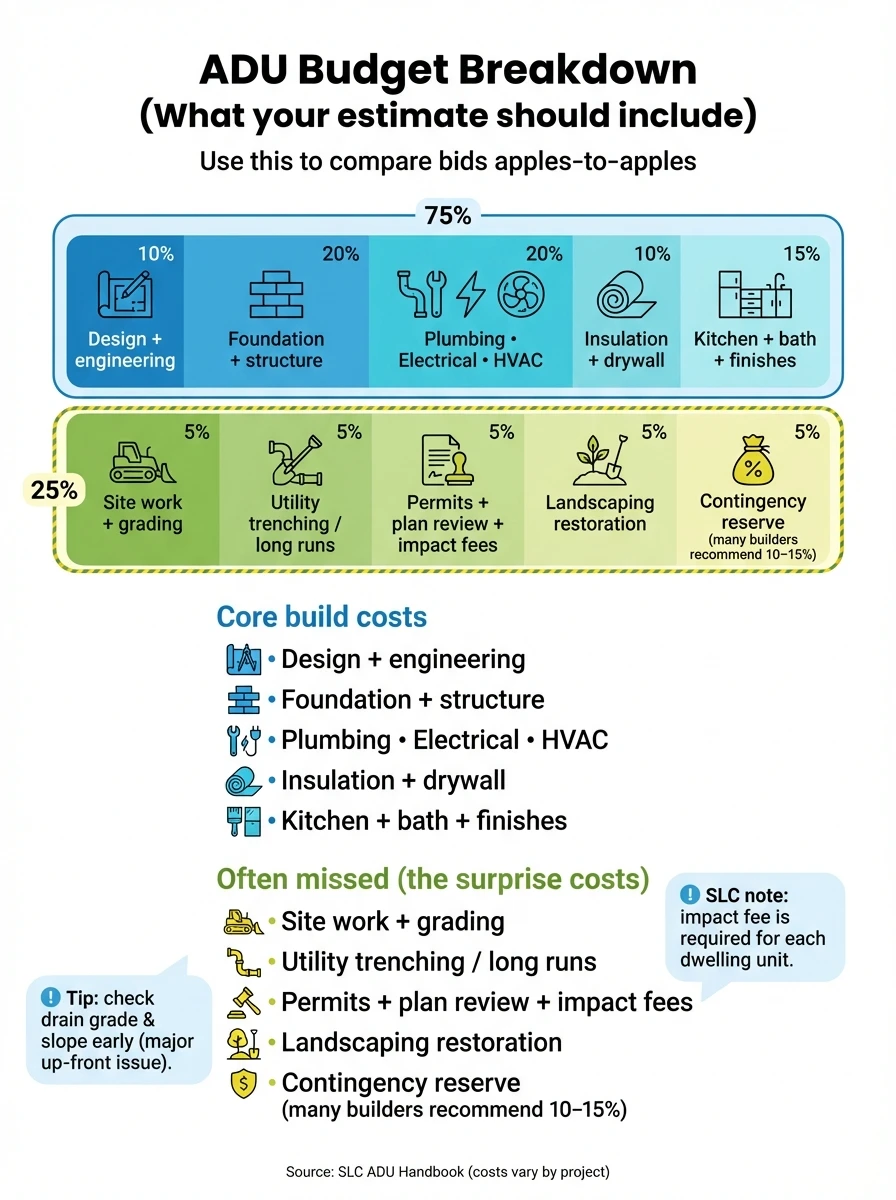
Here's where projects go sideways. Common project costs to include in your budget are:
- Utility connections — Running separate water, sewer, gas, and electrical to a detached ADU is a major cost. If your utility laterals are old, you may need to upgrade them.
- Site work and grading — Especially on SLC's east bench or any sloped lot.
- Permit and impact fees — Budget $3,000–$8,000+ for city permits, plan review fees, utility connection fees, and impact fees (required for each new dwelling unit).
- Fire access distance — Your ADU can't be more than 150 feet from the public right-of-way. Deep lots may need to factor in access paths.
- The restrictive covenant — Not expensive to record, but if you don't know about it, it can delay your certificate of occupancy.
- Landscaping restoration — Construction equipment tears up your yard. Factor in $3,000–$10,000 to fix it.
- Contingency — Industry standard is 10–15% of total project cost. You will need it.
Want to know what YOUR project will cost? Request a review of your address and project type. Check licensing, insurance, relevant experience and a written scope before comparing bids.
Can You Build an ADU on Your Salt Lake City Property?
Before you talk to a single builder, you need to know if your property qualifies. Here's a quick-check based on the current Salt Lake City ADU ordinance (Section 21A.40.200) and the SLC ADU Handbook:
2026 Utah detached ADU law update (SB 284)
Utah SB 284 created Utah Code §10-21-304, effective October 1, 2026. In a "specified municipality," cities must allow one detached ADU on lots or parcels of 11,000 square feet or larger where a single-family home is allowed, and cities may allow detached ADUs on smaller lots. Cities may still regulate size, height, setbacks, lot coverage, design compatibility, utility capacity, owner-occupancy, front-yard placement, short-term rental use under 90 days, and whether more than one ADU is allowed. Local permits and building, fire, utility, and health-code review still apply. Because this statewide rule interacts with local zoning, confirm the current Salt Lake City ordinance and permit checklist before designing around a detached ADU.
Answer these questions:
1. Is your property within Salt Lake City limits? (Not Salt Lake County unincorporated, not South Salt Lake, not Murray, not West Valley.) If you're unsure, check the SLC interactive zoning map — this matters because each jurisdiction has different ADU rules.
2. Is your property zoned residential? ADUs are permitted in residential zoning districts where residential uses are allowed. This includes R-1, R-2, SR-1, SR-3, RMF-30, and others. While Utah law requires cities to allow internal ADUs in residential zones, that's not a blanket guarantee for every lot — Salt Lake City still applies its own local rules, including zoning-district limits, owner-occupancy and licensing requirements, and parking standards. Check your zone on the city's zoning map.
3. Do you own the property and live there? Salt Lake City requires owner-occupancy — the property owner must reside on the property, either in the main house or the ADU. There are limited exceptions (certain trusts, etc.), but in general, you can't buy a house, build an ADU, and rent out both units.
4. Is there already an ADU on your lot? Only one ADU per lot is permitted. The ADU cannot be sold separately from the primary dwelling.
5. Does your lot meet size and setback requirements? For detached ADUs, you'll need enough room to meet minimum setback requirements (3 feet from side and rear property lines, more on corner lots). The city code spells out the specifics based on your zoning district.
If you answered yes to all five, you're likely eligible. The next step is confirming the specifics with a builder or directly with SLC Planning (801-535-7700, or planning@slcgov.com). They're genuinely helpful, and the consultation is free.
"Am I in Salt Lake City?" — Why This Matters More Than You Think
This trips up more people than you'd expect. "Salt Lake City" the metro area is very different from "Salt Lake City" the municipality. If your mailing address says "Salt Lake City" but you're actually in unincorporated Salt Lake County, or in a neighboring city like South Salt Lake or Millcreek, completely different rules apply.
Here's a quick comparison of how the rules differ across jurisdictions:
| Requirement | Salt Lake City | Salt Lake County (Unincorp.) | South Salt Lake |
|---|---|---|---|
| Min lot size (detached ADU) | No minimum | 7,000 sq ft | 6,000 sq ft |
| Max detached ADU size | 1,000 sq ft (or size of main house, whichever is less) | Varies by zone | 50% of primary dwelling |
| Min separation from main house | Per building/fire code | 6 feet | Per building/fire code |
| Max height (detached) | 17 ft (up to 24 ft with setback increase) | Per zone | Per zone |
| Owner-occupancy required? | Yes | Yes | Yes |
| Short-term rental (Airbnb) allowed? | No | No | No |
| Conditional use permit needed? | No (eliminated 2023) | No (2024 ordinance) | No |
| Max ADUs allowed | 1 per lot | 1 per lot | Up to 2 (1 internal + 1 external) |
Sources: SLC Code 21A.40.200, Salt Lake County ADU page, South Salt Lake ADU Handbook
South Salt Lake is the most permissive of the three — they allow both an internal and an external ADU on a single lot. Salt Lake City and the county each allow only one.
Salt Lake City ADU Rules in Plain English
The SLC ADU ordinance is long and written in legal language. Here's what it actually means for your project.
Size Limits
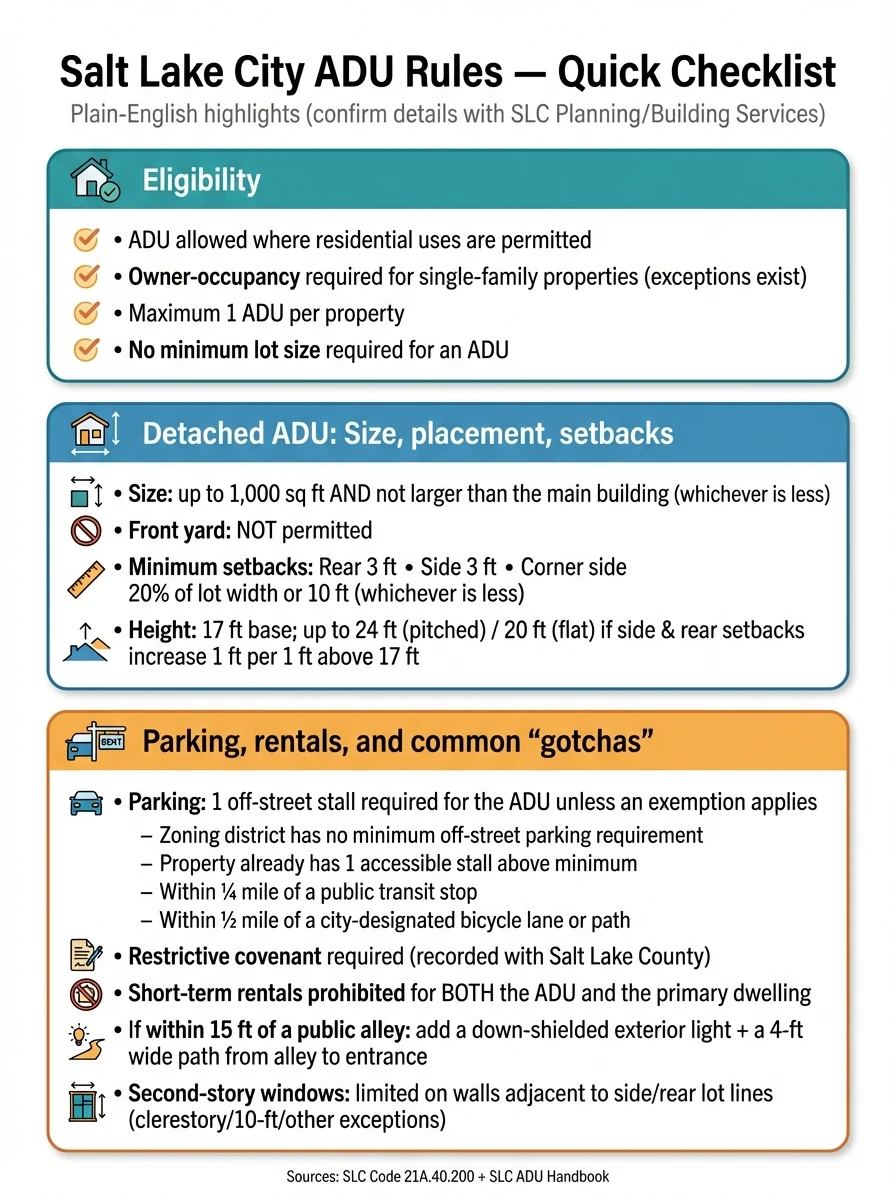
Detached ADUs can be up to 1,000 square feet, but cannot exceed the size of the existing main building — whichever is less. This is per the SLC ADU Handbook. So if your primary residence is 900 square feet, your detached ADU is capped at 900, not 1,000. This constraint was part of the 2023 ordinance amendment that expanded the previous cap and eliminated conditional use requirements. At up to 1,000 square feet, you can fit a comfortable two-bedroom unit — which significantly improves your rental income potential compared to the older, smaller limits.
Internal ADUs (basement apartments, attic conversions, etc.) have no maximum size as long as they comply with the underlying zoning district's bulk requirements. This is a meaningful advantage if you have a large basement.
Height
The baseline maximum height for a detached ADU is 17 feet. However, you can build up to 24 feet with a pitched roof or 20 feet with a flat roof — but for every foot of height above 17 feet, you need to increase your side and rear setbacks by one foot. This rule exists so taller ADUs don't tower over neighbors.
The height increase is especially relevant for above-garage ADUs, which often need the extra headroom. Just know that it comes with a trade-off in how close you can build to the property line.
Setbacks
Detached ADUs must maintain minimum setbacks from property lines:
- Side and rear yards: 3 feet minimum
- Corner side yard: 10 feet or 20% of lot width, whichever is less
- The ADU cannot be in the front yard
- Building and fire code may impose additional fire-separation requirements depending on how close the ADU is to the main house or property lines — your builder should confirm this during plan review
For garage conversions, existing setbacks may remain — but any addition to the structure must comply with the required setbacks.
Owner-Occupancy
This is the rule that catches people off guard. The property owner must live on the property — either in the main house or in the ADU. You can't be an absentee landlord renting out both units. The SLC City Council kept this requirement in the 2023 ordinance despite significant debate, and committed to revisiting it in three years.
"Owner" means the person listed on the recorded deed. There are provisions for trusts and similar arrangements — check Section 21A.40.200.C for the full definition.
Rental Rules
Long-term rental (30+ days): Allowed. This is the primary income-generating use case for ADUs in SLC.
Short-term rental (Airbnb, VRBO, etc.): Prohibited. Not just for the ADU — if you have an ADU on your property, neither the ADU nor the primary dwelling can be used as a short-term rental. This prohibition is baked into the restrictive covenant you're required to record against your property.
If rental income is part of your plan, you'll need to:
- Register with Salt Lake City's Good Landlord Program
- Obtain a business license
- Complete the required landlord training
Parking
One additional off-street parking space is required for the ADU, beyond what's already required for your primary residence.
Exceptions: The parking requirement may be waived if: (a) your property is within one-quarter mile of a public transit stop, (b) within one-half mile of a city-designated bicycle lane or path, or (c) your zoning district does not require off-street parking. Given SLC's expanding transit network, many central neighborhoods qualify for the transit waiver. Check with SLC Planning to confirm.
The Restrictive Covenant (Don't Skip This)
Before you receive your final inspection approval (or before occupying the ADU if no final inspection is required), you must record a restrictive covenant with the Salt Lake County Recorder's Office. This covenant states:
- The ADU complies with SLC regulations
- You'll allow city access to verify compliance
- Neither the ADU nor the primary dwelling will be used as a short-term rental
- Owner-occupancy will be maintained (if applicable)
A copy of the recorded covenant must go to the SLC Planning Division and be attached to the building permit record. This sounds like bureaucratic paperwork, and it is — but skipping it or delaying it will hold up your certificate of occupancy.
Rules That Catch People Off Guard (From the ADU Handbook)
The SLC ADU Handbook includes several requirements that aren't obvious from reading the code alone. These are the ones that force design changes or add unexpected cost if you discover them late:
Second-story window restrictions. Windows on the second story of a detached ADU are prohibited on walls facing a side or rear property line unless at least one of these conditions is met: the window is a clerestory with the bottom at least 6 feet above finished floor, the window faces the main house, the window is at least 10 feet from the property line, the wall is adjacent to an alley, or the adjacent property is in a commercial zone. This can significantly affect your floor plan if you're building a two-story ADU on a narrow lot.
Alley activation requirements. If your detached ADU is within 15 feet of a public alley, you must install an exterior light to illuminate the adjacent alley (shielded, downward-facing) and provide a 4-foot-wide path from the alley to the ADU entrance with a gate if there's a fence. Salt Lake City has many active alleys, especially in older neighborhoods like Sugar House and the Avenues.
Fire department access. The maximum distance from the public right-of-way to any point along any wall of the ADU is 150 feet. If your backyard is deep, this constraint can limit where you place the ADU or require providing fire department access.
Impact fees. The ADU Handbook confirms that impact fees are required for each dwelling unit. Budget for this in your permit fee estimates.
How to Choose the Right ADU Builder (10-Point Scorecard)
This is the highest-leverage decision in the entire process. A great builder saves you tens of thousands of dollars and months of frustration. A bad one can double your costs and leave you in a legal mess.
The problem is that every builder's website says "we're the best." Every one of them has nice photos and testimonials. So how do you actually tell the difference?
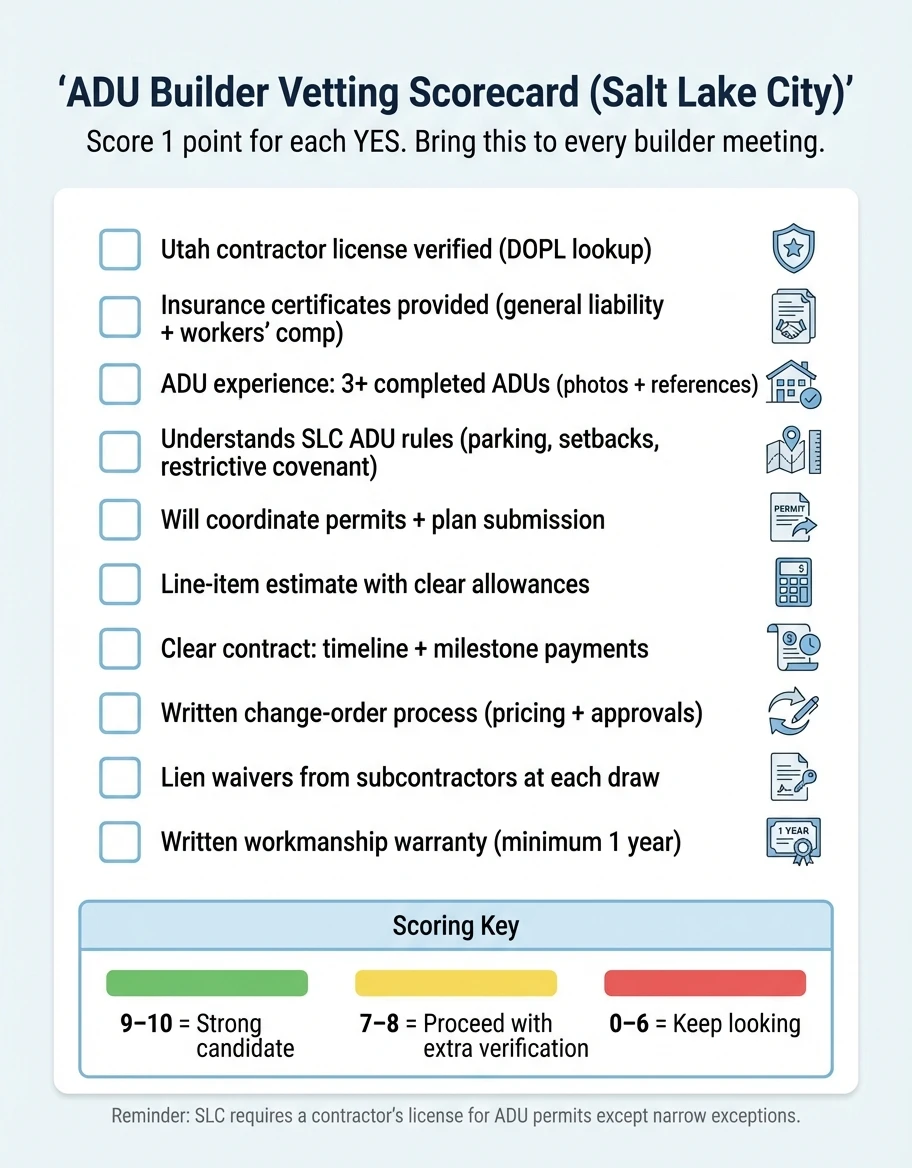
Use this checklist to compare written proposals, relevant ADU projects, references, license records and permit responsibilities. Salt Lake City's published contractor guidance and Utah's DOPL license lookup are starting points; verify the provider's current credentials and project scope before hiring.
Print this out. Bring it to every builder meeting. Score them honestly.
The 10-Point ADU Builder Vetting Scorecard
| # | What to Check | What "Good" Looks Like | Red Flag |
|---|---|---|---|
| 1 | Active Utah contractor license | License verified on dopl.utah.gov. Classification B100 (General Contractor) or R100 (Residential/Small Commercial Contractor). No disciplinary actions. | Unlicensed, expired license, or "working under someone else's license." SLC published guidance is clear: a contractor license is required for ADU building permits, with very limited exceptions. |
| 2 | ADU-specific experience in SLC | Has completed at least 3–5 ADU projects in Salt Lake City specifically. Can show photos and addresses (with owner permission). Understands the local permit process. | "We do additions and remodels, ADUs are basically the same thing." (They're not — the permitting, covenant, and zoning requirements are different.) |
| 3 | Permit navigation track record | Has successfully pulled ADU building permits through SLC's Citizens Access Portal and submitted plans through ProjectDox. Handles or coordinates the permit process for you. | "The homeowner handles permitting." (A good builder at minimum guides you. The best ones handle it entirely.) |
| 4 | Verifiable references | Provides 3+ Salt Lake City ADU client references you can actually call or email. Not just online reviews — real people willing to talk about their experience. | "Our Google reviews speak for themselves." (Reviews are helpful but can be curated. Direct references are harder to fake.) |
| 5 | Detailed written estimate | Line-item bid breaking out: site prep, foundation, framing, plumbing, electrical, HVAC, insulation, drywall, finishes, exterior, utility connections, permit fees, and contingency. Allowances are clearly stated. | Verbal quote only. Single lump-sum number with no breakdown. No contingency line item. No clarity on what's included vs. excluded. |
| 6 | Clear contract with milestone payments | Written contract with: start date, milestone schedule, payment schedule tied to completed work (not front-loaded), change order process, and delay provisions. | Demands 50%+ payment upfront before any work begins. No written timeline. Vague about change order pricing. |
| 7 | Insurance verification | Carries general liability insurance ($1M+), workers' compensation coverage, and builder's risk insurance. Provides actual certificates of insurance, not just verbal confirmation. | "Yeah, I'm insured" without providing documentation. No workers' comp. (If an uninsured worker is injured on your property, you could be liable.) |
| 8 | Subcontractor transparency | Provides a list of all subcontractors who will work on your project. Obtains signed lien waivers from every sub before requesting your final payment. | Won't tell you who the subs are. Doesn't mention lien waivers. (If your GC doesn't pay a subcontractor, that sub can file a lien against YOUR property.) |
| 9 | Written warranty | Minimum one-year workmanship warranty. Passes through all manufacturer warranties on materials, appliances, and fixtures. Warranty terms are in the contract. | No written warranty. "Just call us if something breaks." (Verbal warranties are unenforceable.) |
| 10 | In-person site visit before bidding | Visits your property before providing any estimate. Checks setbacks, utility access locations, grade/slope, soil conditions, lot access for equipment. | Gives you a price per square foot over the phone or email without ever seeing your property. (Every lot has surprises. A builder who doesn't visit isn't being serious.) |
How to score: Give one point for each criterion the builder meets. A builder scoring 9–10 is a strong candidate. At 7–8, they're viable but verify the weak areas in writing before signing. At 6 or below, keep looking.
How to Verify a Utah Contractor's License
This takes about two minutes and could save you from a catastrophic hiring mistake.
- Go to the Utah DOPL License Lookup
- Click "Verify a License"
- Search by business name or individual name
- Look for an active license with classification B100 (General Contractor) or R100 (Residential/Small Commercial Contractor)
- Check for any disciplinary actions on the record
These classifications are listed on the Utah Division of Professional Licensing contracting page. Don't confuse them with specialty classifications (electrical, plumbing, etc.) — you need a general contractor or residential contractor license for ADU construction.
Why does this matter so much? Salt Lake City's Building Services division has explicitly stated that a contractor's license is required to obtain a building permit for an ADU. The exceptions are narrow: projects under $7,000 with no mechanical, electrical, or plumbing work, or a simple change-of-use conversion with no construction. Neither of those exceptions applies to most ADU projects.
Also important: the Utah owner-builder certification — which allows homeowners to act as their own general contractor on their personal residence — generally cannot be used for an ADU that you intend to rent out. If rental income is your goal, you need a licensed contractor.
Questions to Ask During Your First Meeting
These questions are designed to reveal whether a builder actually knows what they're doing in Salt Lake City — not just whether they can build a nice structure.
About their SLC experience:
- "How many ADU permits have you pulled in Salt Lake City in the last two years?"
- "Can you walk me through how the SLC permit submission works — Citizens Access Portal, ProjectDox, plan review timeline?"
- "Have you dealt with the restrictive covenant recording process?"
About cost and scope:
- "What's your typical cost per square foot for a detached ADU in SLC, and what does that include?"
- "What line items are NOT in your standard bid? Utility connections? Landscaping? Permit fees?"
- "How do you handle change orders — is there a markup? What's the approval process?"
About process and protection:
- "What does your payment schedule look like? How is it tied to milestones?"
- "Do you provide lien waivers from all subcontractors?"
- "What's your current project backlog — when could you realistically start?"
- "What warranty do you offer, and is it in writing?"
A good builder will answer these questions confidently and specifically. A builder who gets vague, defensive, or dismissive is telling you everything you need to know.
Custom Builder vs. Prefab vs. Design-Build: Which Is Right for You?
There's no single "best" approach to building an ADU. The right choice depends on your budget, timeline, lot constraints, and how much design flexibility you want. Here's how the three main paths compare in the Salt Lake City market:
| Factor | Custom Builder (GC) | Prefab / Modular | Design-Build Firm |
|---|---|---|---|
| Cost range (SLC) | $200–$375/sq ft | $175–$275/sq ft | $225–$350/sq ft |
| Typical timeline | 6–12 months | 3–6 months | 5–10 months |
| Design flexibility | Maximum — fully custom | Limited to manufacturer's catalog | High — in-house design + build |
| Permit handling | Varies (some help, some don't) | Usually included | Usually included |
| Best for | Unique lots, specific architectural vision, high-end finishes | Speed, budget priority, straightforward lots | Homeowners who want one point of contact from design through move-in |
| Main risk | More coordination required between architect, GC, and subs | Less customization; crane/delivery logistics on tight lots | Quality varies widely between firms |
| SLC pre-approved plans | May or may not use them | Often compatible | May or may not use them |
Custom Build with a General Contractor
This is the traditional approach: you hire an architect or designer, get construction drawings, then hire a general contractor to build it. You get maximum control over design, materials, and finishes. The trade-off is more coordination on your end (or your architect's end) and typically a longer timeline. This approach makes the most sense when your lot has unusual constraints (steep slope, tight access, historic district requirements), when you want your ADU to closely match your home's architectural style, or when you're building a high-end unit with specific finish requirements.
Prefab and Modular ADUs
Prefab ADUs are built in a factory and delivered to your property, where a local contractor handles the foundation, utility connections, and installation. The main advantages are speed (the unit is built while your site is being prepared) and quality control (factory conditions are more consistent than outdoor job sites).
The trade-offs are important, though. Design options are limited to the manufacturer's catalog. Delivery logistics matter — the unit needs to get to your backyard, which means crane access and enough space for equipment. You still need a local contractor for site work, foundation, and utility connections, which can cost $40,000–$60,000+ on top of the unit price. And SLC's winter weather can complicate delivery timing.
ADU Utah offers five pre-designed models ranging from roughly $99,000 to $136,000 for the structure, with total installed costs (including site work) typically running $160,000–$200,000.
Design-Build Firms
Design-build firms handle both the design and construction under one contract. This simplifies communication (one point of contact instead of several) and often reduces the total timeline because design and permitting can overlap with early site preparation. The key risk with design-build is that quality varies enormously between firms. Some are excellent; others are remodeling companies that added "ADU" to their service list without deep experience. Apply the 10-point scorecard above regardless of the delivery model.
Salt Lake City Pre-Approved Standard Plans
This is worth calling out separately because it's a real money-and-time saver that many homeowners don't know about. SLC Building Services maintains a list of pre-approved ADU standard plans from local architectural firms. These plans have already been reviewed and approved by the city's building code staff.
Using a pre-approved plan means the plan set has already been reviewed for building code compliance by SLC staff, which can significantly reduce back-and-forth during the approval process. You still need a building permit, a site-specific review (to verify setbacks, utility access, etc.), and all standard fees still apply. The city does not endorse any plan's author or any specific builder.
The trade-off: you're choosing from a fixed set of designs. If that works for your lot and your aesthetic preferences, it's a smart way to save money on architectural fees and potentially compress the review timeline.
Important note: Using a pre-approved plan does not mean you can skip the building permit or site review. It also doesn't prevent SLC's Building Official from requiring corrections. Salt Lake City does not endorse the plan's author or any specific builder — it simply means the plan set meets building code requirements.
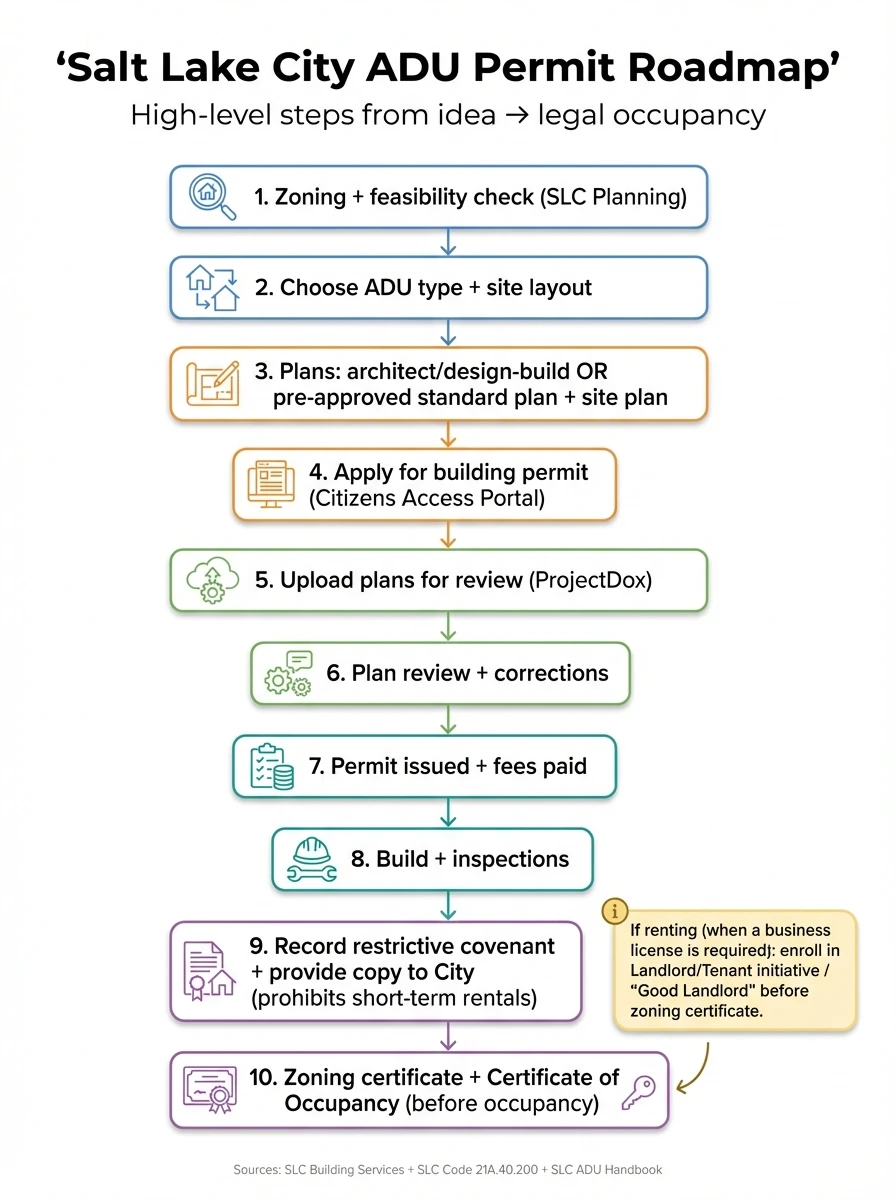
The Salt Lake City ADU Permit Process, Step by Step
The permit process is where most homeowners feel overwhelmed. It doesn't need to be. Here's exactly how it works, based on the SLC Building Services permit page and the ADU Handbook.
| Step | What Happens | Who Does It | Realistic Timeline |
|---|---|---|---|
| 1. Zoning verification | Confirm your property is in an eligible zoning district and meets setback/size requirements. | You, your builder, or SLC Planning (801-535-7700) | 1–5 days |
| 2. Design and plans | Architectural drawings, structural engineering (if needed), site plan, floor plans, and elevations. If using pre-approved plans, select one and confirm site fit. | Architect, designer, or prefab company | 2–8 weeks (custom) or 1–2 weeks (pre-approved) |
| 3. Permit application | Submit application through SLC's Citizens Access Portal. Upload plans and documents via ProjectDox. | You or your builder | 1 day to submit |
| 4. Plan review | SLC reviews plans for building code compliance. Multiple departments weigh in: Building, Public Utilities, Engineering, Transportation. This is the step that takes the longest. | SLC Building Services | 4–12 weeks (the bottleneck) |
| 5. Permit issuance | Plan review approved. Pay permit fees. Building permit issued. Construction can legally begin. | SLC Building Services → You | 1–3 days after approval |
| 6. Construction | Foundation → Framing → Mechanical/Electrical/Plumbing rough-in → Insulation → Drywall → Finishes → Exterior | Your builder and subcontractors | 3–9 months depending on scope |
| 7. Inspections | Multiple required inspections throughout construction: foundation, four-way (framing + mechanical + electrical + plumbing), insulation, final. | SLC Building Inspectors | Scheduled during construction |
| 8. Restrictive covenant | Record the required covenant with Salt Lake County Recorder's Office. Provide a copy to SLC Planning. | You (your builder or attorney can help prepare it) | 1–2 weeks |
| 9. Certificate of occupancy | Final inspection passes. ADU is legally habitable. | SLC Building Services | 1–2 weeks after final |
| 10. Business license (if renting) | Register with the Good Landlord Program. Complete landlord training. Obtain business license. | You | 1–3 weeks |
Total timeline from "let's do this" to a rentable unit: Plan on 8–18 months for a detached new build (including design, permitting, and construction). Basement conversions and garage conversions can be faster — sometimes 4–8 months total.
What the Permit Actually Costs
Permit fees are based on the project's total valuation and the specific reviews required. For most ADU projects, homeowners commonly budget between $3,000 and $8,000 for the full permit package, including:
- Building permit fee (based on project valuation)
- Plan review fee
- Utility connection fees (water, sewer)
- Impact fees (required for each new dwelling unit, per the ADU Handbook)
Contact SLC Building Services for a precise fee estimate based on your project scope — fees change and are tied to your project's specific valuation.
The Contractor License Requirement
This is critical and often misunderstood. Salt Lake City has published clear guidance: a licensed contractor is required to obtain a building permit for an ADU or IADU (Internal ADU), with very limited exceptions.
The exceptions, per SLC's published document:
- Work valued under $7,000 that doesn't involve mechanical, electrical, or plumbing
- A change-of-use only (converting existing legal space to ADU designation) with no construction work
If your project involves any actual construction — which virtually all ADU projects do — you need to hire a licensed contractor. The Utah owner-builder exemption that allows homeowners to act as their own general contractor on their primary residence is generally not available for ADUs intended as rental units.
How to Speed Up the Process (Legally)
There are a few legitimate ways to compress the timeline:
Use pre-approved standard plans. As mentioned above, pre-approved plan sets have already been reviewed for building code compliance, which can reduce back-and-forth during plan review. You still need a site review and all standard fees, but eliminating revision cycles on the plan itself can meaningfully compress the timeline.
Choose a builder who handles permit coordination. A builder who regularly works with SLC Building Services knows the submission requirements, anticipates common correction requests, and can get through plan review faster.
Prepare a complete document package the first time. Incomplete submissions get kicked back, sometimes multiple times. Make sure your package includes: site plan, floor plans, elevations, structural engineering (when required), utility confirmation, and any survey documents.
Start design during your research phase. You don't need to wait until you've selected a builder to start architectural work. Getting plans ready while you're vetting builders means you can submit the permit application faster once you've signed a contract.
How to Pay for Your ADU: Financing Options Compared
Most homeowners don't have $150,000–$300,000 in cash sitting around. That's normal. There are several financing paths, each with different trade-offs. Here's how they compare for Salt Lake City homeowners (note: rates shown are approximate ranges as of early 2026 — check with lenders for current rates):
| Financing Option | How It Works | Typical Rate (2026) | Pros | Cons | Best For |
|---|---|---|---|---|---|
| HELOC | Revolving credit against your home equity. Draw funds as needed during construction. | 7.5–10% variable | Flexible draws; interest-only during build phase; keeps your first mortgage intact | Variable rate; requires significant equity (15–20%+) | Homeowners with substantial equity and a low-rate first mortgage they don't want to lose |
| Cash-out refinance | Replace your existing mortgage with a larger loan. Pocket the difference for ADU construction. | 6.5–7.5% fixed | Single fixed payment; potentially lower rate than HELOC | You lose your current mortgage rate; higher closing costs ($5K–$10K+) | Homeowners with a high existing mortgage rate who'd benefit from refinancing anyway |
| Home equity loan | Lump-sum second mortgage at a fixed rate | 8–10% fixed | Predictable payments; fixed rate; simpler than construction loan | Lump sum (may borrow more than needed early in the project); requires existing equity | Those who want payment certainty and have enough equity |
| Construction loan | Short-term loan with staged draws during construction, converting to permanent financing when complete | 8–11% | Designed for construction; draws aligned to milestones; can be based on after-renovation value | More paperwork; requires appraisal; higher rates during build phase | Newer homeowners with less equity (loan uses projected property value including ADU) |
| SLC "Backyard Keys" ADU Loan | City-backed low-interest loan for eligible west side properties | 3% fixed | $200K max; city-backed; up to 10% loan forgiveness; 30-year amortization | West of I-15 only; income-dependent rent restrictions may apply; limited pilot funding | Income-qualifying homeowners on SLC's west side |
| Personal loan / unsecured | Unsecured bank or credit union loan | 10–18% | No home equity needed; fast approval | High interest rates; shorter repayment terms; lower borrowing limits | Small projects (minor conversions) or bridge funding for short gaps |
The SLC "Backyard Keys" ADU Loan Program
This is a financing option most people don't know about, and it's unique to Salt Lake City. The SLC Community Reinvestment Agency (CRA) created this program specifically to help west side homeowners build ADUs. It's administered by the Community Development Corporation of Utah (CDCU).
Program terms:
| Feature | Details |
|---|---|
| Max loan amount | $200,000 |
| Interest rate | 3% fixed |
| Loan term | 5 years, with a 5-year extension option |
| Amortization | 30 years |
| Loan forgiveness | Up to 10% for rent-restricted ADUs |
| Application + origination fee | $2,000 (may be rolled into loan) |
| Compliance fee | $200/year for affordability verification |
Eligibility depends on income level:
| Your Household Income | Rental Requirements |
|---|---|
| ≤ 80% of Area Median Income (AMI) | No rent restrictions — rent the ADU at any price |
| > 80% AMI | Must rent either the main home or the ADU at a rate affordable to renters earning ≤80% AMI |
Other requirements:
- Must be an owner-occupant on a property west of Interstate 15 in Salt Lake City
- Properties within the 9-Line Community Reinvestment Area (along 900 South between I-15 and the Jordan River) receive loan priority
- Must complete Good Landlord training and participate in financial counseling
The program was created because financing has been identified as the biggest barrier to ADU construction on SLC's west side. Applications are accepted on a rolling basis as funding is available — this is a pilot program with limited slots. The program page has an interest list you can join to be notified when applications open. Use the CDCU AMI calculator to estimate where your household income falls.
A Note on Tax Implications
Interest paid on a HELOC or home equity loan used to "buy, build, or substantially improve" your home may be tax-deductible under the Tax Cuts and Jobs Act, for qualifying debt up to $750,000. An ADU construction project typically qualifies as a "substantial improvement." However, tax law is complex and individual circumstances vary — talk to a CPA before relying on any deduction.
ADU Rental Income and ROI in Salt Lake City
The money question: does building an ADU actually make financial sense? For most Salt Lake City homeowners, the answer is yes — but with realistic expectations, not fantasy numbers. Let's look at what ADUs actually rent for here and what the real return looks like.
What SLC ADUs Rent For (2026)
Rental rates depend on size, location, condition, and amenities. Based on current Salt Lake City rental listings on Zillow and KSL Classifieds as of early 2026:
| Unit Type | Size Range | Monthly Rent Range |
|---|---|---|
| Studio / 1BR (400–600 sq ft) | Smaller, basic finishes | $900–$1,300 |
| 1BR (500–700 sq ft) | Standard to nice finishes | $1,100–$1,500 |
| 2BR (700–1,000 sq ft) | Standard to nice finishes | $1,300–$1,800 |
These are long-term rental rates (30+ days). Remember, short-term rentals like Airbnb are not allowed for ADUs in Salt Lake City.
Rents vary significantly by neighborhood. An ADU in Sugar House or the Avenues will command a premium over one in Rose Park or Glendale, reflecting the same patterns as the broader rental market.
5-Year ROI Projections
Here are three scenarios modeled on real SLC cost and rent data. These are projections, not guarantees — but they give you a realistic framework for evaluating whether the investment makes sense for your situation.
| Scenario | Build Cost | Monthly Rent | Annual Gross Income | Annual Expenses (Est.) | Annual Net Income | 5-Year Net Income | 5-Year Cash ROI |
|---|---|---|---|---|---|---|---|
| Budget: Basement conversion | $80,000 | $1,050 | $12,600 | $3,800 | $8,800 | $44,000 | 55% |
| Mid-range: Detached 650 sq ft | $185,000 | $1,350 | $16,200 | $5,200 | $11,000 | $55,000 | 30% |
| Premium: Detached 900 sq ft | $290,000 | $1,650 | $19,800 | $6,400 | $13,400 | $67,000 | 23% |
Expense assumptions in these projections:
- Property tax increase: ~$1,500–$2,500/year (your property value goes up; so do taxes)
- Insurance increase: ~$400–$800/year
- Maintenance reserve: 5% of gross rent
- Vacancy allowance: 5% (one month vacant every ~20 months)
- Property management: 8–10% of rent if you hire a manager (not included above — these assume self-management)
What these projections don't include: The increase in your property's resale value. Appraisers typically value ADUs using a combination of the cost approach (what it cost to build), comparable sales (when ADU-equipped homes have sold nearby), and the income approach (rental income capitalized at the local market rate). The simplest way to estimate the income-based value: take your annual net rent, divide by the local capitalization rate (roughly 5–7% in SLC residential), and that's the implied value contribution. For a unit netting $12,000/year, that suggests roughly $170,000–$240,000 in added value at current cap rates. This is illustrative — confirm with a local appraiser for your specific property.
The Honest Assessment
Building an ADU is a strong investment for most SLC homeowners, but it's not a get-rich-quick move. The math works best when:
- You're building for the long term (5+ years of rental income)
- You're in a neighborhood with strong rental demand
- You keep construction costs reasonable (pre-approved plans, standard finishes, experienced builder)
- You can manage the property yourself (saving 8–10% in management fees)
The math is harder to justify when:
- You're financing the entire project at high interest rates (10%+)
- You're building a luxury unit far beyond what the local rental market will bear
- You plan to sell the property within 2–3 years (you may not recoup the full investment in that timeframe)
Designing Your ADU for Salt Lake City's Climate and Neighborhoods
Design decisions affect both construction cost and long-term livability. Here's what matters most in the SLC context.
Climate Considerations
Salt Lake City's climate demands more from a building than a lot of homeowners realize. You're dealing with hot, dry summers (highs regularly above 95°F), cold winters (lows in the teens and twenties), significant snow load on roofs, and a frost line that affects foundation depth.
Insulation matters. SLC is in climate zone 5B, which means code requires substantial insulation in walls, attic, and foundation. Going beyond code minimum (especially in the attic and around windows) will noticeably reduce heating and cooling costs for your tenant — and make the unit more attractive to renters.
Snow load affects roof design. Your structural engineer will calculate the required snow load capacity for your specific location. Above-garage ADUs in particular need careful structural analysis because of the combined weight of the roof plus snow on top of an already-loaded structure.
Foundation depth. The frost line in SLC is 30 inches, per the SLC Building Services design criteria, which means footings need to extend below the freeze depth. This affects excavation costs. Slab-on-grade construction (the most common for detached ADUs) still requires proper frost protection.
Passive solar design. SLC gets abundant sunshine, even in winter. Orienting your ADU with south-facing windows and proper overhangs can significantly reduce heating costs in winter while preventing overheating in summer. This doesn't add much to construction cost but adds meaningful long-term value.
Matching Your Home's Style
Salt Lake City's neighborhoods have distinct architectural characters — the Victorian and bungalow homes of the Avenues, the mid-century ranch homes in Millcreek-adjacent areas, the newer construction in the west side neighborhoods. The SLC ordinance does not require your ADU to match your home's style, but there are good reasons to consider it:
- Neighbor relations. A backyard cottage that complements the existing neighborhood character is less likely to generate complaints.
- Resale value. A cohesive-looking property sells for more than one where the ADU looks out of place.
- Your own satisfaction. You're going to look at this building from your kitchen window for years.
A good architect or design-build firm will help you find a design that balances your budget with the neighborhood context.
ADU Types for SLC Homeowners
Detached backyard cottage — The most common new-build option. Maximum flexibility in layout and design. Provides the most privacy for both you and your tenant. Highest cost due to full foundation, utility runs, and separate structure. Learn more about detached ADU construction.
Above-garage unit — Maximizes usable space on smaller lots by building up rather than out. Requires structural engineering to ensure the garage can support the additional load. Popular in neighborhoods where backyard space is limited.
Basement conversion — The lowest-cost option by far. You're converting existing space rather than building new. The key challenges are ceiling height (minimum 7 feet for habitable space), egress windows (required for bedrooms), separate entrance, and moisture management. Many older SLC homes have basements that can work. Learn more about basement ADU conversions.
Garage conversion — A middle-ground option between a basement conversion and new construction. You're repurposing an existing structure, which saves on foundation and framing costs. The trade-off is losing your garage parking and storage. Structural upgrades are usually needed for insulation, windows, and code compliance. Learn more about garage conversions.
Attached addition — Extends the footprint of the main house. Can work well when the ADU shares a wall with the primary residence (shared wall reduces insulation and exterior finish costs). Must still function as a separate dwelling with its own entrance, kitchen, and bathroom.
Seven Costly Mistakes SLC Homeowners Make With ADUs
These aren't theoretical risks. They come from real projects that went wrong in Salt Lake City.
1. Starting construction before the permit is issued. It happens more than you'd think, usually because a builder is eager to start or a homeowner is impatient. It's illegal. SLC can issue a stop-work order, assess fines, and you may have to undo completed work. No amount of schedule pressure is worth this risk.
2. Choosing the lowest bid without comparing scope. A bid that's $40,000 below the others isn't necessarily a deal — it's often missing critical line items. The most common exclusions in low bids: utility connections, permit fees, site prep and grading, landscaping restoration, and finish allowances. Always compare bids on an apples-to-apples basis using a scope checklist.
3. Forgetting to record the restrictive covenant. This is a legal requirement under SLC's ADU ordinance. Without the recorded covenant, your certificate of occupancy can be delayed or withheld. Some homeowners discover this requirement at the very end of construction and scramble to get it done. Put it on your checklist early.
4. Underestimating utility connection costs. Running water, sewer, gas, and electrical from your main house to a detached ADU can easily cost $15,000–$30,000+ depending on the distance and existing infrastructure condition. Get utility quotes early in the design phase, not after construction starts.
5. Skipping the Good Landlord Program registration. If you plan to rent your ADU (and most people do), you must register with SLC's Good Landlord Program and obtain a business license before placing a tenant. Operating without registration is a code violation. The program includes landlord training that's actually useful — it covers Utah landlord-tenant law, fair housing requirements, and property management basics.
6. Not budgeting a contingency. Every experienced builder will tell you: no construction project goes exactly as planned. Buried debris in the excavation area, unexpected soil conditions, plan review corrections, material price changes, weather delays — something will come up. Industry standard is a 10–15% contingency on total project cost. If you don't need it, great. If you do (and you probably will), it's there.
7. Hiring a general remodeler who's never done an ADU in SLC. Kitchen remodels and ADU construction require different knowledge. ADU permitting in Salt Lake City has unique requirements — the zoning certification, the restrictive covenant, the Good Landlord Program, the owner-occupancy rules, the specific setback and height calculations. A builder who's done 50 bathroom remodels but never pulled an ADU permit will be learning on your project, on your timeline, and on your dime.
Official Resources and Sources
Every claim in this guide is backed by publicly available, verifiable sources. Here are the primary references:
Salt Lake City Government:
Salt Lake County:
South Salt Lake:
Utah State:
Local News Coverage:
Update Log
This guide is reviewed quarterly to reflect changes in SLC regulations, cost data, and financing programs. If you notice something that's out of date or inaccurate, we want to know — accuracy is the foundation of everything on this page.
- February 2026: Initial publication. All regulations, costs, and program details verified against current sources.
- Next scheduled review: May 2026
About This Guide
This guide is published by an independent research team focused on helping Salt Lake City homeowners navigate the ADU process. We are not builders, contractors, or architects. If you request quotes through this site, we may connect you with local builders and may receive a referral fee. This does not affect the guidance, scoring, or recommendations in this article.
Use the linked city, county and state publications to check regulatory information for your property. Cost ranges are preliminary planning estimates; compare them with the assumptions in our Utah ADU cost methodology and request a site-specific written proposal before committing money. The scorecard organizes questions for you to investigate. It does not certify or independently vet any listed provider.
If you have questions, corrections, or feedback, reach out. This guide is a living document — it gets better with input from the community it serves.
Related guides: Ogden ADU Builders · ADU Costs in Utah · Utah ADU Overview · Salt Lake City's 5 pre-approved ADU plans
Request a builder site assessment
You've done the research. Now get real numbers from builders who actually do this work in SLC.
Here's how it works:
Tell us about your project — ADU type, approximate size, your address, and timeline.
The provider reviews your request — Address, project type and availability need review. Verify current licensing, insurance and SLC permit experience directly before hiring.
You compare bids on your terms — No pressure, no obligation. Use the 10-point scorecard above to evaluate each builder.
What to discuss with the provider:
- Relevant Salt Lake City ADU experience and a written project scope — verify credentials before hiring
- Site assessment scope, any fees, setbacks and access — a visit is not booked by this request
- Who handles SLC permits, application fees and corrections
- No commitment — compare quotes and decide on your own timeline
- No obligation to hire; confirm assessment fees and final pricing with the provider
Your contact and project details are shared with the named provider only when you explicitly consent to a builder request.
© 2026. All rights reserved. This guide is not legal, financial, or construction advice. Consult qualified professionals for your specific situation. Salt Lake City regulations can change — always verify with the city before making decisions based on this content.
Your project information is shared only with the local builder option we connect you with. We never sell your data to third parties. Verify licensing, insurance, and references before hiring anyone.