
Southern Utah ADU Resource · Updated March 2026
Washington County Utah ADU Guide: Can You Build a Casita or ADU on Your Property?
By the Utah ADU Builders Research Team · Last Updated March 2026 · Code verified for unincorporated Washington County, St. George, and Washington City as of March 2026. Other jurisdictions reflect published code with dates noted in each section.
Disclosure: Utah ADU Builders connects homeowners with local builder options. If you request an estimate through this page, we may earn a referral fee at no cost to you. Verify licensing, insurance, and references before hiring.
Yes, many Washington County properties can legally add an ADU — but the answer depends entirely on which city your property sits in. St. George, Washington City, Hurricane, Santa Clara, and unincorporated Washington County each have different rules on ADU size, height, parking, rental use, and lot requirements. That’s the part most people discover too late.
We built this guide so you don’t have to read six different city ordinances to figure out if your property qualifies. Below you’ll find the city-by-city rules in one comparison table, realistic cost ranges for the St. George metro, a step-by-step permit process, and a clear breakdown of what type of ADU — internal, detached, garage conversion, or casita — fits your situation best.
Whether you want rental income, a place for your parents, or a casita for guests, the information below will tell you exactly what you’re working with. And if you’d rather skip the research and get a direct answer for your specific lot, we can help with that too.
Get a Free Property Feasibility Assessment
Tell us your address and we’ll tell you what you can likely build, what it may cost, and what to watch for.

What Is an ADU — and Why Is Everyone in Washington County Talking About Them?
An accessory dwelling unit (ADU) is a self-contained living space built on the same property as your primary home. It has its own kitchen, bathroom, sleeping area, and entrance. You might hear it called a casita, guest house, granny flat, mother-in-law apartment, backyard cottage, or in-law suite. “Casita” is common local shorthand in Washington County — Washington City’s permit materials literally use the word. But “guest house” and “ADU” are not always the same legal category.
The three main ADU types
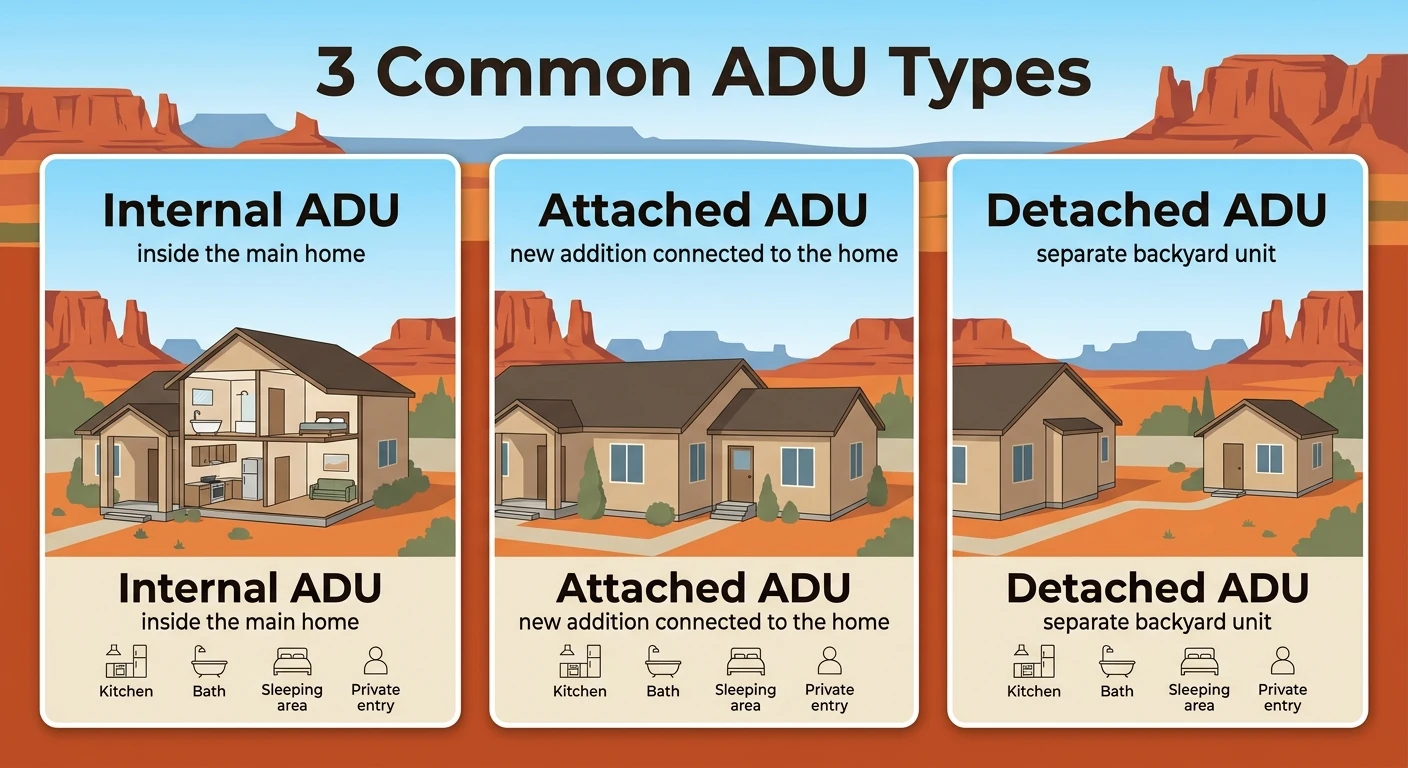
Internal ADU (IADU)
Built inside the footprint of your existing home — a basement apartment, converted bonus room, or above-garage suite. Easiest to permit in Utah because state law protects your right to create one in most residential zones.
Attached ADU
A new addition that shares a wall or roofline with your primary home. An extension with its own entrance and separate living space. Moderate cost and typically shares utilities with the main structure.
Detached ADU / Casita (DADU)
A standalone structure in your yard — a backyard cottage, casita, or purpose-built rental unit. Most privacy and highest rental income potential. Also the most cost and permit requirements.
Why Washington County homeowners are building ADUs right now
Washington County is one of Utah’s fastest-growing areas. The St. George metro has seen explosive population growth over the past decade, and housing demand is outpacing supply. ADU applications in St. George jumped from just 1 in 2019 to 94 in both 2022 and 2023. That’s not a trend — that’s a fundamental shift in how homeowners are thinking about their property.
The math makes sense. A well-built ADU in the St. George area currently rents for $1,200 to $2,100 per month depending on size and finishes. For a homeowner paying a mortgage, that rental income changes the financial picture fast. And unlike a stock or a side business, an ADU is a physical asset on land you already own — one that appreciates alongside your property.
But income is only part of the story. Many homeowners are building ADUs for aging parents who want to live close but not under the same roof. Others want a guest casita for the snowbird season — Washington County’s mild winters draw visitors from across the Mountain West. Some are converting an existing garage or basement because the bones are already there and the investment is modest.
The regulatory picture is increasingly favorable too. Utah’s state legislature has been actively expanding ADU rights over the past several years. State law now requires that internal ADUs be treated as a permitted use in most residential zones (Utah Code § 10-21-303, formerly § 10-9a-530). Internal ADUs are also exempt from impact fees when built within an existing primary dwelling.
At the local level, Washington City updated its ADU rules as recently as January 2026 — removing the 10,000 sq ft minimum lot requirement for detached ADUs and creating a new tiered size system. St. George has loosened detached ADU restrictions over the past two years, including allowing two ADUs within the downtown boundary. Hurricane has clarified ADU placement rules for different lot sizes.
The direction is clear: building an ADU in Washington County has been getting more accessible over the past several years, not less. And homeowners who move forward now lock in today’s construction costs and can start generating rental income while others are still researching.
Can I Build an ADU on My Property?
Before you spend a dollar on plans, run through this quick checklist. If you can check every box, your property is likely a good candidate:
- \u2713You own a single-family home in Washington County (city or unincorporated)
- \u2713Your property is zoned residential (check with your city’s planning department)
- \u2713You — the owner — will live on the property (in either the main home or the ADU)
- \u2713Your lot meets the minimum size requirement for your city (see the comparison table below)
- \u2713You don’t already have the maximum number of ADUs allowed (one in most cities)
- \u2713Your property is not restricted by a planned development or community that prohibits ADUs
If you checked all six, you’re likely in good shape. The next question is which set of rules applies to you.
Why “Washington County” is not one rulebook
This trips people up more than anything. Washington County is home to more than a dozen cities and towns — each with its own ADU ordinance. The county code only applies to unincorporated land (areas outside any city boundary). If your property is inside St. George, Hurricane, Washington City, Santa Clara, Ivins, or any other incorporated city, that city’s rules apply — not the county’s.
The practical difference can be significant. Unincorporated Washington County allows up to four ADUs on large acreage. Washington City recently eliminated minimum lot size requirements for detached ADUs. St. George allows two ADUs per lot in its downtown boundary. The rules vary enormously.
If you’re not sure whether your property is in a city or unincorporated county, your property tax bill will tell you, or a quick call to the Washington County Assessor’s Office will clear it up.
A note on “casita” vs. “ADU” vs. “guest house”
Locals in Washington County use these words interchangeably, but they’re not always the same thing legally. A casita or guest house without its own kitchen may not qualify as a legal ADU under city code — and that matters if you want to rent it out. Conversely, Washington City’s code literally labels ADUs as “Casitas” in their permit materials.
The key distinction: if the space has a kitchen, bathroom, bedroom, and separate entrance, it’s functionally an ADU and needs to meet ADU requirements. If it’s just a bedroom and bathroom with no kitchen, it’s typically considered an accessory building — different rules, different limitations.
Washington County ADU Rules: City-by-City Comparison
We pulled these rules directly from published city and county ordinances and verified them against the most recent code updates available. Last verified: March 2026.
City codes change. Always confirm current rules with your city’s planning department before making financial commitments.
| Rule | Unincorp. Washington County | St. George | Washington City | Hurricane | Santa Clara |
|---|---|---|---|---|---|
| ADUs allowed? | Yes | Yes | Yes | Yes | Yes |
| Max ADUs per lot | 1 (under 5 acres); up to 4 on large acreage | 1 (2 in Downtown Boundary) | 1 DADU per § 9-8A-8; 1 IADU per § 9-8B-8 | 1 | 1 internal OR 1 external |
| Minimum lot size | Varies by zone | No specific minimum | Removed for DADU (Jan 2026); 6,000 sq ft for IADU | Varies by zone | 6,000 sq ft for IADU |
| Max ADU size | 1,500 sq ft (½ acre or less); 2,500 sq ft (up to 2.5 acres); 3,500 sq ft (over 2.5 acres) | Must be smaller than primary dwelling | 1,000 sq ft (R-1-6/R-1-12); higher for lots over 15,000 sq ft | Must be subordinate to primary | 1,000 sq ft or 30% of primary footprint |
| Max height | 25 ft (½ acre); 35 ft (larger lots) | Varies; detached must be shorter than primary | Tiered by zone and setback | Per zone | 20 ft (detached) |
| Parking required | 2 spaces per ADU (1 for internal); hard surface | 1 off-street space; no tandem | DADU: 1 space (≤1,000 sq ft) or 2 spaces (>1,000 sq ft); IADU: 1 additional | Varies | 1 off-street space |
| Owner-occupancy required? | Yes | Yes | Yes | Yes | Yes |
| Rental allowed? | Long-term only; separate STR program (§ 10-13-23) may apply | Long-term; business license required | Long-term; business license required | Verify current ordinance | 30+ days; annual business license |
| Deed restriction required? | Yes (recorded at County Assessor) | Yes | Yes (before building permit) | Verify | City records notice with County Recorder |
| Key code reference | County Code § 10-13-18 | City Code § 10-17A-3 | City Code §§ 9-8A-8 (DADU) and 9-8B-8 (IADU); Jan 2026 amendments | City Code § 10-37; § 10-7-9 | City Code (verify current) |
For Ivins, La Verkin, Toquerville, Virgin, Springdale, and other smaller communities: rules may differ. We recommend a property-specific assessment rather than guessing.
Detailed Rules by Jurisdiction
Codes verified against published ordinances as of March 2026. Always confirm with your city’s planning department before proceeding.
Unincorporated Washington County
If your property is outside any city boundary, Washington County Code § 10-13-18 governs your ADU project. These rules apply to unincorporated areas like Dammeron Valley, Winchester Hills, Pine Valley, and some areas between cities.
Number of ADUs
One ADU on lots under 5 acres. On lots zoned 5 acres or more, one additional ADU may be approved for each additional 5 acres — up to a maximum of four. Only one ADU per property may be rented.
Size Limits (tiered by lot)
- ½ acre or smaller: 1,500 sq ft max, 25 ft height
- 40,000 sq ft to 2.5 acres: 2,500 sq ft max, 35 ft height
- Over 2.5 acres: 3,500 sq ft max, 35 ft height
- Minimum across all zones: 150 sq ft
Parking & Owner-Occupancy
Two hard-surface parking spaces per ADU. Internal ADUs require only one. Owner must occupy either the primary home or the ADU and hold the primary residential exemption.
Rental & Deed Restriction
Long-term rental (30+ consecutive days) permitted with a business license. The county maintains a separate STR program under § 10-13-23 — how these provisions interact depends on your specific situation. A deed restriction must be recorded.
Source: Washington County Code § 10-13-18; STR provisions under § 10-13-23. Verified March 2026.
St. George
St. George is the largest city in Washington County and has been actively updating its ADU regulations to encourage more housing. Recent amendments have made the city one of the more ADU-friendly jurisdictions in southern Utah.
Key Recent Changes (Ord. 2025-059)
- Reduced rear-yard setback requirements for ADUs
- Increased allowable size for detached ADUs (must still be smaller than primary dwelling)
- Relaxed matching-design requirements for rear-yard ADUs shorter than primary home
- Increased ADUs allowed per lot in the downtown boundary from one to two
Design Standards
ADUs visible from the street generally must match the primary home’s roof form, materials, and color scheme. Rear-yard ADUs shorter than the primary home may be exempt from design matching. Exterior stairs to an above-first-floor ADU entrance must not be visible from the street.
Parking & Rental
One additional off-street space per ADU. No tandem parking allowed for ADU spaces. If you convert a garage, you may need to replace parking elsewhere. Business license required. Long-term rental only in most cases.
Source: St. George City Code § 10-17A-3 (amended by Ord. 2025-059)
Washington City
Washington City has been making significant ADU-friendly changes. In January 2026, the City Council adopted amendments to the detached ADU code (Titles 9-8A and 9-8B) that made building a casita more accessible. Washington City’s permit materials explicitly use the word “Casita” to describe an ADU — reflecting the local language homeowners actually use.
Key January 2026 Changes
- Removed the 10,000 sq ft minimum lot requirement for detached ADUs
- Allowed attached garages and carports for ADUs
- Created a tiered square-footage cap (1,000 sq ft in R-1-6 and R-1-12 zones; higher caps for lots over 15,000 sq ft)
- Established a height and setback formula — taller ADUs allowed with larger setbacks
IADU Rules (§ 9-8B-8)
- Permitted in all residential zones
- 6,000 sq ft minimum lot size
- Owner must occupy primary dwelling
- One additional off-street parking space
- Must maintain single-family appearance
DADU Parking (§ 9-8A-8)
One additional off-street space for DADUs up to 1,000 sq ft; two additional spaces for DADUs over 1,000 sq ft.
Deed restriction required before building permit is issued. Business license required for rental.
Source: Washington City Titles 9-8A and 9-8B; January 2026 amendments.
Hurricane
Hurricane allows ADUs on residential properties, with rules that vary by lot size and zone. On lots 0.5 acres or larger, an ADU may be placed in the front buildable area as a permitted use, provided it meets primary setback requirements. On lots smaller than 0.5 acres, front-yard placement requires a conditional use permit.
Source: Hurricane City Code §§ 10-37 and 10-7-9 (general framework — confirm current version with the city)
Santa Clara
Santa Clara distinguishes between internal and external ADUs with separate requirements for each.
Internal ADUs
- Permitted in all residential zones
- 6,000 sq ft minimum lot
- 1 off-street parking space
- Rental periods: 30+ days
- Annual business license if rented
External (Detached) ADUs
- Conditional use in SF residential zones
- Max 1,000 sq ft or 30% of primary footprint, whichever is greater
- 20-foot height cap
- May be placed over garage or in yard if setbacks are met
Source: Santa Clara City Code and ADU conditional use application materials. Verify current version.
La Verkin, Ivins, Toquerville, and Other Communities
La Verkin: Allows both internal and detached ADUs. Detached ADUs are permitted on lots of at least 10,000 sq ft. Owner-occupancy required. The ADU cannot be sold separately from the primary property. Recent ordinance activity around detached ADU rental use means current rules may differ from older online summaries.
Ivins: The ADU section was revised in 2025, and the current code should be verified directly before relying on any summary. Get a property-specific assessment rather than depending on potentially outdated information. frost depth in St. George, Ivins and Santa Clara
Toquerville, Virgin, Springdale, and others: These smaller communities may have limited or no ADU-specific ordinances. Springdale and Rockville have unique considerations as Zion National Park gateway communities.
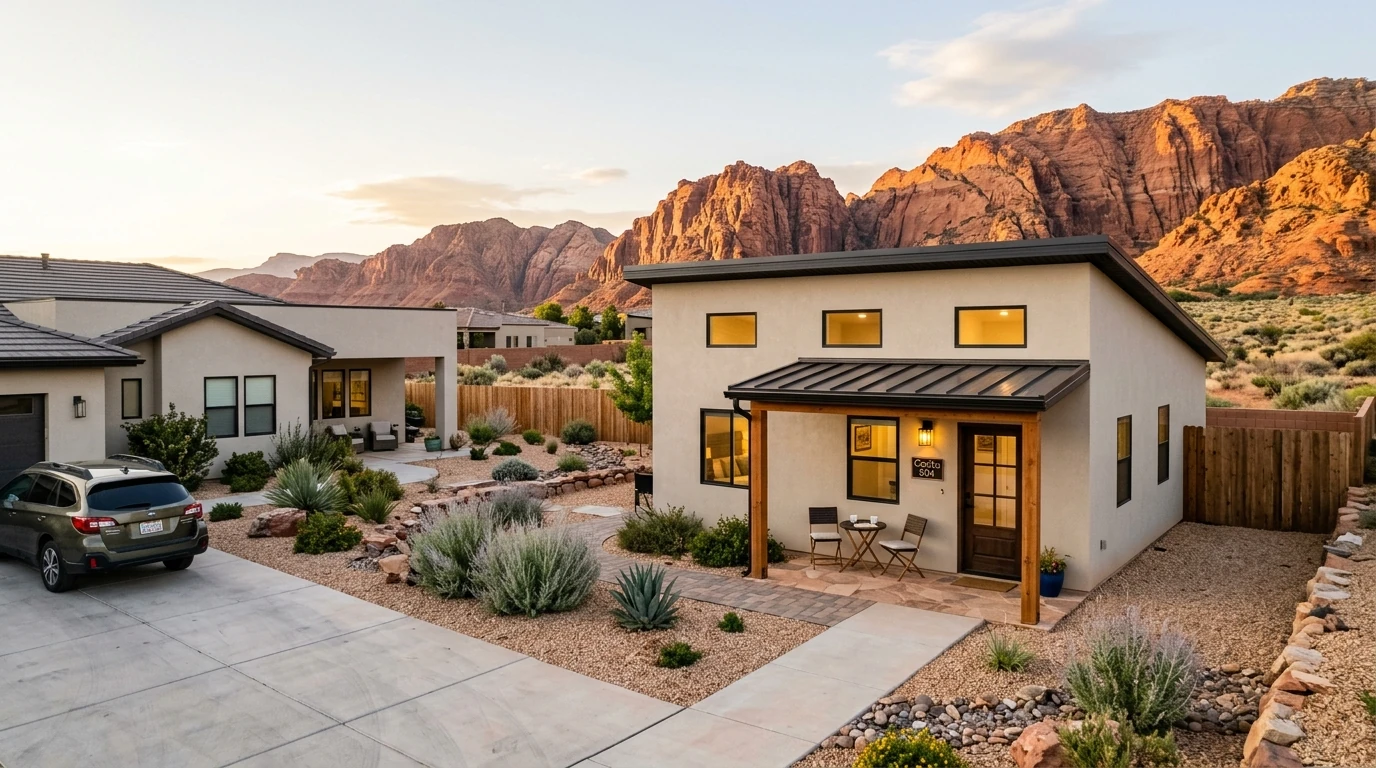
Which ADU Type Fits Your Situation Best?
The “right” ADU isn’t the cheapest one or the biggest one. It’s the one that fits your property, your budget, your goals, and your city’s rules. Here’s a decision framework:
| ADU Type | Best For | Typical Cost Range | Fastest to Permit? | Main Constraint |
|---|---|---|---|---|
| Basement / internal conversion | Budget-conscious homeowners, first-time ADU builders | $50,000 – $100,000 | Yes — strongest state-law protections | Must be within existing home footprint |
| Garage conversion | Homeowners with an existing garage they don’t need | $60,000 – $150,000 | Usually straightforward | May need to replace parking elsewhere |
| Attached addition | Families wanting connected but separate space | $100,000 – $250,000 | Moderate | Must not alter single-family appearance |
| Detached ADU / casita | Maximum privacy, highest rental income | $150,000 – $350,000+ | More steps — but doable | Size limits, setbacks, utility hookups |
| Above-garage suite | Small lots where yard space is limited | $120,000 – $250,000 | Varies by city | Height limits, stair access rules |
Quick decision guide
💰 If you want the lowest cost and fastest path →
Convert a basement or existing interior space. Internal ADUs are the most protected by Utah state law, exempt from impact fees, and the cheapest to build because the structure already exists.
🏚️ If you have a garage you rarely use →
A garage conversion gets you a rental-ready unit without building from scratch. Just plan for replacement parking if your city requires it.
🏠 If you want the highest rental income and most privacy →
Build a detached casita. It costs more and takes longer, but detached ADUs command the highest rent and add the most property value.
🌵 If you're on large acreage in unincorporated county →
You may be able to build an ADU up to 3,500 sq ft — essentially a full second home. That’s a significant asset.
👨👩👧👦 If you're planning for aging parents →
Consider an attached ADU for proximity or a single-story detached casita with ADA-accessible design. Both keep your family close while maintaining independence.
⛔ If your plan involves Airbnb or short-term rentals →
Stop and check your city’s rules first. Most Washington County jurisdictions restrict ADU rentals to 30+ consecutive days. Don’t build a $200,000 unit around income you can’t legally earn.
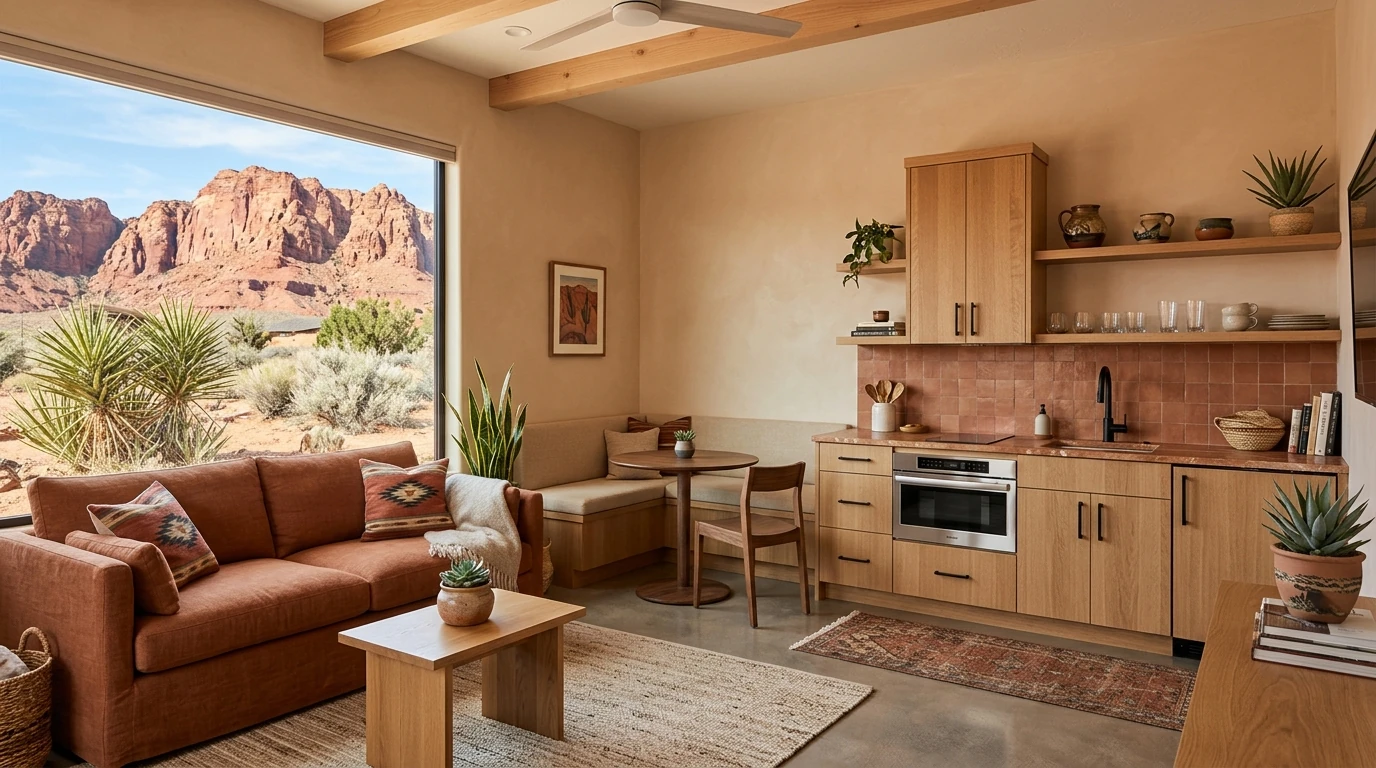
How Much Does an ADU Cost in Washington County?
Here’s the real answer: $50,000 to $350,000+, depending on what you’re building. That range is wide because a basement conversion and a custom detached casita are very different projects.
Cost by ADU type (Washington County, 2026 estimates)
| ADU Type | Low End | Mid Range | High End | Best For |
|---|---|---|---|---|
| Basement / internal conversion | $50,000 | $75,000 | $100,000 | Budget path; using existing space |
| Garage conversion | $60,000 | $100,000 | $150,000 | Existing structure; moderate budget |
| Attached addition | $100,000 | $175,000 | $250,000 | Shared-wall efficiency |
| Detached ADU (1-bed casita) | $150,000 | $200,000 | $280,000 | Privacy; solid rental income |
| Detached ADU (2-bed, premium) | $200,000 | $280,000 | $350,000+ | Maximum rental income; highest value-add |
Estimated total project ranges based on current Washington County construction market conditions and builder project data. A local KSL report noted that a one-bedroom detached ADU in St. George averaged over $100,000 to build as of 2024. Always get a site-specific estimate before committing to a budget.
What drives the cost in Washington County specifically
Hard Costs (what you can see)
Foundation, framing, roofing, plumbing, electrical, HVAC, and interior finishes. In the St. George metro, labor costs trend higher than the Utah average because growth and demand keep tradespeople busy.
Soft Costs (what people miss)
- Design & engineering: 10–15% of total cost
- Permit fees: $2,000–$5,000
- Impact fees: $3,000–$10,000 (internal ADUs exempt)
- Utility hookups/trenching: $8,000–$18,000+
- Septic permit: Required on unincorporated land without sewer
- REScheck energy compliance: Required
The costs most people miss
Property taxes
Your ADU adds assessed value, increasing your property tax bill. But Utah's 45% primary residential exemption still applies, so the increase is typically modest compared to rental income.
Insurance
Notify your homeowner’s insurance. A separate dwelling may require a rider or policy adjustment.
Landscaping & site restoration
After construction, your yard will need attention. Budget for it.
Separate address & mailbox
Required for emergency response and mail delivery. A small but real added step.
Is it worth it? Here’s what the numbers look like.
| Scenario | Build Cost | Monthly Rent | Annual Income | Payback | Value Added |
|---|---|---|---|---|---|
| Basement conversion | $75,000 | $1,300/mo | $15,600/yr | ~5 years | $70,000–$100,000 |
| Garage conversion | $100,000 | $1,400/mo | $16,800/yr | ~6 years | $80,000–$120,000 |
| Detached 1-bed casita | $200,000 | $1,600/mo | $19,200/yr | ~10 years | $140,000–$200,000 |
| Detached 2-bed premium | $280,000 | $2,100/mo | $25,200/yr | ~11 years | $180,000–$250,000 |
Rental estimates based on published St. George metro listings (Apartments.com, Rent.com, Redfin 2025–2026 data). Property value estimates based on national ADU value-add research applied to local conditions. Actual results depend on location, unit quality, and market conditions. Illustrative projections only.
Beyond rental income: the value most people underestimate
If you’re building for family housing rather than rental income, the ROI looks different — but it’s arguably even stronger. Assisted living in Utah runs $4,000–$8,000+ per month. A well-designed casita for aging parents keeps them close, independent, and safe — saving the family tens of thousands per year compared to a care facility.
And there’s one more angle: Washington County is a destination. Having a self-contained guest space on your property — whether you ever rent it or not — is a lifestyle asset that pays dividends every year you own it. When you eventually sell, a permitted ADU with clean documentation makes your property stand out to buyers increasingly looking for income potential.
What Can Disqualify or Delay Your ADU Project?
The hardest part of building an ADU is usually not the construction. It’s discovering too late that your city, HOA, parking situation, or utility setup changes what you can legally build. Every one of these problems is discoverable before you spend heavily on plans.
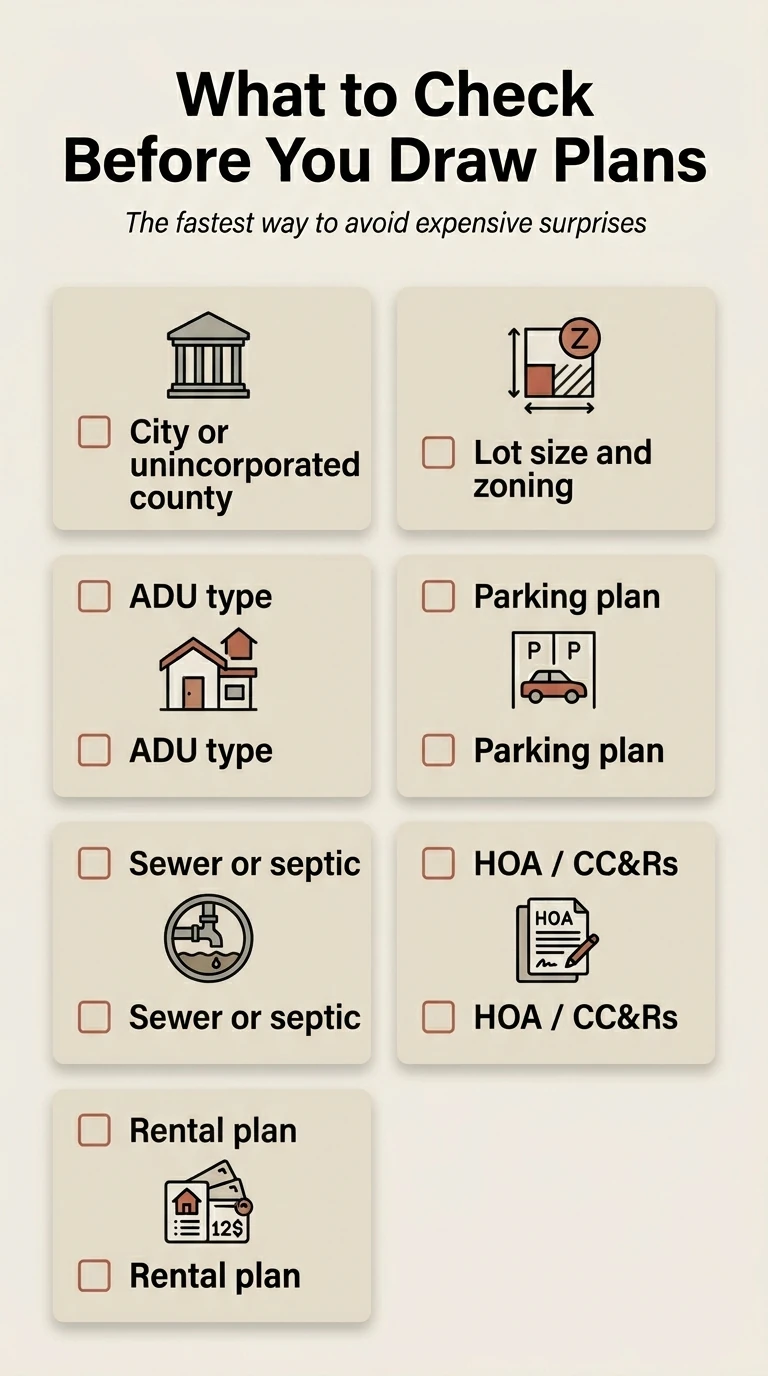
HOA and CC&Rs
Utah enacted 2025 H.B. 217, which generally prevents HOAs from blocking internal ADUs (IADUs) if the unit complies with local land-use, building, health, and fire codes — subject to certain exceptions. But for detached ADUs, casitas, and external structures, your CC&Rs may still impose design restrictions or outright prohibitions. Review your HOA documents before you draw up plans. If your HOA claims they can block an internal ADU, the Utah Property Rights Ombudsman’s office is the right resource.
Owner-occupancy
Don’t assume owner-occupancy requirements have disappeared in Utah. Current Washington County and city rules still require the property owner to live on the premises — either in the main house or the ADU — in order to rent the other unit. The owner must hold the primary residential exemption through the County Assessor’s Office.
Short-term rental restrictions
This is the number-one surprise we see. In unincorporated Washington County, the ADU chapter prohibits short-term ADU rentals — though the county maintains a separate STR licensing program (§ 10-13-23) that may apply in certain circumstances. Most cities within Washington County similarly restrict ADU rentals to 30 or more consecutive days. If your plan depends on Airbnb or VRBO income, verify your specific jurisdiction’s rules first.
Parking and garage conversions
Most jurisdictions require at least one additional off-street parking space for an ADU. If you’re converting a garage, some cities require you to replace the parking elsewhere. St. George specifically prohibits tandem parking for ADU spaces. This isn’t usually a dealbreaker, but it affects your site plan.
Septic, utilities, and water availability
If your property is on septic rather than municipal sewer, requirements change. Unincorporated Washington County properties may need a septic permit from the Southwest Utah Public Health Department. Water availability must be verified before a building permit is issued — some areas require proof of a water stock certificate or hookup fee receipt.
Wildland-Urban Interface (WUI)
Properties near Ivins, Santa Clara, Snow Canyon, or Pine Valley may fall within a WUI zone. This triggers additional requirements for defensible space, fire-resistant materials, and specific building elevation standards. It doesn’t prevent building an ADU, but it adds to the scope and cost. Better to know upfront.
Separate sale is not an option
An ADU cannot be sold separately from the primary property. It is not a subdivided lot. This is universal across Washington County jurisdictions. Think of it as adding value to your property — not as creating a separate real estate asset.
Seven Mistakes Washington County Homeowners Make With ADU Projects
We see the same mistakes on repeat. Every one of them is avoidable.
Assuming county rules apply when they’re actually in a city
St. George, Washington City, and Hurricane each have their own ADU ordinances. The county code only applies to unincorporated land. Building under the wrong rulebook can mean plans that don’t pass review.
Designing before checking feasibility
We’ve seen homeowners spend $5,000+ on architectural plans for a detached casita, only to discover their lot is 500 square feet too small or their setbacks don’t work. Always get a feasibility check first. It costs nothing and takes fifteen minutes.
Planning Airbnb income without checking short-term rental rules
This is the most expensive mistake because it affects the entire financial model. Most Washington County jurisdictions restrict ADU rentals to 30+ consecutive days. Build your budget around long-term rental rates, not nightly rates.
Skipping the deed restriction
In most jurisdictions, the recorded deed restriction must be in place before the building permit is issued. Homeowners who don’t understand this requirement find themselves stuck in a documentation loop that delays the entire project.
Underestimating utility hookup costs on rocky lots
Washington County’s desert terrain is beautiful, but it’s not cheap to dig through. Utility trenching for a detached ADU can run $8,000–$18,000 on a normal lot. On rocky soil — common in areas around Ivins, Santa Clara, and parts of Hurricane — that number can double.
Not checking Wildland-Urban Interface requirements
Properties near Snow Canyon, Pine Valley, or the red cliffs above Santa Clara may fall within a WUI zone. This triggers defensible-space provisions and fire-resistant material requirements that add cost and design constraints. Better to know upfront than after you’ve finalized plans.
Trying to pull the permit without understanding contractor requirements
Utah law generally requires a licensed general contractor for second dwelling unit permits, though owner-builder exemptions may be available. Either way, an experienced builder navigates the process faster, catches issues earlier, and keeps the project on track.
What Does the Permit and Build Process Look Like?
The permit process varies by city, but here’s the general sequence for a Washington County ADU project. A good builder handles most of this on your behalf — that’s the point of hiring one.
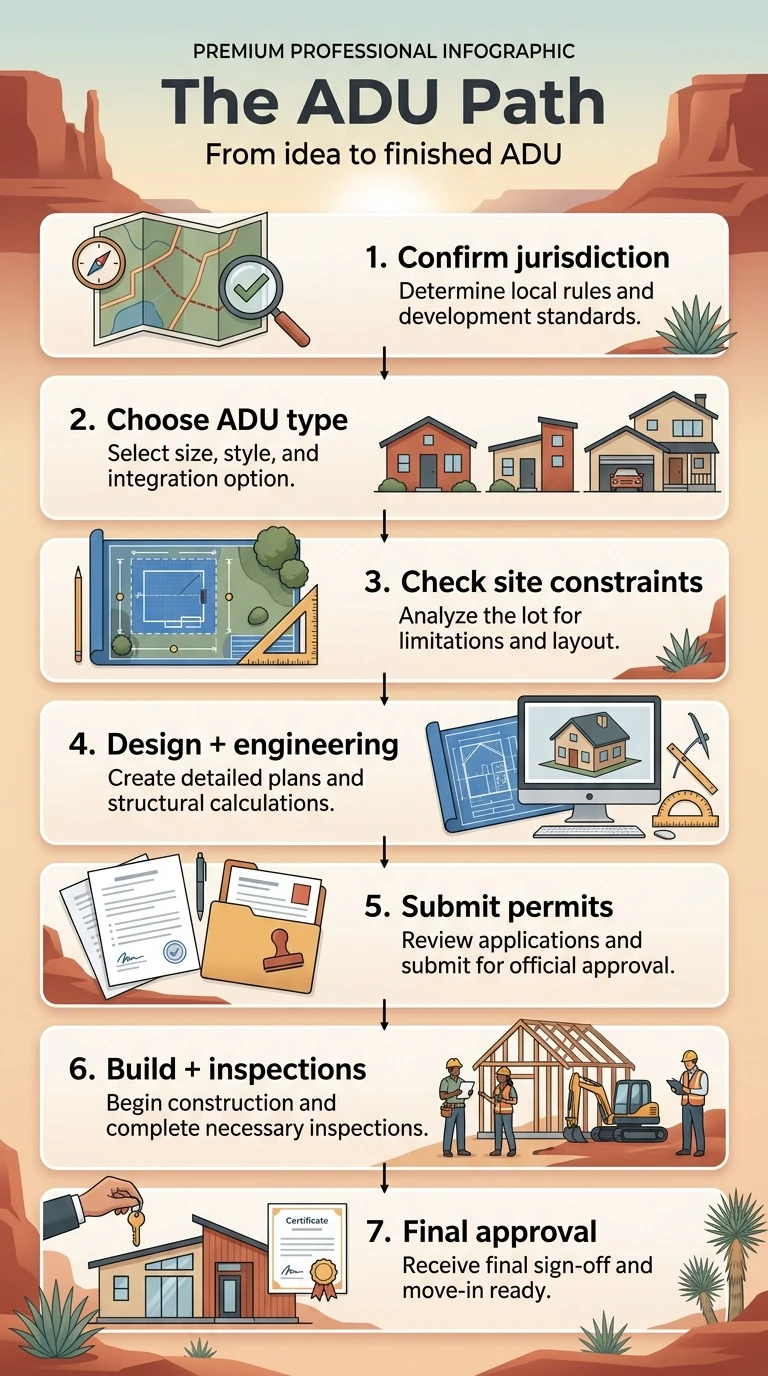
Confirm Your Jurisdiction and Zoning
Determine whether your property is in a city or unincorporated county. Confirm your zoning allows ADUs. This takes about fifteen minutes with the right tools.
Property Feasibility Assessment
Before spending money on plans, verify your lot size, setbacks, utility access, soil conditions, and any special overlay zones (like Wildland-Urban Interface). This is where most surprises surface — and where they’re cheapest to discover.
Design and Engineering
Work with a designer or your builder’s design team to create architectural drawings, a site plan showing ADU placement and setbacks, structural engineering with an engineer’s stamp, and a REScheck energy compliance report. If your area requires it, a defensible space plan is also prepared at this stage.
Record the Deed Restriction
Most jurisdictions require a deed restriction before the building permit is issued. This document is notarized and recorded at the Washington County Assessor’s Office. It acknowledges the owner-occupancy requirement and the ADU standards your property must maintain.
Submit Permit Application
Applications are submitted through your city or county’s online permitting system. Required documents typically include the items from Steps 3 and 4, plus a pad certification form, truss design verification from an engineer, and (for unincorporated areas) a septic permit from the Southwest Utah Public Health Department if not on municipal sewer.
Plan Review and Corrections
Your city reviews the submitted plans for compliance with zoning, building code, fire code, and energy requirements. Review times vary — expect 2 to 8 weeks depending on the jurisdiction and workload. Some back-and-forth on corrections is normal.
Construction
Once the permit is approved, construction begins. A typical detached ADU takes 4 to 7 months to build. Internal conversions take 2 to 4 months. Inspections happen at key milestones — foundation, framing, rough plumbing and electrical, insulation, and final.
Final Inspection and Occupancy
After passing all inspections, you’ll receive a certificate of occupancy. If you plan to rent the unit, apply for a business license. Set up a separate address for mail and emergency response.
How long does the whole thing take?
| Phase | Typical Timeline |
|---|---|
| Feasibility + design | 3 – 8 weeks |
| Permit application + review | 2 – 8 weeks |
| Construction (detached) | 4 – 7 months |
| Construction (internal/conversion) | 2 – 4 months |
| Total for a detached ADU | 6 – 12 months |
| Total for an internal conversion | 3 – 6 months |
What slows the process down (and how to avoid it)
The most common delays aren’t in construction — they’re in the planning and permitting phase. Incomplete submittals get kicked back. Missing documents add weeks. Here’s what we tell homeowners: the single fastest thing you can do is start with a feasibility assessment, not an architect. A builder who knows Washington County can tell you in fifteen minutes whether your property qualifies, which ADU type fits, and what the city is going to want to see.
The second biggest time-saver: let the builder handle the permit process. Experienced Washington County ADU builders have relationships with local planning departments. They know the submittal requirements cold. They catch the things that trigger corrections before the plans are submitted, not after.
Can You Rent the ADU, Use It for Family, or List It Short-Term?
Long-term rental income
This is the most common ADU use case in Washington County, and the rules are clear: most jurisdictions allow long-term rentals (30+ consecutive days) with a business license. Owner-occupancy is required — you live in the main house and rent the ADU, or vice versa. At current St. George rents ($1,200–$2,100/month for ADU-sized units), this is a meaningful income stream.
A few things to know about the rental path: you’ll need a business license from your city (or county, if unincorporated). The tenant should sign a lease for 30+ days. You’re responsible for landlord obligations — maintenance, habitability standards, and compliance with Utah’s residential landlord-tenant law.
The math tends to work
A $200,000 detached casita renting at $1,600/month generates $19,200/year before expenses. After property management (typically 8–10%), maintenance, and the property tax increase, many homeowners net in the range of $14,000–$16,000 annually. That’s money working for you while you sleep, while your property value climbs, and while your mortgage balance drops.
Family housing
Whether it’s aging parents, adult children, or extended family, an ADU gives your family close proximity and independence at the same time. There’s no rental income in this scenario, but the value is real: you avoid thousands per month in assisted living costs, give a family member a launchpad, or create a comfortable guest space for the snowbird season.
Utah’s state law makes internal ADUs particularly accessible for family housing. You don’t need a rental business license if you’re not charging rent, but the owner-occupancy and permit requirements still apply.
Short-term rentals (Airbnb, VRBO)
What happens if you sell the home?
The ADU stays with the property — it can’t be sold separately. A recorded deed restriction runs with the land. When you sell, the new owner must sign and record a new owner-occupancy declaration to continue using the ADU for rental purposes. This is actually a selling point: a permitted, well-built ADU with documented rental income makes your property significantly more attractive to buyers.
Utah State Laws That Protect Washington County Homeowners
You have more rights than you might think. Here’s what Utah state law guarantees, regardless of what your city’s ordinance says:
Internal ADUs are a permitted use in most residential zones
Under Utah Code § 10-21-303 (formerly § 10-9a-530), your city must allow internal ADUs in residential areas without requiring a conditional use permit. A basement apartment or interior conversion cannot be subjected to discretionary review processes that make building uncertain.
No impact fees for internal ADUs within an existing primary dwelling
State law (§ 11-36a-202) bars impact fees on the construction of an internal ADU within an existing primary dwelling. Depending on your city, this saves $3,000 to $10,000.
HOAs generally cannot block internal ADUs
If your internal ADU complies with local land-use, building, health, and fire codes, your homeowner association generally cannot prohibit it — even if the CC&Rs seem to say otherwise. This protection was strengthened by 2025 H.B. 217, though the statute does include certain exceptions.
Cities can only restrict IADUs in limited areas
A municipality can prohibit internal ADU creation in zoning districts covering no more than 25% of its total residential area. For cities with a university and a student population of 10,000 or more — which includes St. George due to Utah Tech University — that threshold increases to 67%.
Minimum square footage floors
State law says a city cannot require ADUs to be larger than 1,000 sq ft (not including a garage). This prevents cities from pricing out smaller, more affordable ADU projects.
A note on code section numbers
If you’re researching Utah ADU law online, you’ll see some sources reference § 10-9a-530 and others reference § 10-21-303. They’re the same law — Utah recodified its land-use statutes, and the old section numbers were renumbered. The substance didn’t change. If a source cites the old number without explaining this, it may not be current.
Sources: Utah Code §§ 10-21-303 and 17-80-303 (internal ADU provisions); § 11-36a-202 (impact fees); 2025 H.B. 217 (HOA restrictions); Utah Property Rights Ombudsman guidance at propertyrights.utah.gov.
How We Verified This Guide
Primary sources: Washington County Code § 10-13-18, St. George City Code § 10-17A-3, Washington City Titles 9-8A and 9-8B (including January 2026 amendments), Santa Clara City Code, La Verkin City Code, Hurricane City Code §§ 10-37 and 10-7-9, Utah Code §§ 10-21-303 and 11-36a-202, and Utah HB 217.
Market data: St. George rental market data from Apartments.com, Rent.com, and Redfin (2025–2026). Cost estimates based on Washington County construction market conditions and builder project data.
What we did NOT do: We did not treat outdated blog posts or generic national ADU data as local fact. Where a city’s code was unclear or recently amended beyond what’s published online, we flagged it and recommend direct verification.
How we keep it current: We review this guide against published city and county codes at least quarterly. When a jurisdiction updates its ADU rules (as Washington City did in January 2026), we update this page and note the date.
Get a Free Washington County ADU Feasibility Assessment
You’ve read the rules. You’ve seen the numbers. Now the question is: what does all of this mean for your specific property?
No charge. No obligation. No pressure. Tell us your address and your ADU idea, and we’ll give you a straight answer.
Frequently Asked Questions
18 questions Washington County homeowners ask most
Related Utah ADU Guides
This guide is provided for informational purposes and does not constitute legal advice. City and county codes change — always verify current regulations with your local planning department before making financial commitments. Regulations verified against published municipal codes as of March 2026.