Utah Frost Depth by City: Official Building Design Criteria (6–48 Inches)
By Utah ADU Builders Research · Updated September 2026
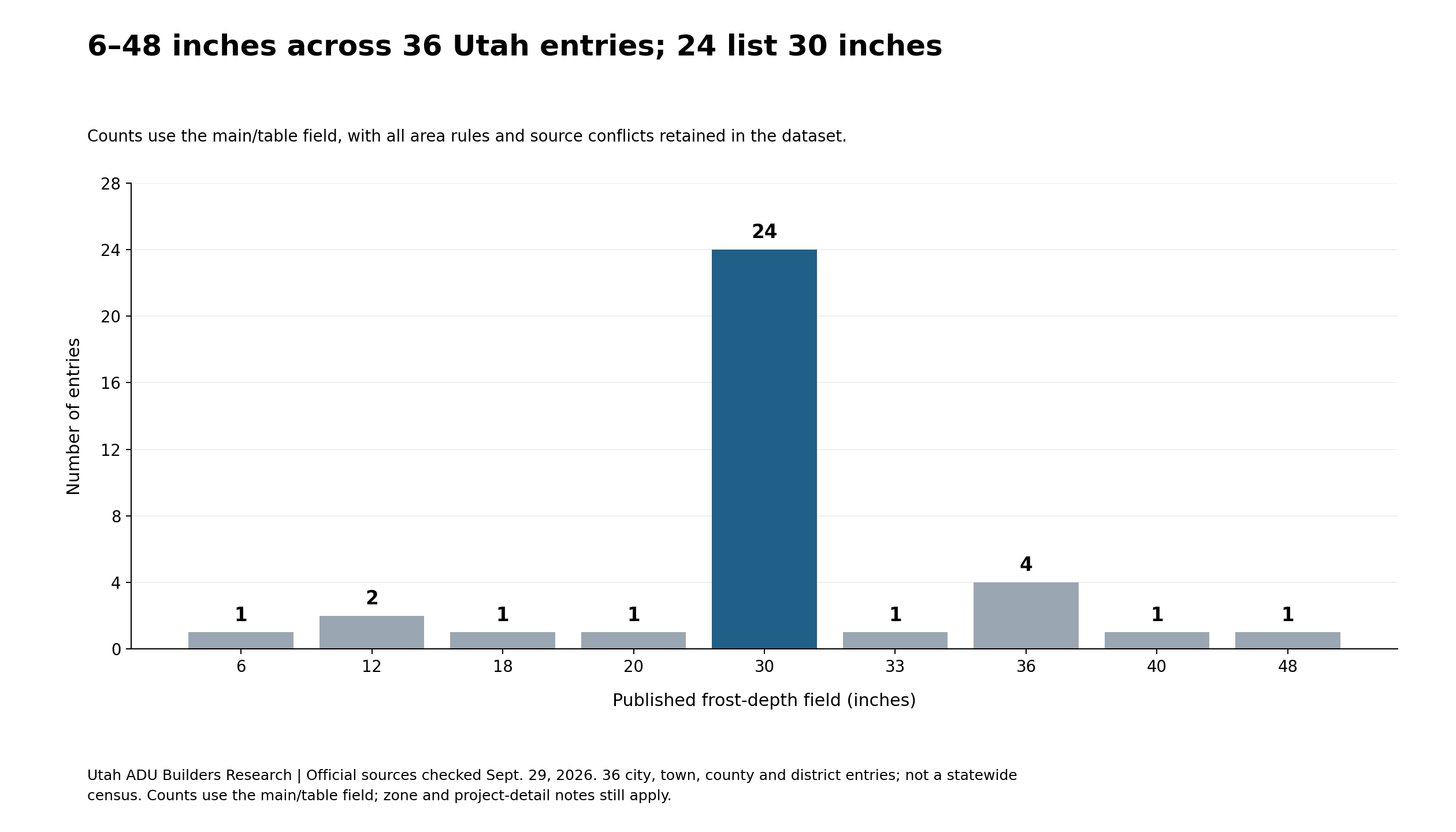
Published Utah frost-depth criteria range from 6 inches in Santa Clara to 48 in Brian Head across 36 local entries checked by Utah ADU Builders Research in September 2026. That's an 8-fold gap. Twenty-four entries list 30 inches, including all 21 Wasatch Front entries in this table.
Find your city in the table below. Then see why three cities near St. George list less than half of Salt Lake City's frost-depth figure, and why the "Utah average" you'll find online is not a verified statewide average. These are published design criteria, not measured freezing or an excavation plan. Check the sources and measurement notes.
Key Utah frost depth statistics
- Published frost-depth criteria span 6 inches in Santa Clara to 48 inches in Brian Head across 36 checked Utah entries, an 8-fold gap. Utah ADU Builders Research, Sept. 29, 2026; Santa Clara, Brian Head, and the full table.
- All 21 Wasatch Front entries in this compilation list a 30-inch frost-depth field. That includes checked sources in Salt Lake, Davis, Weber, Utah and Box Elder counties, not every department in those counties. Utah ADU Builders Research, Table 1, checked Sept. 29, 2026.
- 24 of 36 checked Utah city, town, county and district entries (67%) list a 30-inch frost-depth field. Utah ADU Builders Research, Table 1, Sept. 29, 2026; 24 ÷ 36, rounded to a whole percent.
- Three Washington County cities publish 6 to 12 inches: Santa Clara (6), St. George (12) and Ivins (12). Santa Clara design criteria, St. George City Code §9-10-1, and Ivins City Code §14.02.102; checked Sept. 29, 2026.
- Park City lists 40 inches; Summit County lists 36. Heber City and Wasatch County each list 36 inches. City and county sources are separate entries. Park City, Summit County, Heber City, Wasatch County; checked Sept. 29, 2026.
- 3 of the 36 checked entries explicitly vary by elevation or area: Greater Salt Lake MSD, Grand County and San Juan County. San Juan lists 24, 36 or 42 inches by area. Utah ADU Builders Research, Table 4, checked Sept. 29, 2026.
- There is no single statewide frost-depth value in Utah's IRC amendments. The local jurisdiction fills the frost-depth field in the model code. Utah Code §15A-3-202, effective July 1, 2026, and 2021 IRC Table R301.2, note b; checked Sept. 29, 2026.
- The residential code's frost-depth field refers to the minimum footing depth below finished grade, not the top of the concrete. 2021 IRC Table R301.2, note b; checked Sept. 29, 2026. Keep each local sheet's measurement notes attached.
- Under the residential code, exterior footings have a separate 12-inch minimum below undisturbed ground, even where the local frost field is shallower. 2021 IRC R403.1.4; checked Sept. 29, 2026.
- The IRC exempts qualifying freestanding accessory structures from frost protection at 600 square feet or less for light-frame construction, or 400 square feet or less for other construction, with eave height no more than 10 feet in either case. 2021 IRC R403.1.4.1; checked Sept. 29, 2026. This is not an automatic ADU exemption.
- Duchesne County's published air freezing index (2,841) is 5.16 times the 551 in Millcreek's PDF, yet both frost fields say 30 inches. Utah ADU Builders Research, Table 6, Sept. 29, 2026. This compares published fields, not one period of measured climate; Millcreek's webpage differs.
- Utah's state-code table lists 29 towns, one in each county, with ground snow loads from 21 psf (St. George and Moab) to 67 psf (Monticello). Utah Code §15A-3-202(19), effective July 1, 2026; checked Sept. 29, 2026. These are design loads, not snowfall totals.
On this page: City table and lookup · Statewide number? · How it's measured · Shallowest and deepest · Elevation rules · The "Utah average" · Colder vs. deeper · ADUs, sheds and decks · Snow loads · Method · Limits · Cite · Download · FAQ · Sources
What is the frost depth in my Utah city?
In 24 of the 36 checked local entries, the published frost-depth field is 30 inches. The other 12 range from 6 inches (Santa Clara) to 48 inches (Brian Head). Use the source for the authority that handles your permit, not a neighbor's.
Each row below links straight to that authority's own source. We read every one on September 29, 2026. A city and its surrounding county can have different criteria; their entries are not interchangeable.
| Place | Type | County | Frost depth (in.) | What the sheet adds | Official source | Source date | Beaver County | county | Beaver | 30 | Below grade; county also inspects in Beaver City, Milford and Minersville | Beaver County FAQ | undated | Bluffdale | city | Salt Lake | 30 | "From bottom of footing" | Design criteria FAQ | undated | Bountiful | city | Davis | 30 | Both residential and commercial fields say 30 | Code and design criteria | rev. Oct. 13, 2025 | Brian Head | town | Iron | 48 | Deepest field in this table | Table R301.2 | Nov. 20, 2024 in filename | Brigham City | city | Box Elder | 30 | — | Design criteria | undated | Cedar City | city | Iron | 30 | City source, not all Iron County | Building design standards | undated | Cottonwood Heights | city | Salt Lake | 30 | City lists elevations of 4,500–5,100 ft | Codes and standards | undated | Duchesne County | county | Duchesne | 30 | May be site specific | Table R301.2(1) | undated | Eagle Mountain | city | Utah | 30 | Retrieved version dates differ; frost field agrees | Building design criteria | July 2026 text / Oct. 2024 image | Garfield County | county | Garfield | 33 | — | Design criteria | undated | Grand County | county | Grand | 20 | 20 below 5,000 ft; above that, ask the department. Exactly 5,000 ft needs confirmation. | Design criteria | undated | Greater Salt Lake MSD service area | municipal services district | Salt Lake | 30 | May increase at higher elevations | Design criteria | undated | Heber City | city | Wasatch | 36 | City sheet, not a county-wide assignment | City design criteria | criteria undated; code list July 2026 | Herriman | city | Salt Lake | 30 | 30 from bottom of footing to finished grade; separate 36 from bottom to slab or wall top | Codes and design criteria | undated | Ivins | city | Washington | 12 | Set in city code | City Code §14.02.102 | current code; 2020/2025 history | Kanab | city | Kane | 18 | City source, not all Kane County | City design criteria | undated | Kaysville | city | Davis | 30 | Same value for homes and commercial | Design criteria | undated | Millcreek | city | Salt Lake | 30 | Frost field agrees; freezing-index sources differ | Design criteria | undated | Murray | city | Salt Lake | 30 | — | Design criteria | undated | North Salt Lake | city | Davis | 30 | Stated as a minimum | Design criteria | undated | Ogden | city | Weber | 30 | Below grade | Design criteria | undated | Orem | city | Utah | 30 | — | Table R301.2(1) | criteria undated; code list July 2026 | Park City | city | Summit | 40 | City sheet, not Summit County's 36-inch sheet | City design criteria (PDF) | 2026 in filename; undated sheet | Provo | city | Utah | 30 | — | Design criteria | undated | Salt Lake City | city | Salt Lake | 30 | — | Design criteria | posted Apr. 23, 2026 | San Juan County | county | San Juan | 36 | 24 in Spanish Valley, Bluff and similar places; 36 elsewhere; 42 in the mountains | Building code information | undated | Santa Clara | city | Washington | 6 | Shallowest field in this table; separate exterior-footing minimum still applies | Design criteria | rev. Oct. 2021 | South Jordan | city | Salt Lake | 30 | Bottom of footing to finished grade | Building department | undated | Spanish Fork | city | Utah | 30 | — | Design criteria | undated | Springville | city | Utah | 30 | Table says 30; Detail D shows 36 minimum. See the source conflict | Additions handout | undated; April 2026 hosting path | St. George | city | Washington | 12 | Set in city code | City Code §9-10-1 | code current through Aug. 20, 2026 | Summit County | county (unincorporated areas) | Summit | 36 | Separate from Park City's 40-inch city sheet | Design criteria | effective July 1, 2026 | Wasatch County | county | Wasatch | 36 | Separate from Heber City; retrieved version dates differ | Design criteria | July 1 / Jan. 13, 2026 versions | West Bountiful | city | Davis | 30 | Frost field verified; other text on page still cites the 2015 IRC | Building design criteria | undated | West Jordan | city | Salt Lake | 30 | — | Design criteria | rev. July 2026 | Woods Cross | city | Davis | 30 | — | Codes and design criteria | undated |
|---|
Source: the official pages, documents and codes linked in the table. Compiled by Utah ADU Builders Research; every row checked September 29, 2026. "Undated" means no document date was established, not that the criterion is invalid. Counts use the published main/table field, not every zone or project detail.
Here's the pattern in one breath. In all 21 Wasatch Front entries here, the table field is 30 inches. St. George lists 12. Park City lists 40 and Brian Head lists 48. Springville's separate footing detail and the area rules below still matter.

Look up your city
Pick your city or county, and the lookup shows its published frost depth, what the sheet says it's measured to, and the link to check it yourself. If your place isn't in the table yet, it tells you that plainly. It never guesses from a neighbor.
Utah frost depth lookup
Choose a place to see its published frost-depth criterion, source and measurement notes. This is a reference lookup, not a foundation calculator or a jurisdiction detector.
My city isn't in the table
That doesn't mean it has no frost depth. Many of the departments here post a short "design criteria" sheet. Search for "[your city] design criteria" or "[your city] Table R301.2," or look in its deck or addition handouts. Some small cities hire their county to do inspections. Beaver County, for example, inspects for Beaver City, Milford and Minersville. Ask which jurisdiction's criteria apply; an inspection contract alone does not settle that.
Iron County: its linked design document could not be retrieved on the check date, so no Iron County number is included. The county's building page is the next source to check. Cedar City and Brian Head have their own verified entries; neither stands in for the county.
Does Utah have one statewide frost depth?
No. Utah adopts the 2021 International Residential Code (Utah Code §15A-2-103), but its statewide changes to that code, effective July 1, 2026, set no single frost line depth. The code's own design table leaves that blank for each local building department to fill in.
Think of a form with a line that says "your number here." The state hands every city the same form. Each city writes its own number on the line.
We read every numbered change in Utah Code §15A-3-202, the section that edits chapters 1 through 5 of the residential code. It swaps in a Utah snow-load table, adjusts anchor-bolt spacing and adds a definition of an accessory dwelling unit. It never names a frost depth. Meanwhile, the code's table note tells "the jurisdiction" to fill in the frost line depth column (2021 IRC Table R301.2, note b).
So the useful "Utah frost depth" answer is the one for the correct local jurisdiction, not a statewide average.
What is frost depth measured to?
For the residential code's frost-depth field, the reference is finished grade down to the footing. South Jordan makes the bottom-of-footing reference explicit. A local table field is not a complete foundation design, and a sheet's other measurement notes still apply.
That's how the residential code defines it: the frost line depth is "the minimum depth of footing below finish grade" (2021 IRC Table R301.2, note b). South Jordan says the same thing in plain words: 30 inches from the bottom of the footing to finished grade (South Jordan). So do Herriman and Bluffdale.
Herriman also gives a second measurement. It uses the top of the slab or foundation wall instead of finished grade. Keep the reference point attached to the number; the page does not establish that both measurements end at the same level on every project.
| Measure from | Measure to | Depth | Finished grade | Bottom of footing | 30 in. | Top of slab or foundation wall | Bottom of footing | 36 in. |
|---|
Source: Herriman Building Codes and Design Criteria, checked Sept. 29, 2026. The two numbers use different reference points. Their relationship depends on the project's levels.
Say a drawing shows a footing 10 inches thick with its bottom 30 inches below finished grade. Its top would be 20 inches down (30 − 10). That is an example of the reference points, not a footing size or digging depth to use on a project.
One more rule sits beside the frost field. Under the residential code, exterior footings have a separate 12-inch minimum below undisturbed ground (2021 IRC R403.1.4). That is not the same reference as finished grade. Santa Clara's 6-inch frost field does not mean a 6-inch footing.
Springville shows why the detail matters. Its additions handout lists 30 inches in both the design table and the submission text, but Detail D shows a 36-inch minimum below finished grade. We preserve the table's 30-inch field in the count and flag the detail beside it. Ask Springville which detail applies to the project; do not choose between them from this summary. Read the table and Detail D on page 1.
Where is Utah's frost line shallowest and deepest?
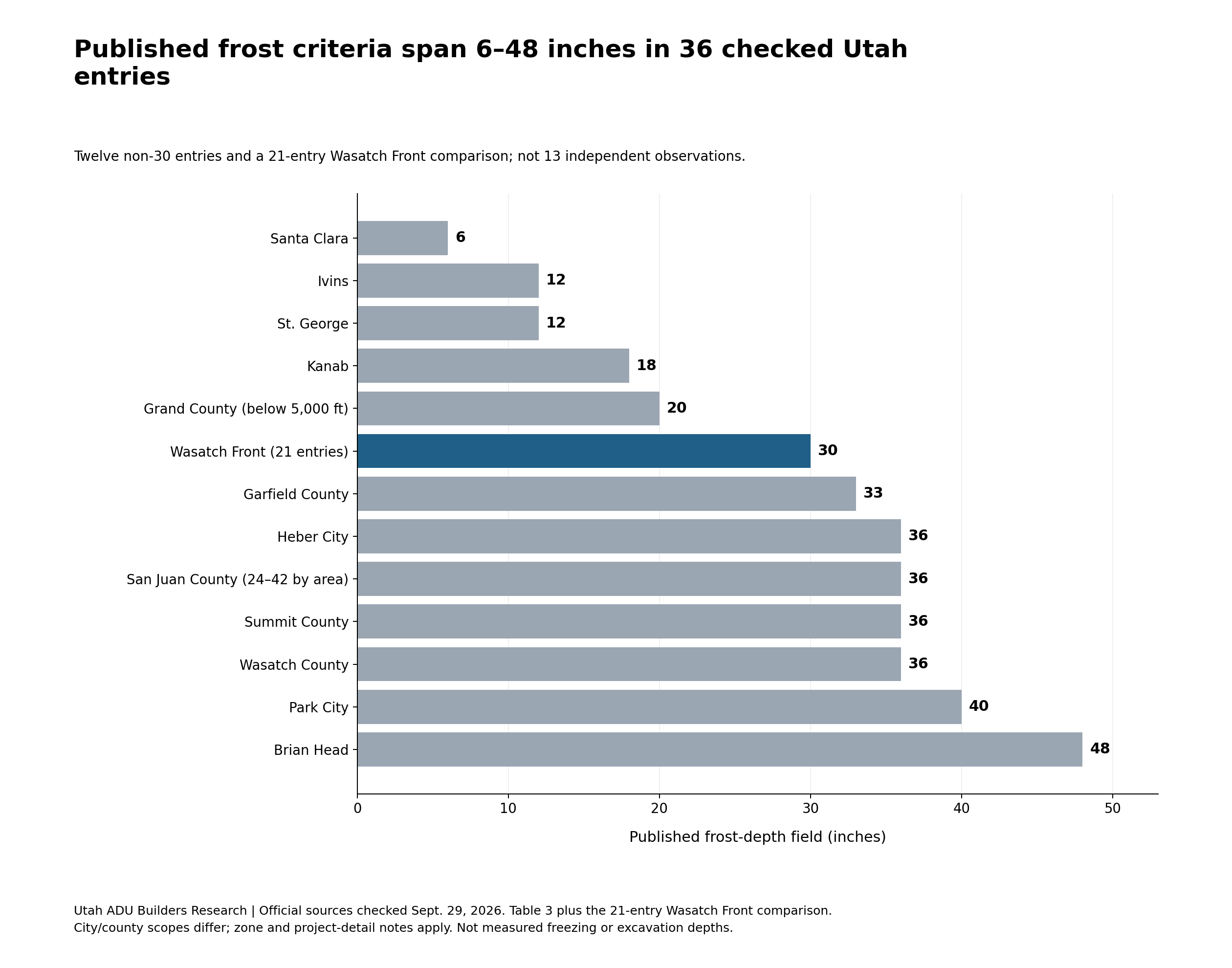
Five of the 36 checked entries list a frost field below 30 inches. Seven list a field above 30. The shallowest in this compilation is Santa Clara at 6 inches; the deepest is Brian Head at 48. These are not claimed statewide extremes.
That's an 8-fold gap and a 42-inch spread. Brian Head's published frost field is 4 feet. Santa Clara's is half a foot. Neither number alone sets a project's excavation depth.
| Place | County | Frost depth (in.) | Region | Santa Clara | Washington | 6 | Southern | Ivins | Washington | 12 | Southern | St. George | Washington | 12 | Southern | Kanab | Kane | 18 | Southern | Grand County (below 5,000 ft) | Grand | 20 | Southeast | Garfield County | Garfield | 33 | South-central | Heber City | Wasatch | 36 | Mountain | San Juan County (24–42 by area) | San Juan | 36 | Southeast | Summit County | Summit | 36 | Mountain | Wasatch County | Wasatch | 36 | Mountain | Park City | Summit | 40 | Mountain | Brian Head | Iron | 48 | Mountain |
|---|
Source: official design sheets linked in Table 1, checked Sept. 29, 2026. Compiled by Utah ADU Builders Research. San Juan County lists 36 outside its specified lower areas and mountains. County and city scopes remain separate.

Southern Utah: 6 to 20 inches
Santa Clara uses 6 inches, St. George and Ivins use 12, Kanab uses 18, and Grand County uses 20 below 5,000 feet. Salt Lake City's 30 inches is 2.5 times St. George's and 5 times Santa Clara's.
St. George's number is written into city law: St. George City Code §9-10-1 fills in a 12-inch frost field, and the code site says it is current through August 20, 2026. Ivins' current code also lists 12 inches. Its ordinance history includes 2020-05 and 2025-08; that history does not establish that the value first changed in 2025.
If you're sizing up a backyard unit down there, our St. George ADU guide covers the local rules.
Mountain country: 33 to 48 inches
Garfield County uses 33 inches. Summit and Wasatch counties and Heber City list 36. San Juan County lists 24, 36 or 42 by area. Park City lists 40 and Brian Head lists 48. The source for each is linked in Table 1.
Brian Head is a different world. Its sheet also sets a minimum ground snow load of 250 pounds per square foot, rising to 295 above 9,800 feet (Brian Head Table R301.2). Salt Lake City's minimum is 28 at and below its stated 4,239-foot reference elevation (Salt Lake City design criteria). The 250-to-28 comparison is about 9 times the design load, not 9 times the snowfall.
Park City and Heber City run their own building offices. Park City lists 40 inches; Heber City lists 36. Those city sources are separate from the 36-inch Summit and Wasatch County sources. Planning a unit up there? Our Park City ADU guide walks through the local rules.
Where does the frost depth change with elevation?
Three of the 36 checked entries explicitly vary their frost-depth criterion by elevation or area: Greater Salt Lake MSD, Grand County and San Juan County. The depth can change with elevation or neighborhood, so one county can have more than one right answer. This count does not include general site-specific cautions or different drawing reference points.
| Department | Rule as written | Source | Greater Salt Lake MSD | 30 inches; "may increase at higher elevations" | MSD design criteria | Grand County | 20 inches below 5,000 feet; above that, contact the department. Exactly 5,000 feet is not resolved by the wording. | Grand County design criteria | San Juan County | 24 inches in Spanish Valley, Bluff and similar places; 36 everywhere else; 42 in the mountains | San Juan County building code information |
|---|
Source: each department's sheet, checked Sept. 29, 2026.
Two homes in San Juan County can have different published criteria. The county lists 24 inches for Spanish Valley and 42 for mountain areas. The approved design, not those numbers alone, sets the excavation.
Is 30 inches the "Utah average" frost depth?
Thirty inches is not a verified statewide average in the sources checked here. It is the most common table field in this compilation: 24 of 36 entries. That count is not a survey of every city or of measured soil freezing.
Some numbers repeated on contractor, calculator and design-blog sites don't match what the official sheets say. Here's how they line up.
| What the named page says | What the primary source says | Hammerpedia labels 30 inches the state average. | The linked source trail does not supply an averaging method or observation period. Our table finds 30 in 24 of 36 entries; that is not a measured statewide average. | MeltPlan lists Park City at 48 inches. | Park City's own 2026 sheet lists 40, not 48. | MeltPlan describes Summit and Wasatch County frost depths as typically 48 inches. | Summit County and Wasatch County each publish 36 in the sources checked. Local scope and site conditions still apply. | MeltPlan lists St. George at 18 inches. | St. George City Code §9-10-1 says 12. | MeltPlan places the local numbers in Utah's amended IRC table. | Utah Code §15A-3-202 supplies snow-load amendments, not a statewide frost-depth schedule. 2021 IRC Table R301.2 leaves the frost-depth criterion to the local jurisdiction. |
|---|
Source: the named publishers' own pages for their claims, and the primary documents for the corrections. All read Sept. 29, 2026. We do not use the publishers' numbers as design evidence.
These examples show the problem with squeezing a whole state into one number. Your footing doesn't sit in the whole state. It sits on one lot, under one building department.
Do colder places always dig deeper?
Not in these published fields. Duchesne County's air freezing index (2,841) is 5.16 times the 551 in Millcreek's PDF, yet both frost fields say 30 inches. This compares two source entries, not climate measured over the same period, and Millcreek's webpage gives different index values.
Here's what the freezing index counts. It measures the amount and duration of below-freezing air, in degree-days. In a simple example, a day averaging 22°F contributes 10 °F-days below the 32°F freezing point. The design code calls for a 100-year-return-period index; that is a statistical design value, not a record of one winter. NSIDC defines the index; NOAA explains its design use and different data periods.
| Department | Air freezing index (°F-days) | Frost depth (in.) | Millcreek | 551 | 30 | Provo | 834 | 30 | Grand County | 850 | 20 | Ogden | 868 | 30 | Orem | 1,000 | 30 | Herriman | 1,163 | 30 | Summit County | 2,500 | 36 | Duchesne County | 2,841 | 30 |
|---|
Source: each selected document linked in Table 1, checked Sept. 29, 2026. Analysis by Utah ADU Builders Research. This is an eight-entry illustration, not all sources with numeric index fields or a common-period climate sample. West Jordan and Eagle Mountain give upper bounds; Garfield County gives a range. Brian Head's sheet expressly bases its 781 index and 49.3°F mean temperature on Fort Duchesne data, so it is not used as a local climate point.
Millcreek's sources differ. The PDF lists 551. The city webpage lists 550 in its climatic table and 2,500 separately under Manual J. All inspected frost fields say 30 inches. Table 6 uses the PDF's 551 to keep the calculation traceable, not to decide which index should govern a project.

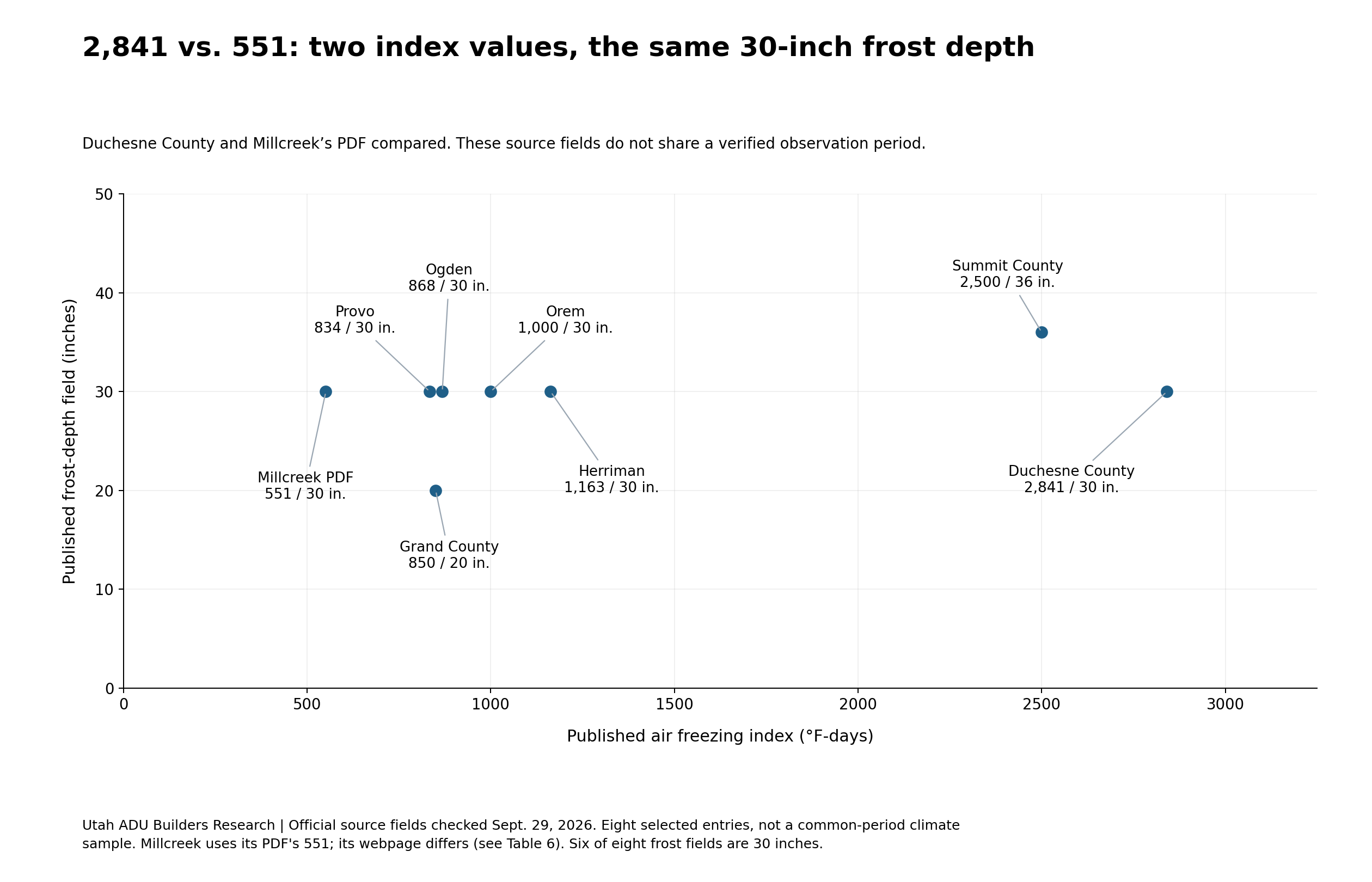
Why wouldn't the numbers track the cold? A published air index is not a measurement of frost at a footing. NOAA describes it as a climate input for foundation design, with local conditions and different source periods to consider (NOAA). We did not establish why any department chose its number. So this is a source comparison, not proof that cold and frost depth are unrelated. The practical lesson is simple: don't guess your number from the weather. Look it up.
What does frost depth mean for a backyard ADU, shed or deck?
A detached ADU needs a foundation design that addresses local frost conditions. All 21 Wasatch Front entries here list a 30-inch frost field, but the code also provides designed frost-protection options. Its small-accessory-structure exemptions are not an automatic exemption for a unit someone lives in (2021 IRC R403.1.4.1).
Detached ADUs and backyard cottages
Say you're adding a 700-square-foot backyard cottage in Ogden. Ogden's published frost field is 30 inches (Ogden design criteria). Move that same cottage to St. George, and the city's number is 12 (City Code §9-10-1). Move it to Brian Head, and it is 48. These are inputs to the design, not a footing plan for that example building.
Same building. Three different published criteria. Our guide to planning a detached ADU in Utah covers the rest of the path, from setbacks to utilities.
Garage and shed conversions
Here's the catch with old outbuildings. The residential code exempts qualifying freestanding accessory structures from frost protection at 600 square feet or less for light-frame construction, or 400 square feet or less for other construction, with eave height no more than 10 feet in either case (2021 IRC R403.1.4.1). So a small detached garage or shed may have been allowed without frost protection. Before you turn one into living space, ask your building department whether its foundation is acceptable for a dwelling. Our guide to converting a detached garage into an ADU walks through the other checks.
Basement and internal ADUs
For this IRC amendment, Utah defines an accessory dwelling unit as a living unit created inside the existing footprint of an owner-occupied single-family home (Utah Code §15A-3-202(9)). That definition is not a statement that detached ADUs cannot exist under other Utah law. A basement unit rides on the house's existing foundation. New exterior work, like a stair, landing or addition, needs its own design review.
Frost-protected shallow foundations
The residential code lists several frost-protection paths: below-frost-depth footings, Section R403.3, ASCE 32, or bearing on solid rock (2021 IRC R403.1.4.1). Frost-protected shallow foundations use insulation to protect a shallower foundation (NOAA). It's a designed detail, so talk to your building department before you plan around it. Foundation depth is one piece of a detached ADU's budget; our Utah ADU cost guide shows planning ranges by type.
Sheds and decks
Sheds need to fit the size, construction and height conditions above before that frost exemption applies. Decks and patio covers have their own rules and local handouts. The IRC also has a frost-footing exception for decks not supported by a dwelling (2021 IRC R403.1.4.1).
Springville's patio-cover handout describes a support 36 inches in height, not a 36-inch frost depth. Its drawing shows 6 inches above grade and 30 below, and its table lists a 30-inch frost field. The text allows a 12-inch pier depth for self-supporting covers where wind conditions allow. Those are specific handout conditions, not a rule for every shed or deck. Read the text and drawing together.
Can I use this table for water pipes or gardens?
No. These are footing numbers. Pipe depth is a separate blank in the plumbing part of the code; the building sewer depth line is Section P2603.5.1, and cities fill it in on their own (Ivins, for example, fills in both). Garden frost dates are about the air, not how deep the ground freezes. For pipes, ask your building department and your water or sewer provider.
If you're weighing a backyard ADU on your own lot, our free ADU feasibility check walks through the zoning, cost range and permit steps before you pay for plans.
What other design numbers do Utah's official sheets list?
Frost depth sits in the same table as snow load, wind and earthquake design. For snow, Utah's statewide code lists a ground snow load for one town in each of its 29 counties, from 21 pounds per square foot in St. George and Moab to 67 in Monticello. The code also points to Utah State University's snow-load study and preserves named-jurisdiction rules in Table R301.2(5b).
Monticello's number is about 3 times St. George's (67 ÷ 21). Cities can also set their own, higher numbers, so check the local sheet.
| Town | County | Ground snow load (psf) | Elevation (ft) | Beaver | Beaver | 35 | 5,886 | Brigham City | Box Elder | 42 | 4,423 | Castle Dale | Emery | 32 | 5,669 | Coalville | Summit | 57 | 5,581 | Duchesne | Duchesne | 39 | 5,508 | Farmington | Davis | 35 | 4,318 | Fillmore | Millard | 30 | 5,138 | Heber City | Wasatch | 60 | 5,604 | Junction | Piute | 27 | 6,030 | Kanab | Kane | 25 | 4,964 | Loa | Wayne | 37 | 7,060 | Logan | Cache | 43 | 4,531 | Manila | Daggett | 26 | 6,368 | Manti | Sanpete | 37 | 5,620 | Moab | Grand | 21 | 4,029 | Monticello | San Juan | 67 | 7,064 | Morgan | Morgan | 52 | 5,062 | Nephi | Juab | 39 | 5,131 | Ogden | Weber | 37 | 4,334 | Panguitch | Garfield | 41 | 6,630 | Parowan | Iron | 32 | 6,007 | Price | Carbon | 31 | 5,558 | Provo | Utah | 31 | 4,541 | Randolph | Rich | 50 | 6,286 | Richfield | Sevier | 27 | 5,338 | St. George | Washington | 21 | 2,585 | Salt Lake City | Salt Lake | 28 | 4,239 | Tooele | Tooele | 35 | 5,029 | Vernal | Uintah | 39 | 5,384 |
|---|
Source: Utah Code §15A-3-202(19), Table R301.2(3), effective July 1, 2026; checked Sept. 29, 2026. For towns with substantial altitude changes, the source applies the load at and below the cited elevation with a 100-foot tolerance. Its notes exclude separate statutory requirements of the local authority and cite the 2018 Utah Snow Load Study for other locations. These are design-load values, not 2026 snowfall observations.
Why check your city's sheet now?
Summit County's sheet says effective July 1, 2026, and West Jordan's current page says revised July 2026. Those dates do not prove the frost numbers changed then. Starting October 1, 2026, Utah Code §10-21-304 requires covered municipalities to allow a detached ADU on qualifying lots of 11,000 square feet or more with an existing permitted single-family dwelling, subject to the statute's conditions. Building-code requirements still apply.
A new backyard unit needs its own foundation design. For the law itself, see our SB 284 detached ADU tracker. For each city's ADU rules, see Utah ADU laws by city.
Source versions need checking, too. For Eagle Mountain, the retrieved PDF text says July 2026 while the rendered page says October 2024. For Wasatch County, the dates are July 1 and January 13, 2026. The frost fields agree in both versions: Eagle Mountain 30, Wasatch County 36. We record the date differences rather than claiming one verified revision date. Table 1 links to both documents.
How we built this
We collected the frost line depth in the official sources listed in Table 1, along with anything the sheet says about zones, elevation or what the depth is measured to. We also transcribed selected air freezing index and mean annual temperature fields. A blank climate cell means no value was transcribed, not that the department publishes none.
- Where it came from: official city, town, county and district web pages, PDFs and city codes, plus the state's code amendments and the residential code as adopted in Utah. Every row links to its exact source.
- When: every source was read on September 29, 2026.
- One row per named local entry. The main/table number goes in the frost depth column. Zone rules, alternate reference points and source conflicts go in the notes. Springville is counted at its table field of 30, with its 36-inch detail preserved. San Juan is counted at its general 36-inch field, with 24/42 area values preserved. We never filled a blank with a neighbor's number.
- What we counted: 36 entries — 28 cities and towns, 7 counties and one municipal services district. "Wasatch Front" here means the 21 entries in Salt Lake, Davis, Weber, Utah and Box Elder counties. City, county and district scopes can overlap; these are not counts of distinct inspection companies, residents or parcels.
- How we read them: each numeric frost field was read in its primary page, PDF, ordinance or code, not accepted from a search snippet. Park City required the PDF image because its frost field was missing from extracted text. Page images were also checked for the noted Springville, Santa Clara, Woods Cross, Duchesne, Eagle Mountain and Wasatch records. Other PDFs were read as full extracted text where image access failed. The CSV records the method and source location for each entry.
- What we left out: places whose own sheet we couldn't read on the check date. A missing city means "not verified yet," never "zero."
- To reproduce any row: open its link, search for "frost," and inspect the table, drawing or section named in
source_locator. Keepzones_or_notes, alternate dimensions andverification_noteswith the number. A document filename or hosting folder alone is not a publication date. - To reproduce the findings: count the 36 CSV records; 24 have
frost_depth_inches = 30. That is 24 ÷ 36 = 66.67%, rounded to 67%. Filterwasatch_front = true: all 21 rows are 30. Minimum 6, maximum 48, spread 48 − 6 = 42, ratio 48 ÷ 6 = 8. These are equally weighted entries, not a statewide average. - To reproduce the charts: Chart 1 groups all rows by the main frost field. Chart 2 uses every non-30 row plus a labeled 21-entry Wasatch Front comparison. Chart 3 uses exactly the eight rows flagged
include_in_freezing_chart = true; six have a 30-inch frost field. The ratio 2,841 ÷ 551 = 5.16 uses the named PDFs, not one climate period. - Snow table: we transcribed all 29 rows of Utah Code §15A-3-202(19), including their elevations. Minimum 21, maximum 67; 67 ÷ 21 = 3.19, or about 3 times. This file is an extract of the state table, not our original snow measurements.
- Work not done: no field measurements, building-department interviews, or professional engineering review. The authority for each criterion remains the issuing source.
What this data does and doesn't show
- It shows published design fields, not how deep frost actually went last winter. Nobody dug test holes for this. Some entries have area rules or a separate project detail; the main field is not always the lowest value the source allows.
- It covers 36 local entries, not every city in Utah. The 6–48-inch range is the range here, not a claim about statewide extremes.
- A project design may require deeper footings or an approved frost-protection approach that does not use the table depth. The lookup cannot approve one.
- Sheets can lag behind new ordinances. Each row carries its own date.
- Some counties do inspections for small cities. Confirm the applicable criteria with the department that handles your permit; do not silently substitute a county row for a city.
- It's a reference, not engineering or legal advice. Confirm your number with your building department before you dig.
How to cite this page
Utah ADU Builders Research. "Utah Frost Depth by City: Official Building Design Criteria (6–48 Inches)." Utah ADU Builders. Updated September 2026. https://utahadubuilders.com/research/utah-frost-depth-by-city
To cite one row, add its anchor and the department's own source. For example:
St. George publishes a 12-inch frost depth (St. George City Code §9-10-1, checked Sept. 29, 2026), per the Utah Frost Depth Table by Utah ADU Builders Research: https://utahadubuilders.com/research/utah-frost-depth-by-city#st-george
Reuse: Reuse our original compilation, counts, analysis and charts with credit to Utah ADU Builders. The government sources and the snow-table extract keep their original attribution and terms. No link is required.
Download the data
Both files are plain CSV, free, with no sign-up. Every row carries its source link and the date we checked it.
- utah-frost-depth-by-city.csv — 36 named local entries, with notes and source dates
- utah-ground-snow-load-by-town.csv — all 29 rows from the state code table
Utah frost depth questions
How deep is the frost line in Utah?
It depends on the city or county. All 21 Wasatch Front entries here list 30 inches, and 24 of the full 36 do. Published fields in Table 1 run from 6 inches in Santa Clara to 48 in Brian Head. That is the range in this compilation, not measured statewide freezing.
How far down do you have to dig to be below the frost line?
This table does not set a digging depth. The IRC relates the frost field to footing depth below finished grade and separately sets a 12-inch exterior-footing minimum below undisturbed ground. Its frost-protection section also provides designed alternatives. Your approved plans and your building department set the project requirements.
How do I find out my frost line?
Start with Table 1 or the lookup. If your city isn't there, search "[city] design criteria" or "[city] Table R301.2." Ask the department that handles your permit which jurisdiction's criteria apply; a county inspection service does not automatically make every county number the city's rule.
What is the frost line in Salt Lake City?
30 inches, per Salt Lake City's design criteria. That answer is for the city itself. Other cities in Salt Lake County publish their own numbers, and every one included here also lists 30.
What is the frost depth in St. George, Utah?
12 inches, set in St. George City Code §9-10-1. Ivins also lists 12 and Santa Clara lists 6. The IRC's separate exterior-footing minimum below undisturbed ground still matters; a frost field is not a digging instruction.
What is the frost depth in Park City and Heber?
Park City lists 40 inches; Heber City lists 36. Those answers come from the Park City PDF and Heber City's design table. Summit County and Wasatch County each list 36 in their separate sources; do not substitute those for the city sheets.
Is frost depth measured to the top or the bottom of the footing?
The bottom. The residential code defines frost line depth as the minimum depth of footing below finished grade. South Jordan, Herriman and Bluffdale say "bottom of footing" on their own sheets.
Do sheds need footings below the frost line in Utah?
Qualifying freestanding accessory structures can be exempt from frost protection: 600 square feet or less for light-frame construction, or 400 square feet or less for other construction, with eave height no more than 10 feet in either case. 2021 IRC R403.1.4.1 gives the conditions. That is not a blanket exemption from permits, all foundation rules, or the requirements for living space.
Does a detached ADU need footings below the frost line?
It needs a foundation design that addresses the applicable frost conditions. Deep footings are one path; the IRC also lists designed frost-protection alternatives. Do not apply the small-accessory-structure exemption to living space without the building department's approval.
Are these frost depths measured in the ground in 2026?
No. They're published design criteria, with zone and project-detail notes where the sources give them. September 2026 is when we checked the sources, not when anyone measured frozen soil.
Sources
All sources below were read on September 29, 2026. Document dates are separate from that check date. The PDFs with differing date versions are noted in the table and CSV.
- Beaver County — Beaver County, Building Department FAQ. Source date: undated. Location: FAQ: frost depth; inspection service areas. Checked Sept. 29, 2026.
- Bluffdale — Bluffdale, FAQs (Design Criteria). Source date: undated. Location: FAQ design criteria, footing frost depth. Checked Sept. 29, 2026.
- Bountiful — Bountiful, Code and Design Criteria. Source date: revised 2025-10-13. Location: PDF p.1, residential and commercial frost-depth fields; revision line. Checked Sept. 29, 2026.
- Brian Head — Brian Head, General Design Information, Table R301.2. Source date: revision 2024-11-20 identified in official linked filename. Location: PDF p.1, frost line depth and climate fields; Fort Duchesne footnotes; snow/elevation note. Checked Sept. 29, 2026.
- Brigham City — Brigham City, Design Criteria and Code Analysis Requirements. Source date: undated. Location: Frost depth or frost line depth field; named climate fields where transcribed. Checked Sept. 29, 2026.
- Cedar City — Cedar City, Building Design Standards. Source date: undated. Location: Building Standards Include, Frost Depth. Checked Sept. 29, 2026.
- Cottonwood Heights — Cottonwood Heights, Building Codes and Standards. Source date: undated. Location: Design Criteria, frost depth and elevation. Checked Sept. 29, 2026.
- Duchesne County — Duchesne County, General Design Information, Table R301.2(1). Source date: undated. Location: PDF p.1, frost line depth / air freezing index / mean annual temperature. Checked Sept. 29, 2026.
- Eagle Mountain — Eagle Mountain, Building Design Criteria. Source date: version mismatch: parsed document revised 07/2026; rendered document revised 10/24. Location: PDF p.1, frost line depth / air freezing index / mean annual temperature; differing revision lines. Checked Sept. 29, 2026.
- Garfield County — Garfield County, Climatic and Geographic Design Criteria. Source date: undated. Location: PDF p.1, frost depth / air freezing index range / mean annual temperature range. Checked Sept. 29, 2026.
- Grand County — Grand County, Design Criteria. Source date: undated. Location: Design criteria table and elevation condition; footnote b; air freezing index / mean annual temperature. Checked Sept. 29, 2026.
- Greater Salt Lake MSD service area — Greater Salt Lake MSD, Codes and Design Criteria. Source date: undated. Location: Codes and Design Criteria, frost depth and high-elevation note. Checked Sept. 29, 2026.
- Heber City — Heber City, Building Safety Division (Climatic/Geographic Design Criteria). Source date: undated criteria; code-list period 2026-07-01 to 2029-07-01. Location: Heber City Climatic/Geographic Design Criteria. Checked Sept. 29, 2026.
- Herriman — Herriman, Building Codes and Design Criteria. Source date: undated. Location: Design criteria, footing frost depth and alternate reference; climate values. Checked Sept. 29, 2026.
- Ivins — Ivins City Code 14.02.102, Revisions (frost line depth field). Source date: current code consulted 2026-09-29; ordinance history includes 2020-05 and 2025-08. Location: Section 14.02.102, local climatic/geographic table, frost line depth; separate P2603.5.1 fields. Checked Sept. 29, 2026.
- Kanab — Kanab, Building Codes and Design Criteria. Source date: undated. Location: Design Criteria, Frost depth. Checked Sept. 29, 2026.
- Kaysville — Kaysville, Design Criteria. Source date: undated. Location: Frost depth or frost line depth field; named climate fields where transcribed. Checked Sept. 29, 2026.
- Millcreek — Millcreek Climate and Geographic Design Criteria. Source date: undated. Location: PDF p.1, frost line depth / air freezing index / mean annual temperature. Checked Sept. 29, 2026.
- Murray — Murray City, Design Criteria. Source date: undated. Location: Structural Design, Frost depth. Checked Sept. 29, 2026.
- North Salt Lake — North Salt Lake, Design Criteria. Source date: undated. Location: Frost depth or frost line depth field; named climate fields where transcribed. Checked Sept. 29, 2026.
- Ogden — Ogden, Design Criteria. Source date: undated. Location: Design Criteria, Frost Line Depth / Air Freezing Index / Mean Annual Temperature. Checked Sept. 29, 2026.
- Orem — Orem, Climatic and Geographic Design Criteria, Table R301.2(1). Source date: undated criteria; code list as of 2026-07-01. Location: Climatic and Geographic Design Criteria, frost / air freezing index / mean annual temperature. Checked Sept. 29, 2026.
- Park City — Park City, Climatic Geographic Design Criteria. Source date: 2026 in official filename; no publication date printed. Location: PDF p.1, lower table Frost line depth 40 / AFI 2500; upper table mean annual temp 42. Checked Sept. 29, 2026.
- Provo — Provo, Design Criteria. Source date: undated. Location: Frost depth or frost line depth field; named climate fields where transcribed. Checked Sept. 29, 2026.
- Salt Lake City — SLC Building Services, Design Criteria (Soils and Foundations). Source date: posted 2026-04-23. Location: Soils & Foundations, Frost depth. Checked Sept. 29, 2026.
- San Juan County — San Juan County, Building Codes Being Used. Source date: undated. Location: Design Criteria, frost depth by area. Checked Sept. 29, 2026.
- Santa Clara — Santa Clara, Climatic and Geographic Design Criteria. Source date: revised 2021-10. Location: PDF p.1, frost line depth; revision line in document text. Checked Sept. 29, 2026.
- South Jordan — South Jordan Building Department page. Source date: undated. Location: Design criteria, Footing frost depth. Checked Sept. 29, 2026.
- Spanish Fork — Spanish Fork, Design Criteria. Source date: undated. Location: Building Design Criteria, Frost depth. Checked Sept. 29, 2026.
- Springville — Springville, Additions pamphlet (design criteria box). Source date: undated document; /2026/04/ in hosting path is not a verified revision date. Location: Additions PDF p.1, Design Criteria box, submission item B, and footing Detail D. Checked Sept. 29, 2026.
- St. George — St. George City Code 9-10-1 (Table R301.2(1) insert). Source date: Ord. 2002-02-008; code current through Ord. 2026-068 (2026-08-20). Location: Section 9-10-1, Table R301.2(1) insertion, Frost Line Depth. Checked Sept. 29, 2026.
- Summit County — Summit County, Design Criteria, Table R301.2(1). Source date: effective 2026-07-01 in both IRC and IBC tables. Location: PDF p.1, both IRC and IBC tables; effective 7/1/2026. Checked Sept. 29, 2026.
- Wasatch County — Wasatch County, Design Element Criteria. Source date: version mismatch: parsed document revised 2026-07-01; rendered document revised 2026-01-13. Location: PDF p.1, frost line depth / air freezing index / mean annual temperature; differing revision lines. Checked Sept. 29, 2026.
- West Bountiful — West Bountiful, Building Permits (Building Design Criteria). Source date: undated. Location: Building Design Criteria, Frost Depth. Checked Sept. 29, 2026.
- West Jordan — West Jordan Building & Safety, Design Criteria. Source date: last revised 2026-07. Location: Climatic and Geographic Design Criteria, Frost Line Depth / Air Freezing Index; Last Revised line. Checked Sept. 29, 2026.
- Woods Cross — Woods Cross, Building Codes and Design Criteria. Source date: undated. Location: PDF p.1, frost line depth. Checked Sept. 29, 2026.
- Utah Code §15A-3-202, IRC amendments, including definition in (9) and complete 29-town snow table in (19); effective July 1, 2026. Checked Sept. 29, 2026.
- Utah Code §15A-2-103, adopted construction codes, including the 2021 IRC. Checked Sept. 29, 2026.
- 2021 IRC Table R301.2, climatic/geographic design criteria, especially notes b and i. Checked Sept. 29, 2026.
- 2021 IRC R403.1.4, minimum exterior-footing depth. Checked Sept. 29, 2026.
- 2021 IRC R403.1.4.1, frost protection and accessory-structure/deck exceptions. Checked Sept. 29, 2026.
- Springville patio-cover handout, text and pier drawing (document undated; April 2026 hosting path). Checked Sept. 29, 2026.
- Utah Code §10-21-304, detached accessory dwelling units; version effective October 1, 2026. Checked Sept. 29, 2026.
- NOAA NCEI, Frost-Protected Shallow Foundations and Air-Freezing Index data. Checked Sept. 29, 2026.
- NSIDC, Air freezing index definition. Checked Sept. 29, 2026.
- Millcreek Building Department webpage, climatic table and Manual J fields; compare with the separately linked PDF. Checked Sept. 29, 2026.
- Hammerpedia, Utah Frost Line — cited only as evidence of its own state-average label. Checked Sept. 29, 2026.
- MeltPlan, Utah Seismic, Snow Load & Foundation Code Requirements — cited only for the claims compared in Table 5. Checked Sept. 29, 2026.
What changed
- September 2026 source edition: 36 local entries, every frost field checked September 29, 2026. Source-document dates remain attached to each entry.