Park City ADU Hub: Accessory Apartment & Internal ADU Rules, Costs, and Permits
Written by the Utah ADU Builders team · Last updated: June 27, 2026 · Last verified against Park City Land Management Code and fee schedules: June 27, 2026
Rules, fees, and process steps are sourced from official Park City code and planning materials. Cost ranges and rental income estimates are Utah ADU Builders estimates based on local project data unless otherwise noted.
The clearest current guide to what you can actually build in Park City, what it will cost, and how to move forward without wasting design money.
Yes — many Park City homeowners can build an ADU. But before you spend a dollar on design, you need to clear two filters that trip up almost everyone: jurisdiction and code path.
Park City doesn't use one set of ADU rules. It uses two. Accessory Apartments are separate units added to or within your home or detached garage — including fully detached backyard units on qualifying lots. Internal Accessory Dwelling Units (Internal ADUs) are units built entirely within an existing single-family home, like a basement conversion. The rules for size, parking, lot requirements, rental terms, and approvals are different for each.
And the thing most people don't realize until they're deep into planning: Park City ADUs are not a short-term rental loophole. Accessory Apartments require a minimum 90-day rental term (LMC 15-4-7, Section A.6). Internal ADUs require a minimum 30-day term (Utah Code §10-21-303, formerly §10-9a-530). Nightly rentals are off the table for both.
That sounds limiting — but it actually gives you a clearer, simpler path if your real goal is long-term rental income, housing for family, or future flexibility. Park City has one of the tightest long-term rental markets in the state and a workforce housing crisis that makes your ADU genuinely valuable to the community.
Administrative Permit; Administrative CUP for certain historic homes
Nightly rental
No
No
Units per lot
1 maximum
1 maximum; only one unit may be rented (owner must occupy the other)
Overwhelmed already?
That's normal — Park City's ADU rules are more complex than almost any other Utah city. If you'd rather have someone walk you through this for your specific property, we do that every day.
Below: whether your property qualifies, which ADU path applies to you, what it actually costs in Park City's construction market, the full permit process with real document checklists, and the mistakes that get projects killed before they start.
The direct answer: probably yes, if you own a single-family home inside Park City city limits, your lot meets the minimum size, and you're not planning to use it for nightly rentals.
The slightly longer answer: it depends on which of the two code paths applies to your project, what zone you're in, whether your property is in a historic district, whether you're in an HOA, and what your lot's physical conditions look like (slope, utilities, parking, setbacks).
This Page Is For You If:
✓ You own a single-family home in Park City and want to add a rental unit, family housing, or separate living space
✓ You're considering buying a Park City property and want to understand ADU feasibility before you close
✓ You want to legalize an existing unpermitted basement apartment or garage conversion
This Page Is NOT For You If:
✗ You're looking for nightly rental / Airbnb rules (ADUs can't be used for nightly rental in Park City)
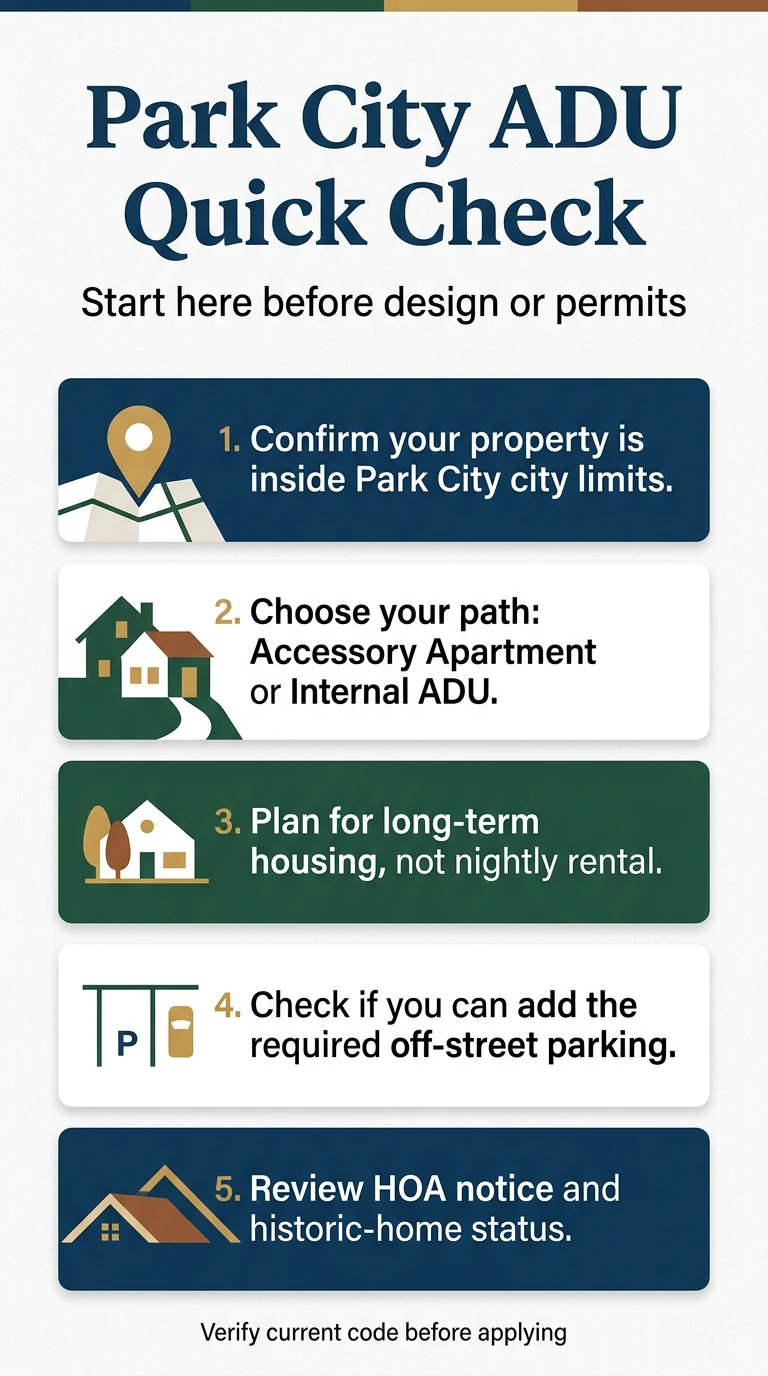
If you're in a rush, here are the three things to confirm first:
1. Is your property actually inside Park City city limits? (A Park City mailing address doesn't guarantee it.)
2. Are you going the Internal ADU route (within your existing home) or the Accessory Apartment route (addition, above-garage, or detached)?
3. Are you planning for long-term rental or family use — not nightly rental?
If the answer to all three is yes, you're very likely eligible. The rest of this guide walks you through the details.
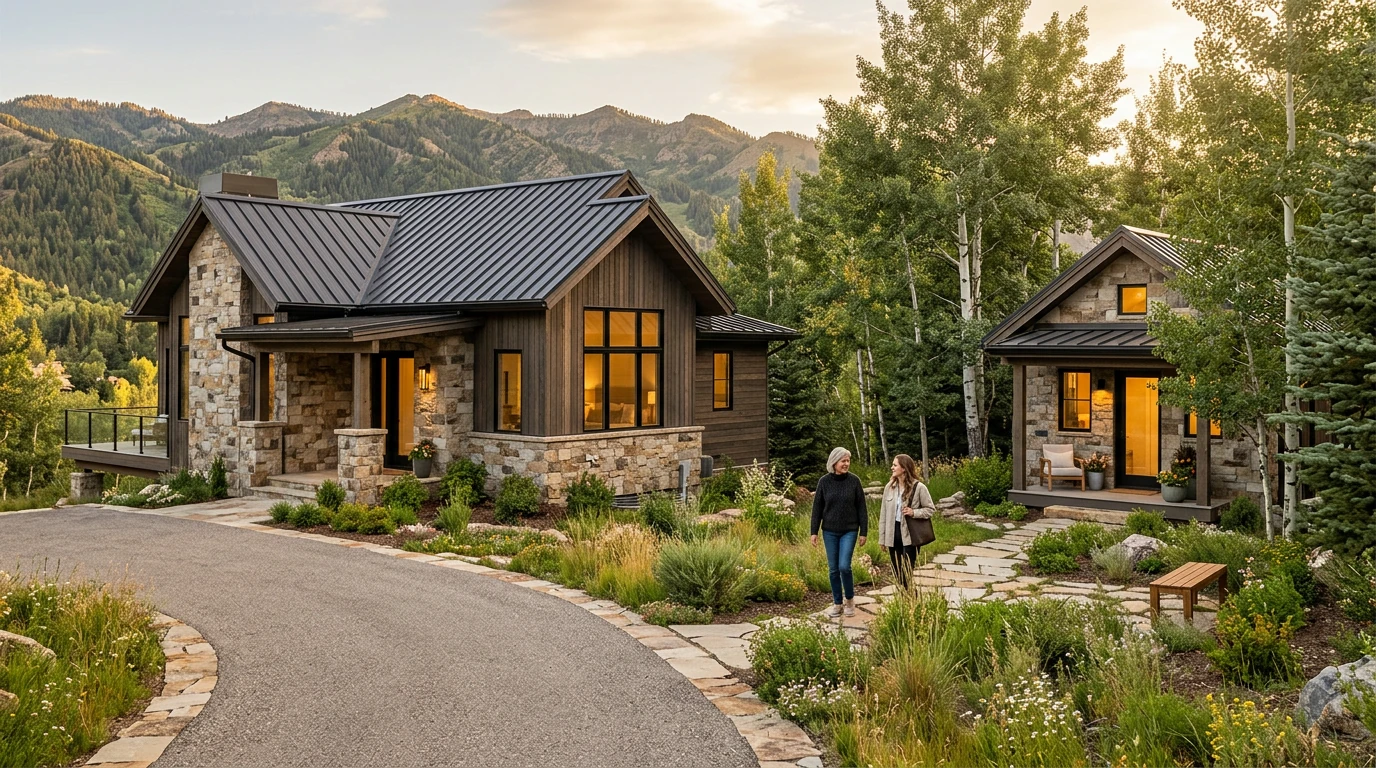
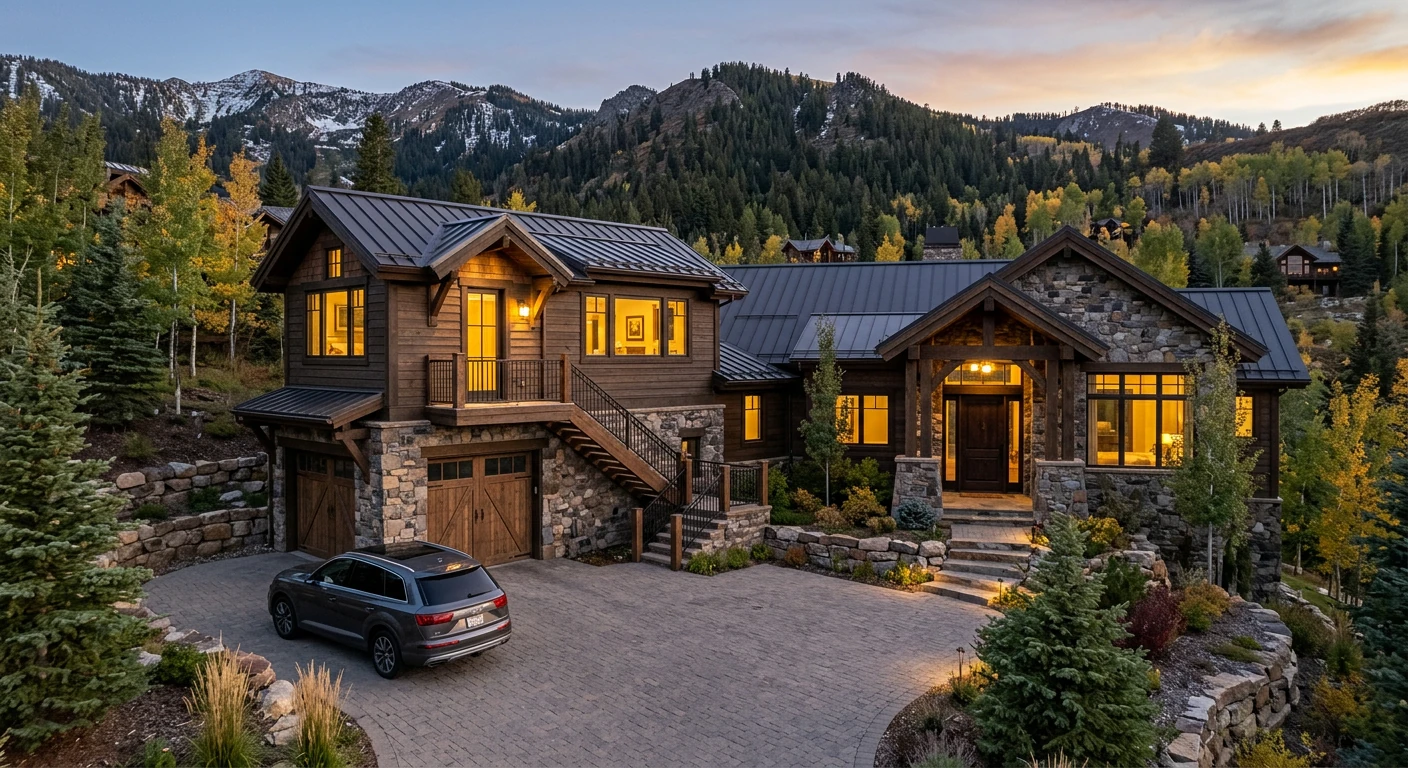
A Park City-area home with a detached accessory unit — one of the most common ADU configurations for qualifying lots.
Is Your Property Actually Inside Park City City Limits?
This sounds like an obvious question. It's not.
A Park City mailing address does not always mean your property falls under Park City's municipal code. Parts of the Snyderville Basin, Kimball Junction, Jeremy Ranch, Pinebrook, Summit Park, and other Summit County communities use a Park City ZIP code but are governed by Summit County — which has its own, different ADU regulations.
This matters because if you read this entire guide and then discover you're actually in unincorporated Summit County, you've been reading the wrong rules.
⚠ Jurisdiction Warning
Communities with Park City mailing addresses that may be under Summit County jurisdiction (not Park City): Snyderville Basin, Kimball Junction, Jeremy Ranch, Pinebrook, Summit Park. Check before you read further.
How to check: Park City's own planning page directs applicants to confirm jurisdiction before starting. Use the Summit County Parcel Viewer or the Park City Interactive Zoning Map to look up your property. If your property shows a Park City zone designation (HR-1, HR-2, HRL, HRM, HRC, R-1, RD, RE, CT, or similar), you're in Park City. If it shows a Summit County zone, you're governed by Summit County code. (Source: Park City Planning Department)
If you're outside Park City city limits: The rules are different, and this guide won't apply to your project. Summit County has its own ADU regulations, its own fee structure, and its own permitting process.
What's the Difference Between a Park City Accessory Apartment and an Internal ADU?
This is the single most important distinction on this page — and the one that confuses the most people.
Park City doesn't have one ADU rulebook. It has two completely separate code sections, each with different requirements for size, lot, parking, rental terms, and approval. The terminology trips people up because most of Utah uses "ADU" as a catch-all, while Park City draws a sharp line between Accessory Apartments and Internal Accessory Dwelling Units.
The 30-Second Answer
An Accessory Apartment(LMC 15-4-7) is a self-contained unit with its own kitchen, bathroom, and sleeping area, created by adding onto or within a detached single-family home or detached garage. This is also the path for fully detached backyard units on qualifying lots.
An Internal ADU(LMC 15-4-7.1 / Utah Code §10-21-303, formerly §10-9a-530) is a separate unit built entirely within the existing footprint of a single-family home. Think basement conversion. This path was mandated by state law (HB 82, effective October 2021) and has its own set of rules that preempt some local restrictions.
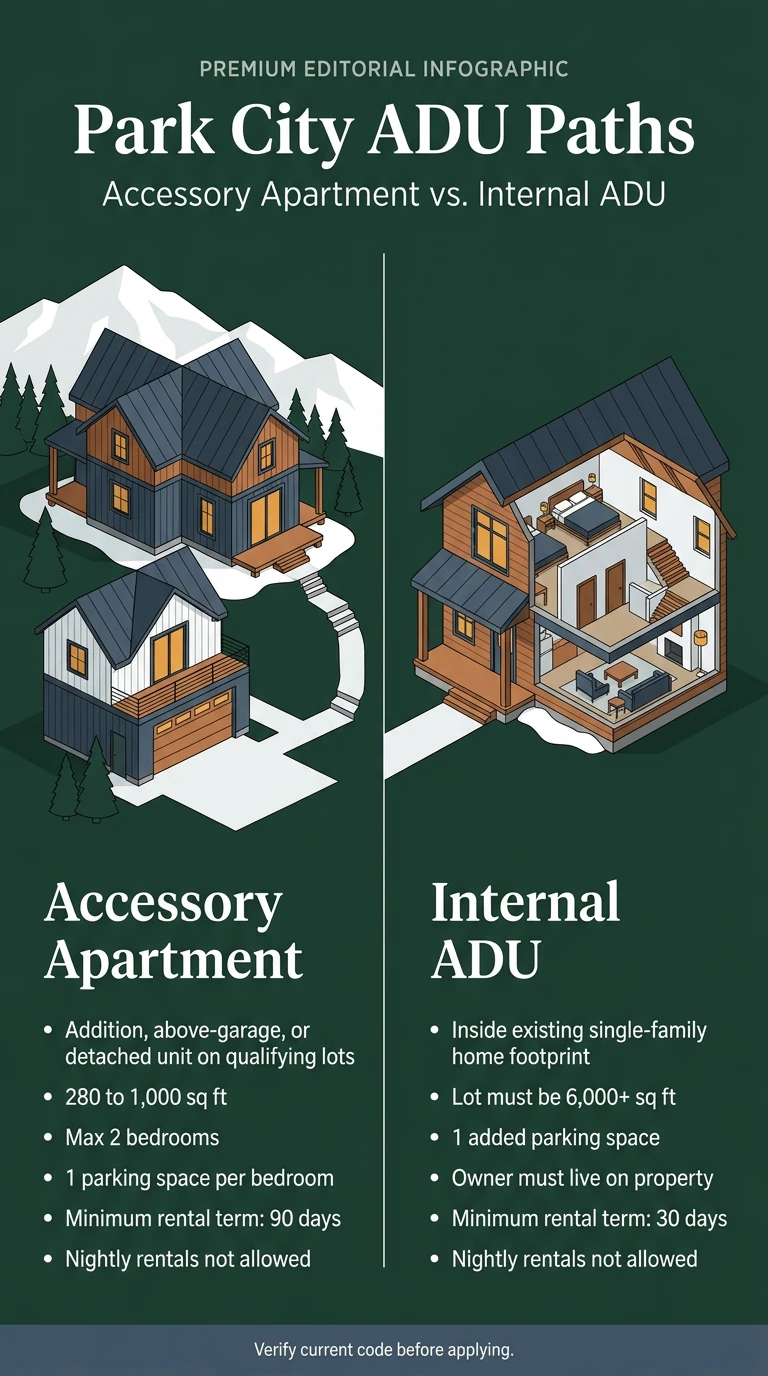
Accessory Apartment vs. Internal ADU — the two official code paths in Park City's Land Management Code.
Side-by-Side Comparison
Rule
Accessory Apartment (LMC 15-4-7)
Internal ADU (LMC 15-4-7.1)
Where the unit can go
Within or added to a home or garage; detached on qualifying lots
Within the existing footprint of a single-family home only
Detached / backyard unit?
Yes — lots 3,750+ sq ft
No
Above-garage?
Yes
No (unless within existing footprint)
Minimum lot size
Varies by zone; 3,750+ sq ft for detached
6,000 sq ft
Size limits
280–1,000 sq ft; cannot exceed 1/3 of main home
No maximum; must fit within existing footprint
Max bedrooms
2
Not specified; limited by footprint and code
Owner occupancy required?
Not in current code text
Yes — owner must live on property
Minimum rental term
90 days
30 days
Nightly / short-term rental
No
No
Parking
1 space per bedroom (in addition to existing)
1 additional off-street space
Units per lot
Maximum 1 Accessory Apartment
Maximum 1 Internal ADU; deed restriction states only one unit may be rented
Approval process
Administrative Permit (staff review)
Administrative Permit; Administrative CUP for Historic Sites Inventory homes
Deed restriction required?
Yes
Yes
Can be sold separately?
No
No
Height cap (detached)
18 feet from existing grade
N/A
Why Older Park City Pages Still Show Different Rules
If you've been researching Park City ADUs for a while, you may have seen different numbers on the city's own website. That's because some older pages — including the Engage Park City FAQ from the accessory apartment survey — still reflect earlier standards that have since been updated in the live code.
Topic
Older Guidance You May Still See
Current Code
Minimum size (Accessory Apt)
400 sq ft minimum
280 sq ft minimum (LMC 15-4-7, A.1)
Owner occupancy (Accessory Apt)
Required — owner must live on site
Not stated as a requirement in current LMC 15-4-7
Minimum rental term (Accessory Apt)
30-day minimum
90-day minimum (LMC 15-4-7, A.6)
Detached units
Not clearly addressed
Explicitly allowed on lots 3,750+ sq ft (LMC 15-4-7, A.8)
Planning review fee
$330 (older application PDF)
$760 Administrative Staff Review (current fee schedule, effective Oct 2025)
This is exactly why we built this page. The code evolves, but cached web pages don't. If you're making decisions based on the Engage Park City survey FAQ or an older application PDF, you could be working from outdated rules. Everything on this page is verified against the current Land Management Code as of our last verification date at the top.
Which Park City ADU Path Fits Your Property?
Now that you understand the two tracks, here's how to figure out which one applies to you.
Run through these 5 checks before spending a dollar on design or permits.
Choose Internal ADU if:
→ You want to convert an existing basement, attic, or portion of your home into a separate unit
→ Your lot is at least 6,000 sq ft
→ You (the owner) plan to live on the property
→ You're comfortable with a 30-day minimum rental term
→ You want the simplest approval path (staff-level review in most cases)
Choose Accessory Apartment if:
→ You want to build an addition onto your home or garage
→ You want to build above your garage
→ You want a fully detached backyard unit (lot must be 3,750+ sq ft)
→ You want a unit between 280 and 1,000 sq ft with up to 2 bedrooms
→ You're comfortable with a 90-day minimum rental term
Do not pursue either if:
• Your real goal is nightly rental income (Airbnb, Vrbo). Neither path allows it.
• You haven't confirmed your property is inside Park City city limits.
• You're planning to sell the unit separately from the main home. ADUs cannot be subdivided in Park City.
Be extra careful if:
• You're in an HOA — Accessory Apartment applications require proof of notice to your HOA (LMC 15-4-7, A.7). For Internal ADUs, Utah law generally prevents HOA rules from prohibiting construction of a compliant internal ADU (Utah Code §57-8a-218) and prevents the association from restricting or prohibiting its rental (Utah Code §57-8a-209) — but verify your CC&Rs and get this conversation started early.
• Your home is on the Park City Historic Sites Inventory — Internal ADUs on Significant or Landmark homes require an Administrative Conditional Use Permit instead of simple staff approval.
• Your lot has significant slope, limited utility access, or tight setbacks — these are the physical factors that can kill a project regardless of zoning eligibility.
What Are the Current Park City ADU Rules That Actually Decide Your Project?
This section covers the specific regulations that will shape what you can build, where, and how. Organized by the questions that come up most often in real conversations with Park City homeowners.
Lot Size and Unit Size Limits
Accessory Apartments: The unit must be between 280 and 1,000 square feet and cannot exceed one-third of the main home's total floor area (excluding the garage). It also cannot increase the structure's total floor area beyond the maximum allowed by your zone. For detached Accessory Apartments, the lot must be at least 3,750 square feet. Only one Accessory Apartment is allowed per lot. (LMC 15-4-7, Sections A.1, A.3, A.8)
Internal ADUs: The lot must be at least 6,000 square feet. There is no state-mandated maximum size for the unit itself, but it must fit entirely within the existing footprint of the home. In practice, this usually means a basement or a portion of a larger floor plan. (LMC 15-4-7.1 / Utah Code §10-21-303, formerly §10-9a-530)
What this means for you: If you have a 2,400 sq ft home, your Accessory Apartment can be a maximum of 800 sq ft (one-third of 2,400). If you have a large home with a full unfinished basement, your Internal ADU could potentially be larger — but it has to stay within those existing walls.
Detached and Above-Garage Rules
Above-garage builds are among the most efficient ADU configurations in Park City — they use existing footprint and complement the home's architecture.
Want a standalone backyard cottage or an apartment above your garage? That falls under the Accessory Apartment path.
Detached Accessory Apartments are allowed on lots 3,750 square feet or larger. They must comply with zoning district setbacks for single-family dwellings and cannot exceed 18 feet in height from existing grade. The unit still has to comply with the 280–1,000 sq ft and one-third-of-main-home size limits. (LMC 15-4-7, Section A.8)
Above-garage units are one of the more common ADU configurations in Park City. They make efficient use of existing footprint, often don't require additional land, and can be designed to complement the main home's architecture. The same Accessory Apartment rules apply.
Bedrooms and Parking
Parking is one of the most common project-killers in Park City, especially on smaller lots or in Old Town where driveways are short and street parking is limited.
Accessory Apartments: One parking space per bedroom, in addition to the existing requirement for the main home. Parking must be in approved garages or on paved driveways. Tandem parking (one car behind another) is allowed if your driveway from property line to garage is at least 25 feet — or with an Administrative Permit in historic zoning districts, subject to specific findings by the Planning Department. (LMC 15-4-7, Section A.2)
Internal ADUs: One additional off-street parking space, regardless of bedroom count. Tandem parking is also available under similar conditions. (LMC 15-4-7.1)
On-street parking does not count toward your ADU parking requirement. This catches a lot of people off guard.
Do You Have to Live on the Property?
This is one of the areas where the two paths diverge significantly — and where outdated information causes the most confusion.
Internal ADUs: Yes. Owner occupancy is required. You must live in either the main home or the Internal ADU. The deed restriction further specifies that only one of the two units may be rented — the owner must occupy the other. (LMC 15-4-7.1)
Accessory Apartments: The current live code text in LMC 15-4-7 does not impose the same owner-occupancy requirement. However, older Park City FAQ content and the Engage Park City survey page still reference owner occupancy as a requirement for Accessory Apartments. If you're pursuing an Accessory Apartment, confirm the current standard with the Planning Department during your application — regulations can evolve between our verification dates.
Can You Rent It on Airbnb or Vrbo?
No. This is clear-cut.
Accessory Apartments require a minimum 90-day rental term. A deed restriction is recorded with Summit County explicitly stating the 90-day minimum. The city can review compliance, and the permit can be revoked for non-compliance. (LMC 15-4-7, Sections A.5 and A.6)
Internal ADUs require a minimum 30-day rental term under Utah state law. (Utah Code §10-21-303, formerly §10-9a-530)
Neither path allows nightly, weekly, or vacation rentals.
2026 Utah detached ADU law update (SB 284)
Utah SB 284 created Utah Code §10-21-304, effective October 1, 2026. In a "specified municipality," cities must allow one detached ADU on lots or parcels of 11,000 square feet or larger where a single-family home is allowed, and cities may allow detached ADUs on smaller lots. Cities may still regulate size, height, setbacks, lot coverage, design compatibility, utility capacity, owner-occupancy, front-yard placement, short-term rental use under 90 days, and whether more than one ADU is allowed. Local permits and building, fire, utility, and health-code review still apply. Because this statewide rule interacts with local zoning, confirm the current Park City ordinance and permit checklist before designing around a detached ADU.
But here's why this isn't the deal-breaker it sounds like.
Park City has one of the most extreme workforce housing shortages in Utah. The city is the only municipality in the state where jobs outnumber the population — roughly 11,000 jobs for a residential population of about 8,500. Over 85% of the workforce commutes in from outside Park City. More than 8,000 workers commute from outside Summit County each day. (Source: Park City Housing Needs Assessment, 2021)
Long-term rental demand is not just strong — it's severe. Park City's 2021 housing assessment reported 99% occupancy of affordable housing units. A well-positioned ADU providing long-term housing faces very strong demand in this market.
Compare the management reality: no turnover cleaning costs, no furnishing investment, no platform fees, no seasonal vacancy gaps, no property management overhead. A long-term tenant at $2,000/month (a reasonable Park City range depending on size and location) produces consistent income with minimal management headaches. The 90-day and 30-day minimums don't limit your income potential. They simplify your life.
What Deed Restrictions and Ongoing Obligations Come With Approval?
When your ADU is approved, a deed restriction — called a "Notice to Purchaser" — is recorded with the Summit County Recorder. This restriction runs with the property, meaning it stays even if you sell. It states that the ADU exists, its permitted use, and the rental term restrictions. (LMC 15-4-7, Section A.5; LMC 15-4-7.1)
For Internal ADUs, the deed restriction specifically states that only one unit on the property may be rented, and the owner must occupy the other.
For Accessory Apartments, the permit can be revoked for non-compliance with the conditions of approval (LMC 15-4-7, Section B.1). We recommend keeping records of your lease terms in case the city requests documentation. These requirements sound onerous, but they're actually straightforward once you know about them. The key is knowing about them before you build — not finding out after.
What If You're in an HOA?
If your property is governed by an HOA, the Accessory Apartment application requires that you provide notice to the HOA before submitting your application. You'll also need to submit proof of that notice — either a properly executed notice form or a signed return receipt from a certified letter. (LMC 15-4-7, Section A.7)
For Internal ADUs, Utah law provides two layers of protection. First, HOA rules generally may not prohibit the construction of a compliant internal ADU (Utah Code §57-8a-218). Second, the association may not restrict or prohibit the rental of a compliant internal ADU (Utah Code §57-8a-209). These protections apply regardless of when the association was created.
That said, HOAs may still have architectural review processes that affect design and timeline. Get this conversation started early — an HOA dispute mid-process can add months.
What If Your Home Is Historic or in a Historic District?
Many of Park City's most desirable properties — Old Town, the historic Main Street corridor — sit within historic zones (HR-1, HR-2, HRL, HRM, HRC). Park City also maintains a Historic Sites Inventory that designates individual properties as Significant or Landmark.
If your home is in a historic zone, your ADU design must comply with Chapter 15-13 Design Guidelines for Historic Districts and Sites. This means architectural compatibility, entrance placement (not visible from the right-of-way), materials, roof pitch, and facade treatment all face additional scrutiny. (LMC Chapter 15-13)
If your home is specifically designated Significant or Landmark on the Historic Sites Inventory, Internal ADUs require an Administrative Conditional Use Permit — which means Planning Commission review rather than simple staff approval. (LMC 15-4-7.1) This adds time and complexity, but it's absolutely still doable. Many properties in Park City's historic districts have successfully navigated this process. The key: hire an architect or designer who has completed projects in Park City's historic zones before.
Can You Legalize an Existing Unpermitted Unit?
This is one of the most common questions we hear, and the answer is nuanced.
Park City's code includes provisions for existing non-conforming Accessory Apartments — units that were constructed before the current standards were adopted or that don't fully comply with current requirements. If you have an existing basement apartment or garage conversion that was never formally permitted, it may be possible to bring it into compliance and obtain legal status. (LMC 15-4-7, Section C)
The process typically involves applying for the appropriate permit, demonstrating that the unit meets (or can be brought up to) current building, fire, and safety codes, recording the required deed restriction, and satisfying any outstanding planning requirements. The Planning Director reviews these requests and can approve them if certain findings are met — including that impacts can be mitigated and the unit has no more than two bedrooms.
This is actually one of the highest-value moves a Park City homeowner can make. An unpermitted unit is a liability — it can complicate a sale, create insurance issues, and expose you to code enforcement. A properly permitted ADU is an asset that adds real, documentable value to your property. If you think you have an existing unit that needs to be legalized, start with a feasibility conversation rather than a permit application.
How Do Park City ADU Permits and Approvals Actually Work?
Most guides either skip the permit process entirely or dump you into raw code language. Here's how the process actually flows, from first conversation to move-in.
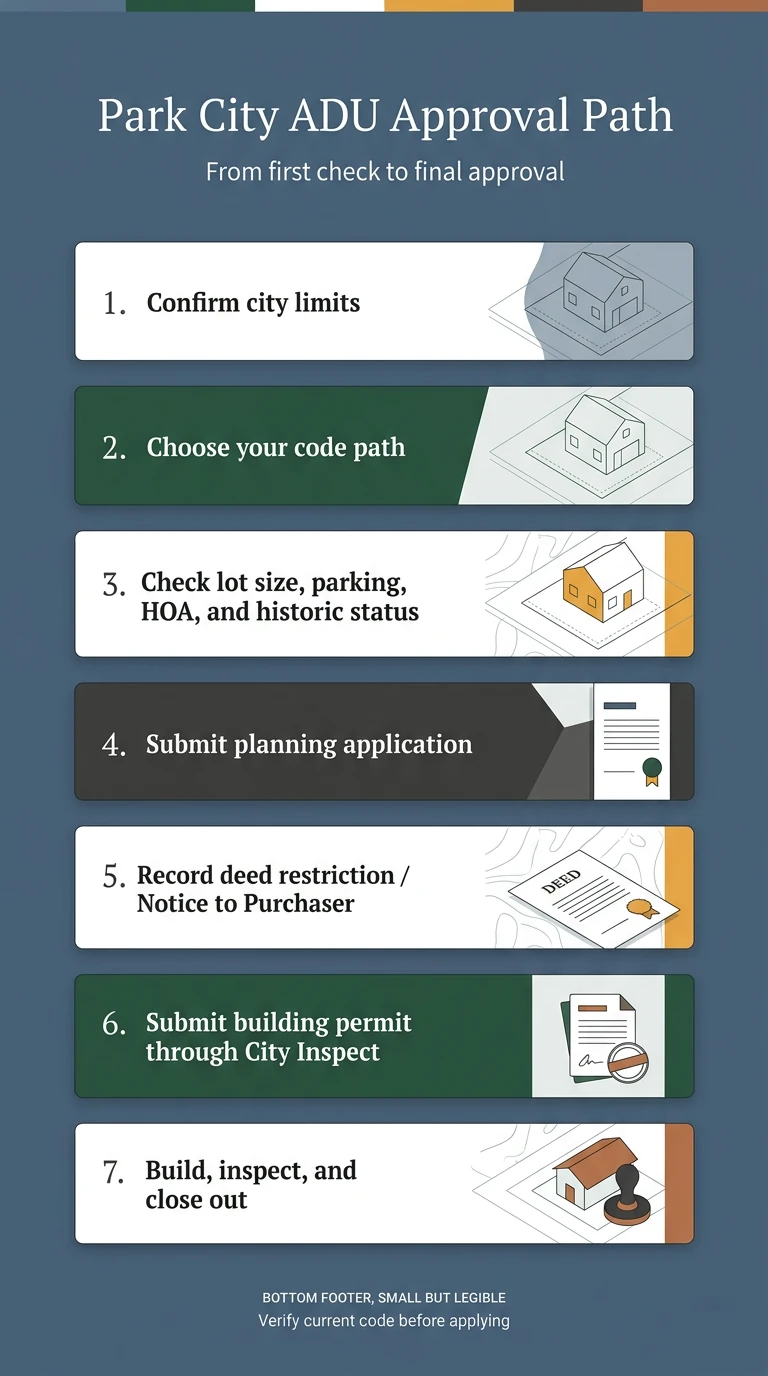
The full Park City ADU approval sequence — from first check to final approval.
1
Confirm Jurisdiction and Zoning
Before anything else, verify that your property is inside Park City city limits (see the jurisdiction section above) and identify your zoning district. Your zone determines what's allowed, what setbacks apply, and whether additional reviews are triggered. Park City's Interactive Zoning Map is your starting point. Look up your parcel and note the zone designation.
2
Choose Your Code Path
Based on your project — basement conversion, addition, above-garage, detached — determine whether you're pursuing an Internal ADU (within existing footprint) or an Accessory Apartment (addition, detached, or above-garage). If you're not sure, this is a great time to talk to someone who has navigated the process. A wrong assumption at this stage cascades into every step that follows.
3
Prepare Your Planning Application
Park City's Planning Department accepts complete applications by email or in person. (Source: Park City Planning Applications page) For Accessory Apartments, the application requires:
• Completed application form
• Written statement describing the proposed unit
• Floor plan showing the ADU layout
• Architectural elevations
• Site plan showing the unit's location on the property, setbacks, and parking
• Draft deed restriction (Notice to Purchaser)
• HOA notice documentation, if applicable
• Mailing list for property owners within 100 feet of your property
For Internal ADUs, the planning submittal is typically simpler — floor plans, site plan, and documentation of lot size and ownership. Historic Sites Inventory properties will need additional materials for the Conditional Use review.
Current planning review fee: $760 for Administrative Staff Review (per Park City's planning fee schedule effective October 2025). Note: the older application PDF still shows $330 — that figure is outdated. Always verify the current fee when you file.
4
Record the Deed Restriction
Before or during approval, you'll need to prepare and record the deed restriction with the Summit County Recorder. This is a legal document that states the ADU's permitted use, rental restrictions, and the conditions of approval. It stays with the property permanently. (LMC 15-4-7, Section A.5; LMC 15-4-7.1)
5
Building Permit and Plan Review
A planning approval tells you what you're allowed to build. A building permit tells you how to build it safely. These are separate processes, and you need both.
Building permit applications are submitted through City Inspect, Park City's online portal. For new structures or substantial additions, the minimum submittal requirements include:
• Scaled construction plans
• Site survey
• Landscape plan
• Fire sprinkler plans (if applicable)
• Sewer district receipt
• Fire district clearance letter
• Energy code documentation
• Geotechnical report (for new structures, especially on slopes)
• HOA notification (if applicable)
• Valuation support documentation
Building permit fees: Calculated at 0.61% of total project valuation for single-family residential work, plus a 1% state surcharge. Plan check deposit is typically $500. (Source: Park City Building Department)
6
Construction, Inspections, and Final Approval
Once your building permit is issued, construction begins. You'll go through a series of inspections at key milestones (foundation, framing, rough-in, insulation, final) as required by building code. After passing final inspection, your ADU is approved for occupancy.
Common stall points in Park City:
• Utility capacity issues, especially drain grade and slope — Park City's own documentation flags this as a "major up-front issue"
• Historic district design revisions — the Planning Department may request changes for compatibility
• Fire access requirements, which can add review comments and design changes
• Geotechnical surprises on steep lots
• HOA disputes that weren't addressed early
Every one of these is manageable with proper planning. None of them should be discovered mid-construction.
What Documents Do You Need for a Park City ADU Application?
We get asked for this checklist constantly, so here it is in one place. Bookmark this section.
Planning Side (land-use approval)
☐Completed planning application (Accessory Apartment or Internal ADU)
☐Written statement describing the proposed unit
☐Floor plan of the proposed ADU
☐Architectural elevations
☐Site plan showing location on property, setbacks, parking
☐Draft deed restriction (Notice to Purchaser)
☐HOA notice documentation, if applicable
☐Mailing list of property owners within 100 feet
☐Application fee ($760 Administrative Staff Review — verify current fee at filing)
Building Side (construction permit)
☐Scaled construction drawings
☐Site survey
☐Landscape plan
☐Fire sprinkler plans (if required)
☐Sewer district receipt
☐Fire district clearance letter
☐Energy code documentation
☐Geotechnical report (new structures, sloped sites)
☐HOA notification (if applicable)
☐Valuation documentation
☐Plan check deposit ($500)
☐Building permit fee (0.61% of valuation + 1% state surcharge)
Pro tip: Most delays happen because applications are incomplete on first submission. Get everything gathered before you file. If you'd like help assembling your application package, that's part of what we do.
How Much Does a Park City ADU Cost?
Let's talk real numbers. Park City construction costs run meaningfully higher than the Wasatch Front — driven by mountain building codes (snow loads, seismic requirements), limited contractor availability, material transport costs, steep lots, and the design standards required in many Park City zones.
The following cost ranges are Utah ADU Builders estimates based on our local Park City project data. Your actual costs will depend on site conditions, finish level, and project scope.
Cost by ADU Type
ADU Type
Typical Total Cost (Park City)
Estimated Cost Per Sq Ft
Typical Timeline
Internal / Basement Conversion
$50,000 – $150,000
$100 – $250/sq ft
3–6 months
Attached Addition
$150,000 – $300,000
$200 – $400/sq ft
6–10 months
Above-Garage Build
$175,000 – $350,000
$250 – $450/sq ft
6–12 months
Detached New Construction
$200,000 – $400,000+
$250 – $500+/sq ft
8–14 months
These ranges include design, permitting, and construction. They do not include furniture, landscaping beyond code requirements, or ongoing maintenance.
Park City Soft Costs and Fees
Soft Cost
Typical Range
Architectural / design plans
$5,000 – $15,000
Structural engineering
$3,000 – $8,000
Planning application fee
$760 (current Admin Staff Review — verify at filing)
Building permit fee
0.61% of total valuation + 1% state surcharge
Plan check deposit
$500
Impact fees
Vary by jurisdiction — confirm with Park City
Utility connections (sewer/water)
Varies significantly by site
Geotechnical report
$3,000 – $6,000
Survey
$1,500 – $4,000
Hidden Park City Cost Drivers
These are the line items that blow budgets when they're not anticipated:
Slope and retaining
Much of Park City is built on hillsides. If your lot requires retaining walls, engineered foundations, or significant grading, expect a meaningful increase to your base construction cost.
Snow load and structural requirements
Park City's snow load requirements are among the highest in Utah. This means heavier roof framing, engineered trusses, and potentially deeper foundations — especially for detached structures. Park City's 40-inch frost-depth criterion
Geotechnical surprises
A geotech report is required for new structures and may reveal soil conditions, bedrock, or water table issues that increase foundation costs.
Fire sprinkler requirements
Depending on your structure type and location, Park City may require fire sprinklers. This can add meaningfully to your budget.
Historic district design compliance
If you're in a historic zone, the design review process may require materials, finishes, or architectural details that cost more than standard construction.
Utility distance and capacity
If your ADU site is far from existing utility connections, or if your existing sewer/water service requires upgrading, these costs can escalate quickly. Drain grade and slope is flagged by Park City itself as a "major up-front issue."
What About the Return?
The following rental income and property value figures are Utah ADU Builders estimates based on local market conditions. They are not guaranteed outcomes.
Long-term rental income in Park City: Park City ADUs typically rent in the range of $1,500 to $3,000+ per month depending on size, location, and finish level. Park City's long-term rental market has very strong demand due to the workforce housing shortage — the city's 2021 housing assessment reported 99% occupancy of affordable units.
Property value impact: A well-built, permitted ADU can add meaningful value to a Park City property. The exact amount depends on size, quality, and comparable sales in your area — but it's real equity you capture at completion.
Simple Example From Our Project Data
Build cost (above-garage, 600 sq ft)
$200,000
Monthly rent
$2,200
Annual gross rent
$26,400
Simple payback
~7–8 years
Property equity added
At completion
After the payback period, the rental income is essentially profit — minus maintenance, insurance, and property tax on the incremental value. The math gets even more compelling when you consider that long-term rental in Park City serves a deep, structural need. You're housing a ski instructor, a restaurant manager, or a hospital worker who needs to live close to work and has very few alternatives.
How Do Most Park City Homeowners Finance an ADU?
The good news: Park City's high property values mean most homeowners have significant equity to work with. Here are the most common financing paths we see.
Home Equity Loan or HELOC
This is the most popular option. You borrow against the equity in your primary home at relatively low interest rates. Many Park City homeowners have enough equity to cover the full ADU build cost without touching their primary mortgage.
Cash-Out Refinance
If your current mortgage rate is favorable, this may not make sense. But if you're due for a refinance anyway, rolling ADU construction costs into a new mortgage can simplify payments and potentially offer better terms than a standalone construction loan.
Construction-to-Permanent Loan
These loans cover the build phase with interest-only payments during construction, then convert to a standard mortgage once the project is complete. Some Utah credit unions and community banks offer ADU-specific versions of this product.
Cash
Straightforward if you have it. No interest, no loan overhead, fastest path to positive cash flow from rental income.
What lenders typically want to see: Approved plans, a licensed contractor or documented owner-builder path, and — ideally — a realistic rental income projection. Having your feasibility assessment and builder estimate in hand before you approach a lender puts you in a stronger position.
One important note: an ADU built on your property is part of your property. This means the financing is secured by your home, the ADU can increase your home's appraised value, and the rental income can be factored into your financial picture. It's a self-reinforcing asset.
Submit planning application, staff review, revisions if needed
Building permit & plan review
4–8 weeks
Submit construction docs through City Inspect, plan check, permit issuance
Construction
3–10 months
Depends on scope: basement conversion (shorter) vs. detached new build (longer)
Inspections & closeout
2–4 weeks
Final inspections, certificate of occupancy, deed restriction recording
Fastest realistic path
5–7 months
Simple Internal ADU / basement conversion
Typical path
9–14 months
Accessory Apartment, above-garage or detached
Timeline estimates are based on Utah ADU Builders project experience.
What slows things down in Park City:
• Incomplete applications (the #1 delay — get your documents right the first time)
• Historic district design review (additional revision cycles)
• Geotechnical issues discovered during excavation
• Utility capacity problems (especially sewer)
• Winter weather shutdowns for exterior construction
• Contractor scheduling (Park City's builder pool is smaller than the Wasatch Front)
None of these are reasons not to build. They're reasons to start the planning process now if you want to be collecting rent by next year.
What Mistakes Get Park City ADU Projects Delayed, Denied, or Overpriced?
We see the same errors repeatedly. Here are the ones that actually matter, and how to avoid each one.
1
Assuming a Park City mailing address means Park City rules
Homeowners in Snyderville Basin, Jeremy Ranch, Pinebrook, and Summit Park often start with Park City's rules only to discover they're in unincorporated Summit County.
How to avoid it: Look up your parcel before you read anything else on this page.
2
Using outdated Park City information
The Engage Park City accessory apartment survey, older application PDFs, and cached web pages still show previous standards — 400 sq ft minimum, 30-day rental term, $330 fee. The live code has moved on.
How to avoid it: Use this guide (verified against current code) and confirm details with the Planning Department at the time of your application.
3
Confusing Accessory Apartment and Internal ADU
These are different code paths with different rules. Filing under the wrong one wastes time and money.
How to avoid it: Use the comparison table above to identify your path before you start design.
4
Planning for short-term rental income
Neither ADU type allows nightly rental. If your financial model depends on Airbnb rates, it won't work.
How to avoid it: Build your pro forma around long-term rental income. The demand is there — Park City's workforce housing shortage is severe and structural.
5
Underestimating parking requirements
Accessory Apartments need one space per bedroom. If your lot can't accommodate additional parking beyond what's already required for the main home, the project may not be feasible.
How to avoid it: Map your parking early, including driveway length (25 feet minimum for tandem).
6
Skipping HOA notice
The Accessory Apartment application requires proof of notice to your HOA before you even submit. Starting the process without this can stall your application at step one.
How to avoid it: Review your CC&Rs and provide notice to your HOA before you file the planning application.
7
Underestimating Park City construction costs
Generic Utah ADU cost guides don't reflect Park City's market. If you budget based on Wasatch Front numbers, you'll likely be short.
How to avoid it: Use the cost ranges in this guide and get a site-specific estimate from a builder who works in Park City.
8
Skipping the drain grade and slope assessment
Park City's own documentation calls this a "major up-front issue." If your property's drain grade doesn't work for the proposed ADU location, you could face significant additional site work.
How to avoid it: Get utilities assessed early, before you invest in full architectural plans.
9
Starting design before confirming your code path and parcel eligibility
We've seen homeowners invest thousands in architectural plans for a project that wasn't permittable on their lot.
How to avoid it: Start with a feasibility check, not an architect. We do this for free.
Is a Park City ADU Worth It?
We've given you the rules, the costs, the process, and the pitfalls. Here's the honest assessment of whether this project makes sense for different goals.
If Your Goal Is Long-Term Rental Income
Park City is one of the strongest long-term rental markets in Utah. The workforce housing shortage is severe and structural — it's not going to resolve anytime soon. The city itself has committed to building 800+ affordable housing units but acknowledges the need for over 1,100 additional units. Every ADU that enters the long-term rental market helps address this shortage. (Source: Park City Housing Needs Assessment, 2021; 2025 Moderate Income Housing Plan Update)
Park City's 2025 housing update reports that the median three-person workforce household in Summit County earns roughly $85,600 — just 56% of the area median income. Most Park City workers cannot afford to live in the town where they work. Your ADU doesn't just produce income for you. It makes the community function.
If Your Goal Is Family Housing
An aging parent who needs to be close but wants their own space. An adult child who works in Park City and can't afford a $2 million home. A caregiver who needs to live on-site. These are some of the most common and most personally meaningful reasons to build.
Park City's ADU framework was designed with exactly this use case in mind. The unit stays part of your property. It's close enough for daily connection but separate enough for independence. And if circumstances change, the unit can transition to rental use under the permitted framework.
If Your Goal Is Long-Term Flexibility and Future Resale
A permitted, well-built ADU is a premium feature when it comes time to sell. Buyers in the Park City market — especially those looking for multi-generational living, rental income potential, or workforce housing solutions — actively seek properties with ADUs.
The deed restriction means the ADU transfers with the property under the same terms. This is actually a selling point: the buyer inherits a legal, permitted unit with an established regulatory framework.
When a Park City ADU Is Not the Right Move
We believe in this product. We also believe in honesty, because it's what makes our advice worth trusting.
Don't build a Park City ADU if:
• Your primary motivation is nightly rental income. The rules don't allow it.
• You can't solve the parking requirement. If your lot physically cannot accommodate the additional spaces, the project won't be approved regardless of everything else.
• You're unwilling to accept a deed restriction and long-term rental framework. These are non-negotiable conditions of approval.
• The jurisdiction question is unresolved. Building under the wrong municipality's rules is a costly mistake.
• Your lot has severe physical constraints (extreme slope, no utility access, flood zone) that make construction economically impractical.
For everyone else — and that's the majority of Park City single-family homeowners — an ADU is one of the highest-value improvements you can make to your property. It creates income, flexibility, and equity while contributing to a community that genuinely needs the housing.
What Should You Do Next?
You've read the guide. You understand the two code paths, the rules, the costs, the process, and the risks. Here's the action sequence that gives you the clearest path forward with the least wasted time and money.
1
Confirm your jurisdiction
Verify that your property is inside Park City city limits, not unincorporated Summit County.
2
Identify your code path
Based on your project type (basement conversion vs. addition vs. detached vs. above-garage), determine whether you're pursuing an Internal ADU or an Accessory Apartment.
3
Assess your lot's physical feasibility
Lot size, setbacks, parking capacity, utility access, slope, and — if applicable — historic status. This is where a professional eye saves you the most time.
4
Run a realistic cost scenario
Use the ranges in this guide as a starting point, then get a site-specific estimate that accounts for your lot's actual conditions.
5
Get a builder-led feasibility assessment
Before you hire an architect or file a planning application, have someone who has navigated Park City's ADU process evaluate your property. This single step catches problems early — before they become expensive problems.
What a free feasibility assessment covers:
✓Jurisdiction confirmation — we verify whether your property is in Park City or Summit County
✓Zoning and code path identification — which ADU track applies and what your zone allows
✓Historic status check — whether your property triggers additional design review
✓Realistic cost range — based on your specific project type, lot conditions, and finish expectations
✓Timeline estimate — how long your project will realistically take from application to occupancy
✓Obstacle flagging — anything that could slow down or stop the project, identified before you spend on design
If you decide to move forward, we can manage the entire process — planning, permits, construction, and final approval. If you decide it's not the right time, you'll walk away with clarity you didn't have before. Either way, the conversation costs you nothing and could save you thousands in misdirected design fees.
Ready to Find Out What's Possible on Your Property?
Get a free Park City ADU feasibility assessment. We'll confirm your jurisdiction, identify your code path, and give you a realistic picture of what you can build, what it will cost, and how long it will take.
Free. No obligation. No pressure.
Park City ADU: Frequently Asked Questions
Does Park City call it an ADU or an Accessory Apartment?▼
Both, depending on the type. "Accessory Apartment" (LMC 15-4-7) covers units added to homes, garages, or built as detached structures. "Internal Accessory Dwelling Unit" (LMC 15-4-7.1) refers specifically to units built within an existing home's footprint. Most people search for "ADU," but Park City's official code uses both terms.
Is every Park City address governed by Park City code?▼
No. Many properties with Park City mailing addresses are actually in unincorporated Summit County, which has different rules. Always verify your jurisdiction using a parcel lookup before relying on Park City's regulations.
Can I build a detached ADU in Park City?▼
Yes, through the Accessory Apartment path, on lots at least 3,750 square feet. Detached units must comply with zone setbacks for single-family dwellings and an 18-foot height limit from existing grade. (LMC 15-4-7, Section A.8)
What lot size do I need?▼
For a detached Accessory Apartment: 3,750+ sq ft. For an Internal ADU: 6,000+ sq ft. Attached Accessory Apartments follow zone-specific lot requirements.
How many ADUs can I have on one lot?▼
One. The code limits each lot to one Accessory Apartment (LMC 15-4-7, Section A.3) or one Internal ADU.
Do I have to live on the property?▼
For Internal ADUs: yes, owner occupancy is required, and only one unit may be rented. For Accessory Apartments: the current code text does not impose the same requirement, though older Park City guidance referenced it. Verify current standards when you apply.
Can I rent a Park City ADU on Airbnb or Vrbo?▼
No. Accessory Apartments require a 90-day minimum rental term. Internal ADUs require a 30-day minimum. Nightly and short-term rentals are prohibited for both.
How big can a Park City ADU be?▼
Accessory Apartments: 280 to 1,000 sq ft, and no more than one-third of the main home's floor area. Internal ADUs: no maximum size, but must fit within the existing home's footprint.
How many bedrooms can it have?▼
Accessory Apartments: maximum 2 bedrooms. Internal ADUs: not specified by current code, limited by existing footprint and code compliance.
How much parking do I need?▼
Accessory Apartments: one space per bedroom beyond the main home's requirement. Internal ADUs: one additional off-street space. On-street parking does not count.
Can parking be tandem?▼
Yes, under certain conditions. If your driveway is at least 25 feet from property line, tandem parking is allowed for Accessory Apartments. Historic zoning districts have an additional Administrative Permit path for tandem parking. (LMC 15-4-7, Section A.2)
What if I'm in an HOA?▼
The Accessory Apartment application requires proof of notice to your HOA. For Internal ADUs, Utah law generally prevents HOA rules from prohibiting construction or rental of a compliant unit (Utah Code §§57-8a-218, 57-8a-209). But check your CC&Rs and address this early.
What if my home is historic?▼
ADUs in historic zones must comply with Chapter 15-13 Design Guidelines. Internal ADUs on Significant or Landmark homes require an Administrative Conditional Use Permit. This adds review time but does not prevent the project.
Do I need a deed restriction?▼
Yes, for both types. A "Notice to Purchaser" is recorded with Summit County and runs with the property. (LMC 15-4-7, Section A.5; LMC 15-4-7.1)
What documents do I need for planning approval?▼
Application form, written statement, floor plan, elevations, site plan, draft deed restriction, HOA notice documentation (if applicable), and nearby-owner mailing list. See the full checklist above.
Do I need a building permit too?▼
Yes. The planning approval covers land use; the building permit covers construction. These are separate applications through separate city departments.
Can I legalize an existing basement or garage apartment?▼
Potentially. Park City's code has provisions for non-conforming Accessory Apartments (LMC 15-4-7, Section C). The process involves demonstrating compliance or mitigating impacts. Start with a feasibility conversation.
Can I build above a garage?▼
Yes, through the Accessory Apartment path. Above-garage units are a common configuration in Park City. Standard Accessory Apartment rules apply.
Where do I apply?▼
Park City's Planning Department accepts applications by email or in person. Building permits go through City Inspect. The planning review fee is currently $760 for Administrative Staff Review (verify at time of filing).
What if my property is outside Park City city limits but has a Park City mailing address?▼
You're likely governed by Summit County, not Park City. Different rules apply. Verify using a parcel lookup, or we'll confirm it during a free feasibility assessment.
Every rule, fee, and requirement cited on this page is sourced from the following official materials:
• Park City Land Management Code, Section 15-4-7 — Accessory Apartments
• Park City Land Management Code, Section 15-4-7.1 — Internal Accessory Dwelling Units
• Park City LMC Zone Chapters 15-2.1 through 15-2.13 — Zone-specific use tables and development standards
• Park City LMC Chapter 15-13 — Design Guidelines for Historic Districts and Sites
• Park City Planning Fee Schedule — Effective October 20, 2025
• Park City Building Permit FAQ and Submittal Requirements — Building Department
• Park City Planning Applications Page — Application submission procedures
• Utah Code Ann. §10-21-303 (formerly §10-9a-530) — State Internal ADU provisions
• Utah Code §10-21-304 — Detached ADUs (SB 284, effective October 1, 2026)
• Utah Code §§57-8a-218, 57-8a-209 — HOA restrictions on Internal ADU construction and rental
• Utah HB 82 (2021) — State preemption of certain local ADU restrictions
• Park City Housing Needs Assessment (2021) — Workforce, commuter, and housing data
• Park City 2025 Moderate Income Housing Plan Update — Current housing statistics and workforce wage data
Cost ranges, rental income estimates, and timeline projections are Utah ADU Builders estimates based on local project data unless otherwise attributed to an official source. This page was last verified against Park City's live code and fee schedules in March 2026. Regulations change. We monitor for updates and re-verify periodically, but always confirm current requirements with the Planning Department at the time of your application.
Researched and written by the Utah ADU Builders team. We help Park City and Utah homeowners navigate ADU feasibility, permitting, and construction — from first conversation to keys in the door.