Midvale Utah ADU Guide: How to Know If Your Lot Qualifies, What It Costs, and What to Do Next
Written by the Utah ADU Builders team · Last reviewed: March 2026 · Verified against Midvale Municipal Code Title 17, Utah Code §10-21-303, §11-36a-202, §57-8a, and HB 82
Disclosure: We connect homeowners with local ADU builder options. If you request an estimate through our site, we may receive a referral fee. Verify licensing, insurance, and references before hiring. This never affects the information in this guide.
Yes — many Midvale homeowners have a clear path to building an ADU. But the real answer starts with your zoning district and runs through a handful of make-or-break filters: detached single-family lot, owner occupancy, lot size over 6,000 square feet, parking, and rental rules. We built this guide to turn the city's actual code into a fast yes / maybe / no answer — so you can move forward with confidence instead of guessing.
Most ADU resources for Midvale either say "call the city" or link you to pages of raw legal code. We've done something different. We reviewed the Midvale Municipal Code, cross-referenced Utah state law (HB 82 and Utah Code §10-21-303), and translated it into plain English with original tables, checklists, and cost estimates you can actually use.
Below, we'll walk you through the key rules, help you figure out which type of ADU fits your property, give you realistic cost and timeline estimates, and cover the edge cases that trip people up — parking, rentals, HOAs, utilities, title notices, and more.
Can You Build an ADU in Midvale? Quick Lot Check
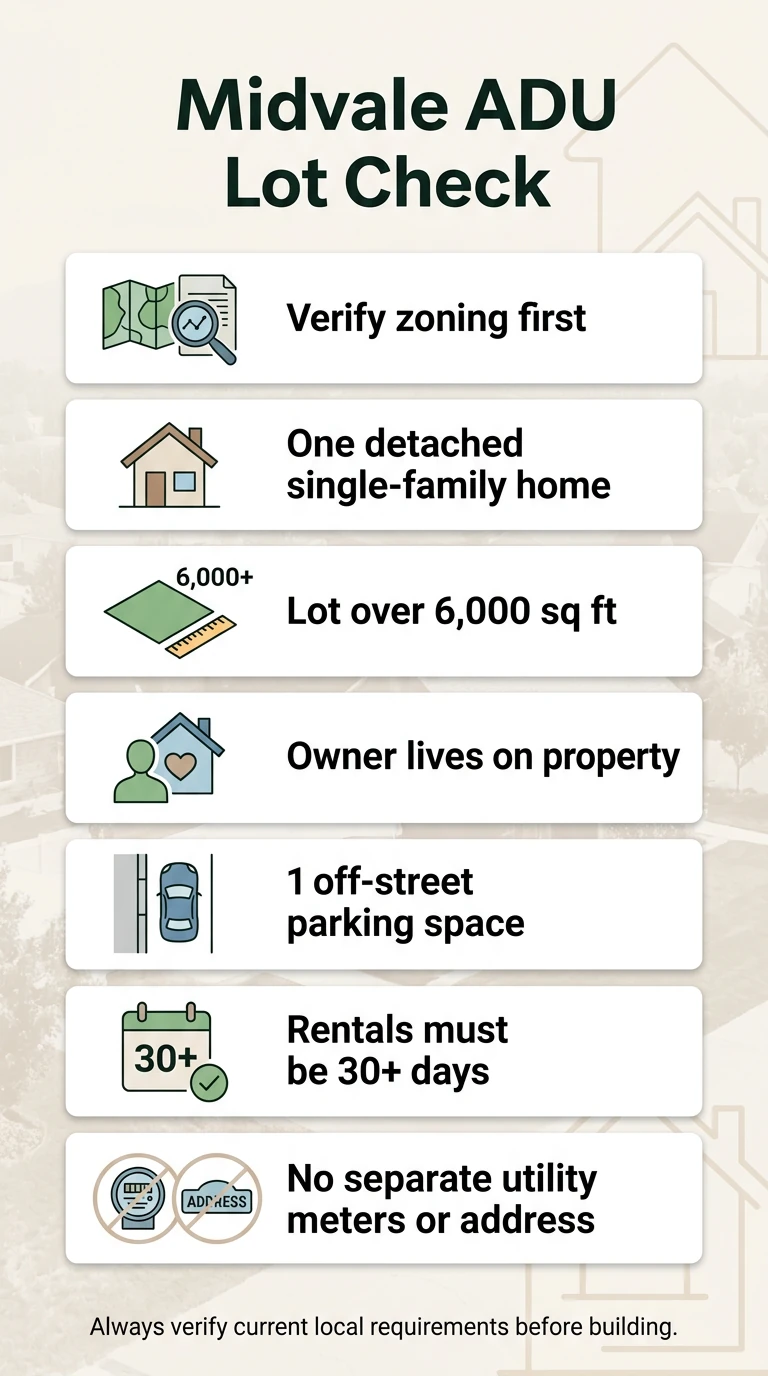
Run through these six filters. If you can check all six, you likely have a path:
☐
Zoning:Is your property in a residential zone that allows ADUs? Verify on the Midvale zoning map.
☐
Dwelling type:Does the lot have one detached single-family home?
☐
Lot size:Is the lot larger than 6,000 sq ft?
☐
Owner-occupied:Do you live on the property (or will you)?
☐
Parking:Can you provide one additional off-street parking space?
☐
Rental plan:Are you planning long-term rental only (30+ consecutive days)?
The 7 key filters every Midvale ADU must pass — check these before investing in plans
Also applies to every Midvale ADU: Building permit required · No separate address or utility meters · One ADU per property · Title notice recorded before certificate of occupancy
Sources: Midvale ADU ordinance materials, city planning and building pages, Utah Code §10-21-303. Reviewed March 2026.
The short answer: very likely yes, if your property checks a few boxes.
Midvale's municipal code expressly addresses both Internal Accessory Dwelling Units (IADUs) — think basement apartments, converted rooms, or additions within your existing home — and External Accessory Dwelling Units (EADUs) — detached backyard cottages, above-garage units, and standalone structures. The city's code includes ADU provisions in multiple residential zone sections, but Midvale still directs homeowners to verify their exact zoning before assuming an ADU is available on their specific parcel.
Here's what we know from the code: to qualify, your property needs to have one detached single-family dwelling, be larger than 6,000 square feet, and you need to live there. If those three things are true, you're probably looking at a viable path — and this guide will walk you through everything else you need to confirm.
Not every Midvale property qualifies. The fastest way to waste time and money is to assume your lot works before checking zoning, lot size, and the other filters. The good news? Once those are checked, the path usually becomes much clearer — and many Midvale homeowners on standard single-family lots find they have a viable option.
Midvale ADU Rules: Internal vs. External Comparison
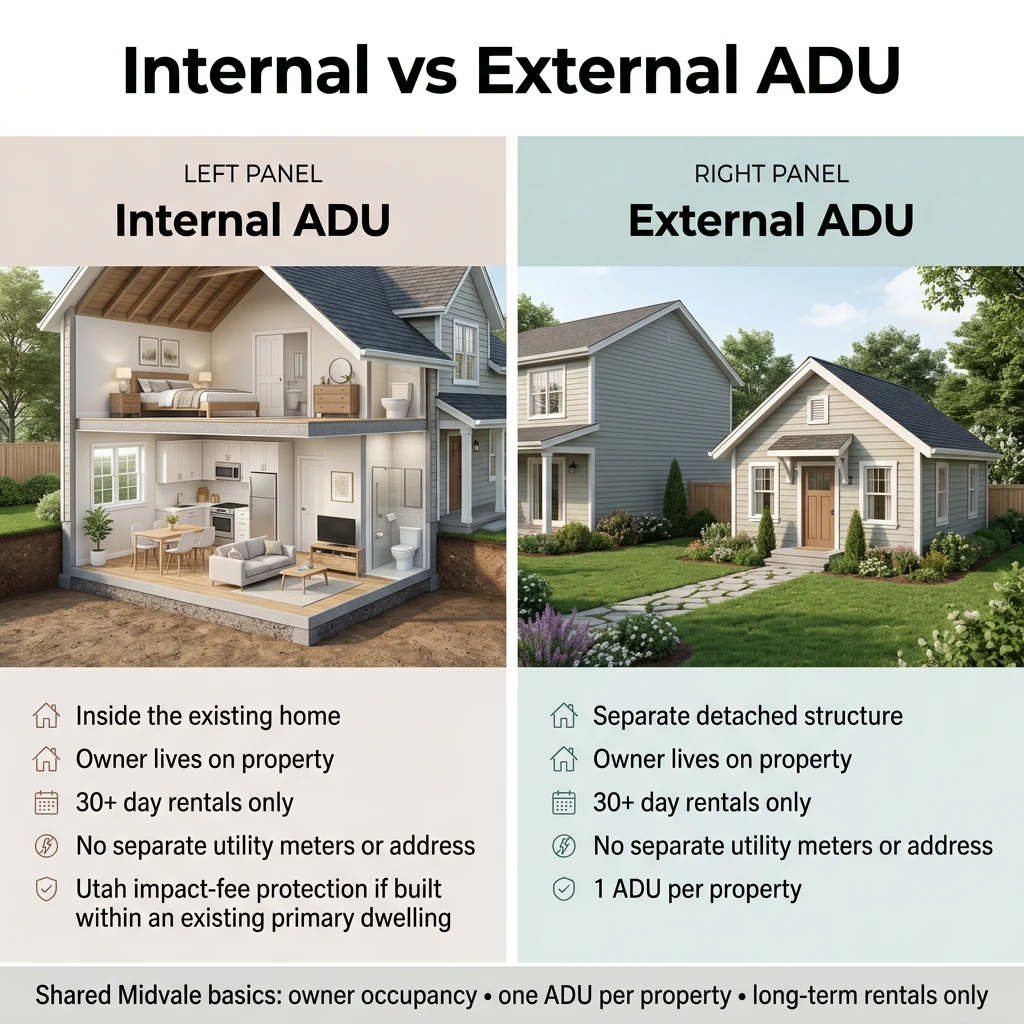
Midvale uses two terms you'll see throughout this guide: IADU (Internal Accessory Dwelling Unit) and EADU (External Accessory Dwelling Unit). Here's how they compare:
Internal vs. External ADU in Midvale — the key differences that determine your permit path, cost, and timeline
Rule
Internal ADU (IADU)
External ADU (EADU)
What it is
A unit inside your existing home — basement apartment, converted space, or addition within the primary dwelling
A separate structure — detached backyard cottage, above-garage unit, or standalone build
Size limit
Utah state law prohibits municipalities from restricting IADU size relative to the primary dwelling (Utah Code §10-21-303(2)(b)(i))
Varies by zone — commonly 900 sq ft OR 13% of lot area, whichever is larger (cumulative with all accessory structures). Confirm for your zone.
Minimum lot size
Must be greater than 6,000 sq ft
Height limit
Must comply with primary dwelling standards
Varies by zone — commonly 20 ft (pitched roof) / 16 ft (flat roof). Confirm for your zone.
Stories
N/A (within existing home)
Commonly 1 to 1.5 stories max. Confirm for your zone.
Setbacks
N/A (within existing home)
Varies by zone — commonly min 2 ft from rear and side lot lines; min 6 ft from main building. Confirm for your zone.
Location
Inside primary dwelling
Rear or side yard only — never the front yard
Separate utilities
Prohibited — no separate meters for either type
Separate address
Prohibited for both types
Owner-occupancy
Required — must live in one unit as permanent residence
Parking
1 additional off-street space required for each
Impact fees
Exempt if built within an existing primary dwelling (Utah Code §11-36a-202)
Subject to local impact fees
HOA restrictions
HOAs generally cannot prohibit compliant IADUs (Utah Code §57-8a)
May still be subject to CC&Rs — check your HOA docs
Sources: Midvale Municipal Code §17-7-1.2.1(D)–(E), §17-7-1.8, §17-7-4.2, §17-7-4.8; Utah Code §10-21-303; Utah Code §11-36a-202; Utah Code §57-8a. Note: EADU dimensional standards can vary between Midvale's different zones. The figures above reflect the most common residential zone standards, but your zone may differ — especially in the Junction at Midvale, Riverwalk, and TOD areas.
The big takeaway: An internal ADU is almost always the simpler, cheaper, and faster path — the state limits how much a city can restrict IADU size, there are no setback issues to navigate, no foundation to pour, and Utah law exempts internal ADUs from impact fees when built within an existing home. An external ADU gives you more privacy and separation, but it costs more, takes longer, and has stricter size and placement rules.
Not Sure Which Type Fits Your Property?
Get a free lot check and we'll look up your zoning, confirm your lot size, and tell you exactly which path — internal, external, or neither — fits your specific property.
Which Is Better for You: Internal or External?
This depends less on the rules and more on your situation. Here's a quick framework:
Choose an Internal ADU if:
✓Your main goal is the simplest, most affordable legal path
✓Your home already has a basement layout or unused space you could convert
✓You want to avoid the complexity of a separate foundation and utility trenching
✓Budget is a primary concern (internal ADUs typically cost 40–60% less)
✓You want to take advantage of the impact-fee exemption under Utah law
Choose an External ADU if:
✓Privacy and full separation matter most — for you, a tenant, or a family member
✓Your backyard has room and favorable site conditions (flat, accessible, no easements)
✓You want the highest possible rental income (detached units typically command higher rents)
✓You're thinking long-term investment and maximum property value increase
Best Fit by Scenario
Your Goal
Best ADU Type
Why
Rental income on a budget
Internal (basement conversion)
Lowest cost, fastest payback, no impact fees
Maximum rental income
External (detached cottage)
Higher rents, more tenant appeal
Aging parent or family member
Internal (attached addition)
Proximity, shared living, lower cost
Privacy for adult child
External (backyard cottage)
Full separation, own entrance
Home office / studio
Either
Depends on space and budget
Maximum property value
External (new detached build)
Adds the most equity on average
How to Check If Your Midvale Lot Likely Qualifies
This is the heart of the guide. Run through these steps and you'll know where you stand in about five minutes.
1
Look Up Your Zoning
Midvale has an interactive zoning map that shows your property's zone, lot area, parcel number, and subdivision. You need to confirm your lot is in a zone that addresses ADUs. Midvale's residential zones — including SF-1, SF-2, RM-12, RM-25, and several mixed-use/planned zones — include ADU provisions, but each zone has its own development standards. If you don't know your zone, the fastest way to find out is the zoning map on Midvale's city website — or you can skip straight to getting a lot check and we'll look it up for you.
2
Confirm Your Lot Is Larger Than 6,000 Square Feet
This is a hard cutoff in Midvale's code for both IADUs and EADUs. If your lot is 6,000 square feet or less, an ADU is not permitted under current rules. You can find your exact lot size on the Salt Lake County Assessor's website or on Midvale's zoning map. Pro tip: Many older Midvale neighborhoods — the ones with single-family homes built before the 1990s — tend to have lots in the 7,000–10,000+ square foot range. If you're in one of those neighborhoods, you're likely above the threshold. But don't assume — confirm.
3
Confirm Your Property Has One Detached Single-Family Dwelling
Both IADUs and EADUs require the lot to have one detached single-family home. If your property is a duplex, condo, townhouse, or multifamily building, the standard ADU rules don't apply the same way. Mobile homes and manufactured homes are also excluded.
4
Confirm You Can Meet the Owner-Occupancy Requirement
You must live in either the main house or the ADU as your permanent residence for as long as the ADU exists on the property. This isn't optional — it's a legal requirement baked into the code and recorded against your property title. If you're an investor who doesn't plan to live on-site, this is a hard stop for Midvale ADUs.
5
Make Sure You Can Add One Off-Street Parking Space
Midvale requires one additional off-street parking space per ADU. That could be a driveway spot, a carport space, or part of your garage. If you're converting a garage into living space, you'll need to replace those parking spaces somewhere else on the property. If you already have a two-car garage plus a driveway, you probably have room. If street parking is your only option, this could be a constraint.
6
For External ADUs — Assess Your Yard
If you're considering a detached unit, take a closer look at your backyard: Setbacks (your zone will specify minimum distances from lot lines and from the main building), Access (can a concrete truck and construction equipment reach the build site?), Utilities (how far will you need to trench water, sewer, and electrical lines?), and Size (will the footprint you need fit within your zone's maximum building area, which is typically cumulative with existing sheds and accessory structures?).
7
Check Your HOA Before You Get Emotionally Committed
Utah law (HB 82 / Utah Code §57-8a) generally prohibits HOAs from banning internal ADUs. If your plan is a basement apartment or an interior conversion, your HOA generally cannot stop you as long as you comply with local building, fire, and health codes. External ADUs are a different story. CC&Rs may still restrict detached structures. Check your HOA documents before you invest in architectural plans for a backyard build.
8
When to Talk to a Builder Before You Spend Money on Plans
If you've made it through steps 1–7 and everything looks good, the smartest next move is not hiring an architect — it's getting a lot check from someone who has built ADUs in the area and understands Midvale's process. A good builder can walk your property, spot issues you'd miss, and tell you what's realistic before you spend a dime on design.
Get a Free Midvale ADU Lot Check — We'll Review Your Property and Give You a Straight Answer
We verify your zoning, lot size, and eligibility, assess your property for the best ADU type, flag any constraints, and give you a realistic cost range — before you spend a dollar on plans.
Which Midvale Properties Usually Have the Easiest ADU Path?
Not all qualifying lots are created equal. Here's what we typically see:
Easiest for Internal ADU
• Homes with an existing unfinished basement and a walk-out or daylight configuration
• Homes with a clear floor plan that can be divided without major structural changes
• Properties already wired and plumbed for a second kitchen area
• Homes with a separate exterior entrance (or an easy path to add one)
Easiest for External ADU
• Lots in the 8,000–12,000+ sq ft range with accessible backyards
• Properties with alley access behind the home
• Flat or gently sloped rear yards (Midvale's valley-floor location is a real advantage over foothill communities)
• Homes with existing detached garages that could be converted or built above
Typically "Not Now"
• Lots at or below 6,000 sq ft
• Mobile or manufactured homes
• Non-owner-occupied investment properties
• Properties where parking cannot be resolved
Needs Extra Review
• Lots right at the 6,000–6,500 sq ft threshold
• Properties in the TOD zone
• Lots with existing accessory structures eating into the cumulative building area cap
• Lots with utility easements through the likely build area
What Can Block or Delay an ADU in Midvale?
Let's be honest about the friction points. Knowing them upfront saves you time, money, and frustration.
⚠
Zoning uncertainty.Some Midvale properties sit in zones with different development standards — especially in the Junction at Midvale, Riverwalk, and TOD areas. If you're not sure about your zone or what standards apply, a lot check can clear this up fast.
⚠
Lot size problems.The 6,000 sq ft minimum is a hard line. If you're close, measure carefully. Salt Lake County's assessor data is usually accurate, but surveying disputes do happen.
⚠
Owner-occupancy conflicts.If you're thinking about turning your Midvale home into a fully investor-owned rental property with an ADU, that won't work under the current rules. You need to live there.
⚠
Parking constraints.Losing a garage to a conversion means you need to create replacement parking. On narrow lots, this can be a design challenge.
⚠
The Airbnb question.Midvale ADUs must be rented for 30 or more consecutive days. No short-term vacation rentals. If your business model depends on nightly rates, an ADU in Midvale isn't the right vehicle.
⚠
Existing unpermitted work.If your basement is already being used as an apartment without a permit, the path forward involves getting it properly permitted — not ignoring it. Midvale's Good Landlord Program requires rental units to be free of building, zoning, and fire code violations.
⚠
HOA pushback on external ADUs.While state law protects internal ADUs from HOA bans, your CC&Rs may still restrict detached structures. Read them before you commit to a backyard build.
⚠
Site access and utility trenching.For detached EADUs, the distance between your main sewer/water lines and the backyard build site directly affects cost. Rocky soil, limited access for equipment, or long trenching runs can add meaningfully to the project.
Here's the thing: every one of these obstacles has been navigated by Midvale homeowners before you. The permit timelines are real, the costs are real, and the rules have teeth — but they exist to protect you and your neighbors, and a good builder knows how to work within them efficiently.
Want to Know Which Obstacles Apply to Your Lot?
Get a free lot check and we'll flag exactly which blockers — if any — apply to your specific property, and what it would take to resolve them.
What Does an ADU Cost in Midvale?
Let's talk real numbers. ADU costs vary based on what you're building, but here are the estimated ranges based on the Salt Lake County market:
ADU Type
Estimated Cost Range
Est. Cost Per Sq Ft
Best For
Basement Conversion (IADU)
$50,000 – $100,000
$80 – $150
Budget-friendly; fastest payback
Garage Conversion
$60,000 – $150,000
$100 – $200
Existing structure saves on foundation
Attached Addition (IADU)
$100,000 – $200,000
$150 – $250
Seamless connection to main home
New Detached Build (EADU)
$150,000 – $350,000+
$200 – $350
Maximum rental value and flexibility
These are estimates based on current Salt Lake County market conditions and may vary significantly based on site conditions, design complexity, finishes, and contractor. Always get a property-specific quote. See our Utah ADU cost guide for full methodology.
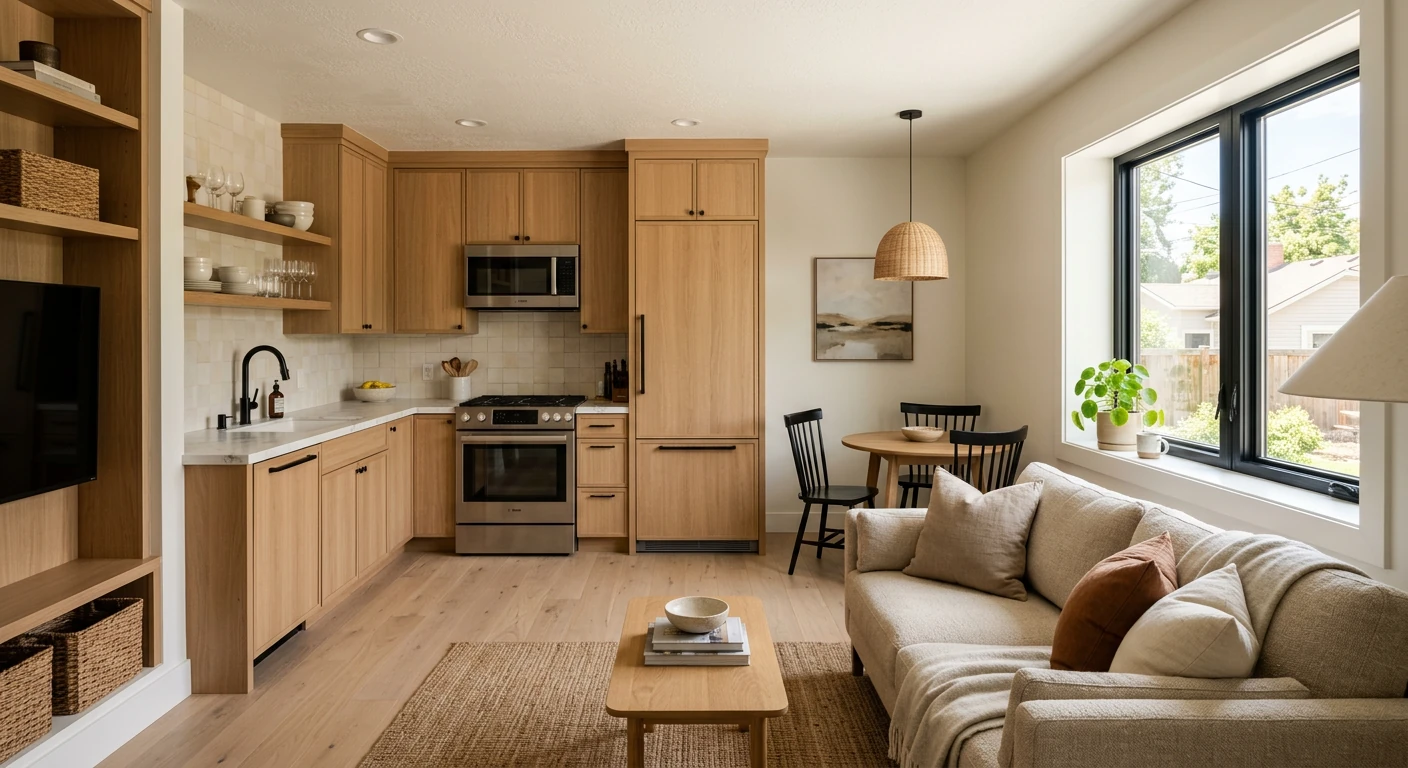
A well-finished ADU interior — mid-range finishes like these rent just as well as luxury builds, and keep your payback timeline on track
The Line Items That Change the Price Most
Design and engineering
Architectural plans and engineering work typically run $2,500–$8,000. You need construction drawings for your permit application.
Permit and impact fees
Midvale charges permit fees based on project scope. Impact fees for infrastructure can add to the total — though Utah's Impact Fees Act (§11-36a-202) specifically says a city may not impose an impact fee on the construction of an internal ADU within an existing primary dwelling. That's a real cost advantage for going internal.
Contractor requirements
Utah's construction licensing law has specific requirements for who can pull building permits. There are limited owner-builder exemptions, but whether they apply to your specific ADU project depends on the type of work and local permit requirements. Confirm your permit and licensing path with Midvale Building & Safety before relying on a DIY approach.
Site prep and excavation
Varies widely depending on access, grading, and what's currently in the build area.
Landscaping and restoration
Budget for putting your yard back together after construction.
Why Internal ADUs Are Often the Smarter Financial Move
When you add up the savings — no foundation, no utility trenching, no separate site prep, exempt from impact fees — an internal ADU can cost 40–60% less than a comparable detached unit. For homeowners whose primary goal is rental income or family housing on a budget, the math almost always favors going internal.
That said, a well-built detached EADU typically commands higher rents and adds more to your property value. If you have the budget and the site conditions, the long-term return can be worth the higher upfront cost.
The honest truth about ADU costs: Building an ADU is a real financial commitment. Even a straightforward basement conversion will likely cost $50,000–$80,000 when you include everything, and detached builds routinely exceed $200,000. But here's what makes it one of the smartest investments a Midvale homeowner can make: you're building on land you already own, in a housing market where rental demand along the Wasatch Front continues to outpace supply. A well-built, permitted ADU adds real equity while generating monthly income — unlike a kitchen remodel, an ADU actually pays you back every month.
Get a Free Cost Estimate Based on Your Midvale Property
We'll scope the likely costs based on your actual lot, property layout, and ADU type — not generic averages. No obligation, no pressure.
How Long Does a Midvale ADU Take From Start to Finish?
Here's a realistic timeline based on the Midvale permitting process and typical construction:
Final inspection, record title notice, certificate of occupancy
3–5 months
Basement conversion (internal ADU)
5–8 months
New detached build (external ADU)
Pro tip: Start the design process in fall or winter, get your permit by late winter, break ground in spring, and have your ADU ready by summer. That timing maximizes your first rental season and avoids the permit-review backlog that often hits in spring when everyone starts building. The timeline is real, and rushing it doesn't help. But a builder who knows Midvale's process can shave weeks off the permit phase by submitting clean, complete applications the first time.
What Permits and Approvals Do You Need?
Midvale's building process involves two departments, and understanding the split saves confusion:
Planning & Zoning
Handles land-use questions: Is your lot zoned correctly? Does the ADU comply with development standards for your zone?
Building & Safety
Handles construction questions: Do your plans meet the building code, fire codes, and structural requirements? Building permits, inspections, and the certificate of occupancy run through this department.
How the Process Works
1
Get a lot check.Before you pay for plans, confirm your lot works. A qualified builder can do this with a property visit.
2
Hire a designer and contractor.You'll need construction drawings for your permit application. Required submittals depend on the project and the city's review requirements.
3
Submit your permit application online.All Midvale building permit applications go through the city's online portal. Large files may need to be emailed to Building & Safety separately.
4
Wait for plan review.The city reviews your application for zoning compliance and code compliance. This typically takes 2–6 weeks. If corrections are needed, you'll get comments to address before approval.
5
Receive your permit and begin construction.Once the permit is issued and fees are paid, you're authorized to build.
6
Schedule and pass inspections.Key milestones are scheduled online in advance. Inspections are available Monday through Thursday.
7
Get your certificate of occupancy.Before the city issues the CO, you must record a notice against your property title with the Salt Lake County Recorder (the owner-occupancy disclosure). Once that's recorded and the final inspection passes, you're cleared to occupy or rent the unit.
8
If you're renting: get a business license.Midvale requires a Residential Landlord license for rental properties. The Good Landlord Program requires your unit to be free of administrative, building, zoning, and fire code violations.
Sources: Midvale Building & Safety; Midvale Municipal Code §17-7-1.2.1(D)(8), (E)(10); Midvale Business Licensing
Can You Rent Out a Midvale ADU?
Yes — with rules.
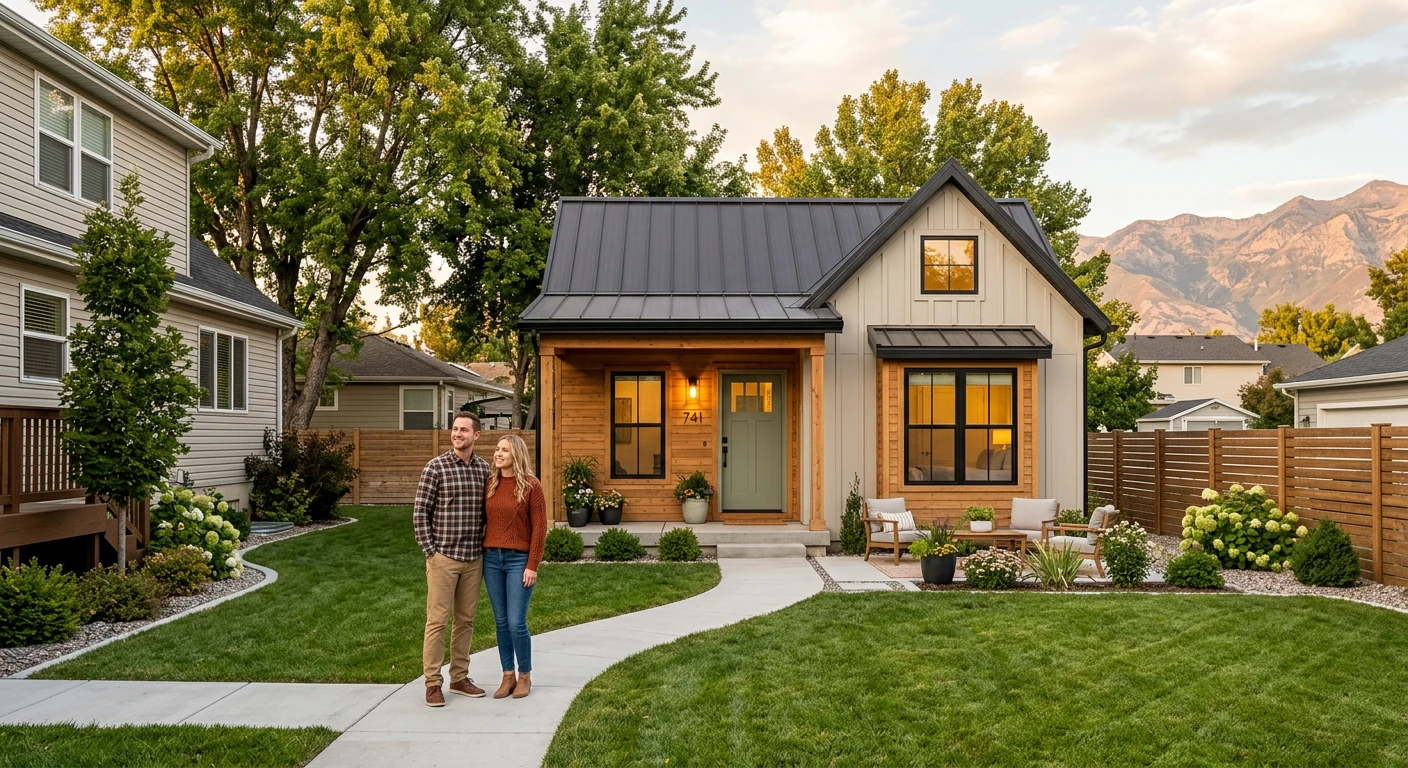
Midvale homeowners standing in front of their completed detached ADU — a long-term rental investment that generates income while building equity
Long-Term Rental: Absolutely
Midvale's ADU ordinance allows you to rent your unit for periods of 30 consecutive days or longer. This is one of the primary reasons people build ADUs in the first place, and the rental potential in Midvale is strong given its central Salt Lake County location and proximity to TRAX light rail.
Short-Term Rental (Airbnb, VRBO): No
Both IADUs and EADUs in Midvale are restricted to long-term rentals only. The 30-consecutive-day minimum is written into the code. If nightly rental income is your goal, a Midvale ADU isn't the right path.
Do You Need a Business License to Rent Your ADU?
Yes. Midvale requires all rental properties to have a valid business license. You'll need to complete the city's Residential Landlord Application. The Good Landlord Program sets standards for rental properties, including the requirement that units be free of building, zoning, and fire code violations. This matters because it means your ADU needs to be properly permitted and inspected before you can legally rent it. Cutting corners on permits doesn't just risk fines — it prevents you from getting the business license you need to operate as a landlord.
What About Utility Costs When You're Renting?
Since Midvale prohibits separate utility meters for ADUs, you'll share utility bills with your tenant. Most landlords handle this one of three ways:
1.
Include utilities in the rent (simplest — just factor the cost into your rental price)
2.
Add a flat monthly utility fee (estimate based on historical usage)
3.
Split based on square footage (fair, but requires more tracking)
Including utilities in the rent is the most common approach and what we typically recommend. It simplifies your life and your tenant's.
Midvale ADU Design Standards: What to Know Before You Design
Understanding the physical constraints upfront prevents expensive redesigns later.
External ADU (EADU) Standards
Midvale's EADU development standards are zone-specific. Here's what the code commonly specifies in the standard residential zones (SF-1, SF-2, RM-12, RM-25):
Standard
Typical Requirement
Location
Rear or side yard only
Proximity to main building
Minimum 6 feet
Side and rear setbacks
Minimum 2 feet from lot lines (including eaves); zero-setback exception if specific conditions are met
Height
Up to 20 feet (pitched roof); 16 feet (flat roof)
Stories
1 to 1.5 stories max
Building area
Larger of 900 sq ft OR 13% of lot area — cumulative with all other accessory structures
Important: These are the standards in the most common residential zone sections. Your zone may have different standards — particularly if you're in the Junction at Midvale, Riverwalk, or TOD areas, where some subareas use different size caps (as low as 500 sq ft or 13%) and different setback requirements. Always confirm the standards that apply to your specific zone before designing.
Sources: Midvale Municipal Code §17-7-1.8, §17-7-4.8, §17-7-8.2, §17-7-9.12
The Cumulative Building Area Rule (This Catches People Off Guard)
The EADU building area cap isn't just for your ADU — it typically includes every accessory structure on the lot. That means your shed, your detached workshop, your greenhouse, and your EADU all count toward one shared maximum. If you have a 400 sq ft shed and you're on a standard 7,000 sq ft lot, your math looks like this: 13% of 7,000 = 910 sq ft total, minus the 400 sq ft shed = 510 sq ft remaining for your EADU.
Building Area by Lot Size (Common 900 sq ft / 13% Standard)
Your Lot Size
13% of Lot
Max Combined EADU + Accessory Structures
6,500 sq ft
845 sq ft
900 sq ft (minimum floor applies)
7,000 sq ft
910 sq ft
910 sq ft
8,000 sq ft
1,040 sq ft
1,040 sq ft
9,000 sq ft
1,170 sq ft
1,170 sq ft
10,000 sq ft
1,300 sq ft
1,300 sq ft
12,000 sq ft
1,560 sq ft
1,560 sq ft
Takeaway: Larger lots get more flexibility. If you're on a 10,000+ square foot lot — common in Midvale's older neighborhoods — you have significantly more room to work with than someone on a 7,000 sq ft lot.
Internal ADU (IADU) Design Standards
Internal ADUs have far fewer physical constraints:
• Size limit: Utah state law (§10-21-303) specifically prohibits municipalities from restricting the size of an IADU in relation to the primary dwelling. This is one of the strongest protections in the statute.
• Appearance: The IADU should not change the exterior appearance of the primary dwelling — it should still look like a single-family home from the street.
• Building code: Must meet all applicable building, plumbing, electrical, mechanical, fire, and health codes — including fire separation from the primary dwelling, egress windows in bedrooms, and proper ventilation.
• Additions: If your IADU involves adding on to the existing building, the addition must comply with the development standards for your zone (setbacks, height, etc.).
Types of ADUs You Can Build in Midvale
Let's translate the legal categories into real-world options:
Basement Conversion (Internal ADU)
$50,000 – $100,000
Convert an existing finished or unfinished basement into a self-contained unit with its own kitchen, bathroom, living area, and sleeping space. This is by far the most common ADU type in Utah, and for good reason: it's the most affordable, the quickest to build, and state law gives it the strongest protections and the most favorable impact-fee treatment.
Good candidates: Homes with daylight or walk-out basements, homes with existing rough plumbing in the basement, and homes where the main floor layout naturally separates from a lower-level entrance.
Garage Conversion
$60,000 – $150,000
Transform an existing detached garage into a living space. Whether this is classified as an internal or external ADU depends on whether the garage is attached to or detached from your primary dwelling — confirm the classification with your builder and the city during the planning stage. You save on some construction costs since the structure already exists, but you'll need to bring it up to residential building code.
Important: If you convert parking spaces to living space, you'll need to replace the lost parking elsewhere on your property.
Attached Addition (Internal ADU)
$100,000 – $200,000
Build an addition onto your existing home that functions as a separate unit. This keeps the ADU connected to the main structure while providing its own entrance, kitchen, and bathroom.
Note: Any addition must comply with your zone's development standards — setbacks, height limits, lot coverage — which can constrain the design.
Detached Backyard Cottage (External ADU)
$150,000 – $350,000+
A brand-new standalone structure in your rear or side yard. This is the most expensive option but gives you the most flexibility in design, the most privacy for occupants, and typically the highest rental potential.
Requirements: New foundation, utility trenching, fire-rated construction, and full compliance with your zone's EADU standards.
Above-Garage Unit (External ADU)
$120,000 – $250,000
Build a living space above an existing or new detached garage. This maximizes your yard space by going vertical, but you'll need to stay within your zone's height limits and story restrictions.
Which ADU Type Fits Your Property?
A free lot check will identify which of these ADU types actually works on your specific lot — and which ones to rule out before you invest in plans.
Utilities, Parking, and Addresses: The "No" List
Do You Need Separate Utilities or a Separate Address?
No, and Midvale's code is clear on this. Both IADUs and EADUs are prohibited from having separate electrical, gas, sewer, or water meters. Separate addresses are also prohibited.
What this means practically:
• For your budget: You won't pay for separate utility hookups or meter installations. For internal ADUs, this is a non-issue — you're already on the same system. For external ADUs, the unit connects to your existing services (though you will need to trench lines to a detached structure, which is a construction cost).
• For renting: You share utility bills with your tenant. Most landlords simply include estimated utility costs in the rent — it's cleaner for everyone and avoids monthly bill-splitting headaches.
How Much Parking Do You Need for a Midvale ADU?
One additional off-street parking space per ADU unit — that's Midvale's requirement for both IADUs and EADUs.
Where Space Usually Comes From
Most Midvale homes on standard lots already have a two-car garage and a driveway. If your current setup can accommodate an extra vehicle — a wider driveway, a carport, or an unused side pad — you're typically fine.
Garage Conversion Parking
If your ADU plan converts a garage into living space, you need to replace those parking spaces somewhere on your property. This might mean widening the driveway, adding a carport, or creating a parking pad in the side yard. It adds cost but it's a solvable problem on most lots.
When Parking Is a Real Constraint
Narrow lots, lots with no alley access, and lots where the driveway is already at its maximum width can make the parking requirement tricky. Discuss this during your lot check — sometimes creative site planning solves it, and sometimes it genuinely limits your options.
What Happens When You Sell a Home with an ADU?
Midvale requires homeowners to record a notice against the property title before the certificate of occupancy is issued. This notice is a public disclosure that an ADU exists and that owner-occupancy rules apply.
For the Buyer
They'll see the ADU notice on the title report. They'll know there's a second unit, and they'll understand they need to occupy one of the units if they want to keep the ADU active.
For You as the Seller
A properly permitted, code-compliant ADU is a significant selling point. Buyers see it as built-in rental income, a space for family, or valuable flexibility. In today's market, that translates to real dollars.
For Appraisers & Lenders
A permitted ADU with a certificate of occupancy is a documented asset. An unpermitted one is a liability that can derail a sale, reduce your appraisal, or create legal complications.
Bottom line: If you build it right — permitted, inspected, CO issued — your ADU becomes one of the strongest features of your home when it's time to sell. If you cut corners on permitting, you create a problem that follows the property. A lawfully permitted, income-producing ADU is a permanent financial asset tied to the land you already own.
Can the ADU be sold separately? No. An ADU cannot be sold or subdivided as a separate lot. It stays attached to the primary property permanently.
What About HOAs, CC&Rs, and Edge Cases?
Can an HOA Stop Your Internal ADU?
In most cases, no. Utah law (HB 82 / Utah Code §57-8a) generally provides that a community association may not prohibit an owner from constructing a compliant internal ADU on a residential lot, and may not restrict or prohibit rental of a compliant internal ADU — as long as you meet all applicable building, fire, and health codes.
This is a big deal for Midvale homeowners in HOA-governed neighborhoods. If you're building a basement apartment or an interior conversion, your HOA generally cannot block it.
What About External ADUs and HOAs?
The state-law HOA protections are strongest for internal ADUs. External/detached ADUs may still be subject to CC&R restrictions on outbuildings, accessory structures, or architectural standards. Read your CC&Rs carefully, and consider getting a legal opinion if there's any ambiguity.
Midvale's city has noted that CC&R enforcement is between the homeowner and the HOA — the city won't get involved in private covenant disputes.
What About Duplexes, Condos, and Multifamily Properties?
Midvale's ADU rules require the lot to have one detached single-family dwelling. If your property is a duplex, condo, townhouse, or multifamily building, the standard IADU and EADU pathways don't apply the same way.
What About Small or Awkward Lots?
If your lot is right at 6,000 square feet, you're over the threshold — but you may run into practical constraints with setbacks, parking, and building area limits. Lots with unusual shapes, steep topography, or utility easements running through the build area need case-by-case evaluation.
What Midvale Homeowners Wish They'd Known Before Building
We see the same lessons come up again and again:
→
Start the process earlier than you think.The timeline from 'I want an ADU' to 'my tenant moves in' is typically 4–8 months. If you want rental income by summer, start your feasibility work in the fall.
→
The impact-fee exemption for internal ADUs is a real financial advantage.Utah law says cities can't charge impact fees on an IADU built within an existing primary dwelling. Depending on your project, this can save you meaningfully. If budget matters, this tips the scale toward going internal.
→
Midvale's ADU standards are actively being discussed.The city's Planning Commission has been reviewing detached ADU standards around height, half-stories, and structures that function like full second homes. No changes have been enacted as of this writing, but the conversation is happening — which means the current standards could evolve over time.
→
Budget a 10–15% contingency.Construction projects hit surprises — unexpected soil conditions, plumbing reroutes, code requirements that weren't obvious from the initial assessment. A contingency fund keeps a surprise from becoming a crisis.
→
The title notice is not scary.Some homeowners get nervous about recording a notice against their property title. It's standard practice, it's required before your CO is issued, and it actually protects future buyers by documenting that a legal, permitted ADU exists. Think of it as proof of quality, not a red flag.
Is Building an ADU in Midvale Worth It?
For most qualifying homeowners, the answer is yes — and the basic math isn't complicated. You're building on land you already own. Utah's Wasatch Front rental market continues to show strong demand. A well-built, permitted ADU adds real equity to your property while generating monthly income that can meaningfully offset your mortgage, fund retirement, or house a family member who needs it.
The exact return depends on your project type, total cost, rental rate, and how long you hold the property. Internal ADUs typically pay back faster because the upfront cost is lower. Detached builds take longer to recoup but tend to add more property value and command higher rents.
When It Makes the Most Sense
✓You have a qualifying lot and you plan to stay in the home for 5+ years
✓You want passive rental income that can meaningfully offset your mortgage
✓You have an aging parent who needs nearby, accessible housing
✓You want a dedicated home office or studio that's truly separate from your living space
✓You're thinking long-term property value
When It Might Not Be the Right Move
✗You're planning to sell within 1–2 years (the upfront cost may not pay back that fast)
✗Your lot barely qualifies and the design constraints make the project disproportionately expensive
✗Your primary goal is nightly Airbnb income (not permitted in Midvale)
Even in the "not right now" scenarios, building an ADU is rarely a bad investment on a qualifying lot. You're creating a permanent, income-producing asset on land you already own — and every additional housing unit along the Wasatch Front has real value.
What Should You Do Next If You're Serious About a Midvale ADU?
If you've read this far, you have a better understanding of Midvale's ADU rules than most homeowners in the city. Here's how to turn that knowledge into action:
1
Verify your zoning and lot size.Use Midvale's interactive zoning map to confirm your zone and lot area. This takes two minutes and eliminates the biggest unknown.
2
Decide whether internal or external makes more sense.Based on your goals, budget, property layout, and the comparison framework above, you likely already have a gut feeling. Trust it.
3
Get a lot check before you spend money on plans.This is the single most valuable step you can take. A qualified builder can walk your property, identify constraints you can't see from a code section, and give you a realistic assessment of what's possible, what it will cost, and how long it will take. We do this for Midvale homeowners at no cost and no obligation — just a clear-eyed look at your property and an honest conversation about your options.
4
Once your lot checks out, move into design.Your builder and designer will create the construction documents needed for your permit application.
5
Submit your permit and start building.With a clean application and experienced builder, the process moves faster than you'd expect.
Yes — Midvale allows both Internal Accessory Dwelling Units (IADUs) and External Accessory Dwelling Units (EADUs) on qualifying single-family lots. Your property must be in a residential zone, have a lot larger than 6,000 sq ft, have one detached single-family home, and you must live on the property as the owner-occupant.
Does Midvale allow basement apartments?
Yes. A basement apartment qualifies as an Internal Accessory Dwelling Unit (IADU). Under Utah state law (§10-21-303), municipalities are prohibited from restricting IADU size relative to the primary dwelling, and HOAs generally cannot prohibit them.
How big does my lot need to be for a Midvale ADU?
Greater than 6,000 square feet for both internal and external ADUs. This is a hard minimum in Midvale's code.
Is there a maximum ADU size in Midvale?
For internal ADUs: Utah state law (§10-21-303) prohibits municipalities from restricting the size of an IADU in relation to the primary dwelling. For external ADUs: the maximum varies by zone — commonly 900 square feet or 13% of lot area, whichever is larger, cumulative with all other accessory structures. Confirm for your specific zone.
Do I have to live on the property?
Yes. Owner-occupancy is required — you must live in either the main house or the ADU as your permanent residence for as long as the ADU exists on the property.
Can I use my Midvale ADU as an Airbnb?
No. Midvale ADUs must be rented for 30 or more consecutive days. Short-term vacation rentals are not permitted under the current code.
Do I need a building permit?
Yes, always. A building permit is required before any construction begins on either an IADU or EADU. All applications are submitted online through Midvale's building portal.
Do I need an extra parking space?
Yes. One additional off-street parking space is required per ADU unit.
Can I get a separate address or utility meter for my ADU?
No. Midvale prohibits separate addresses and separate utility meters (electrical, gas, water, sewer) for both IADUs and EADUs.
Can I build the ADU myself?
Possibly in limited owner-builder situations, but do not assume that path applies to your ADU project. Utah's construction licensing law includes some owner-builder exemptions, but whether they apply depends on the type of work, the intended use, and local permit requirements. Confirm your permit and licensing path with Midvale Building & Safety before relying on a DIY approach.
What if I already have a basement apartment that was never permitted?
You'll need to go through the permitting process to bring it into compliance. Midvale's Good Landlord Program requires rental units to be free of building, zoning, and fire code violations. Getting ahead of this protects you legally and financially — and it makes the unit a legal asset rather than a liability.
Do I need a business license to rent my ADU?
Yes. Midvale requires a Residential Landlord business license for rental properties.
Can my HOA stop me from building an ADU?
For internal ADUs: generally no. Utah law (HB 82 / §57-8a) generally prohibits HOAs from banning compliant internal ADUs. For external ADUs: your CC&Rs may still restrict detached structures — check your HOA documents.
How long does the whole process take?
Typically 3–5 months for an internal ADU (basement conversion) and 5–8 months for a new detached build, including design, permitting, and construction.
What does the title notice mean?
Before your certificate of occupancy is issued, you must record a notice against your property title disclosing that an ADU exists and that owner-occupancy rules apply. This transfers to future owners and is standard practice — it's documentation of a legal, permitted unit, not a negative mark.
What is the fastest way to know if my lot qualifies?
Get a free lot check. We verify your zoning, lot size, and eligibility, assess your property for the best ADU type, and give you a straight answer — before you spend a dollar on plans.
How We Built This Guide
This guide was compiled by our team using primary sources — not recycled from other websites or generic national content. We reviewed Midvale's municipal code, city planning and building department materials, ordinance documents, and cross-referenced Utah state statutes.
• Midvale Municipal Code, Title 17 — Zoning (including §17-7-1.2.1, §17-7-1.8, §17-7-4.2, §17-7-4.8, §17-7-8.2, §17-7-9.12)
• Midvale Building & Safety published materials and FAQ
• Midvale Business Licensing and Good Landlord Program materials
• Salt Lake County ADU ordinance materials
A note on code numbering: Utah recodified the internal ADU provision from §10-9a-530 to §10-21-303 in late 2025. If you see other articles citing the old section number, it's the same law. We use the current numbering throughout this guide. Last reviewed: March 2026.
Ready to Find Out What's Possible on Your Property?
You've done the research. You understand the rules, the costs, and the process. Now it's time to get a real answer for your specific lot.
We help Midvale homeowners move from "I think I want an ADU" to "here's exactly what I can build, what it will cost, and when it will be ready" — and we do the first step for free.
Get Your Free Midvale ADU Lot Check
We'll verify your zoning, lot size, and eligibility — then assess your property for the best ADU type and give you a straight answer before you spend a dollar on plans.