Independent ADU Planning Resource801-441-4365

Davis County ADU Guide: Rules by City, Costs, Permits & Next Steps

By Utah ADU Builders Editorial Team · Updated March 2026 · Verified against Davis County, city, and Utah state code sources

Disclosure: Utah ADU Builders connects homeowners with local builder options. If you request an estimate through this page, we may receive a referral fee at no cost to you. Verify licensing, insurance, and references before hiring. This does not influence our editorial content.

Many Davis County homeowners can build an ADU — but the rules change dramatically depending on which of the county's 15 cities your property sits in. Bountiful allows detached backyard units. West Bountiful does not. Farmington has a path to let you create a separately owned dwelling on your lot. Kaysville limits you to internal units only.

We built this guide because no single resource covered all of Davis County in one place. Now one does. Below you'll find the city-by-city rules matrix, real cost breakdowns, the full permit process, financing options, builder selection criteria, and every edge case that would otherwise send you back to another tab.
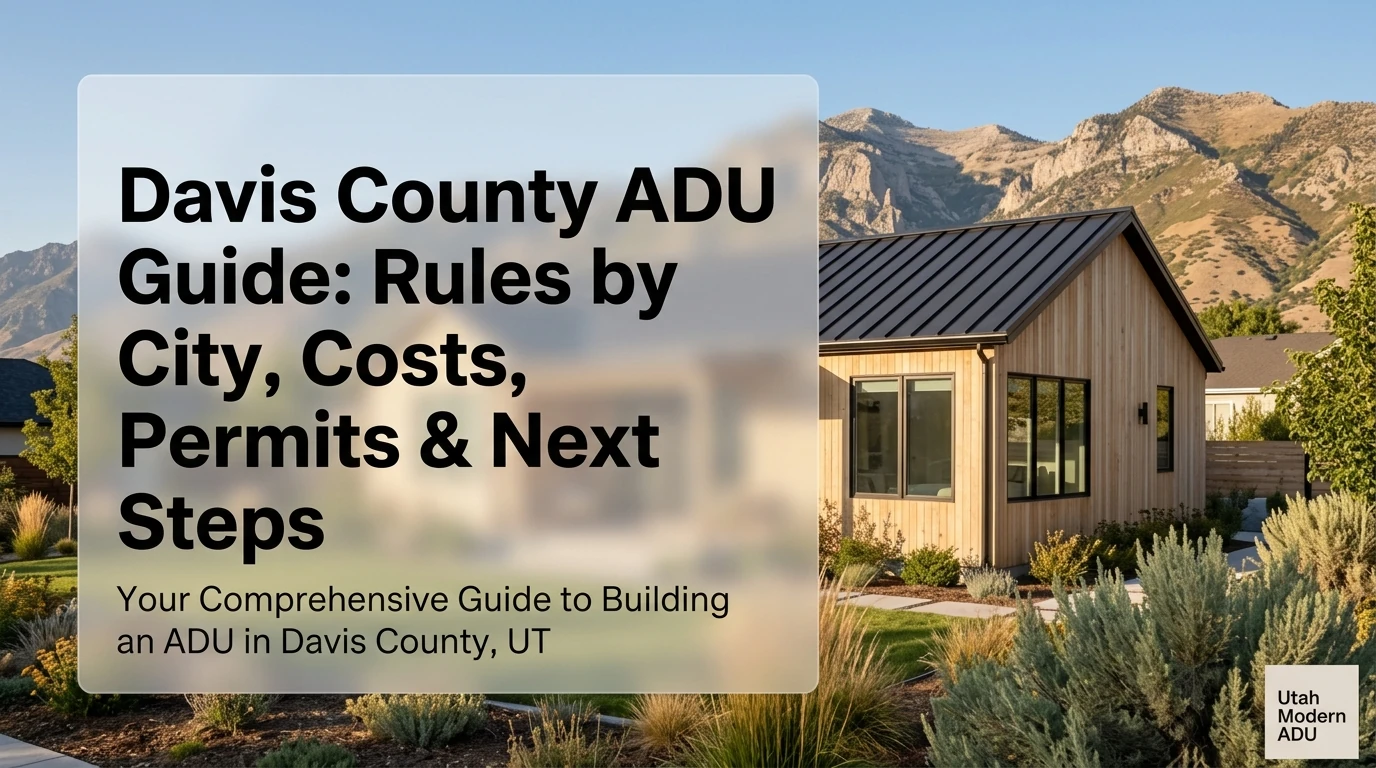
Davis County ADU Guide: Rules by City, Costs, Permits and Next Steps — modern detached ADU with light wood siding and metal roof against Wasatch mountain backdrop

Quick Decision Box

💰Estimated all-in cost: $150K–$350K (detached) · $50K–$150K (internal/basement)
📐Construction cost per sqft: $190–$250 in Davis County
📅Timeline: 4–9 months from design to move-in
🏠Rental income potential: $950–$1,500+/month
Cities allowing detached ADUs: Bountiful, Clearfield, North Salt Lake, Syracuse, Farmington, Layton, and growing
Every city allows internal ADUs (state law requires it)
📈Property value boost: ADUs typically add 65–75% of construction cost in equity

Based on local contractor data, ADU Utah benchmarks, RentCafe/RentalSource Davis County market data (early 2026), and Minson Appraisal Group estimates.

The Catch Most People Miss

Davis County doesn't have one simple ADU rulebook. Each of the 15 incorporated cities writes its own ordinance, and unincorporated county land follows a separate code entirely. Detached ADUs are treated very differently from internal ones. Short-term rental rules vary. Parking requirements range from one extra stall to more, depending on your city.

That sounds like a headache. It's actually an advantage — once you sort the five variables that matter (your city, lot size, parking, owner occupancy, and ADU type), the path gets surprisingly clear. That's exactly what this guide does.

Which ADU Path Fits Your Situation?

Before diving into city-by-city rules, figure out which lane you're in. This saves hours of reading sections that don't apply to you.

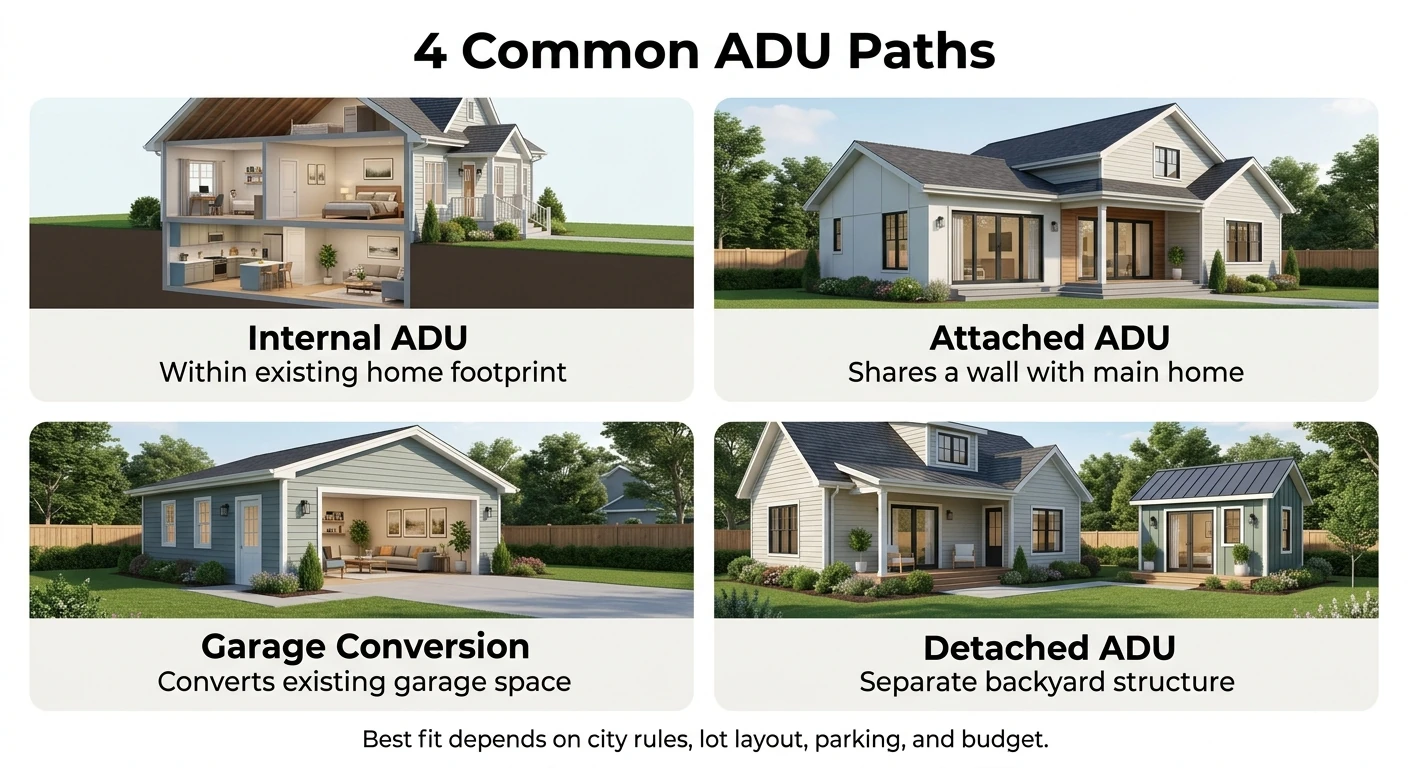
4 Common ADU Paths in Davis County: Internal ADU (within existing home footprint), Attached ADU (shares a wall with main home), Garage Conversion (converts existing garage space), and Detached ADU (separate backyard structure) — best fit depends on city rules, lot layout, parking, and budget
The best ADU type depends on your city's rules, lot layout, parking, and budget. Qualifying internal ADUs are generally protected as a permitted use in primarily residential areas; confirm parcel eligibility before proceeding.
Your GoalBest ADU TypeMost Common BlockerYour Next Step
Fastest rental incomeBasement / internal ADUEgress windows, parking, fire separationFeasibility check
Maximum privacy (aging parent, adult child)Detached backyard ADULot size, setbacks, conditional-use approvalCity rule + lot review
Keep family close without separate structureAttached additionParking, utilities, matching architectureLayout + city review
Lowest upfront costInternal or garage conversionLife-safety upgrades, code complianceCost estimate
Highest long-term flexibilityDetached ADUSite work, utilities, approval pathBuilder + planner review

Can I Build an ADU on My Property in Davis County?

Short answer: very possibly yes, in some form. Under Utah state law, qualifying internal ADUs are generally protected as a permitted use in primarily residential areas — but eligibility depends on specific conditions (owner-occupied, detached single-family, 30-day minimum rental term). Most Davis County cities also allow detached ADUs with conditions. But the specifics matter enormously — always verify with your city.

Step One: Are You in a City or Unincorporated Davis County?

This is the first thing to check because it determines who controls your permit. Davis County's building department handles permits for unincorporated areas. If your property falls inside one of the 15 incorporated cities, that city's planning department is your authority.

Not sure? The Davis County property search map shows whether your parcel is inside a municipality (shaded) or unincorporated (unshaded). This matters because the rules, fees, and approval process differ.

Source: Davis County Building Permits page — daviscountyutah.gov

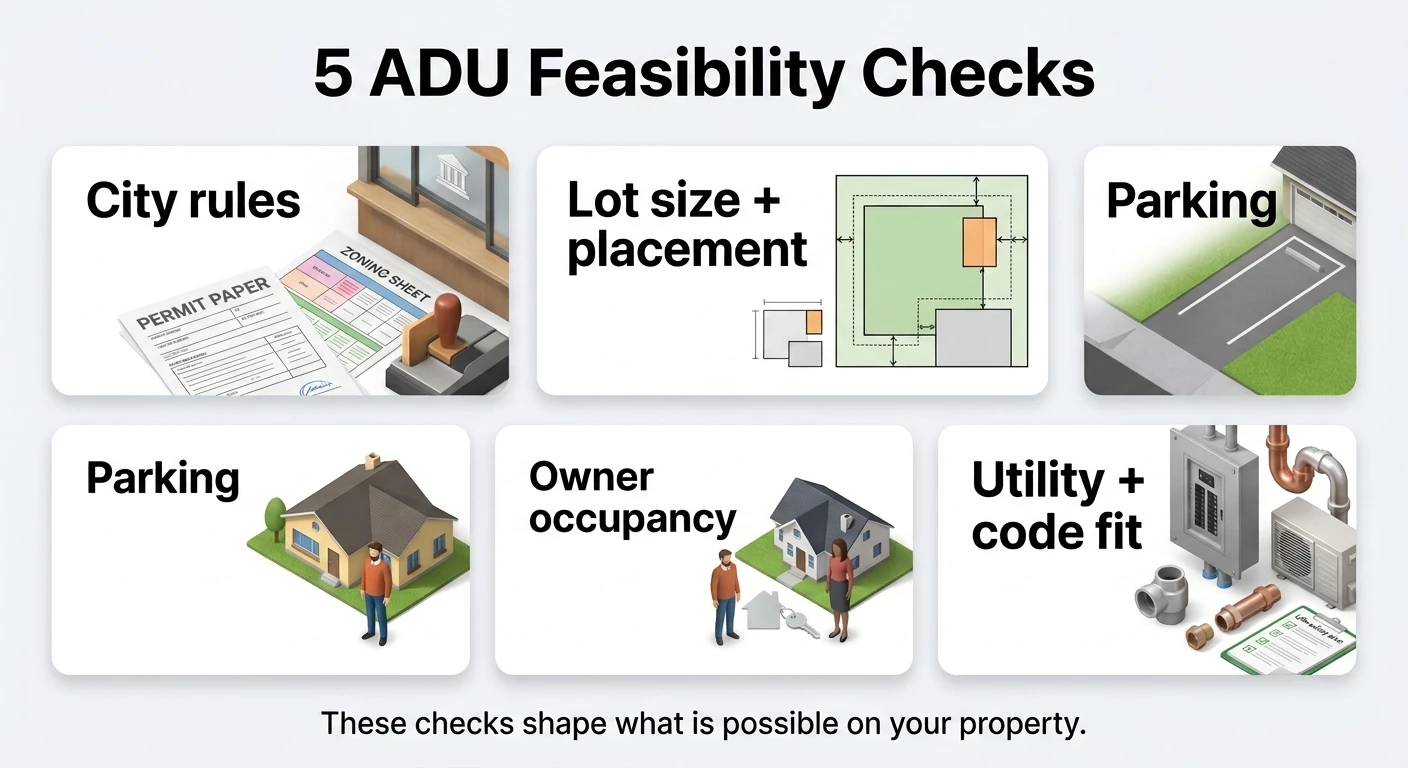
5 ADU Feasibility Checks for Davis County homeowners: (1) City rules - check your city's ordinance, (2) Lot size plus placement - verify minimums and setbacks, (3) Parking - confirm you have enough off-street spaces, (4) Owner occupancy - you must live on the property, (5) Utility plus code fit - electrical capacity plumbing and HVAC feasibility. These checks shape what is possible on your property.
These five checks determine whether an ADU project will work on your specific property. Get them answered before spending money on design.

The Four ADU Paths in Davis County

People use a dozen names for these — mother-in-law apartment, granny flat, backyard cottage, casita, tiny home. Officially, Davis County and its cities recognize four types:

Internal ADU

Built within the existing footprint of your home. A finished basement with kitchen, bathroom, bedroom, and separate entrance is the most common version. Every Davis County city allows this by state law.

Attached ADU

An addition to your existing home that creates a separate living unit sharing at least one wall with the main house. Fewer cities explicitly address this type, but several allow it.

Garage Conversion

Turning an existing garage into a living space. The catch: you usually need to replace the lost parking spaces elsewhere on your lot.

Detached ADU (Backyard Cottage)

A completely separate structure on your property. Highest privacy, best rental income, strongest property value boost — but also the most regulated and most expensive. Availability varies by city.

The Five Things That Decide Yes or No

Across every Davis County city, these five variables show up in every ordinance:

1
Your city’s ordinance: Does it allow your ADU type?
2
Lot size: Most cities require at least 6,000 sqft for internal ADUs; detached ADUs often need 8,000–10,000+ sqft
3
Owner occupancy: You typically must live in either the main home or the ADU
4
Parking: One or more additional off-street spaces, depending on city
5
Building code feasibility: Fire separation, egress, HVAC, plumbing, electrical capacity

If all five line up, you can build. If one doesn't, that's usually fixable — not a dead end.

Want Us to Run These Five Checks for Your Property?

We'll review your lot, your city's rules, and your ADU goals — free, no obligation.

What Are the ADU Rules in Each Davis County City?

We reviewed every Davis County city's available ordinance and public-facing ADU guidance, cross-referenced it against Utah state code, and compiled it into one table with source links.

Important

Ordinances change. We verify this data quarterly, but always confirm current rules with your city's planning department before making financial decisions.

CityInternalDetachedKey Size / Lot RulesParkingOwner-Occ.STRVerified
BountifulYes (staff review)Yes (conditional use)Detached: 350\u20131,250 sqft; lot 8,000 sqft buildable; footprint 10% (permitted) or 15% (conditional)+1 off-street stallYesAllowed with STR permitMar 2026
CentervilleYesVerifyPer ordinancePer ordinanceYesVerifyMar 2026
ClearfieldYesYes (Ord. 2025-23)Registration + business license required if rentedPer ordinanceYesVerifyMar 2026
ClintonYesVerifyPer ordinancePer ordinanceYesVerifyMar 2026
FarmingtonYesYes (DADU + SSF)IADU: lot 6,000 sqft; DADU: lot 10,000 sqft; DADU subordinate to primary footprint+1 off-street stallYes (temp absence allowed)ProhibitedMar 2026
Fruit HeightsYesVerifyPer ordinancePer ordinanceYesVerifyMar 2026
KaysvilleYes (IADU)Not allowedLot 6,000 sqft for IADU+1 paved stall + 2-car garage + 2-car drivewayYesLong-term only (30+)Mar 2026
LaytonYesYes (SF zones)Per ordinancePer ordinanceYesProhibitedMar 2026
North Salt LakeYesYes300\u20131,200 sqft; 2 bedrooms+1 off-street stallYesAllowed (land use permit + biz license)Mar 2026
South WeberYesVerifyPer ordinancePer ordinanceYesVerifyMar 2026
SunsetYesVerifyPer ordinancePer ordinanceYesVerifyMar 2026
SyracuseYesYesDeed restriction requiredVaries by bedroom countYesVerifyMar 2026
West BountifulYesNot permittedNo separate utility meters+1 ADU stall; replace parking if garage convertedYesCannot rent both unitsMar 2026
West PointYesVerifyPer ordinancePer ordinanceYesVerifyMar 2026
Woods CrossYesVerifyPer ordinancePer ordinanceYesVerifyMar 2026
Unincorp. Davis Co.VerifyVerifyCounty code governs; confirm directly with County CEDPer zonePer codeVerifyMar 2026

"Verify with city/county" means the city's public-facing ADU guidance was limited at time of review. Always confirm before committing funds.

Key takeaways from the matrix

  • Every city allows internal ADUs. Utah's HB 82 (2021) made that state law.
  • Detached ADUs are expanding fast. Bountiful, Clearfield, Farmington, North Salt Lake, Syracuse, and Layton all allow them in some form.
  • Kaysville and West Bountiful do not allow detached ADUs.
  • Farmington has a unique Subordinate Single-Family Dwelling (SSF) path that allows a qualifying detached ADU to be placed on its own subdivided lot with separate ownership — a path no other Davis County city offers.

City-by-City Details

Bountiful ADU Rules

Bottom line: One of the most ADU-friendly cities in Davis County. Internal ADUs are staff-approved. Detached ADUs require Administrative Committee approval as a conditional use.

Allowed types: Internal, detached
Size/lot: Detached: 350–1,250 sqft; lot ≥8,000 sqft buildable; footprint of all accessory structures ≤10% (permitted) or ≤15% (conditional)
Parking: One additional off-street parking space for the ADU.
Owner-occupancy: Required. Deed restriction recorded at county.
STR: Allowed within approved ADUs with a separate STR permit — one of the few Davis County cities that permits this.
Utilities: No separate utility meters permitted for the ADU.

Key detail: Detached ADUs are conditional use, which means a hearing before the Administrative Committee. This adds time but is a well-established process.

Source: Bountiful City ADU Requirements Guide (2024); Ch. 14-14-124

Clearfield ADU Rules

Bottom line: Updated their ADU ordinance in 2025 to allow internal, attached, and detached ADUs — a significant expansion from their previous internal-only policy.

Allowed types: Internal, attached, detached (Ordinance 2025-23)
Owner-occupancy: Required. ADUs cannot be sold or subdivided separately from the primary dwelling.
Utilities: Separate utility meters generally not permitted for internal ADUs.

Key detail: Registration and business licensing are required when renting an ADU.

Source: Clearfield City Code Title 11, Chapter 19; Ordinance 2025-23

Farmington ADU Rules

Bottom line: Has one of the most innovative ADU frameworks in Utah, formalized in a January 2025 ADU Toolkit. Both internal and detached ADUs are allowed, plus a unique Subordinate Single-Family Dwelling (SSF) path for separate ownership.

Allowed types: Internal (IADU), detached (DADU), and Subordinate Single-Family Dwelling (SSF)
Size/lot: IADUs require lots ≥6,000 sqft. DADUs and SSFs require lots ≥10,000 sqft. DADU must be subordinate to the footprint of the primary dwelling.
Parking: One additional off-street parking space.
Owner-occupancy: Required. Temporary absentee ownership may be allowed for military, employment, or family obligations.
STR: Prohibited. ADUs require occupancy of 30 days or more.
Utilities: SSF path requires separate utilities.

Key detail: The SSF path allows a qualifying DADU to be placed on its own subdivided lot with separate ownership. Requires Planning Commission approval, separate utility connections, and 2-year owner-occupancy upon initial separation. This is genuinely rare in Davis County.

Source: Farmington ADU Toolkit (Jan 2025); Code §11-28-200; Ord. 2024-41, 2024-62

Kaysville ADU Rules

Bottom line: Internal ADUs only — detached structures explicitly cannot be used as a dwelling/ADU.

Allowed types: Internal (IADU) only
Size/lot: Lot ≥6,000 sqft for IADU.
Parking: One dedicated paved ADU stall plus a two-car garage plus a two-car driveway — one of the most demanding requirements in the county.
Owner-occupancy: Required.
STR: IADUs are for long-term occupancy (30+ days) only.

Key detail: The parking requirement is notably strict. Make sure you can accommodate it before proceeding.

Source: kaysville.gov/818; KCC 17-31-3

North Salt Lake ADU Rules

Bottom line: Allows both internal and detached ADUs with relatively clear guidelines.

Allowed types: Internal, detached
Size/lot: 300–1,200 sqft; ≤2 bedrooms.
Parking: One additional off-street parking space.
Owner-occupancy: Required.
STR: Allowed with land use permit + business license; primary dwelling must be owner-occupied.

Key detail: One of only two Davis County cities (with Bountiful) that allows short-term rentals in ADUs.

Source: Ch. 10-1-44; NSL STR page (nslcity.org)

Syracuse ADU Rules

Bottom line: Allows both internal and detached ADUs. A deed restriction is required.

Allowed types: Internal, detached
Size/lot: Per ordinance; deed restriction required.
Parking: Varies by bedroom count.
Owner-occupancy: Required.
STR: Verify with city.

Key detail: The deed restriction is a standard requirement — your builder should handle this as part of the permit process.

Source: City planning materials; deed restriction form

West Bountiful ADU Rules

Bottom line: Internal and attached ADUs only — detached ADUs are not permitted.

Allowed types: Internal, attached only
Size/lot: Per building code minimums; no separate utility meters.
Parking: +1 designated ADU stall; replacement parking if ADU replaces garage.
Owner-occupancy: Required. Both units cannot be rented simultaneously.
STR: Both units cannot be rented simultaneously.
Utilities: No separate utility meters or separate mailing addresses.

Key detail: The recorded agreement and owner-occupancy requirement transfer to any new owner.

Source: Ch. 17.82; wbcityut.gov

Other Cities: Centerville, Clinton, Fruit Heights, South Weber, Sunset, West Point, Woods Cross

Internal ADUs are allowed per state law in all of these cities. Public-facing guidance for detached ADUs was limited at time of review. A quick call to each city's planning department will clarify your specific situation faster than searching online.

Unincorporated Davis County: Properties outside any incorporated city fall under Davis County's own land use code. Contact Davis County CED, 61 South Main Street, Farmington, UT 84025 — 801-451-3279.

Find Your City-Specific ADU Rules

We check your city's ordinance, your lot's eligibility, and your parking situation \u2014 free, no obligation.

What Kind of ADU Makes the Most Sense for My Property?

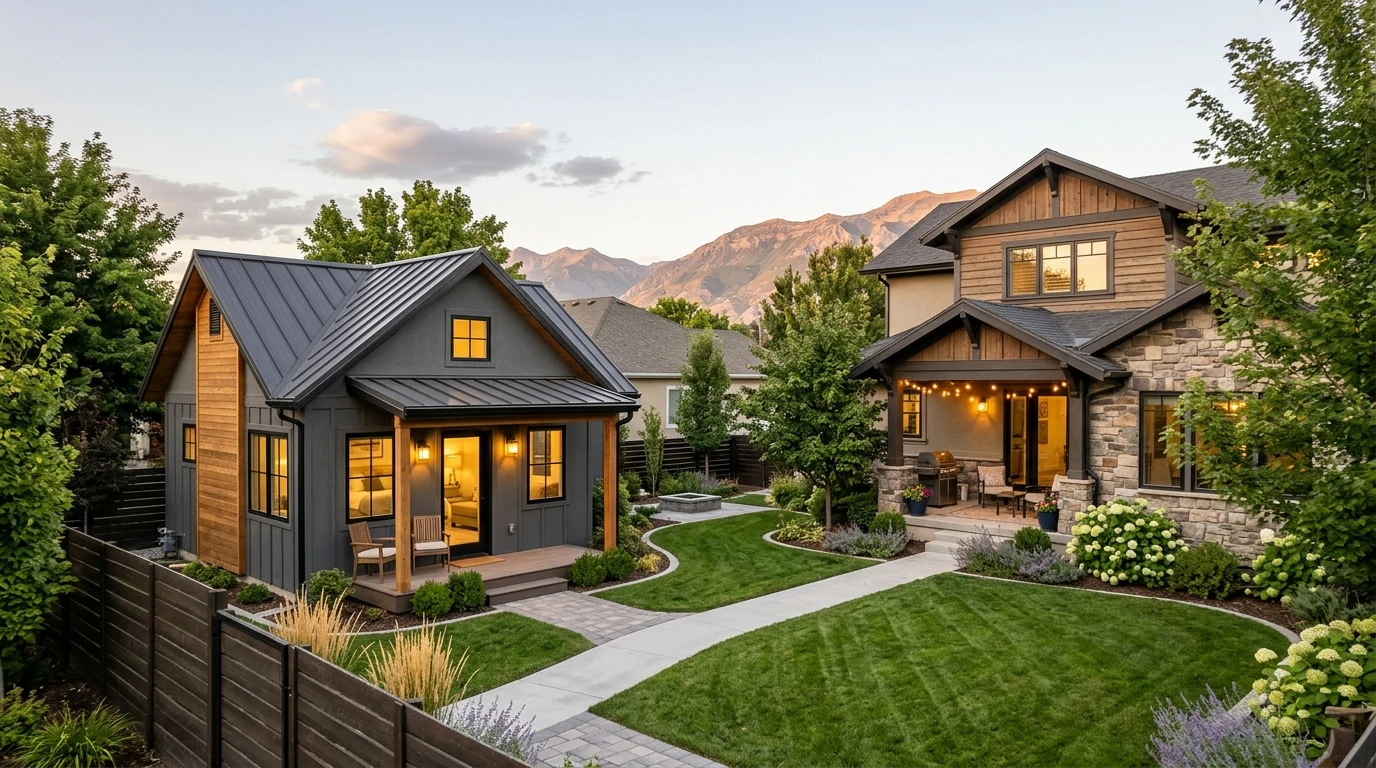
Davis County home with detached ADU backyard cottage at sunset \u2014 dark gray siding with cedar accents, covered porch, stone and timber main house, landscaped walkway, and Wasatch mountain backdrop
A detached backyard ADU in Davis County offers the highest privacy, best rental income, and strongest property value boost \u2014 but availability varies by city.
ADU TypeBest ForEstimated CostApproval SpeedCommon Blocker
Internal (basement)Fastest, lowest cost, every city$50K\u2013$150KFastestEgress windows, fire separation, ceiling height
Attached (addition)Family who wants connected space$80K\u2013$200KModerateMatching architecture, setbacks, parking
Garage conversionUsing existing structure$60K\u2013$120KModerateReplacing lost parking, structural upgrades
Detached (backyard)Max privacy, rental income, property value$150K\u2013$350K+LongestLot size, setbacks, utility connections, cost

Internal ADU (Basement Apartment)

The path of least resistance. It's allowed everywhere in Davis County, it's the cheapest option, and the permitting is usually straightforward \u2014 staff-level review in most cities, no public hearings. The typical internal ADU is a finished basement with a kitchen, bathroom, bedroom with egress window, and a separate entrance.

Best for: Homeowners who want rental income fast, have unfinished basement space, and want to minimize upfront investment.

Watch for: Ceiling height (7-foot minimum), emergency egress in bedrooms, fire separation (half-inch gypsum), and HVAC sufficiency statement from a licensed professional.

Detached ADU (Backyard Cottage)

The premium option. A detached ADU is essentially a small independent home on your property. It offers complete privacy, commands the highest rental income, and adds the most to your property value.

Best for: Homeowners with a large lot (typically 8,000\u201310,000+ sqft minimum) who want maximum rental income, are housing aging parents who need real independence, or want to build long-term equity.

Watch for: Separate foundation, roof, and utility connections drive the $150K+ price tag. Site work (excavation, grading, utility trenching) is often the cost that surprises people most.

The Quick Decision

  • \u2192Budget under $100K and want to start soon? → Internal ADU
  • \u2192Want the best ROI and have a large lot? → Detached ADU
  • \u2192Aging parent needs accessible, single-story, private space? → Detached ADU
  • \u2192In Kaysville or West Bountiful? → Internal or attached only — detached isn’t permitted
  • \u2192In Farmington with a big lot? → Detached ADU, with potential SSF path for separate ownership

How Much Does It Cost to Build an ADU in Davis County?

ADU TypeEstimated TotalCost Per SqftWhat Drives Cost Up
Internal (basement)$50K\u2013$150K$80\u2013$180/sqftEgress work, plumbing relocations, HVAC
Garage conversion$60K\u2013$120K$100\u2013$200/sqftStructural upgrades, insulation, plumbing
Attached addition$80K\u2013$200K$150\u2013$250/sqftFoundation, roofing, utilities
Detached (new construction)$150K\u2013$350K+$190\u2013$250/sqftFoundation, framing, roof, utilities, site work

Based on local Davis County contractor data and ADU Utah benchmarks ($190\u2013$250/sqft). Site work and utility connections can add $25,000\u2013$75,000 depending on distance to mains.

Where Every Dollar Goes (Detached ADU Breakdown)

Cost Category% of TotalTypical RangeNotes
Design & engineering5\u201310%$8K\u2013$25KArchitectural plans, structural, civil
Permits & fees3\u20135%$3K\u2013$12KBuilding permit, plan review, inspections, impact fees
Site prep & foundation8\u201315%$10K\u2013$40KExcavation, grading, concrete
Construction (materials + labor)50\u201365%$95K\u2013$250KFraming, roofing, siding, insulation, windows, doors
Utility connections5\u201312%$8K\u2013$35KSewer, water, electrical, gas \u2014 distance to mains is the variable
Interior finishes10\u201320%$15K\u2013$60KKitchen, bath, flooring, cabinets \u2014 your biggest style choice
Landscaping & restoration2\u20135%$3K\u2013$15KYard repair, driveway, fencing

Davis County Permit Fees (Unincorporated)

Project ValuationPermit Fee
Up to $7,500$200 flat
$7,501\u2013$15,000$200 + $0.025 per dollar over $7,500
$15,001\u2013$25,000$387 + $0.019 per dollar over $15,000
$25,001\u2013$50,000$576 + $0.014 per dollar over $25,000
$50,001\u2013$100,000$928 + $0.011 per dollar over $50,000
$100,001\u2013$250,000$1,458 + $0.008 per dollar over $100,000
$250,001\u2013$500,000$2,658 + $0.006 per dollar over $250,000

Plan review fee added on top. New construction has a $1,000 minimum permit fee. Credit card: 2.5% processing fee. Source: Davis County Municipal Code \u00A72.48.050

The Costs Nobody Budgets For

Utility connections

If your city's sewer main is 100 feet from your ADU location instead of 30 feet, that's an extra $10K–$20K you didn't expect. Get a site evaluation early.

Soil and drainage

Davis County sits along the Wasatch Front with variable soil conditions. A soils report ($1,500–$3,000) can save you from a $15,000 surprise mid-build.

Parking changes

If your ADU requires additional paved parking on a tight lot, concrete, grading, and possible driveway modifications add up fast.

Three ways to reduce costs without cutting corners

  • Go smaller. A 500 sqft unit doesn't cost much more than a 400 sqft unit, but a 400 sqft unit costs far less than a 700 sqft unit.
  • Use pre-designed plans. A pre-engineered plan that's been approved in your city before can save $5K\u2013$15K in design costs plus weeks of review.
  • Phase your finishes. Standard cabinets and LVP flooring today. Upgrade to quartz and hardwood later when rental income is flowing.

Get a Realistic Price Range for Your Specific Property

We'll connect you with Davis County builders who can assess your lot and give you a detailed budget range \u2014 free.

Is an ADU Worth It? The Rental Income and ROI Math

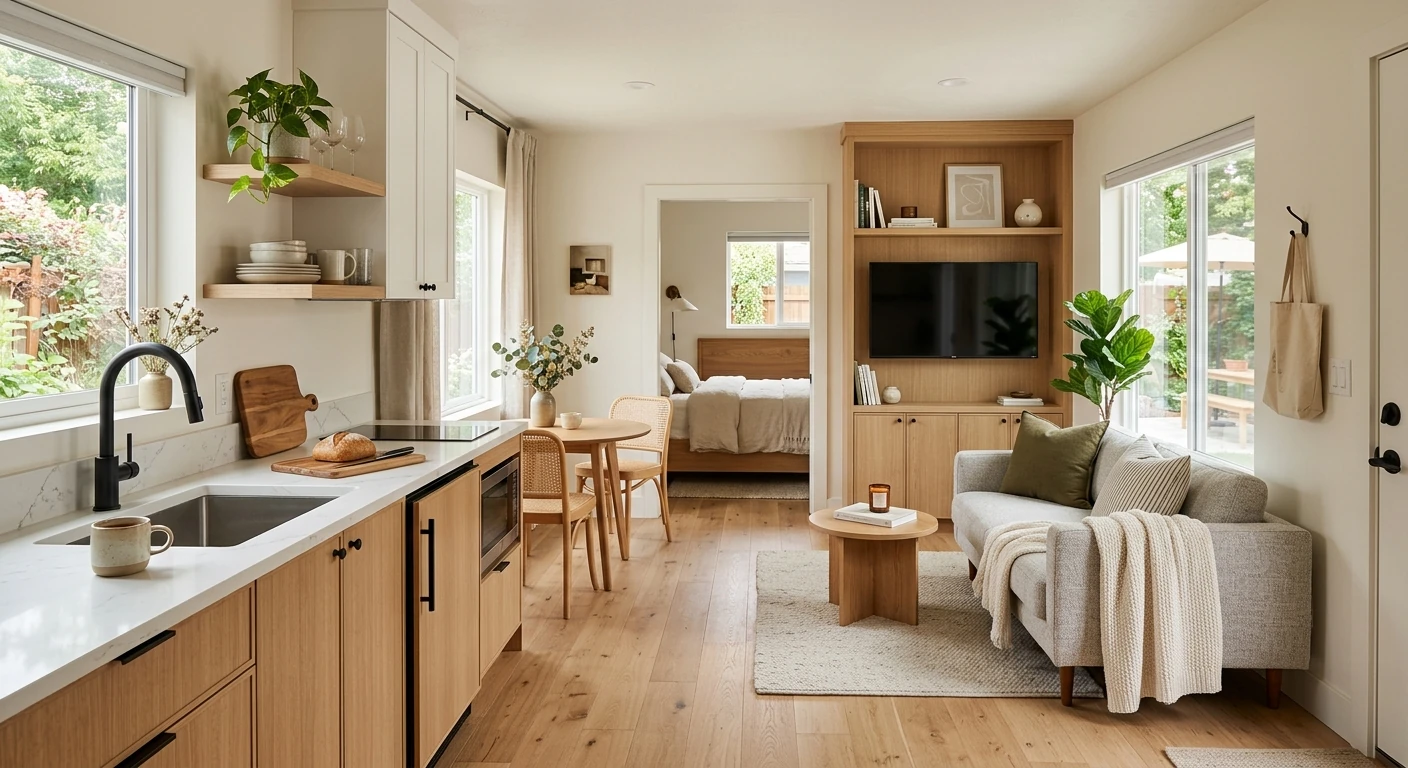
Interior of a beautifully designed Davis County ADU \u2014 open-plan kitchen with white and oak cabinetry, living area with sofa, natural wood flooring, dining nook, bedroom visible through sliding door, abundant natural light from large windows
A well-designed Davis County ADU commands strong rents. The county's average rent is approximately $1,525/month as of early 2026, with ADU-sized units renting from $700 to $1,600+/month.

What You Can Charge for Rent in Davis County

ADU SizeEstimated Monthly RentMarket Context
Studio / efficiency$700\u2013$1,100/moDemand from Hill AFB, young professionals
One-bedroom$950\u2013$1,400/moNear FrontRunner stations command premiums
Two-bedroom$1,200\u2013$1,600/moBountiful/Farmington/Kaysville corridor premium

Based on RentCafe/RentalSource Davis County data, early 2026. Properties near Hill Air Force Base, FrontRunner commuter rail stations, and the Bountiful/Farmington/Kaysville corridor tend to command premiums.

Illustrative ROI Scenario: 650 sqft Detached ADU

Example to show how the math works \u2014 not a guarantee. Your numbers depend on your city, lot, and choices.

Estimated build cost$185,000
Estimated monthly rent$1,200
Annual gross rental income$14,400
Annual expenses (mgmt, maint, ins.)~$3,500
Estimated annual net cash flow~$10,900
Simple payback (cash flow only)~17 years

The part most people miss:

Local appraisers report ADUs typically add 65\u201375% of construction cost to appraised value. On a $185K build, that could mean $120K\u2013$140K in added equity. Your effective out-of-pocket could be $45K\u2013$65K \u2014 then you collect cash flow indefinitely. An ADU is one of the stronger real estate investments a Davis County homeowner can make.

The honest tradeoff

$150K\u2013$350K is serious money. The permit process takes weeks. Construction takes months. You'll have workers in your yard. But the disruption is measured in months. The income and equity are measured in decades. Once you see it that way, the real question shifts from "can I afford to build" to "what's it costing me to wait?"

How Does the Permit Process Work in Davis County?

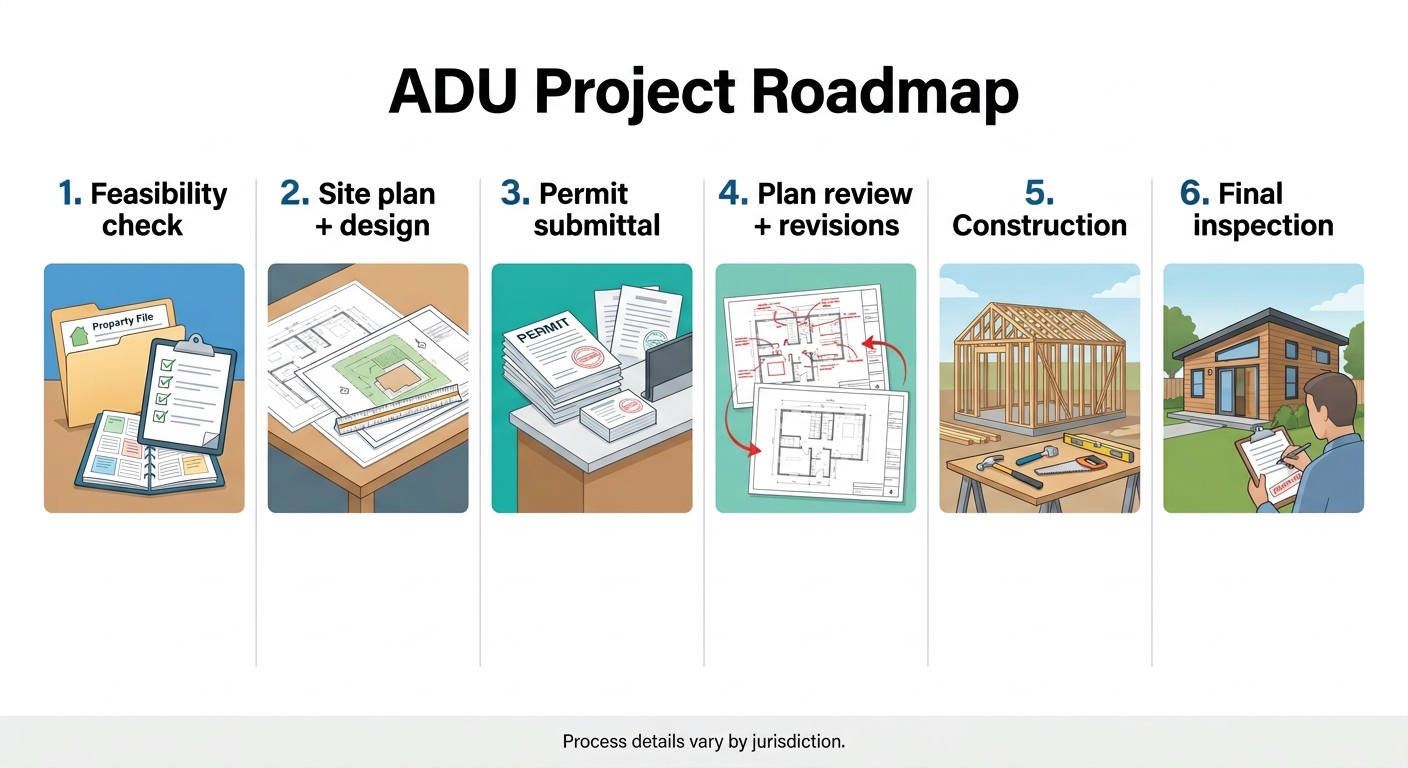
ADU Project Roadmap for Davis County: 6 stages \u2014 (1) Feasibility check (2) Site plan plus design (3) Permit submittal (4) Plan review plus revisions (5) Construction (6) Final inspection. Process details vary by jurisdiction.
The typical ADU project moves through six stages. Timeline: 4\u20139 months from design to move-in. Working with a builder who knows your city's process can save weeks.
1

Feasibility Check (1–2 weeks)

Before you spend money on design, verify that your property qualifies. Confirm your zoning, lot size, setbacks, utility access, parking availability, and owner-occupancy status against your city's ADU ordinance.

2

Design and Plans (2–6 weeks)

Hire an architect or designer to create a full plan set. You'll need a site plan showing the ADU location and setbacks on all four sides, floor plans, elevation drawings, and structural, electrical, plumbing, and mechanical plans. For detached ADUs, you'll also need contractor information and sewer connection verification.

3

Permit Submission and Review (2–8 weeks)

Submit your plans to your city's building department (or Davis County CED for unincorporated areas). Internal ADUs are typically reviewed at staff level — faster and simpler. Detached ADUs in cities like Bountiful require a conditional use hearing before the Administrative Committee. Budget for revisions.

4

Construction (3–6 months)

Once your permit is issued, construction begins. Inspections happen at multiple stages: foundation, framing, electrical rough-in, plumbing rough-in, mechanical, and final. In unincorporated areas, inspections are coordinated through Shums Coda Associates with 24-hour minimum scheduling notice.

5

Final Inspection and Occupancy

After passing final inspection, you receive a Certificate of Occupancy. Most cities also require recording an ADU agreement or affidavit with the Davis County Recorder and obtaining a business license before renting.

What usually slows things down

  • \u2022Submitting incomplete plans (missing site plan details, contractor info, or sewer verification)
  • \u2022Not understanding whether your city treats detached ADUs as permitted use or conditional use
  • \u2022Parking conflicts that weren't caught in the design phase
  • \u2022Utility questions that surface during plan review
  • \u2022Trying to go it alone when an experienced builder could have navigated the process faster

Get Matched With a Builder Who Knows Your City's Process

The fastest path through permitting is a builder who has permitted ADUs in your specific city before.

Utah ADU Laws Every Davis County Homeowner Should Know

HB 82 (2021): The Law That Changed Everything

In 2021, Utah's legislature passed House Bill 82 (Single-Family Housing Modifications). This law requires every Utah municipality and county to allow internal ADUs as a permitted use in single-family residential zones. Before HB 82, many Davis County cities either prohibited ADUs entirely or made approval extremely difficult.

What Cities CAN Restrict

  • \u2022Prohibit IADUs on lots smaller than 6,000 sqft
  • \u2022Require the IADU not change exterior appearance
  • \u2022Require one additional off-street parking space
  • \u2022Require a permit or business license to rent
  • \u2022Prohibit short-term rentals (under 30 days)
  • \u2022Prohibit new IADUs in up to 25% of residential-zoned land

Source: Utah Code \u00A710-21-303 (municipalities); \u00A717-80-303 (counties)

What Cities CANNOT Do

  • Cannot completely ban internal ADUs in residential zones
  • HOAs and community associations cannot restrict or prohibit rental of a compliant internal ADU
  • HOAs cannot prohibit construction of a compliant internal ADU on a residential lot
  • Impact fee exemption: No impact fee may be imposed on construction of an internal ADU within an existing primary dwelling (Utah Code \u00A711-36a-202)

Source: Utah Code \u00A757-8a (Community Association Act); \u00A711-36a-202

Common building code and plan-review requirements across Davis County

  • \u2022Permanent concrete foundation (no piers, no mobile/temporary)
  • \u2022Fire separation between ADU and primary dwelling (half-inch gypsum common standard)
  • \u2022Separate entrance (minimum 32” side-hinged door, not through a garage)
  • \u2022Emergency egress openings in all sleeping rooms
  • \u2022Interconnected smoke and carbon monoxide detectors
  • \u2022Written HVAC sufficiency statement from a licensed professional
  • \u2022Separate electrical branch circuits accessible to ADU occupants

Common plan-review items, not a comprehensive list. Your city's building department will specify exact requirements.

How to Finance Your Davis County ADU

Most Davis County homeowners aren't writing a $200K check. Here are the common funding paths.

Home equity loan or HELOC

The most popular option. With Davis County's median home value well above $400K, many long-term homeowners have significant equity to tap.

Cash-out refinance

Replace your current mortgage with a larger one and use the difference. Makes sense if your existing rate is high and you can refinance at a better rate.

Construction loan

Short-term loan specifically for building that converts to a permanent mortgage. Some lenders now factor in projected ADU rental income during underwriting.

401(k) loan

Borrow against your retirement account. No credit check, no bank approval, you pay yourself back with interest. Useful for bridging a funding gap.

Family contribution

When the ADU is being built for aging parents, they often contribute funds — especially since they'll be the ones living in it. More common than people think.

Combination approach

Many homeowners use a HELOC for most of the cost and savings or family funds for the rest. Let your lender know you're adding a second dwelling unit that increases appraised value.

How to Choose the Right Davis County ADU Builder

Your builder is the most important decision you'll make after deciding to build. The wrong builder costs you money, time, and sanity. The right one makes the process feel almost easy.

Local Davis County experience

Not 'we serve all of Utah.' You want a builder who has permitted and completed ADUs in your specific city, who knows your city's reviewers by name.

Licensed and insured

Verify their Utah contractor license at dopl.utah.gov. For detached ADUs, the property owner or a licensed general contractor must obtain the building permit.

Completed ADU portfolio

Ask to see photos of finished projects. Better yet, visit one. A builder who can't show you completed ADUs probably hasn't built many.

Transparent, detailed pricing

Written estimate itemizing scope, materials, labor, permits, utility assumptions, and exclusions. If they give you one number with no breakdown, keep looking.

Handles permitting

The best ADU builders manage the entire permit and inspection process — plans, submissions, revisions, inspections, final sign-off.

Red flags

  • \u2022Can't name specific Davis County cities they've worked in
  • \u2022Won't provide written references from ADU clients
  • \u2022Asks for more than 10–20% as a deposit
  • \u2022Vague about what's included vs. excluded
  • \u2022Pressures you to skip permits or take shortcuts
  • \u2022Unfamiliar with your city's specific ADU ordinance

10 Questions to Ask Before You Sign

1

Are you licensed and insured in Utah? (Verify the license number independently)

2

How many ADUs have you built in Davis County?

3

Which cities specifically?

4

Do you handle the full permit process — plans, submission, revisions, inspections?

5

Can I see a completed ADU similar to what I want?

6

What's your current timeline from contract to move-in?

7

What's included in your price, and what's explicitly NOT included?

8

How do you handle change orders?

9

Can I contact three past ADU clients?

10

What warranty do you offer on workmanship?

Get Matched With Verified Davis County ADU Builders

Our matching process checks for: active Utah contractor license, current insurance, ADU-specific project history, and Davis County permit experience.

Your 5-Step ADU Feasibility Checklist

1

Confirm your city allows your preferred ADU type

Use the city-by-city matrix in this guide. Internal ADUs are allowed everywhere. Detached ADUs depend on your city.

2

Check your property's physical eligibility

Lot size meets minimums. Setbacks allow placement. No utility easement conflicts. Parking spaces available. HOA reviewed (remember: HOAs can't ban internal ADUs).

3

Set a realistic budget

Internal: $50K–$150K. Detached: $150K–$350K+. Don't forget permits, utilities, and landscaping ($25K–$75K on top). Get three builder estimates.

4

Get financing pre-approved

Talk to your lender about HELOC, cash-out refi, or construction loan options. Ask about ADU-inclusive appraisal and rental income underwriting.

5

Interview builders and start design

Get three estimates from builders with Davis County ADU experience. Review portfolios. Call references. Choose the one who handles permitting and knows your city.

What Can Stop or Delay an ADU Project in Davis County?

We want you to go in with clear eyes. These are the nine blockers we see most often \u2014 and how to avoid each one.

Wrong jurisdiction

You apply to the county but your property is inside a city (or vice versa). Check the Davis County property map first.

Lot too small for detached

Many cities require 8,000–10,000+ sqft. If under the threshold, an internal ADU is your path.

Owner-occupancy conflict

Almost every city requires you to live on the property. Investors buying to add and rent while living elsewhere won't be approved.

Parking shortfall

Explore creative solutions: tandem parking, driveway extensions, or garage-plus-ADU configurations.

Utility surprises

Sewer or water mains farther than expected. A local builder can flag this during feasibility, before you spend on design.

HOA pushback (detached)

State law protects internal ADUs from HOA bans. Detached ADUs may still face HOA restrictions. Read your CC&Rs carefully.

Short-term rental expectations

Most Davis County cities prohibit STR in ADUs. Bountiful and North Salt Lake are notable exceptions. Plan for 30+ day income.

Trying to rent both units

West Bountiful is explicit: you cannot rent both the primary home and the ADU simultaneously. Most cities have similar provisions.

Skipping feasibility

The biggest blocker: spending $10K–$20K on design before confirming your property qualifies. A 30-minute review saves thousands.

The good news: Every one of these blockers is discoverable early. Most Davis County homeowners who want an ADU can build one \u2014 the question is which type, how big, and where on the lot.

Screen the Risks Before You Invest in Plans

Our feasibility review checks your zoning, lot, parking, access, and utility situation for free.

Edge Cases: Owner Occupancy, Parking, Utilities, Short-Term Rentals & Selling

Do I have to live on the property?

Yes. Virtually every Davis County city requires the property owner occupy either the primary dwelling or the ADU as their principal residence. Farmington allows temporary absentee ownership for military, employment, or family obligations.

Can I use my ADU for Airbnb or VRBO?

In most Davis County cities: no. Short-term rentals (under 30 days) are prohibited in ADUs. Bountiful allows it with an approved ADU and a separate STR permit. North Salt Lake allows it with a land use permit and business license, provided the primary dwelling is owner-occupied. Plan finances around long-term rental income.

What about parking requirements?

Requirements vary by city. Bountiful requires one extra off-street stall. Kaysville has one of the most demanding requirements: a dedicated paved ADU stall plus a two-car garage plus a two-car driveway. Syracuse varies by bedroom count. Parking is often the constraint that determines ADU placement and size on tight lots.

Can the ADU have separate utility meters?

Most cities prohibit separate metering for internal ADUs. Some allow detached ADUs to have separate meters as long as the property owner's name is on all accounts. West Bountiful explicitly bans separate metering and separate mailing addresses. Farmington's SSF path requires separate utilities. Without separate meters, you'll either include utilities in the rent or estimate usage with your tenant.

What happens when I sell the house?

Your ADU adds value. The recorded ADU agreement runs with the land. The new owner inherits the ADU but may need to submit a new ADU application and personally occupy the property. Farmington's SSF path allows for separate ownership. Always permit your ADU properly — unpermitted ADUs can torpedo a sale.

Can an HOA stop my project?

For internal ADUs: no. Utah law (Utah Code §57-8a) explicitly prohibits community associations from restricting or prohibiting the rental or construction of a compliant internal ADU. For detached ADUs, HOA restrictions may still apply — read your CC&Rs.

What Should I Do Next?

Three steps between you and a property that works harder for you \u2014 generating income, housing family, or adding serious equity to your biggest asset.

STEP 1

Check your city + lot fit

We confirm your city's rules, your lot's eligibility, and your parking situation.

STEP 2

Choose the right ADU type

Internal for fast and affordable. Detached for maximum income and privacy.

STEP 3

Get a realistic estimate

Talk to builders who know your city. Compare estimates. Pick the right one.

No cost. No obligation. Just a clear answer about what's possible on your property.

Frequently Asked Questions About Davis County ADUs

Sources & How We Verified This Guide

  • \u2022Davis County Municipal Code — §15.20.130, §2.48.050 (daviscounty.municipalcodeonline.com)
  • \u2022Davis County CED Building Permits (daviscountyutah.gov/ced/planning/building-permits)
  • \u2022Farmington City ADU + SSF Toolkit (January 2025); Code §11-28-200; Ord. 2024-41, Ord. 2024-62
  • \u2022Bountiful City ADU Requirements Guide (2024); Code Ch. 14-14-124
  • \u2022West Bountiful City Code Ch. 17.82 (wbcityut.gov)
  • \u2022Clearfield City Code Title 11; Ordinance 2025-23
  • \u2022Syracuse City planning materials and deed restriction form
  • \u2022North Salt Lake City Code Ch. 10-1-44; STR License page (nslcity.org)
  • \u2022Kaysville City IADU page (kaysville.gov/818); Code 17-31-3
  • \u2022Layton City FAQ and planning resources
  • \u2022Utah Code §10-21-301 et seq. — Municipal internal ADU provisions
  • \u2022Utah Code §17-80-301 et seq. — County internal ADU provisions
  • \u2022Utah Code §57-8a — Community Association Act (HOA provisions)
  • \u2022Utah Code §58-55-301, §58-55-305 — Contractor licensing requirements
  • \u2022Utah Code §11-36a-202 — Impact fee exemption for internal ADUs
  • \u2022Utah HB 82 (2021) — Single-Family Housing Modifications
  • \u2022Utah Property Rights Ombudsman (propertyrights.utah.gov)
  • \u2022Rental market data: RentCafe, RentalSource (Davis County, early 2026)
  • \u2022Appraisal methodology: Minson Appraisal Group (Davis County coverage)
  • \u2022Construction cost benchmarks: Local Davis County contractors; ADU Utah (aduutah.com)

Important disclaimer

Ordinances change. This guide is reviewed and updated quarterly. Always confirm current requirements with your city or county planning department before committing funds. Last verified: March 2026.

\u00A9 2026 Utah ADU Builders \u00B7 utahadubuilders.com \u00B7 This guide is updated quarterly. Last review: March 2026.