Independent ADU Planning Resource801-441-4365

Heber City ADU Guide: Rules, Costs, Permits, and How to Choose the Right Builder

By Utah ADU Builders Editorial Team · Last Updated March 2026 · Code-verified against Heber City Municipal Code §18.68.611, §18.68.030, §5.26, Utah HB 82, and Heber City FAQ

Disclosure: Utah ADU Builders connects homeowners with local builder options. If you request an estimate through this page, we may receive a referral fee at no cost to you. Verify licensing, insurance, and references before hiring. This does not influence our editorial content.

Yes, you can build an ADU in Heber City. Both internal ADUs (think basement apartments) and detached ADUs are allowed on owner-occupied, single-family lots in residential zones. Heber City amended its ADU rules in 2021 in response to Utah's statewide HB 82 law, then updated and reorganized the ADU section again during its broader Envision Heber code revision — going further than the state minimum by also permitting external units.

But here is what most generic ADU pages will not tell you: the answer for your property depends on five things that trip up more Heber homeowners than anything else. Whether you are actually inside Heber City limits (not just a Heber mailing address), whether the unit is internal or detached, parking, owner-occupancy, and your site and utility situation. Get those five right, and the rest is execution.
Heber City ADU Guide: Rules, Costs, Permits, and How to Choose the Right Builder — mountain home in the Heber Valley with Wasatch Range backdrop

The Quick Answer for Heber City ADUs

  • Internal and detached ADUs are allowed in Heber City residential zones
  • Owner must live on-site (in either the main home or the ADU)
  • One ADU per single-family lot (CHOZ properties may have additional options)
  • Must include a separate kitchen and full bathroom
  • At least three total off-street parking spaces required (ADU space must be hard-surfaced)
  • Business license required if you rent the unit
  • 💰Typical total cost: $60,000 – $350,000+ depending on ADU type
  • 📋Building permit required through Heber City Building Department

Can You Build an ADU in Heber City?

Short answer: most Heber City homeowners on a residential lot can. But "most" is doing some heavy lifting, so let's get specific.

You are likely in good shape if:

  • Your property is inside Heber City limits (not unincorporated Wasatch County)
  • The property is an owner-occupied single-family dwelling in a residential zone
  • It is owner-occupied — you live in either the main house or the ADU
  • You can provide at least three total off-street parking spaces (two for the main + one hard-surfaced for the ADU)
  • The property is not in a mobile home park or large-scale multi-family development

Proceed carefully if:

  • You have a Heber mailing address but are actually in Wasatch County jurisdiction (different rules)
  • You are in an HOA (state law protects internal ADUs, but detached ADUs may be more complicated)
  • You plan to rely on short-term rental income exclusively (STR is a separate compliance question from ADU approval)
  • Your lot has tight access, steep grades, or utility limitations
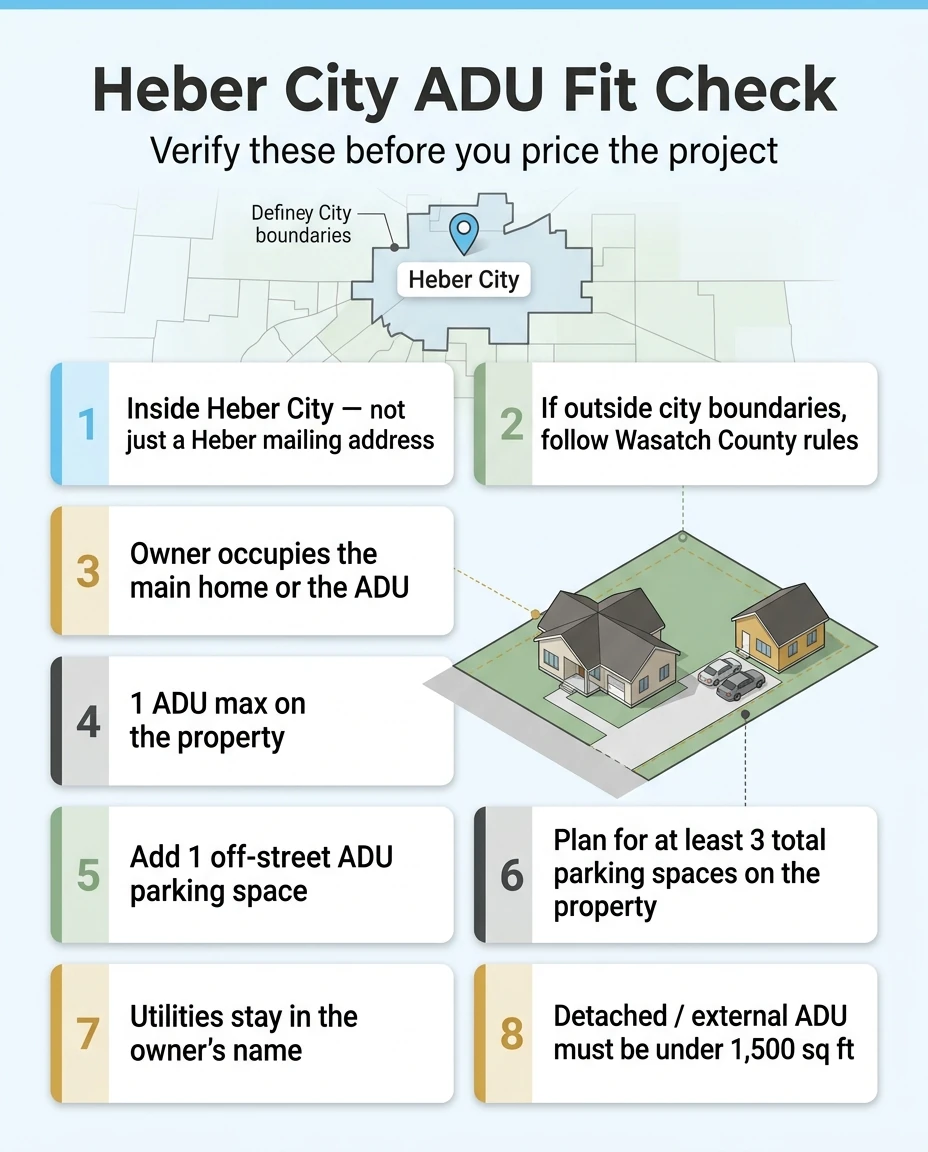
Heber City ADU Fit Check — verify these 8 items before you price the project: (1) Inside Heber City limits not just a mailing address, (2) If outside city boundaries follow Wasatch County rules, (3) Owner occupies the main home or the ADU, (4) 1 ADU max on the property, (5) Add 1 off-street ADU parking space, (6) Plan for at least 3 total parking spaces on the property, (7) Utilities stay in the owner's name, (8) Detached or external ADU must be under 1,500 sq ft
Verify all eight of these items before investing in design — catching a problem at this stage can save thousands of dollars and months of time.

The CHOZ edge case most guides miss

If your property is in Heber's Central Heber Overlay Zone (CHOZ), you may have access to additional flexibility that standard ADU rules don't cover — including the possibility of both an SDU and an internal ADU on the same property. We break that down in detail below.

Reference: Heber City Municipal Code §18.68.611 (Accessory Dwelling Units); §18.68.030 (One Dwelling and Internal and External ADU Per Lot)

First Things First: Are You Actually in Heber City?

This sounds like a strange question, but it is the single most common mistake we see. Many people have a "Heber City" mailing address but their property is actually in unincorporated Wasatch County. Heber City's own FAQ page makes this explicit: if your address or parcel number is outside the municipality boundary lines on the zoning map, you are in Wasatch County jurisdiction — not Heber City.

This matters because Wasatch County has its own ADU application process, its own conditional use permit requirements, and its own set of rules. If you design an ADU around Heber City's ordinance but your lot is actually in the county, you will hit a wall at the permit counter.

How to Check in Two Minutes

  1. 1Pull up the Heber City interactive zoning map (available at heberut.gov under Maps → Heber City Zoning Map)
  2. 2Search your address or parcel number
  3. 3If your parcel appears inside the city boundary and shows a residential zone code, you are in Heber City
  4. 4If it falls outside the boundary, you are in Wasatch County and need to contact their planning office instead

If you are in Wasatch County:

The ADU path involves a conditional use permit application with the county's planning department. The rules, application forms, and review process are different from Heber City's. We can still help — just make sure you are working with the right jurisdiction from the start.

Not Sure Which Jurisdiction You're In?

We will check your parcel for free as part of our feasibility review — including whether Heber City or Wasatch County rules apply to your property.

What Types of ADUs Can You Build in Heber City?

Not all ADUs are created equal. The type you choose affects your cost, your timeline, your permit complexity, and ultimately how much income or value the unit generates. Here is how the four main options compare in the Heber Valley.

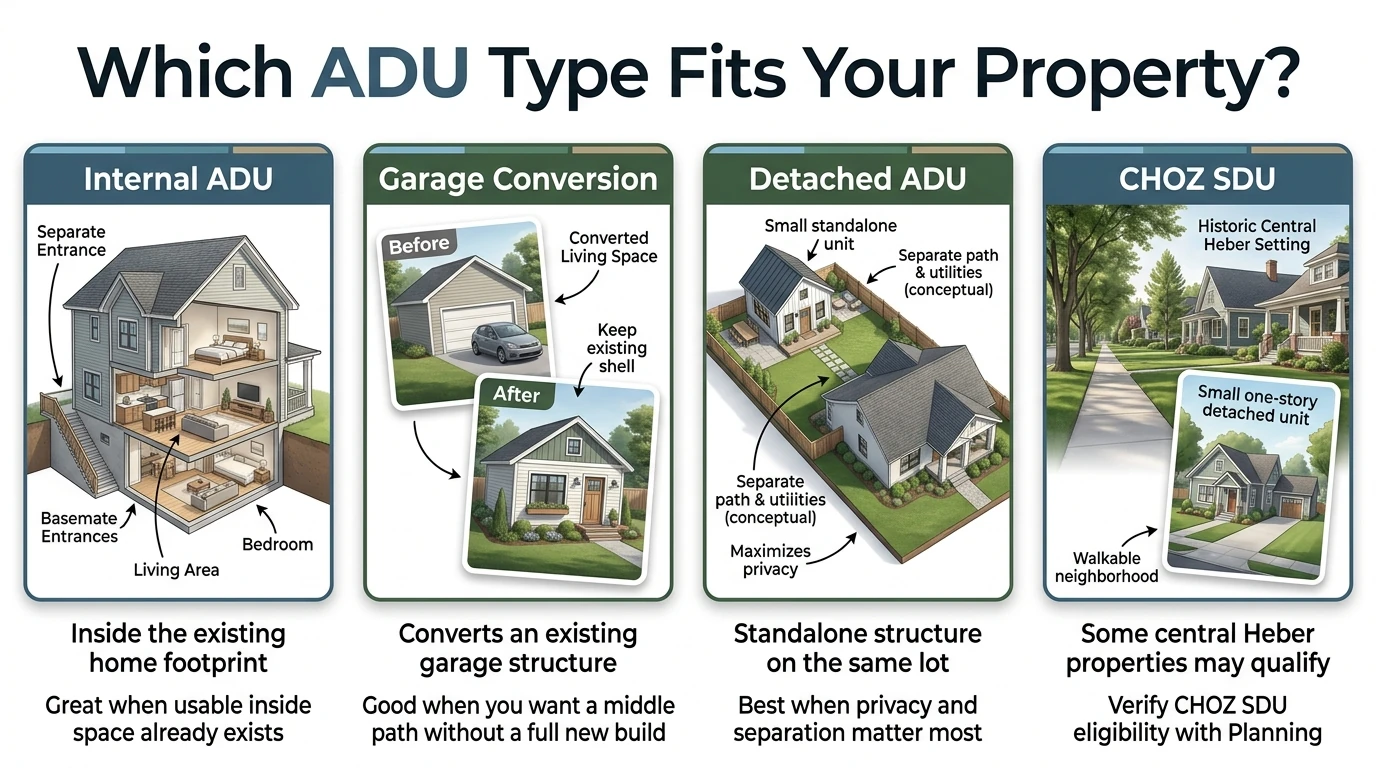
Which ADU Type Fits Your Heber City Property? Four options compared: Internal ADU (inside existing home footprint, great when usable inside space already exists), Garage Conversion (converts existing garage structure, good middle path without a full new build), Detached ADU (standalone structure on same lot, best when privacy and separation matter most), CHOZ SDU (some central Heber properties may qualify for Subordinate Dwelling Unit with walkable neighborhood setting)
The right ADU type depends on your property, your goals, and the specific Heber City rules for your zone. The CHOZ SDU option is unique to central Heber properties — most guides completely miss it.
ADU TypeTypical CostTimelinePrivacyRental IncomePermit Complexity
Internal (Basement) ADU
Unit within existing footprint
$60K–$150K3–6 monthsModerate$1,200–$1,800/moLower
Garage Conversion
Convert existing garage to livable space
$80K–$180K4–8 monthsHigh$1,300–$2,000/moModerate
Detached ADU (New Build)
Standalone structure in yard
$150K–$350K+8–14 monthsHighest$1,500–$2,500/moHigher
CHOZ Subordinate Dwelling Unit
Central Heber Overlay Zone only
$120K–$250K6–12 monthsHigh$1,300–$2,000/moModerate–High

Estimates updated March 2026 based on contractor feedback, published Utah construction cost data, and Heber Valley site-condition adjustments. Your actual costs will vary based on site, scope, finishes, and market conditions. Get a project-specific estimate before making financial commitments.

Internal (Basement) ADU

Choose this if you already have existing square footage you can convert

Utah's 'basement culture' means many Heber homes were already built with rough-in plumbing downstairs, unfinished lower levels with good ceiling heights, and sometimes even separate entries. That is a huge head start. Internal ADUs are the most affordable path and the fastest to permit. Under Utah state law (HB 82), they are exempt from impact fees, HOAs cannot ban them, and cities must allow them in residential zones. The tradeoff is less privacy — you are sharing a structure with your tenant.

Detached ADU

Choose this if privacy matters most and you have yard space, site access, and budget

Detached units command the highest rents in the Heber Valley because tenants get a fully independent living experience. The catch is cost and complexity. At Heber's 5,595-foot elevation, that means snow load engineering, high-performance insulation, and proper drainage — all of which add to the build cost compared to lower-elevation Utah cities.

Garage Conversion

Choose this if your garage is structurally sound and you want a middle-ground between cost and independence

You already have the shell — you are paying to make it livable (insulation, plumbing, electrical, HVAC, egress, finishes) rather than starting from the ground up. One thing to watch: if you convert a garage, you need to replace those lost parking spaces on your property. Heber requires hard-surfaced parking, so budget for that separately.

CHOZ Subordinate Dwelling Unit

Look at this if you are in central Heber — it's an option no other guide tells you about

The Central Heber Overlay Zone allows qualifying lots of 5,000 sq ft or more to build a one-story SDU of 300–800 sq ft. Here is the powerful part: the original existing dwelling in the CHOZ may also contain an internal ADU on top of the SDU. For qualifying properties, that is a materially different deal than the standard one-ADU rule. Confirm current SDU eligibility with Planning before designing around the CHOZ path.

Which ADU Type Makes Sense for Your Heber City Property?

We'll assess your specific lot, goals, and budget and tell you which path gives you the best outcome — free, no pressure.

Heber City ADU Rules: The Complete Breakdown

This is the section to bookmark. We verified these against Heber City Municipal Code §18.68.611 and the city's ADU Notice form. If you have seen other "Heber City ADU" pages that cite Salt Lake City rules or generic Utah numbers — those are wrong for Heber. Here are the real rules.

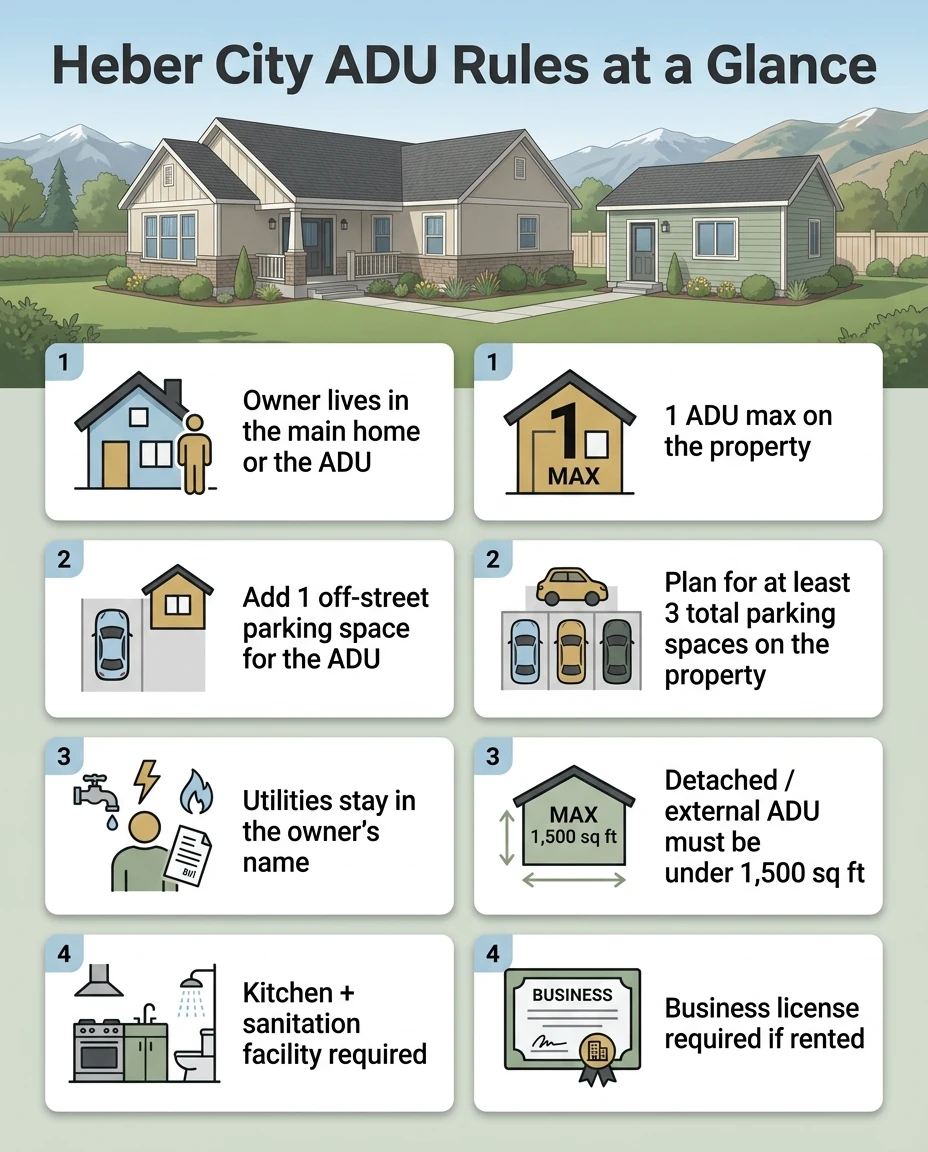
Heber City ADU Rules at a Glance — 8 key rules: (1) Owner lives in main home or ADU, (2) Add 1 off-street parking space for ADU, (3) Utilities stay in owner's name, (4) Kitchen plus sanitation facility required; and (5) 1 ADU max on the property, (6) Plan for at least 3 total parking spaces, (7) Detached or external ADU must be under 1,500 sq ft, (8) Business license required if rented
Heber City ADU rules at a glance — all verified against Heber City Municipal Code §18.68.611 and the city's ADU Notice form.
RuleWhat Heber City RequiresWhat It Means for You
ADUs per lotMaximum one ADU per single-family residential lotYou pick internal OR external — not both (except CHOZ SDU scenarios)
Owner-occupancyEither the ADU or the main home must be occupied by the property ownerYou cannot build an ADU and leave the whole property as a rental. You live in one unit.
ParkingTwo off-street spaces for the main dwelling plus one additional for the ADU (three total). ADU space must be hard-surfaced (concrete or asphalt).Garage and carport spaces count. ADU parking can be in setback areas if it does not displace required landscaping.
External appearanceNo external evidence of occupancy by more than one familyThe property should still look like a single-family home from the street
KitchenADU must include a kitchen separate from the main dwellingThis is what makes it a dwelling unit, not just a bedroom suite
BathroomFull sanitation facilities requiredFull bathroom — toilet, sink, shower or tub
AddressSame address as main structure, with Apartment #1 or #2 designationYour ADU does not get a separate street address
Utility metersWater and gas: maximum two meters per service. Electric: one meter per building. All meters must be in the property owner's name.Even if a tenant uses the ADU, the meters stay in your name.
Building codesMust comply with International Residential Code (IRC) and International Building Code (IBC) as adoptedNo cutting corners on structural, electrical, plumbing, or fire safety
LandscapingLot must have landscaped yard per Heber City Chapter 18.76, including street tree requirementsThis is the rule most contractor pages skip entirely
Business licenseRequired if you rent the ADU (maintained annually)Whether long-term or short-term rental, you need a business license from Heber City
Short-term rentalNot automatically included with ADU approval. Heber City has a separate STR ordinance (§5.26) with its own licensing requirements.Treat rental strategy as a separate compliance question — do not assume every ADU can be used for nightly stays without verifying first.

Three Rules Worth Explaining in More Detail

Owner-Occupancy Is Non-Negotiable

This is the rule that surprises investors. You cannot build an ADU and then rent out both the main house and the ADU while living somewhere else. Either you live in the main home and rent the ADU, or you live in the ADU and rent the main home. One of the two units must be your primary residence.

Parking Kills More Projects Than People Expect

You need at least three total off-street parking spaces — two for the main dwelling and one for the ADU — and the ADU space must be hard-surfaced. In Heber's climate, where winter street parking is restricted during snow removal, this is not just a rule — it is a practical necessity.

The good news: garage and carport spaces count toward the requirement, and the ADU parking stall can be placed in setback areas as long as it does not displace required landscaping.

Utility Accounts Stay in Your Name

Even if your ADU tenant is paying their own bills, the meters stay in the property owner's name. Heber allows a maximum of two meters for water and gas service, and only one electric meter per building. Plan your utility design around these constraints from the start — this affects how you run electrical for a detached ADU.

Reference: Heber City Municipal Code §18.68.611; §18.68.030; §5.26; Heber City ADU Notice form

How Much Does an ADU Cost in Heber City?

The honest answer is: it depends heavily on what you are building. But we can give you real ranges based on Utah market data and Heber Valley conditions.

Cost by ADU Type

ADU TypeLow EstimateMid EstimateHigh EstimateCost per Sq Ft
Basement finish / conversion$60,000$100,000$150,000+$100–$200
Garage conversion$80,000$130,000$180,000+$120–$220
Detached new build (400–800 sq ft)$150,000$225,000$350,000+$200–$400

What Drives Costs Higher in the Heber Valley

Building at 5,595 feet elevation in the Heber Valley is not the same as building in Lehi or West Jordan. Several factors push costs toward the upper end of Utah ranges:

Snow load and energy-code compliance

Roofs and structures must meet snow load requirements for this elevation, and energy codes demand higher-performance insulation for Heber's climate zone.

Site access, utility runs, and excavation

Depending on your specific lot, running utilities to a detached unit or excavating for a foundation can be more involved than on flat Wasatch Front lots — especially if you hit rock.

Drainage and grading

Snowmelt and storm water management requirements can add meaningfully to site preparation costs in the Heber Valley.

Finish level and design complexity

The level of finish you choose is one of the biggest cost variables you control. Thoughtful value engineering here saves real money without sacrificing livability.

The Costs Most People Forget

The sticker price for construction is not the whole picture. Budget for these soft costs and site expenses that can add $15,000 to $40,000+ to a project:

Cost ItemTypical Range
Architectural and engineering plans$5,000–$15,000
Permit and plan review fees$1,500–$5,000+
Utility connections (water, sewer, gas, electric to detached units)$8,000–$18,000
Site preparation (excavation, grading, retaining work)$2,000–$10,000+
Parking surface (hard-surfaced pad for required ADU space)$2,000–$6,000
Landscaping restoration and street tree compliance (Chapter 18.76)$2,000–$5,000

The one cost advantage of internal ADUs

Under Utah state law (Utah Code §11-36a-202), construction of an internal ADU within an existing primary dwelling is exempt from impact fees. Depending on your municipality, impact fees can run several thousand dollars. For a basement conversion, that exemption can meaningfully reduce your total project cost.

Where Does the Money Actually Go?

For a detached ADU, here is how your budget typically breaks down (percentages shift depending on project type):

5–15%

Design and planning

Architectural plans, engineering, surveys, permit fees

8–15%

Site preparation and foundation

Excavation, grading, concrete, drainage — minimal for internal conversions

20–30%

Framing, roofing, and exterior

Structure, siding, windows, doors

15–25%

Mechanical systems

Plumbing, electrical, HVAC — Heber's climate drives costs up; heating must handle sustained sub-zero temperatures and cooling must handle 90°F summer days

15–25%

Interior finishes

Flooring, cabinets, countertops, fixtures, paint — the category you control most, and where thoughtful value engineering saves real money

5–12%

Utility connections

Extending water, sewer, gas, electric to detached units — the wildcard, especially if you hit rock during trenching in the Heber Valley

How to Finance Your Heber City ADU

Financing MethodHow It WorksBest For
Home equity loan or HELOCLeverage equity in your existing home (Heber City home values average ~$819K, Zillow 2026)Homeowners with significant equity; HELOC offers flexibility during construction
Cash-out refinanceNew mortgage that pulls equity outMakes sense if current rates work in your favor
Construction loanDesigned for new build projects; converts to permanent mortgage after completionDetached new builds requiring phased funding
Credit union renovation loansSome Utah credit unions offer renovation-to-permanent loans factoring in future ADU valueImproving loan-to-value ratio for the full project

The rental paydown approach

Many Heber homeowners use a HELOC to fund the project, then pay it down aggressively with rental income. At $1,800 per month in rent, you are putting $21,600 per year directly toward paying off the construction cost — while the unit appreciates in value at the same time. You are not just spending money. You are building an income-producing asset on property you already own.

Want a Real Cost Estimate for Your Specific Property?

We will connect you with a Heber Valley builder who can assess your lot and give you a detailed budget range — free, no obligation.

Can You Rent a Heber City ADU? Rental Rules and Income Potential

Yes — but your rental options depend on the type of ADU and a separate layer of licensing. This is where many homeowners make assumptions that get them in trouble. Here is how it actually works.

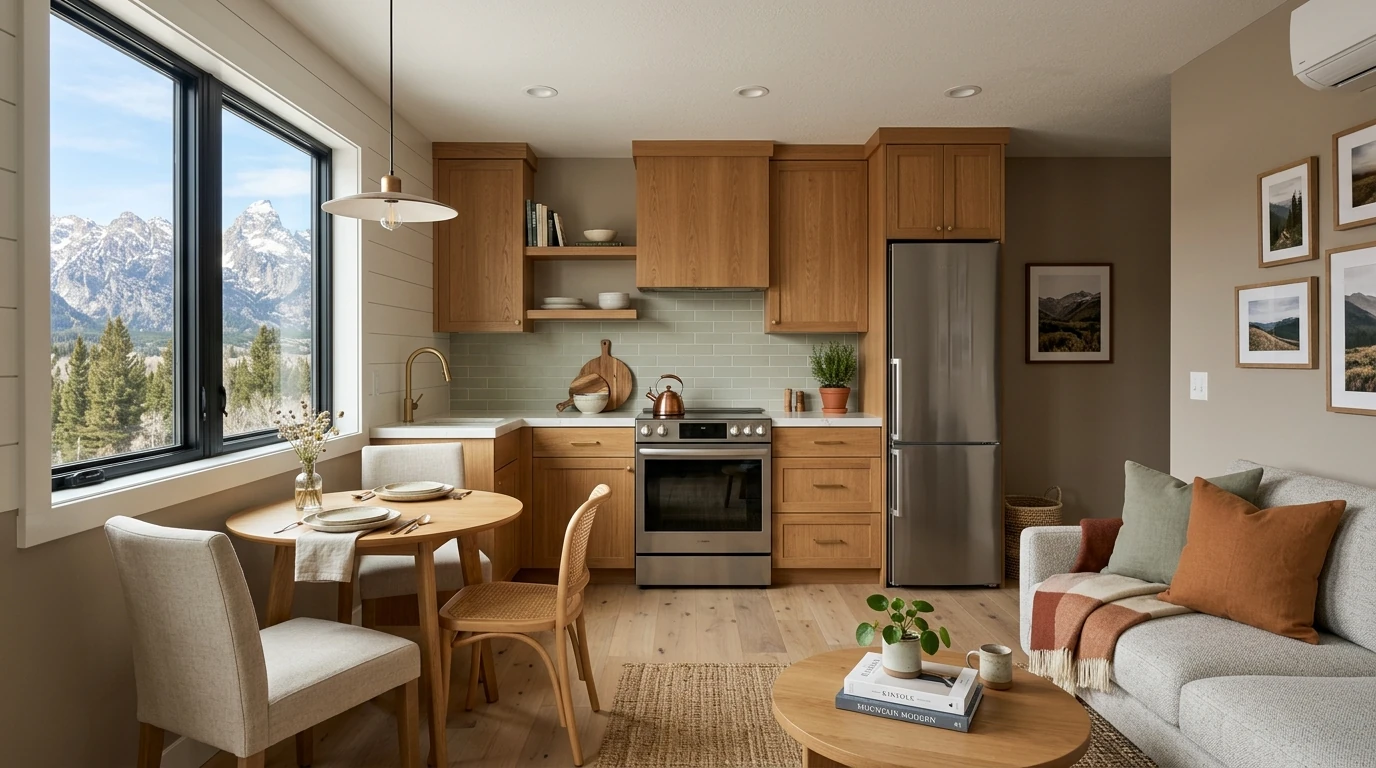
Interior of a well-designed Heber City ADU — open-plan kitchen and living area with mountain views, warm wood cabinetry, stainless appliances, and natural light — the kind of space that commands premium rents in the Heber Valley
A well-designed Heber Valley ADU interior commands premium rents. Heber City's median rent across all property types was approximately $2,655/month as of mid-2025 — roughly 37% above the national average.

Long-Term Rental (30+ Days)

  • Business license required from Heber City (renewed annually)
  • Owner-occupancy requirement applies — you must live in the main home or the ADU
  • Under Utah state law, an internal ADU is specifically defined as a unit for long-term rental of 30 consecutive days or longer

Short-Term Rental (Nightly / Under 30 Days)

  • This is a separate compliance question from your ADU approval
  • Heber City has its own STR ordinance (§5.26) with its own license, inspections, signage, and occupancy rules
  • Local property manager must be within 10 miles
  • One STR reservation at a time per property; owner must live onsite if only part of the dwelling is rented
  • Do not design your project around Airbnb income without first verifying your configuration qualifies

What Can an ADU Rent for in the Heber Valley?

The rental market in Heber City is remarkably strong — and the data explains why homeowners are building ADUs here at an increasing rate.

Rental ScenarioEstimated Monthly IncomeContext
Long-term 1-bed ADU$1,200–$1,800/moHeber City median rent was ~$2,655 across all property types as of mid-2025 (Zumper), roughly 37% above the national average
Long-term 2-bed ADU$1,600–$2,200/moOver 6,000 people commute into Wasatch County daily for work (Park Record, Jan 2025) — demand is strong
Short-term / nightly (peak season)$2,000–$4,000+/moHeber Valley is 25 minutes from Park City and Deer Valley ski resorts. STR licensing required separately.

Rental estimates are illustrative ranges based on published market data. ADU rents vary by unit size, finishes, location, and market conditions. Verify current rental comps before making financial projections.

Why demand is so strong in Heber Valley

The Regional Housing Needs Assessment for Summit and Wasatch Counties estimated Heber City needed approximately 101 new rental units annually during the 2019–2023 assessment period. Over 6,000 workers commute into Wasatch County every day because they cannot find or afford housing locally — teachers, nurses, police officers, service workers who keep the valley running.

Average Heber City home values were approximately $819,000 as of early 2026 (Zillow). At that price point, an ADU generating $1,500–$2,000 per month in rental income is not a luxury — it is a financial lifeline that helps offset a significant mortgage while providing housing the community desperately needs.

Quick ROI Snapshot

Illustrative example to show how the math works — not a guarantee. Your numbers depend on your build cost, rental rate, and expenses.

Mid-range detached ADU at $200,000, rented long-term at $1,800/month:

Annual gross rental income$21,600
Estimated annual expenses~$3,500
Net annual income~$18,000
Simple payback period~11 years

That payback shortens significantly if you factor in property value appreciation in one of Utah's fastest-growing corridors, or if you capture peak-season short-term rental rates. Consult a local appraiser for Heber-specific guidance.

Can Your HOA Block an ADU in Heber City?

This is one of the biggest fear factors we hear from homeowners, and the answer depends on what type of ADU you are building.

For Internal ADUs: Your HOA Cannot Block It

Utah HB 82 specifically prohibits homeowners' associations and CC&Rs from banning internal accessory dwelling units. This was a major change in 2021 — the state legislature explicitly overrode private HOA covenants on this point. (Utah Code §57-8a-218)

For Detached ADUs: HOA May Have More Authority

Your CC&Rs may impose architectural standards, design requirements, or other limitations on external structures. This is a conversation you should have with your HOA board early in the process — before investing in design.

Practical advice

Even when you have state law on your side (for internal ADUs), approach your HOA collaboratively. Notify them early, share your plans, and demonstrate that the unit will meet all building codes and blend with the neighborhood character. Heber City's own FAQ confirms that the Planning Department does not enforce CC&Rs — enforcement is solely up to the HOA. But a cooperative approach avoids unnecessary conflict.

Reference: Utah Code §57-8a-218 (HOA restrictions on IADUs); Heber City FAQ, heberut.gov/344/FAQs

What Does the Permit Process Look Like?

The Heber City permit process is straightforward once you know the sequence. Here is the step-by-step path from idea to move-in day.

1

Verify Your Zoning and Jurisdiction

Before anything else, confirm that your property is inside Heber City limits and zoned residential. Use Heber City's interactive zoning map to search your address or parcel number. If you are outside the city boundary, you will need to follow Wasatch County's conditional use permit process instead.

2

Decide Your ADU Path

Internal (basement), garage conversion, or detached? This decision shapes everything that follows — your budget, your timeline, your plan requirements, and your permit complexity. If you are in the CHOZ area, investigate the SDU option as well.

3

Design and Plan Preparation

Hire an architect or designer familiar with Heber City's requirements. Your plans must show the separate kitchen, full bathroom, parking space, utility connections, and compliance with the International Residential Code. For detached units, you also need to demonstrate setback compliance for your specific zoning district.

This is where working with a Heber-experienced builder pays off. They know what the Building Department wants to see, and they can prepare a submittal that gets through review without unnecessary rounds of revision.

4

Submit Through Heber City's Online Permit Portal

Heber City routes all residential building permit applications through its online portal. Submit your plans, site drawings, and any required engineering documentation along with applicable fees. The ADU section also requires recording a Notice of Compliance Agreement at the time of building-permit application and/or business licensure — a step your builder should handle.

5

Plan Review (4–6 Weeks)

The city conducts two separate reviews: the Planning Department checks your plans against the Zoning Ordinance, and the Building Department reviews for compliance with the International Building Code. These are different reviews by different departments. Expect 4 to 6 weeks for plan review, potentially longer if revisions are needed. Utah state law (HB 98) establishes clear timelines for plan reviews on one-to-two-family dwellings.

6

Construction and Inspections

Once your permit is issued, construction begins. You will schedule inspections at each major phase: foundation, framing, rough plumbing, rough electrical, rough mechanical, insulation, drywall, and final. Heber City's inspection hours are Monday through Thursday, 9 a.m. to 4 p.m.

7

Final Inspection and Occupancy

The Building Department conducts a final inspection. If you are renting the unit, you will also need to obtain your business license from the city. If pursuing short-term rental use, ensure you have also completed the STR licensing process under §5.26.

Realistic Timeline Expectations

4–8 months

Basement conversion

Design through final inspection

5–10 months

Garage conversion

Includes parking replacement

8–14 months

Detached new build

Shorter building season at elevation

These timelines account for Heber Valley's shorter building season — winter weather can limit exterior construction activity at this elevation. Every month you delay is a month of potential rental income you are leaving on the table.

Ready to Start? Get a Free Feasibility Review and Timeline Estimate

We'll map out the realistic timeline for your specific project type in Heber City — before you commit to a designer or builder.

What Can Kill or Delay Your Heber City ADU Project?

Most ADU projects don't fail because the idea is bad. They fail because a critical issue gets discovered too late — after the homeowner has already spent money on design. Here are the risks to screen early.

RiskWhy It MattersHow to Screen ItDeal-Breaker or Solvable?
Wrong jurisdictionHeber City rules don't apply in Wasatch CountyCheck zoning map before anything elseSolvable — but you need the right rules
Parking shortfallCannot provide a hard-surfaced off-street parking spaceMeasure your lot and existing parkingCan be a deal-breaker on tight lots
HOA restrictions (detached)HOA may block or restrict external structuresReview CC&Rs and talk to HOA board earlySolvable for internal ADUs; trickier for detached
Utility limitationsRunning water/sewer/electric to a detached unit is expensive or physically difficultHave a builder walk the site before designUsually solvable — but can significantly increase cost
Tight access or steep gradeConstruction equipment cannot reach the build site, or grade requires extensive retaining workSite visit and feasibility assessmentCan be a deal-breaker for detached; less relevant for internal ADUs
Budget underestimationActual costs 30–50% higher than the homeowner's initial numberGet a real estimate — not a guess — before committingSolvable with realistic planning
Builder without local experienceContractor unfamiliar with Heber City's code, Building Department, or mountain building conditionsAsk how many ADUs they have built in Heber/Wasatch CountySolvable — choose the right builder

The honest admission

Not every Heber lot is a good detached-ADU lot. Parking, access, utility routing, and site grades can stop a project cold. We would rather tell you that now than have you discover it after spending $10,000 on plans.

But here is the flip side: those are exactly the risks a proper feasibility review catches before you spend real money. A 30-minute site visit with a Heber-experienced builder can screen most of these issues. And in most cases, there is a workable path — it might just be a different type of ADU than you originally imagined. The homes where ADUs truly do not work are the exception, not the rule.

Screen the Risks Before You Invest in Plans

Our feasibility review checks your zoning, lot, parking, access, and utility situation for free. Catch problems before they cost you thousands.

Utah State ADU Law: What Protects Heber City Homeowners

You don't need to memorize Utah state code to build an ADU. But knowing the broad strokes helps you understand what is required, what is optional, and where the law is on your side.

HB 82 (2021) — Single-Family Housing Modifications

This is the bill that changed the ADU landscape across Utah. Here is what it did:

  • Made internal ADUs a permitted use in all residential zones statewide — cities must allow them
  • Prohibited HOAs from banning internal ADUs — even existing CC&Rs cannot block basement apartments
  • Exempted internal ADU construction from impact fees (Utah Code §11-36a-202) — saving homeowners thousands
  • Limited what cities can restrict: cities cannot regulate the size of an internal ADU within the existing dwelling, total lot size requirements, or street frontage for internal ADUs
  • Allowed cities to require: building permits, owner-occupancy, one additional parking space, bedroom window egress, and to prohibit separate utility meters and short-term rentals for ADUs

What this means practically for Heber City homeowners

Cities were required to update their ordinances to comply with HB 82 by October 1, 2021. Heber City amended its ADU rules in 2021 to comply, then further updated and reorganized the ADU section during its broader Envision Heber code revision. Heber notably went beyond the state minimum by also permitting detached ADUs.

If you are building an internal ADU in Heber City, you have strong legal backing at the state level. Impact fee exemption, HOA protection, and guaranteed permitted-use status are all written into Utah Code. For detached ADUs, Heber City's local ordinance controls — and Heber's rules are more permissive than many Utah cities.

Reference: Utah HB 82 (2021); Utah Code §10-8-85.4; Utah Code §11-36a-202; Utah Code §57-8a-218; Utah Property Rights Ombudsman ADU overview

The CHOZ Edge Case: Central Heber Overlay Zone

If your property is in the Central Heber Overlay Zone — adopted as part of the Envision Heber code update — you have access to an ADU option that does not exist anywhere else in the city.

CHOZ allows qualifying properties to build a Subordinate Dwelling Unit (SDU) — a one-story, standalone dwelling unit between 300 and 800 square feet. The lot must be at least 5,000 square feet, and the SDU must be designed to reflect the architecture of the existing home with specific material and design requirements (painted wood, composite, brick or stone exteriors, pitched roof with minimum 3:12 slope).

The Part That Makes CHOZ Uniquely Valuable

CHOZ allows the original existing dwelling to also contain an internal ADU, on top of the SDU. The SDU itself cannot have an internal ADU. But the main house can have one.

For qualifying downtown Heber homeowners, that is a materially different deal than the standard one-ADU rule — and it is something no other generic ADU guide is going to tell you about. This could meaningfully change the economics and feasibility of your project if your lot qualifies.

CHOZ SDU Requirements

  • Lot must be at least 5,000 sq ft
  • SDU must be one story, 300–800 sq ft
  • Separate utilities from the main dwelling
  • At least one off-street parking stall
  • Owner-occupancy of the SDU
  • Permanent access easement or deeded driveway
  • Design must reflect architecture of existing home (painted wood, composite, brick/stone, pitched roof minimum 3:12 slope)

Important: Verify eligibility before designing

Heber adopted the CHOZ in September 2025, but overlay standards are parcel- and process-specific. Confirm current SDU eligibility and submittal requirements directly with Planning before you design around the CHOZ path.

Reference: Envision Heber CHOZ materials; Heber City overlay zone adoption (2025)

Heber City ADU Design: What Works at 5,595 Feet

Design is not just about looks. In the Heber Valley, your design choices directly impact construction cost, energy efficiency, long-term maintenance, and whether your ADU passes inspection.

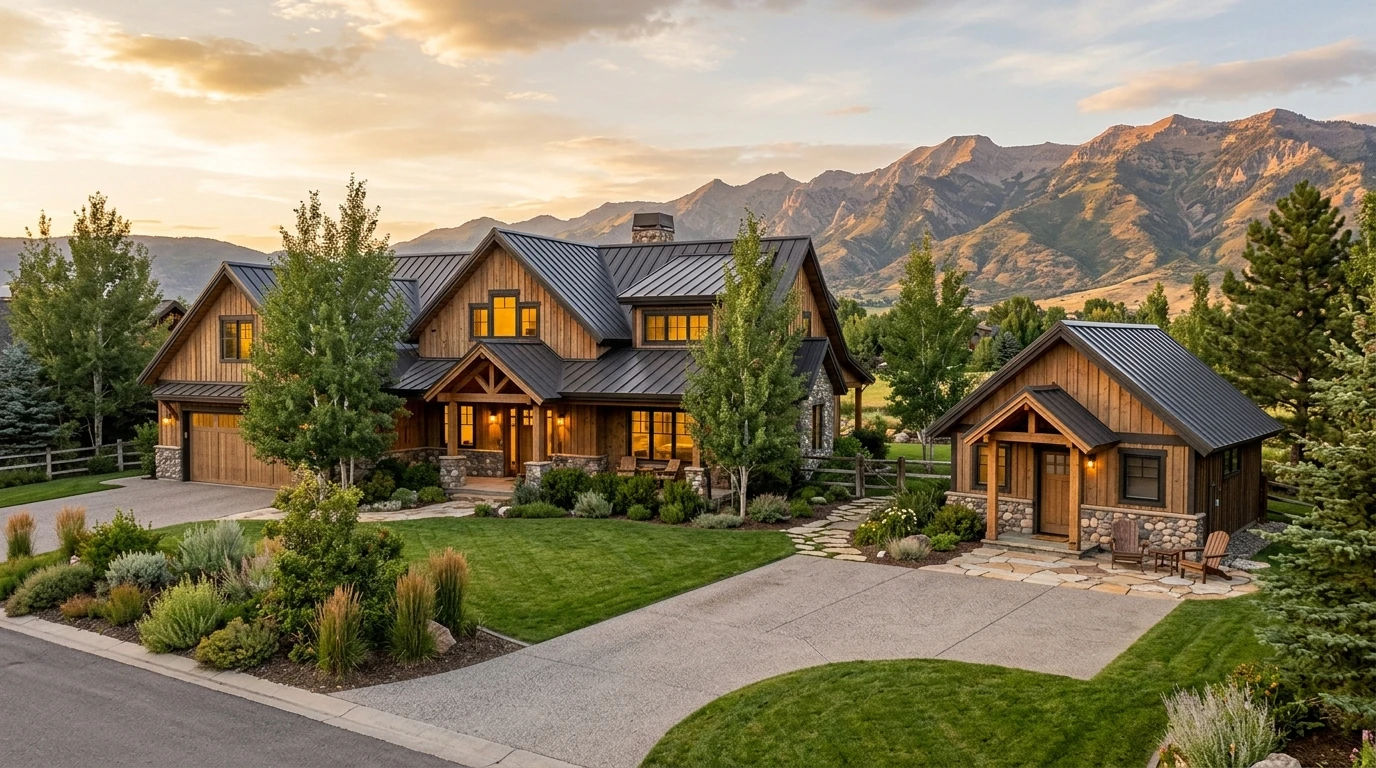
Beautiful Heber Valley mountain home with detached ADU cottage at sunset — timber frame construction, dark metal roof, stone and cedar exterior, mature landscaping, with Wasatch mountain backdrop and warm amber interior lighting
A detached ADU in Heber City should complement the main home's architecture and be designed for mountain climate performance — snow loads, high-performance insulation, and proper drainage are non-negotiable at 5,595 feet.

Climate-Driven Design Priorities

Heber sits at 5,595 feet with a climate that swings from sub-zero winter nights to 90°F summer afternoons. Your ADU needs to handle both extremes — and the Building Department will make sure it does.

Insulation

Heber requires higher R-value insulation than lower-elevation Wasatch Front cities. Walls, ceilings, and foundations all need to meet or exceed energy code requirements for this climate zone. Under-insulating to save money upfront costs far more in heating bills over the life of the unit.

Snow load

Roof structures must be engineered for Heber's significant snow loads. This affects framing lumber sizes, roof pitch, and structural connections. Flat or low-slope roofs that work in St. George are not appropriate here.

Drainage

Spring snowmelt and summer thunderstorms mean water management is critical. Proper grading away from the foundation, adequate drainage, and moisture barriers are non-negotiable.

Heating

Mini-split heat pumps are increasingly popular for ADUs — they provide both heating and cooling efficiently. Make sure any model chosen is rated for cold-climate operation at Heber's temperatures.

Blending With the Neighborhood

Heber's ordinance requires that an ADU not change the character of the property from a single-family dwelling — no external evidence of multi-family occupancy. In practice, this means detached ADUs should match or complement the main home's architectural style, use cohesive materials and colors, and position separate entrances discreetly.

For CHOZ Subordinate Dwelling Units, design standards are more specific: painted wood or composite wood-appearing materials, brick or stone exteriors, and a pitched roof with a minimum 3:12 slope.

Smart Layouts for 400–800 Sq Ft

Most Heber ADUs fall in this range. Making that space feel livable:

  • Open floor plans combining kitchen, dining, and living into one flowing area
  • Strategic window placement to maximize natural light (critical for basement conversions)
  • Built-in storage instead of space-eating furniture
  • Full-height ceilings where possible — even 6 extra inches makes a small space feel dramatically larger
  • Washer/dryer hookups with stackable units — save space and significantly increase rental appeal

A well-designed 600 sq ft ADU feels bigger than a poorly designed 800 sq ft one. The design phase is worth the investment.

How to Choose the Right ADU Builder in Heber City

The builder you choose will determine whether your project stays on budget, passes inspections cleanly, and gets done on a reasonable timeline — or becomes a headache that drags on for months longer than it should.

CriteriaWhy It MattersRed Flag If Missing
Utah general contractor license (verify through DOPL)Legal requirement; protects you from liabilityUnlicensed = walk away immediately
Workers' comp and liability insuranceProtects you from liability during constructionNo documentation = serious risk
ADU-specific project portfolioBuilding an ADU is different from a standard remodel or new home"We can do that" but no examples
Heber/Wasatch County permit experienceKnowing the local Building Department and Planning Department saves weeksHas only worked in other jurisdictions
Mountain building experienceSnow loads, insulation, drainage, soil conditions at 5,595 ft elevationOnly built at lower elevations
Handles permits on your behalfA good builder manages the permit process so you do not have toExpects you to pull your own permits
Written contract with detailed scopePrevents scope creep and surprise costsVerbal agreements or vague "estimates"
Transparent change-order processConstruction always has surprises — the question is how they are handledNo written change-order policy

8 Questions to Ask Every Builder Before You Hire

1

How many ADUs have you completed in Heber City or Wasatch County?

2

Were they internal, detached, or both?

3

Will you handle the building permit application and inspections?

4

Do you work with an architect/designer, or should I bring my own?

5

What is your estimated timeline from design to certificate of occupancy?

6

What assumptions are built into your price — and what is not included?

7

What usually causes budgets to increase on ADU projects?

8

Can you provide references from recent Heber Valley ADU clients?

The biggest red flag

A builder's website that swaps in "Heber City" but uses generic rules or examples from Salt Lake City, California, or some other jurisdiction. If they cannot explain Heber City's owner-occupancy requirement, the parking rules, or the difference between the Planning Department and Building Department review process, they are not a Heber builder. You deserve someone who has walked a project through this Building Department before. Always verify any contractor's license through Utah's DOPL license lookup system (secure.utah.gov/llv) before signing a contract.

Get Matched With a Vetted Heber City ADU Builder

Our matching process checks for: active Utah contractor license, current insurance, ADU-specific project history, and Heber/Wasatch County permit experience. Free, no obligation.

Is Building an ADU in Heber City Worth It?

We have covered the rules, the costs, the permits, and the risks. Now the real question: does it make sense for you?

It Makes Strong Sense If You Want To:

Generate rental income in one of Utah's strongest rental markets. As of mid-2025, Heber City's median rent was approximately $2,655 per month (Zumper), roughly 37% above the national average. With over 6,000 people commuting into Wasatch County daily because they cannot find local housing, demand is not a question.
House a family member with privacy and independence. An aging parent, an adult child, a relative who needs a place — an ADU gives them their own space without losing the proximity and connection of shared property.
Offset your mortgage. At Heber's home values (averaging ~$819,000 as of early 2026), even $1,500 per month in ADU rental income makes a meaningful dent in your monthly housing costs.
Add lasting value to your property. A well-built, permitted ADU adds livable square footage and income potential that buyers value at resale. Talk to a local appraiser for Heber-specific guidance on value impact.

Pause and Think Carefully If:

  • Your lot cannot accommodate the required three off-street parking spaces — this is a hard requirement in Heber
  • You are planning to rent both units as a non-resident owner — owner-occupancy is non-negotiable
  • You are counting on short-term rental income as your primary financial justification — verify STR licensing eligibility before you build around it
  • Your budget does not include a 15–20% contingency — mountain construction at this elevation has a higher rate of surprises than lower-elevation builds

Let's Find Out Whether an ADU Makes Sense for Your Specific Property

Our free feasibility review tells you whether your lot qualifies, which ADU type makes the most sense, and what a realistic budget looks like — before you spend a dollar on design.

Ready to Build Your Heber City ADU?

You have the information. You understand the rules, the costs, the process, and the risks. Now it comes down to one question: is your property a fit?

STEP 1

Jurisdiction check

City vs. county — which rules actually apply to your address.

STEP 2

Lot assessment

Zoning, parking, access, and site conditions.

STEP 3

Builder match

Connected with a vetted Heber Valley builder who has done this before.

No cost. No obligation. No pressure. A local Heber Valley specialist will review your property and respond within one business day.

Frequently Asked Questions About ADUs in Heber City

How We Verified This Guide

We take accuracy seriously because your project decisions depend on it. This guide was built and verified using:

  • Heber City Municipal Code §18.68.611 (Accessory Dwelling Units) and §18.68.030 (One Dwelling and ADU Per Lot)
  • Heber City ADU Notice form and residential building permit documentation
  • Heber City Council meeting records (June 2023) documenting the Phase 3 Envision Heber code update to Chapter 18.68
  • Heber City FAQ pages and Planning Department resources (heberut.gov/344/FAQs)
  • Utah Code §10-8-85.4 (Internal Accessory Dwelling Units)
  • Utah Code §11-36a-202 (Impact Fee Exemptions)
  • Utah HB 82 (2021) — Single-Family Housing Modifications
  • Utah Property Rights Ombudsman ADU overview and legal guidance
  • Envision Heber CHOZ materials for Central Heber Overlay Zone provisions
  • Heber City Municipal Code §5.26 (Short-Term Rentals)
  • Market data from Zumper, Zillow, Redfin, and local reporting (Park Record, KPCW, Fox 13)
  • Regional Housing Needs Assessment for Summit and Wasatch Counties (2019–2023)

Important disclaimer

Regulations change. Heber City is actively updating its zoning and subdivision ordinances as part of the Envision Heber process. While we verify this guide regularly, always confirm current requirements with the Heber City Building Department or Planning Department before making project decisions. Online municipal code is an informational convenience copy — the official hard copy governs. Last verified: March 2026.

© 2026 Utah ADU Builders. This guide is for informational purposes only and does not constitute legal, financial, or construction advice. Verify all requirements with Heber City officials before beginning your project. Last verified: March 2026.