
By the Utah ADU Builders Editorial Team · Last verified: June 2026
Salt Lake County ADU Guide: Rules by City, Costs & Feasibility
Many Salt Lake County homeowners — especially those with a detached single-family home — may be able to add an ADU, but the real answer depends on your city, your lot, the type of ADU, and your plans for it.

Concept image; actual design, cost, and approval depend on site and local rules.
Who we are (and how we make money): Utah ADU Builders is a Utah-focused ADU planning, feasibility, and builder-matching resource. We're not a city, county, government office, law firm, lender, architect, engineer, or licensed contractor. We may earn compensation when a homeowner requests a feasibility review or is connected with a local professional. That compensation does not shape how we explain the rules, costs, or risks below.
What we verified for this guide:
- Utah state ADU law — the Utah Office of the Property Rights Ombudsman and Utah Code for internal ADUs (§10-21-303), plus Senate Bill 284 (2026 session), which enacts §10-21-304 on detached ADUs.
- Salt Lake County's ADU ordinance for unincorporated/county-administered areas (adopted June 2024).
- Individual city rules from each city's official planning page, code, or ADU handbook — including Salt Lake City, West Valley City, Sandy, Murray, Millcreek, South Jordan, South Salt Lake, Cottonwood Heights, Draper, and West Jordan.
- Cost inputs from published Utah cost data and typical local project ranges — presented here as estimates only, not quotes.
- Builder/estimate limitations — we describe project paths and options; we do not guarantee approval, timelines, income, or that any specific builder is available for your project.
Rules change at both the state and city level. Some city-source information may predate the October 1, 2026 state-law effective date. Treat this as a starting point, then confirm the current rule for your specific property.
A short, property-specific check before you spend a dollar on plans.
Check ADU feasibility for your Salt Lake County property →The fast answer
| Question | Short answer |
|---|---|
| Can I build an ADU in Salt Lake County? | Often yes — but it's decided city by city, not by one countywide rule. |
| Is a basement/internal ADU usually easier? | Usually. Internal ADUs have a statewide baseline and aren't charged impact fees (permit and other fees still apply). Parking and owner-occupancy rules still apply. |
| Can I build a detached backyard ADU? | Maybe. Some cities allow them, some restrict them, and a 2026 state law requires larger cities to allow them on qualifying lots. |
| Can I use it as an Airbnb? | Usually not. Most ADU rules require long-term rentals (30+ days) or ban short-term rentals outright. |
| What's the safest first step? | Check property-level feasibility before paying for plans, engineering, or builder bids. |
Who actually makes the rules: state, county, or your city?
"Salt Lake County" isn't one rulebook. State law sets a floor, Salt Lake County government writes rules only for unincorporated (county-administered) areas, and each incorporated city — Salt Lake City, Sandy, West Valley City, Millcreek, Murray, Draper, and the rest — has its own ADU ordinance. The single most common mistake we see is a homeowner reading the county's page (or one city's page) and assuming it applies to their address. It often doesn't.
| If your property is in… | The rules that govern it | Why it matters |
|---|---|---|
| Unincorporated Salt Lake County (county-administered / metro-township areas) | Salt Lake County's ADU ordinance | Sets lot-size thresholds, parking, owner-occupancy, utilities, licensing, and permits for those areas. |
| Salt Lake City | Salt Lake City's ADU code + standard-plan program | SLC has its own detached size, height, setback, parking, and rental rules. |
| Another incorporated city (Sandy, Murray, Millcreek, West Valley City, Draper, etc.) | That city's ADU ordinance | Rules vary sharply — especially on detached units, lot size, and owner-occupancy. |
| A property inside an HOA | City/county rules and your recorded CC&Rs | A city may allow the ADU while private HOA documents create a separate limit. For an internal ADU that meets local code, state law limits what an HOA can prohibit — but detached units and other conditions can still be restricted. |
A quick vocabulary check — because these terms decide everything
ADU (accessory dwelling unit)
A self-contained second home on the same lot as your primary house, with its own kitchen, bathroom, and sleeping area.
Internal ADU
Built within the footprint of your existing home — most often a basement apartment. Under Utah law, this applies to an owner-occupied, detached single-family home for long-term rental (30+ days). This is the type Utah protects statewide.
Attached ADU
An addition physically connected to the house, with its own entrance.
Detached ADU
A separate structure in the yard (a backyard cottage or standalone unit).
Garage conversion
Reusing a garage as living space; can count as internal or detached depending on the structure, which changes the rules.
Owner occupancy
A requirement that you (or, in some cities, a family member) live on the property.
Setback
The minimum distance a structure must sit from your property lines.
Impact fee
A one-time charge some cities/counties apply to new construction to fund infrastructure.
Short-term rental (STR)
A rental of fewer than 30 days (Airbnb/Vrbo-style), regulated separately and often prohibited for ADUs.
Salt Lake County ADU rules by city
This table is the heart of the guide: a side-by-side look at the largest, most-searched Salt Lake County jurisdictions. Salt Lake County has more than a dozen cities — if yours isn't listed, its ordinance still governs, and a feasibility check will confirm your specific rules. Even a "Yes" still depends on your lot meeting setbacks, parking, and utility requirements.
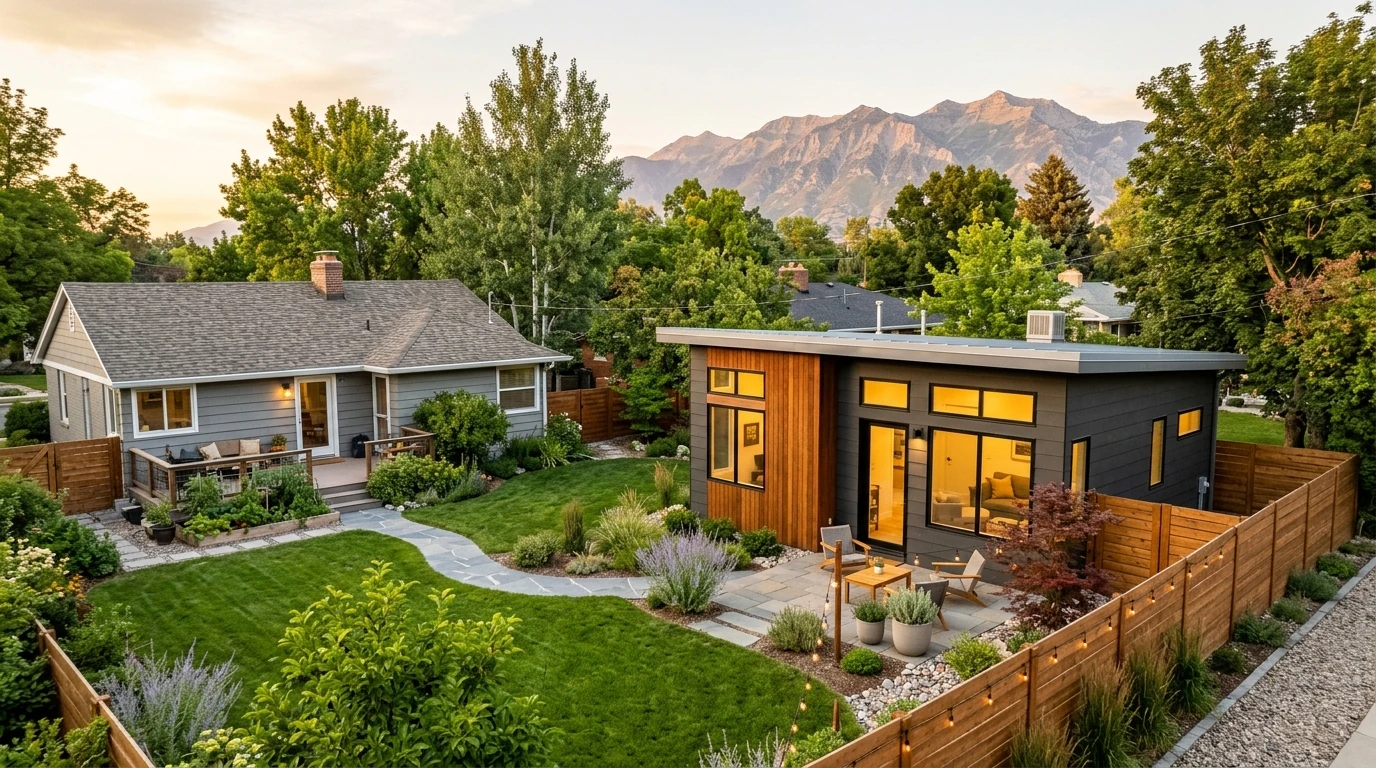
Concept image; actual design, cost, and approval depend on site and local rules.
Every row is drawn from that jurisdiction's official page or code, verified June 2026. Several cities are revising ordinances in 2026 to match new state law — confirm before you design. Full source links are at the end of this guide.
| Jurisdiction | Internal / basement ADU | Detached ADU | Owner must live on-site? | Key local notes | Source |
|---|---|---|---|---|---|
| Unincorporated Salt Lake County | Yes — lot ≥ 6,000 sq ft | Yes — lot ≥ 7,000 sq ft (6,000 in PC zone); 10 ft from rear line, 6 ft from house; ≤ 20 ft tall | Yes — recorded affidavit (up to 2-yr exceptions for military/medical/mission) | One ADU per lot; can't be sold or subdivided; written water-provider confirmation required before a permit; no separate meters for internal units | Salt Lake County, Office of Regional Development |
| Salt Lake City | Yes — no maximum size | Yes — up to ~1,000 sq ft (conditional-use hurdle removed in 2023) | Yes — owner or a family member in the home or ADU | Recorded covenant + landlord-program enrollment to rent; extra parking waived within 1/4 mile of transit; pre-reviewed standard ADU plans offered; ADUs can't be used as short-term rentals | SLC Code 21A.40.200 |
| West Valley City | Limited — allowed only west of 4000 West | Prohibited citywide (as of last verification) | — | The clearest example of why 'the county' isn't uniform. West Valley may need to update its rules under the 2026 state law — verify current status | West Valley City Planning & Zoning |
| Sandy | Yes ('accessory apartment') — must connect to the existing home (not through a garage) | Not part of Sandy's current accessory-apartment program; recheck under the 2026 state law | Yes — proof of full-time residency + notarized affidavit | Annual business license (lapses if not renewed); extra off-street parking; no separate meters or addresses; design must match the home | Sandy City (Accessory Apartments) |
| Murray | Yes (Chapter 17.78) | Yes — lot ≥ 10,000 sq ft; 1 story, ≤ 20 ft; ≤ 50% of the home and ≤ 1,000 sq ft; 10 ft rear/side setbacks | Yes — owner in the home or the ADU | Owner-building not allowed — a licensed contractor and building permit are required; affidavit recorded with the county before the application is accepted; short-term rentals prohibited; business license to rent long-term | Murray City (Ch. 17.78) |
| Millcreek | Yes — no lot-size minimum | Yes — lot ≥ 8,000 sq ft, rear yard, up to 1,000 sq ft; 5-ft side/rear setback (more above 14 ft); not on slopes over 30% | Yes — owner must live on-site year-round to rent | One off-street stall, no street parking; garage conversions must replace covered parking; no separate meters | Millcreek (Ch. 18.71) |
| South Jordan | Yes (ADU 'floating zone' applied to eligible zones) | Yes, within eligible zones | Yes — recorded affidavit + consent to annual inspection | A larger 'guesthouse' (over 35% of the home's living area or 1,500 sq ft) needs Planning Commission approval; not approved on properties with open code/building violations | South Jordan City |
| South Salt Lake | Yes — no maximum size | Yes ('external') — up to 50% of the home (excl. garage), max 2 bedrooms | Yes — owner must reside in one of the units to rent | Allows up to two ADUs (one internal + one external); ADUs can't cover more than 50% of the rear yard; predevelopment review before a building permit; 30+ day rentals only; no separate meters | South Salt Lake (ADU Handbook) |
| Cottonwood Heights | Yes — lot ≥ 6,000 sq ft | Yes — as a conditional use | Yes | +1 parking stall for internal, +2 for detached (no tandem stalls); short-term rentals prohibited | Cottonwood Heights Community Development |
| Draper | Yes — lot > 6,000 sq ft and fronting a qualifying public street (a city map shows where internal ADUs are prohibited) | Yes — lot ≥ 12,000 sq ft; same setbacks as a house; footprint smaller than the main home | Yes | One ADU per property (no internal ADU if you have a detached one); 30+ day rentals; +1 parking (no tandem); garage conversions must replace the garage; no separate meters | Draper City |
| West Jordan | Yes | Yes ('external') in R-1-10, R-1-12, R-1-14, RR, and RE zones; in PC/LSFR/VLSFR zones only on lots ≥ 10,000 sq ft; permanent foundation, not in the front yard | Rental tied to owner-occupancy (see notes) | One ADU per property — internal or external, not both; if the owner lives in one unit they may rent the other; business license to rent; +1 parking | West Jordan City Code 13-5B-8 |
Not seeing your city?
Taylorsville, Riverton, Herriman, Holladay, Midvale, Bluffdale, and Salt Lake County's metro townships each have their own ADU ordinance. Some city-source summaries may predate the October 1, 2026 state-law effective date, so check the current rules for your specific address.
Internal, detached, garage conversion, or prefab: which path fits?
For most Salt Lake County homeowners, an internal or basement ADU is the lowest-friction path because it reuses the existing home, has a statewide legal baseline, and isn't charged impact fees. A detached unit gives you the most space and privacy but raises the most questions about lot size, setbacks, utilities, and cost. A garage conversion sits in the middle — it may reuse a structure, but it can trigger parking-replacement, life-safety, and setback issues.
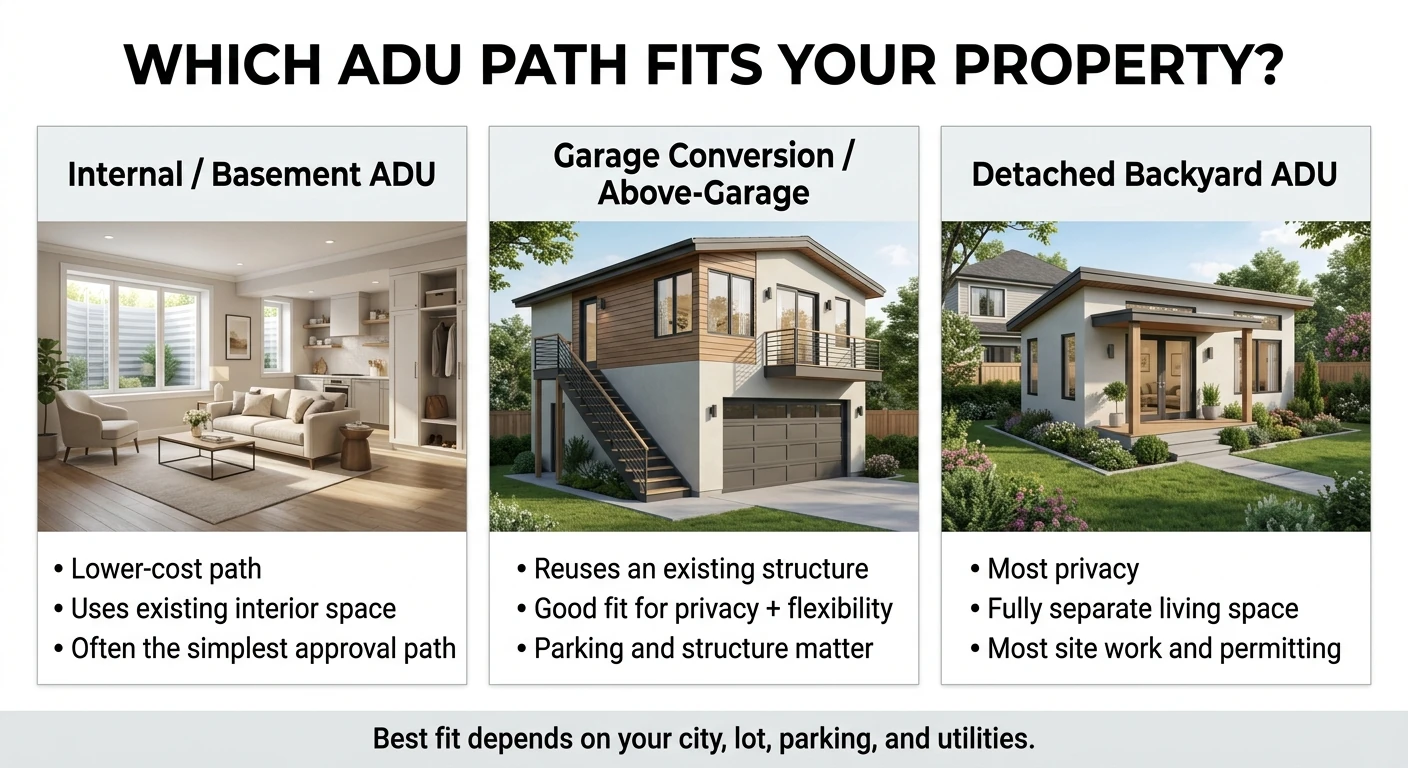
Concept image; actual design, cost, and approval depend on site and local rules.
| ADU type | Usually best for | Main advantages | Main friction |
|---|---|---|---|
| Basement / internal | Lowest-cost path, family housing, long-term rental | Uses existing footprint; statewide baseline; no impact fees | Egress windows, fire/life safety, separate entrance, owner-occupancy, parking |
| Attached addition | More privacy than a basement without a full detached build | Adds new space while staying connected | New-construction cost, design, setbacks, utilities |
| Detached | Privacy and separation for family or long-term tenants | Independent living space; flexible use | Lot size, setbacks, utility capacity, cost, city-specific rules |
| Garage conversion | Reusing an existing garage | May reduce shell cost | Replacing lost parking, structure condition, code upgrades, setbacks |
| Prefab / modular | A faster, more repeatable unit | Clearer product and price to compare | Site work, foundation, utility hookups, access/crane constraints, city approval |
A note on standard plans and builders (with disclosure)
Salt Lake City maintains a list of pre-reviewed standard ADU plans from several providers, including Nest Tiny Homes, a Utah company that builds ADUs. Utah ADU Builders has a partnership with Nest Tiny Homes, so treat any mention of them as commercial content. Two honest caveats: a listed standard plan still requires a city site review before a permit is issued, and the city's list is a convenience — not a city endorsement of any builder. Before hiring anyone, verify their active Utah license and classification through the state's official contractor license lookup.
What changed for detached ADUs in Utah in 2026?
Utah’s Senate Bill 284 enacted Utah Code §10-21-304, which took effect October 1, 2026. A specified municipality must permit a detached ADU on a qualifying lot or parcel of at least 11,000 square feet that contains a single-family dwelling, where that dwelling is a permitted use. A specified municipality is a first-, second-, third-, or fourth-class city, or a fifth-class city with at least 5,000 residents in a first-, second-, or third-class county. This municipal mandate does not govern unincorporated county land. The city table retains its June 2026 source-review date; an older prohibition or larger municipal lot minimum is not the full current answer for a qualifying lot covered by the new statute.
| SB 284 may change | It does not erase |
|---|---|
| Some local bans on detached ADUs, on qualifying lots in covered cities | Building, health, and fire codes |
| Conditional-use barriers for qualifying detached units | Setbacks, height limits, lot coverage, utility capacity, easements |
| Whether a city has any detached-ADU pathway at all | Owner-occupancy, where a city lawfully keeps it |
| — | Local rental-duration limits and the need for permits and a real design |
Our practical view:
Don't treat this law as a green light to build a backyard unit anywhere. It's a floor that larger cities must meet, each city is still writing its own local standards (size, setbacks, height, parking, rental limits), and the details are landing throughout 2026. If a detached ADU is your goal, confirm your city's currently adopted ordinance before you invest in plans — this is exactly the kind of moving target a feasibility check is built for.
How much does a Salt Lake County ADU cost?
There's no honest single number — cost depends on the ADU type, your existing conditions, utilities, finishes, site access, and your city's requirements. The ranges below are published estimates to set expectations, not quotes. What moves them: site prep (rocky soil, slope, tight access), custom design, high-end finishes, and whether you need separate utility meters. What keeps them down: reusing a basement or garage, staying within your lot's existing utility capacity, and — for internal ADUs — the impact-fee exemption.
How we frame these numbers: the ranges here reflect published Utah ADU cost data and typical local project ranges, not Utah ADU Builders quotes. Your actual cost depends on your property. For a number tied to your lot and plans, use the cost estimator.
| Cost bucket | What's typically included | Rough estimate* |
|---|---|---|
| Basement / internal conversion | Egress, kitchen, bath, electrical, HVAC, fire/life safety, finishes | Often the low end — some suburban conversions are reported under $100k |
| Garage conversion | Structural fixes, insulation, parking replacement, plumbing, electrical, HVAC, life safety | Varies widely with the existing structure |
| Attached addition | Foundation, framing, roof tie-in, utilities, design/engineering, finishes | Mid-to-high, depending on size |
| Detached new build | Foundation, shell, utility trenching, water/sewer/electric, access, design | Often the top of the range; new detached units in Salt Lake City routinely land high |
| Design & engineering | Drawings, structural plans, energy compliance | Commonly reported around $5,000–$15,000 |
| City fees & permits | Application, plan check, building permit, license | Commonly reported around $1,000–$5,000 (internal ADUs are exempt from impact fees, but not other fees) |
| Utility upgrades | Water, sewer, electrical, gas, stormwater, trenching | Site-specific; can be a major swing factor |
*Estimates only. Published Utah figures put total finished project costs somewhere in the low six figures on average, with basement/garage conversions on the lower end and detached new construction on the higher end. Your number depends on your property.
An ADU is not automatically a smart project just because Utah has become more ADU-friendly. Between city restrictions, utility upgrades, parking, setbacks, and site conditions, the right move depends on your lot, city, budget, and use case. In parts of the county — most of West Valley City, for example — the type you want may not be allowed at all. That's not a reason to give up; it's a reason to check feasibility before you spend on design.
What permits, licenses, and approvals are usually involved?
A legal ADU is more than a finished room or a backyard building. Across Salt Lake County, the process almost always includes a zoning/property check, plans, a building permit, inspections, and — if you rent it — a business or rental license, plus a recorded owner-occupancy affidavit or covenant in many cities. Skipping permits risks fines, stop-work orders, and an unrentable unit.
Concept image; actual design, cost, and approval depend on site and local rules.
| Step | What happens | Risk if skipped |
|---|---|---|
| 1. Confirm your jurisdiction | City vs. unincorporated county | Applying the wrong rules |
| 2. Property-fit check | Zoning, lot size, setbacks, parking, utilities, HOA | Paying for plans for an infeasible project |
| 3. Choose the ADU path | Internal, attached, detached, garage, prefab | Wrong design direction |
| 4. Plans / design / engineering | Site plan, floor plan, elevations, structural as needed | Permit delay or denial |
| 5. Building permit | City or county review and issuance | Fines, stop-work, an illegal unit |
| 6. Inspections | Framing, electrical, plumbing, mechanical, fire/life safety, final | No legal occupancy |
| 7. License / affidavit | Business or rental license and recorded owner-occupancy where required | Illegal rental use |
| 8. Estimates / build | Bids from appropriate professionals | Bad scope, underbidding, change orders |
Timelines vary by jurisdiction, project type, application completeness, plan corrections, inspections, utilities, and city workload — and internal conversions generally move faster than detached new builds. One early item worth confirming: Salt Lake County's county-administered process requires written confirmation from your water provider before a permit is issued, and individual cities may run their own utility-capacity review.
What can block an ADU even when ADUs are "allowed"?
An ADU can be legal in theory and still impractical on your specific lot. Knowing the common blockers now saves you money later.
| Blocker | Why it matters |
|---|---|
| Wrong jurisdiction | County rules don't override your city's rules |
| Lot size | Cities and the county set minimums for internal and/or detached units |
| Parking | Many places require extra off-street parking or replacing a converted garage's spaces |
| Utilities | Water/sewer/electric capacity and meter rules can change feasibility or cost |
| Setbacks / easements | Detached units can be blocked by rear/side setbacks or utility easements |
| Owner occupancy | Many cities require you (or family) to live on the property |
| Short-term rental plans | Most ADU rules prohibit Airbnb-style use |
| HOA / CC&Rs | Private restrictions can create a separate hurdle, especially for detached units |
| Unpermitted existing work | A finished basement or garage done without permits may need to be opened up for inspection |
| Budget vs. path | Utility upgrades, engineering, and finishes can push a project past your budget |
If two or more of these are a "no" for you, it's better to know before you draw plans. A feasibility review is designed to surface these early.
Can I rent a Salt Lake County ADU — or use it as an Airbnb?
Long-term rental is the normal ADU assumption; short-term rental is not safe to assume. Utah's internal-ADU protections are tied to long-term rentals of 30 consecutive days or more, and many Salt Lake County cities prohibit short-term ADU rentals entirely or require a separate license. Some cities also treat internal, attached, detached, and guesthouse units differently, so confirm the rule for your city and your ADU type before you count on any rental use. Owner-occupancy rules can also affect whether — and how — you can rent. We won't promise rent figures or returns; those depend on your unit, location, and the market.
| Rental plan | Risk level | Guidance |
|---|---|---|
| Family housing (no rent) | Lower friction | Still needs code and permit compliance |
| Long-term rental (30+ days) | Common, accepted use | Confirm owner-occupancy, license, parking, and city rules |
| Airbnb / short-term rental | High | Don't assume it's legal — many ADU rules prohibit it |
| Renting both the home and the ADU | High, city-specific | Verify owner-occupancy and licensing before you count on it |
Salt Lake County ADU feasibility checklist
Before you pay for plans or request builder bids, answer these. They're the same questions a good feasibility review starts with.
- What city (or unincorporated area) is the property in? → determines the rule source
- Is the home a detached single-family house? → many ADU rules apply only to these
- Which ADU type are you considering? → internal, detached, attached, garage, or prefab
- Will the owner live on the property? → owner-occupancy is often required
- What's the lot size? → internal/detached minimums may apply
- Is there room for off-street parking? → one of the most common blockers
- Are water, sewer, and electrical service adequate? → capacity or upgrades can change the math
- Any setbacks, easements, slopes, or access limits? → especially important for detached units
- Is there an HOA or recorded covenant? → can add a separate restriction
- Is the rental plan long-term, family, or short-term? → STR plans can end a project
- Any existing unpermitted work? → can trigger inspection or removal
- What budget range is realistic? → prevents designing the wrong path
We'll check your property against your city's current rules and outline practical build options before you commit to quotes.
Request a Utah ADU feasibility review →Frequently asked questions
Sources we checked
- Utah Office of the Property Rights Ombudsman — Accessory Dwelling Units (internal ADU law, impact-fee exemption, HOA limits): Utah Code §§ 10-21-303 and 17-80-303
- Utah Legislature — Senate Bill 284, 2026 General Session, enacting Utah Code § 10-21-304 (detached ADUs, effective 10/01/26)
- Salt Lake County, Office of Regional Development — ADUs (unincorporated/county-administered rules)
- Salt Lake City — ADU code (Title 21A.40.200) and Building Services standard-plan program
- West Valley City — Planning & Zoning FAQs
- Sandy City — Accessory Apartments standards
- Murray City — ADUs (Chapter 17.78)
- Millcreek — Accessory Dwelling Units (Chapter 18.71)
- South Jordan — Accessory Dwelling Unit Floating Zone
- South Salt Lake — ADU Handbook
- Cottonwood Heights — Accessory Dwelling Units
- Draper — Accessory Dwelling Unit Permits
- West Jordan — City Code 13-5B-8 (Accessory Dwelling Units) and ADU application
This guide is general information, not legal, tax, financial, engineering, or contractor advice. Rules change; confirm your property's specifics before designing, permitting, or building.