Eagle Mountain, Utah ADU Guide: Rules, Eligibility, Costs & How to Get Started
By the Utah ADU Builders Research Team · Last Updated: March 2026 · Last Verified Against Eagle Mountain Municipal Code: March 2026
Disclosure: We connect homeowners with local ADU builder options. If you request an estimate through our site, we may receive a referral fee. Verify licensing, insurance, and references before hiring. This never affects the information in this guide.
Yes — Eagle Mountain allows accessory dwelling units on single-family-zoned property. You can build a basement apartment, an attached addition, a detached backyard cottage, or an above-garage unit. Whether you want rental income to offset your mortgage, a private space for aging parents, or simply a way to make your property work harder — Eagle Mountain's code supports it.
But before you call a contractor, there is one decision you need to make first — and it is the one that determines your entire permit path, your costs, and your timeline. You need to figure out whether your project requires a full ADU permit or just a recorded second-kitchen agreement. That single fork changes everything.
We have broken down Eagle Mountain's actual rules (EMMC Chapter 17.70), translated them into plain English, and built the most complete Eagle Mountain-specific ADU resource available — with real local costs, the exact permit submittal requirements from the city's own checklist, the step-by-step process, and a decision framework that tells you exactly which path applies to your situation.
Yes, on lots of 8,000+ sq ft with 70+ ft of street frontage
Max detached ADU size
400–1,200 sq ft living space, max 2 bedrooms (EMMC 17.70.040(D)(3))
Max height (detached / above-garage)
35 feet / 2 stories
Owner must live on property?
Yes — in main home or ADU (EMMC 17.70.040(B))
Parking required?
Two off-street spaces on hard surface — confirm layout with Planning before design
Short-term rentals allowed?
No — minimum 30 consecutive days
ADU entrance location
Side or rear of building only (EMMC 17.70.040(E))
ADU permit fee
$230 (Eagle Mountain Fee Schedule, Jan. 2026)
First decision
ADU permit vs. second-kitchen agreement
Governing code
EMMC Chapter 17.70 (Accessory Dwelling Units)
Source: Eagle Mountain Municipal Code, current through Ordinance O-36-2025. Eagle Mountain ADU Checklist (Nov. 2025). Always verify current requirements with the city before starting your project.
Can You Build an ADU in Eagle Mountain, Utah?
Short answer: almost certainly yes. Eagle Mountain is one of the more ADU-friendly cities in Utah, and Utah itself is one of the most ADU-friendly states in the country.
Eagle Mountain has grown fast — the population has roughly tripled since 2010, and home values sit in the high-$400Ks to low-$500Ks. That combination of growth and home prices means two things for ADU homeowners: rental demand is real and sustained, and the city has gotten serious about ADU regulations because so many residents are asking about them. ADUs are one of the most common topics the Eagle Mountain Planning Division fields questions about.
Here is what is on the table:
ADU Type
Allowed?
Best For
Typical Cost Range
Basement / Internal ADU
Yes
Budget-friendly rental income, fastest ROI
$50K–$100K
Attached Addition
Yes
Connected family space with separate entrance
$80K–$180K
Detached Cottage / Casita
Yes (8,000+ sq ft lots, 70+ ft frontage)
Maximum privacy and rental income
$200K–$350K+
Above-Garage Unit
Yes (where permitted by EMMC 17.25.030)
Leveraging existing structure
$150K–$300K+
Second Kitchen Only (no rental)
Yes
Family use without full ADU permit
Varies
Eagle Mountain also permits tiny homes on wheels as ADUs under specific conditions (EMMC 17.70.080) — see the edge-case section below.
The real question is not if you can build one — it is which type fits your property and your goals. And that starts with one decision most people do not even know they need to make.
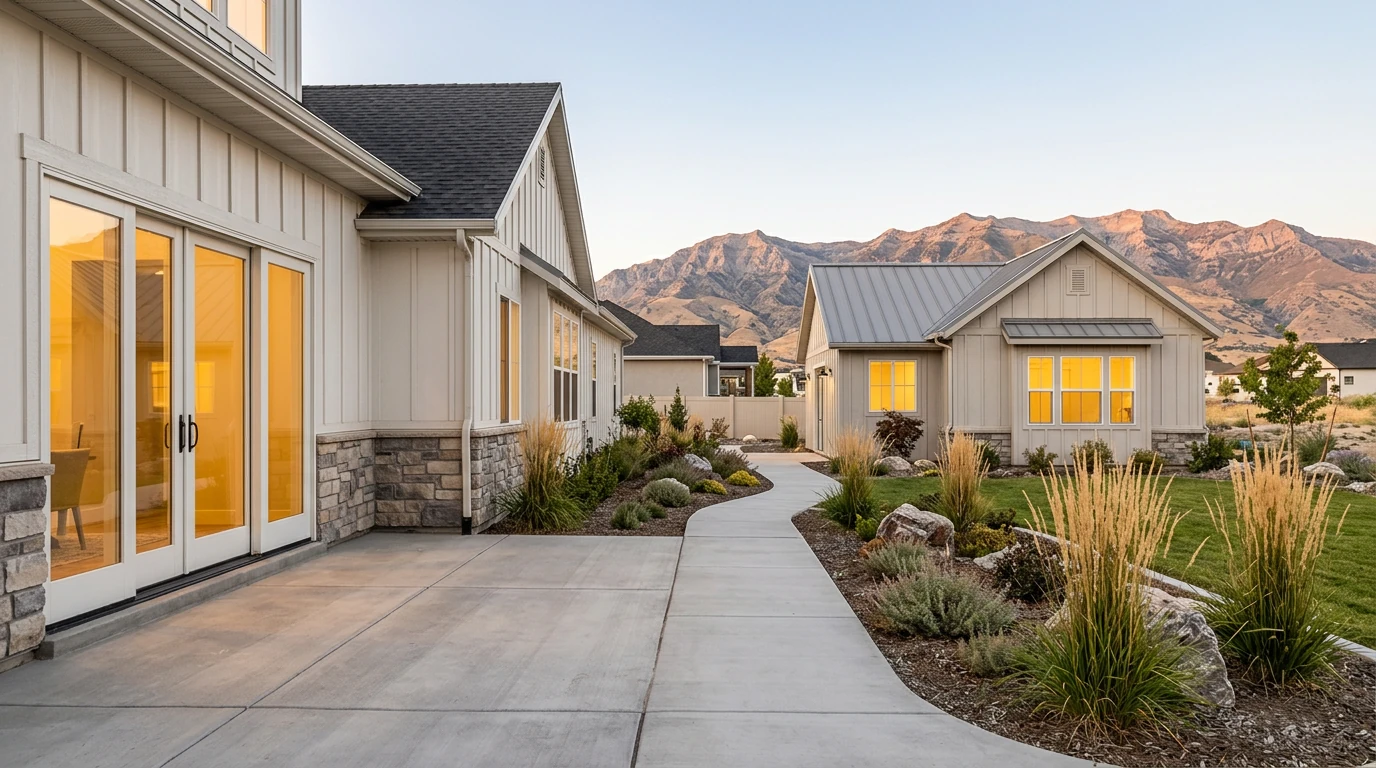
Eagle Mountain ADU neighborhoods: detached cottages that match the primary home's architecture are permitted on qualifying lots under EMMC 17.70
Do You Need an ADU Permit or Just a Second-Kitchen Agreement?
This is the section that could save you thousands of dollars and months of time. Eagle Mountain treats these as two completely different paths, and picking the wrong one creates problems.
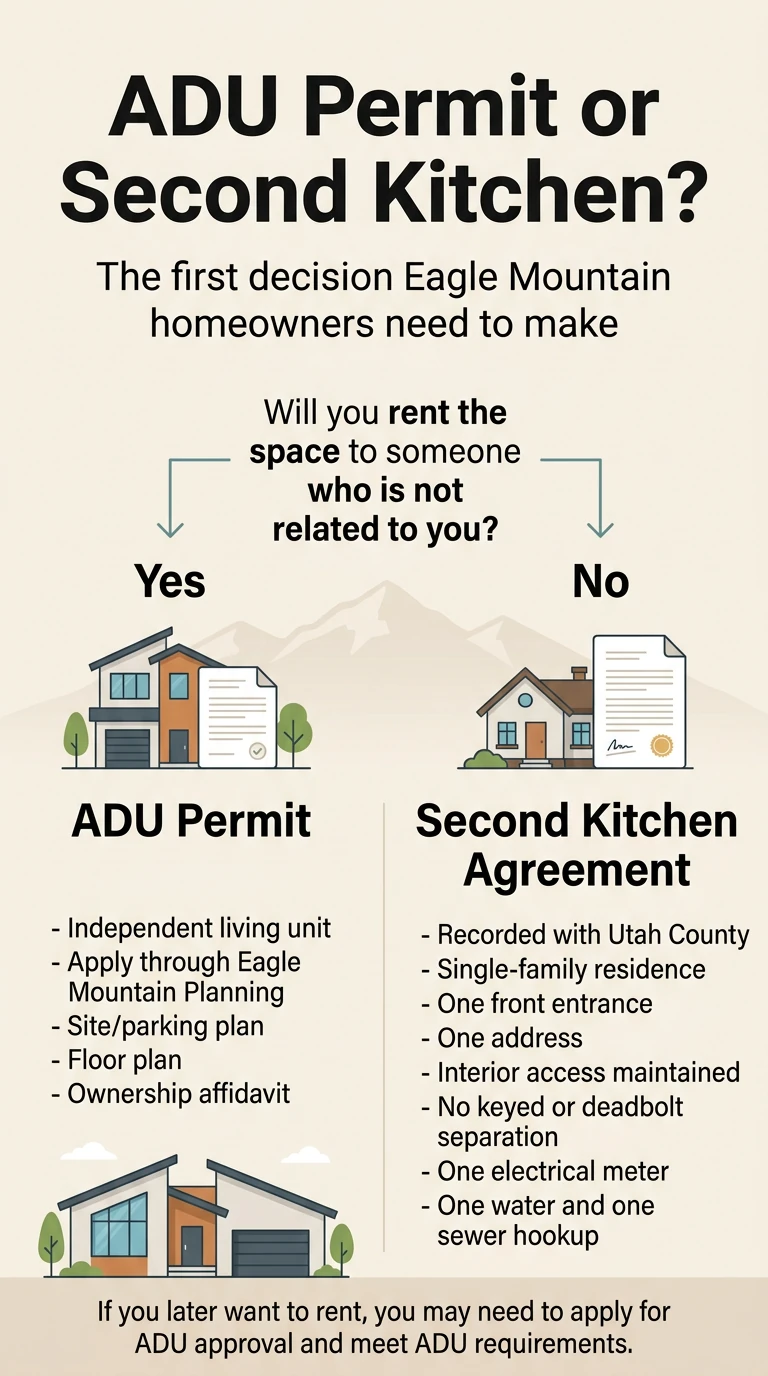
The first decision every Eagle Mountain homeowner must make — ADU permit or second-kitchen agreement — determines your entire permit path, costs, and timeline
When You Need a Full ADU Permit
You need an ADU permit from Eagle Mountain's Planning Division if:
• You plan to rent the unit to someone who is not related to you by blood, marriage, or adoption (as defined in EMMC 17.10.030)
• The space will function as a separate, independent living unit with its own kitchen, bathroom, and entrance
• The tenant will have their own lease or rental agreement
An ADU permit requires a site/parking plan, floor plan, and supporting documents. It goes through Planning Division review, then you apply for a building permit separately. The space gets treated as a true second dwelling unit on your property.
When the City Points You Toward a Second-Kitchen Agreement
If a family member will use the space and you are not renting it out, Eagle Mountain may direct you to a second-kitchen agreement instead. A second-kitchen agreement is a document recorded with Utah County that explicitly states you will not be renting the unit. It applies when you add a second kitchen or kitchenette to your home (per EMMC 17.69.010) for family use — not for rental income.
Here is what a second-kitchen agreement means in practice:
• The home is still treated as a single-family residence — one address, one household
• There is typically interior access between the spaces (no deadbolt separation)
• You keep one water and sewer hookup
• No separate tenant, no lease, no rental income
• The recorded deed restriction stays with the property
The Decision Framework
Your Situation
Path
What It Requires
Renting to non-family
ADU Permit
Full application, site plan, parking plan, building permit, inspections
Family member, no rent
Second-Kitchen Agreement
Recorded deed restriction with Utah County, building permit for any new work
Not sure yet — might rent later
Plan for ADU from day one
Build to ADU standards now so you can get the permit later without rework
That third row is important. If there is any chance you will want to rent the space in the future, tell your builder upfront. It is far cheaper to build to ADU standards from day one than to retrofit later — especially for things like separate entrances, fire-rated assemblies, and parking.
Can You Convert Later?
Yes. If you start with a second-kitchen agreement and later decide to rent, you can apply for an ADU permit at that point. But you will need to meet all the ADU requirements — parking, entrance location, owner occupancy, and full code compliance. Plan for this possibility upfront and it will save you money later.
Not sure which path you need?
That is one of the first things we help homeowners figure out. Get a free Eagle Mountain ADU feasibility assessment and we will tell you exactly which path applies to your situation.
What Properties Qualify for an ADU in Eagle Mountain?
Not every lot is a fit for every ADU type. Here is how to figure out what works on your property.
Where ADUs Are Allowed
Eagle Mountain's current city materials state it simply: ADUs are allowed on single-family-zoned property. Internal ADUs are permitted in single-family detached homes. Detached ADUs are permitted on lots of 8,000 square feet or more. Under Utah state law (HB 82, passed in 2021), internal ADUs are a permitted use in any area zoned primarily for residential use — cities cannot ban basement apartments.
Detached ADUs have two additional lot requirements beyond the 8,000 square foot minimum:
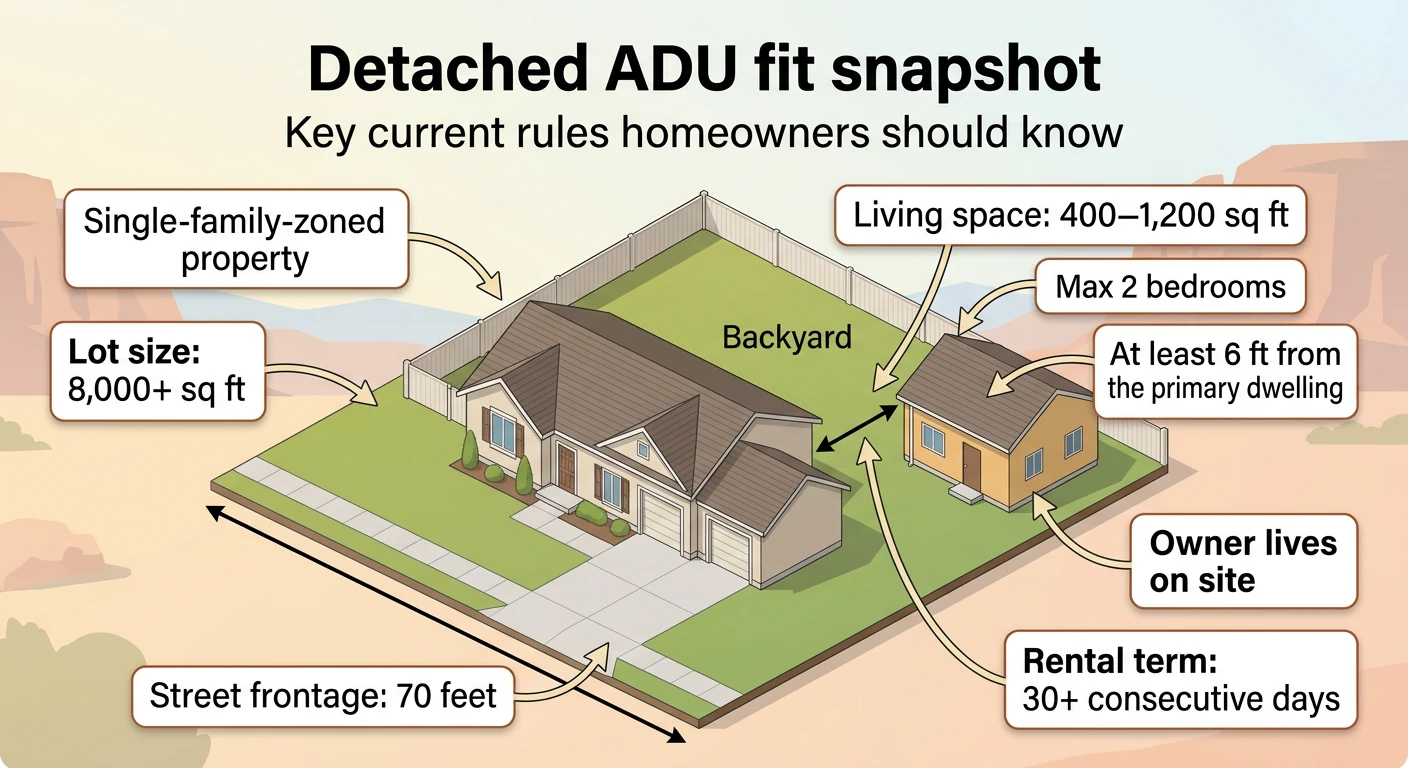
• Minimum street frontage of 70 feet. A smaller-frontage lot may be approved at the city's discretion if the lot configuration is unique and the impacts to neighbors are substantially similar to those on a 70-foot-wide lot. (EMMC 17.70)
• The detached ADU type must be listed as a permitted use in your specific zone per EMMC 17.25.030.
Key Eagle Mountain detached ADU requirements — lot size, frontage, size limits, setbacks, and occupancy rules at a glance
How to Check Your Zone
The fastest way to confirm your property's eligibility is to look up your parcel on the Utah County Parcel Map, find your zone, and cross-reference it with Eagle Mountain's permitted uses table (EMMC 17.25.030). Most Eagle Mountain residential properties fall into the R1, R2, or R3 zones — all of which allow internal ADUs under state law. Some newer subdivisions were platted with lots just barely above or below the 8,000 square foot threshold, so a 7,900 vs. 8,100 square foot lot can matter. Street frontage is another factor — a deep, narrow lot may meet the square footage requirement but fall short of the 70-foot frontage minimum.
Owner Occupancy: Non-Negotiable
The property owner must live on-site — either in the main house or in the ADU itself (EMMC 17.70.040(B)). The only exception is a "bona fide temporary absence" like military deployment or a temporary job assignment. You cannot buy a property, build an ADU, and rent out both units while living somewhere else. Owner occupancy is a permit condition — violations may result in the ADU permit being revoked by the planning director (EMMC 17.70.050).
One ADU Per Lot
Eagle Mountain allows a maximum of one ADU per residential lot — whether it is internal, attached, or detached. No exceptions. (EMMC 17.70.040(A))
Parking: The Requirement That Catches People Off Guard
This is where a lot of Eagle Mountain ADU plans hit a wall. Eagle Mountain's current ADU checklist requires the location and dimensions of two off-street parking spaces to be shown on the site plan, and all parking must be on a hard surface (concrete, asphalt, etc.). Driveway parking in front of a garage does not qualify — unless the ADU is located inside that garage, in which case the main home's required garage parking must be provided elsewhere. Because older city materials have summarized the parking rule in slightly different ways, confirm the final parking layout with the Planning Division before your plans are drawn. Plan your parking before you plan your ADU.
Separate Utilities
Detached ADUs may have separate utility meters, but all municipal utilities must remain in the property owner's name. The owner is responsible for payment. (EMMC 17.70.040(F))
HOA and CC&Rs
If your property is in an HOA-governed community, review your CC&Rs before spending money on plans. Utah state law limits HOA restrictions on internal ADUs, but HOAs may still have rules affecting detached ADUs, exterior changes, or additional structures. The city does not enforce HOA rules — that is between you and your association. But ignoring it can create expensive problems.
Not sure if your lot qualifies?
We check your zoning, lot size, frontage, and parking options as the first step in every feasibility assessment. It takes us minutes — and it gives you clarity before you spend a dollar on plans.
The Eagle Mountain ADU Rules That Matter Most
This section is your plain-English translation of EMMC Chapter 17.70. Every rule below is cited so you can verify it.
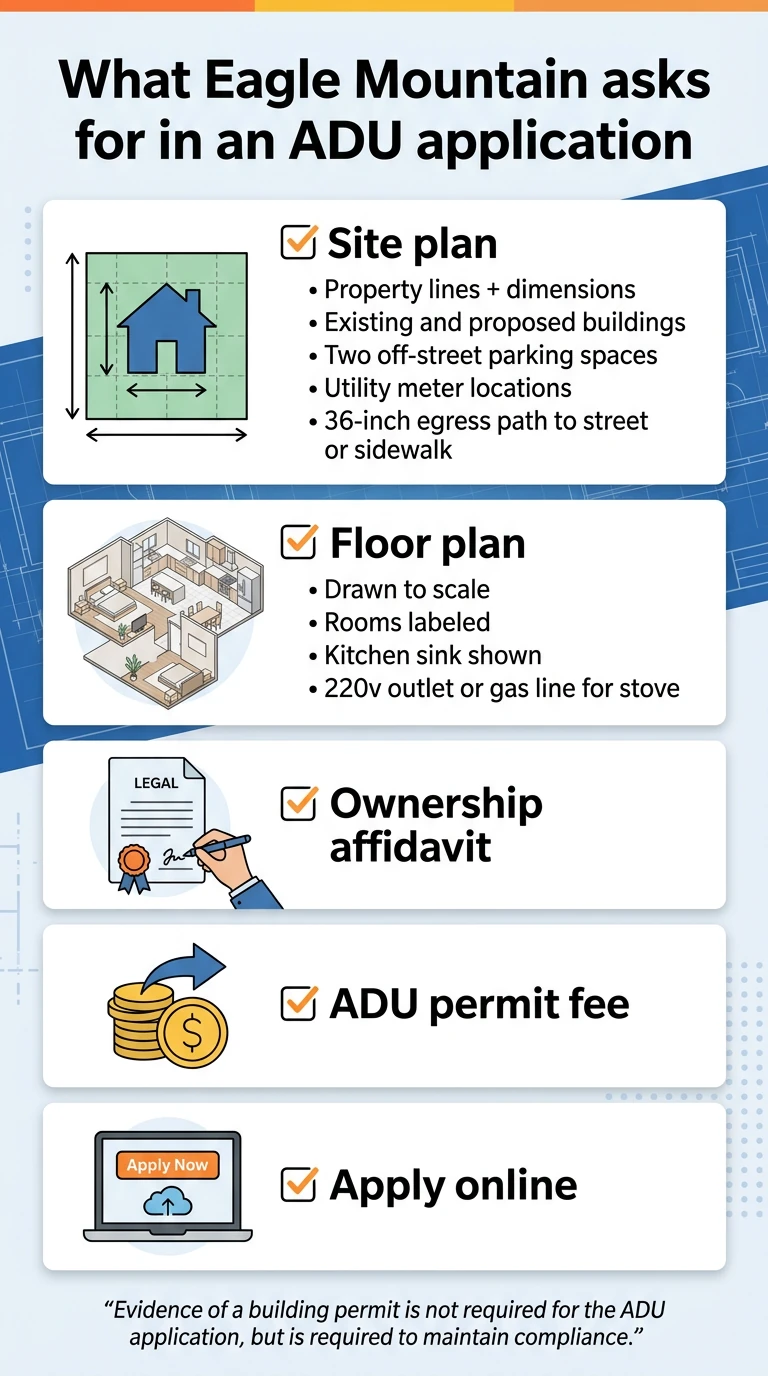
Eagle Mountain ADU application requirements — everything you need to submit for a complete application packet
ADU Size Limits
Detached ADUs must be between 400 and 1,200 square feet of living space, with a maximum of two bedrooms. The unit must be on a permanent, site-built foundation and permanently connected to utilities. (EMMC 17.70.040(D)(3))
Internal (basement) ADUs are limited by your existing footprint — there is no separate square footage cap beyond what your basement allows.
Attached ADUs must meet the setback standards for the primary dwelling in your zone (per EMMC 17.25.040).
Setbacks for Detached ADUs
Detached ADUs follow the same front, side, and rear setback standards as the primary dwelling in that zone (per EMMC 17.25.040). Setback requirements vary by zone, and up to a 10% variation may be approved by the planning director and building official for unique lot configurations. These setback requirements determine where on your lot a detached ADU can physically sit — which is why a site visit from a qualified builder is essential before finalizing plans.
Height Limits
• ADUs above a detached garage: 35 feet maximum
• Standalone detached ADUs: 2 stories / 35 feet maximum
Height is measured from the average of the highest and lowest finished grade to the highest point of the roof.
Entrance Location
All ADU entrances must be on the side or rear of the building — not street-facing (EMMC 17.70.040(E)). The idea is that the property should still look like a single-family home from the street.
For detached ADUs, the architectural style, materials, and colors must match the primary dwelling. If the ADU is above a detached garage, it must match the garage.
The 30-Day Rental Minimum
Eagle Mountain does not allow ADU short-term rentals. Your tenant must rent for 30 consecutive days or more. If your financial model depends on Airbnb-style nightly income, an ADU in Eagle Mountain is not the right vehicle for that.
The rental income projections in this guide assume long-term tenants, which is what the code requires.
Building and Fire Code Compliance
Your ADU must conform to the International Fire Code and the International Residential Code (EMMC 17.70.040(C)). Eagle Mountain's adopted codes are current as of July 1, 2023 — verify for any updates before your project begins.
What If Your Basement Was Finished Without Permits?
This is more common than you would think — especially in homes built during Eagle Mountain's rapid growth years. If your basement was finished without a building permit, you will need to get that resolved before — or as part of — your ADU permit application. Per EMMC 17.70.030, unpermitted units are considered illegal until a permit is submitted and approved.
The typical path is:
1. A builder assesses the existing work against current building code
2. They identify what needs to be corrected (common issues: egress windows too small, missing fire-rated assemblies, electrical not up to code)
3. You apply for a basement finish permit and ADU permit simultaneously
4. The city inspects the corrected work
5. Once approved, you have a legal, permitted ADU
A good builder will walk you through this process. In many cases, the corrections are less expensive than homeowners fear — the biggest cost is usually egress window enlargement, which typically runs $2,000–$5,000 per window.
Tiny Homes on Wheels
Eagle Mountain specifically allows tiny homes on wheels as ADUs under EMMC 17.70.080, with its own requirements:
• Must comply with ANSI 119.2 or 119.5 (NFPA 1192) standards
• Must be towable (not self-propelled)
• Must be registered with the Utah Department of Motor Vehicles
• Must have skirting
• Minimum first-floor living area of 140 square feet (per EMMC 17.10.030)
This is not the mainstream ADU path — it has its own registration, design, and compliance requirements. But for homeowners interested in a flexible, lower-cost option, it is worth exploring with the city.
Does the Permit Transfer When You Sell?
The ADU permit is tied to the property, not the owner. If you sell your home, the new owner inherits the ADU — but they must meet the owner-occupancy requirement to continue renting it. If they do not live on-site, they cannot legally operate it as a rental.
How Much Does an ADU Cost in Eagle Mountain?
Building an ADU is not cheap — you are essentially building a small home. But Eagle Mountain's combination of strong rental demand and ADU-friendly regulations means the investment can pay off. Here is how costs break down by project type.
Cost by ADU Type
Cost Component
Basement Conversion
Attached Addition
Detached ADU (600–1,200 sf)
Above-Garage
Design & Engineering
$3,000–$8,000
$5,000–$15,000
$8,000–$20,000
$5,000–$15,000
Permits & City Fees
$2,000–$6,000
$3,000–$8,000
$5,000–$12,000+
$4,000–$10,000
Construction
$40,000–$75,000
$70,000–$150,000
$175,000–$300,000+
$130,000–$250,000+
Utility Connections
Minimal (shared)
$2,000–$8,000
$5,000–$20,000
$3,000–$12,000
Landscaping & Site Work
Minimal
$2,000–$5,000
$5,000–$15,000
$2,000–$8,000
Estimated Total
$50,000–$100,000
$80,000–$180,000
$200,000–$350,000+
$150,000–$300,000+
Estimated ranges based on current Utah County construction market conditions (2026). Your actual cost depends on site conditions, finishes, and your builder. Always get a property-specific quote.
Eagle Mountain City Fees
Based on Eagle Mountain's Consolidated Fee Schedule (updated January 7, 2026) and the ADU Checklist (November 2025):
• ADU permit application fee: $230
• Building permit fee: based on project valuation (per ICC valuation tables)
• Plan review: 40% of the building permit fee
• Surcharge: 1% of permit fees
• Utility connection fees: varies if separate meters are needed for a detached unit
• Basement finish permit: required if the basement was not previously permitted
Impact fees: Eagle Mountain's fee schedule currently states that no additional impact fees are charged for ADUs. Utah law (Utah Code § 10-21-303) also prohibits cities from charging impact fees on internal ADUs within existing primary dwellings. This is a meaningful savings — impact fees in growing Utah cities can run $3,000–$10,000+ for a new dwelling unit.
The Costs Nobody Budgets For
• Structural fixes: Older basements may need reinforcement, waterproofing, or egress window enlargement
• Utility upgrades: Your electrical panel may need an upgrade. Sewer laterals may need work.
• Parking pad / driveway work: Those required off-street spaces may mean pouring new concrete
• Fire and life safety: Smoke detectors, carbon monoxide detectors, fire-rated assemblies between units
• Kitchen and bath finishes: These are the rooms where costs escalate fastest based on your material choices
Building an ADU in Eagle Mountain is usually not cheap or instant — especially if you need new utilities, parking work, or a detached structure. A basement conversion can feel manageable at $50K–$100K, but a detached backyard cottage is a six-figure commitment that rivals building a small home from scratch. The homeowners who get into trouble skip the due diligence. Eagle Mountain's ADU process is well-defined — the process is navigable, you just need to navigate it correctly.
Get a property-specific ADU cost estimate — free
Generic ranges are a starting point, not a plan. We'll look at your specific lot, goals, and budget and give you a realistic estimate — before you spend a dollar on plans.
What Can You Rent an ADU For in Eagle Mountain?
Eagle Mountain's rental market is active and growing. Based on current asking-rent data from Zumper, RentCafe, and Rentometer (Eagle Mountain, UT — 2025–2026 data):
• 1-bedroom ADU-style units: approximately $800–$1,100/month
• 2-bedroom basement apartments: approximately $1,100–$1,500/month
• Median rent across all Eagle Mountain rentals: approximately $2,000–$2,100/month
ADU-style units typically rent below the citywide median because they are smaller — but they are in high demand because they are more affordable than full apartments in a market where rents have been climbing. Eagle Mountain's position in the Utah County growth corridor means consistent demand for affordable rental options — exactly what an ADU provides.
These are asking-rent ranges based on current listings, not guaranteed income figures. Actual rents depend on unit size, condition, location within Eagle Mountain, and market conditions at the time you list.
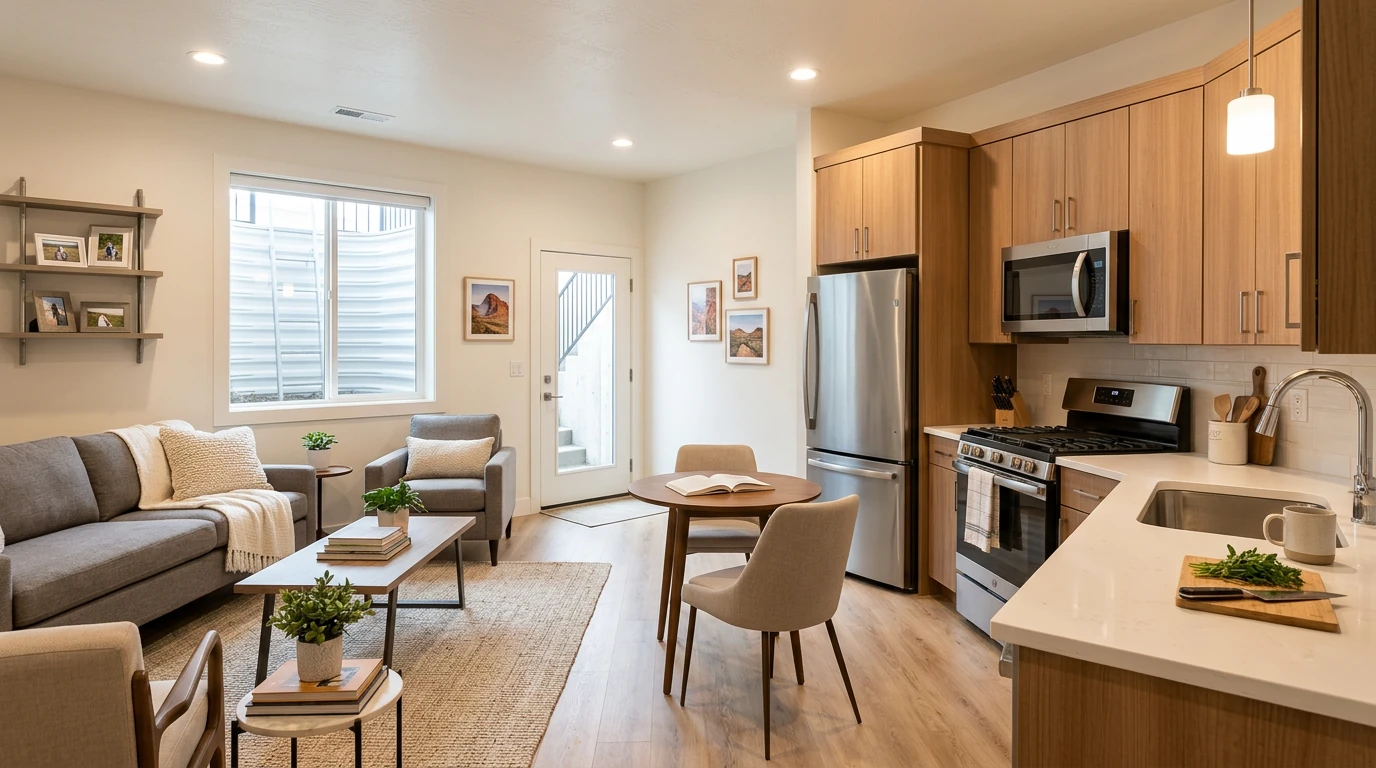
A well-finished ADU interior commands top-of-range rent — and adds lasting value to your Eagle Mountain property
Illustrative ROI: Three Scenarios
To give you a sense of the math, here are three common Eagle Mountain ADU scenarios with estimated numbers. These are illustrations, not guarantees — your actual returns depend on your build cost, financing terms, vacancy, maintenance, and rental market conditions.
Scenario 1: Basement Conversion
Estimated build cost: $65,000
Estimated monthly rent: $1,200
Est. annual gross income: $14,400
Gross yield before expenses: ~22%
Scenario 2: Above-Garage ADU
Estimated build cost: $175,000
Estimated monthly rent: $1,100
Est. annual gross income: $13,200
Gross yield before expenses: ~7.5%
Scenario 3: Detached Backyard Cottage
Estimated build cost: $275,000
Estimated monthly rent: $1,500
Est. annual gross income: $18,000
Gross yield before expenses: ~6.5%
The basement conversion has the strongest gross yield. The detached unit commands the highest absolute rent and adds the most square footage value to the property. Which one makes sense depends on your goals, your lot, and your budget.
What About Property Taxes?
Property taxes may increase because the added improvement can affect your assessed value. However, Utah's 45% primary residential exemption still applies to your home. In practice, most homeowners find the tax increase is modest relative to the rental income the unit generates — but factor it into your financial planning.
Financing Options
• Home Equity Line of Credit (HELOC): Borrow against your existing equity. The rental income helps pay down the line.
• Cash-Out Refinance: Refinance your mortgage at a higher amount and use the cash for construction.
• Construction Loan: A short-term loan that covers the build, then converts to permanent financing. Some Utah credit unions specialize in these for ADU projects.
• Renovation-to-Permanent Loan: Newer products designed for home improvements. They may consider the future value of your home with the completed ADU.
• Cash Savings: Avoids interest entirely and maximizes returns from day one.
Talk to your lender about ADU-specific options before assuming you need to fund the project entirely out of pocket. The lending landscape for ADUs has improved significantly in the past few years. For a full guide, see our ADU Construction Financing in Utah →
Which ADU Path Is Smartest for Your Situation?
Not everyone should build the same thing. Here is how to match your goal to the right path.
If You Want the Cheapest Path to Legal Rental Income
Go with a basement / internal ADU. Most Eagle Mountain homes have basements — many of them unfinished or partially finished. You already have the shell and the roof. You need to add a kitchen, a separate exterior entrance (side or rear), fire-rated separation, and proper egress. This is the fastest-payback path and the lowest construction cost. Utah state law also prohibits impact fees on internal ADUs within existing dwellings, which saves you more.
If You Need Family Space But Are Not Renting
A second-kitchen agreement may be all you need. If your parents, adult child, or another family member needs their own kitchen and living space — and nobody is paying rent — you can skip the full ADU permit process. Record a second-kitchen agreement with Utah County and you are done (assuming the work meets building code). Simpler, cheaper, faster.
If You Want Maximum Privacy and the Highest Rent
Build a detached ADU or backyard cottage. This is the most expensive option, but it commands the highest rent because it offers true independence — separate structure, separate entrance, no shared walls. Your lot needs to qualify (8,000+ square feet and 70+ feet of street frontage), and you will need to match the main home's architecture. But if the numbers work, this is the premium play.
If You Are Buying New Construction
Look for builders offering integrated ADU floor plans. Some Utah builders now design homes with built-in ADU suites — separate entrances, soundproofing, and independent systems designed from day one. This is often more cost-effective than retrofitting because the ADU is part of the original construction.
When You Should Skip the ADU Entirely
Not every property is a good ADU candidate. If your lot cannot accommodate the parking requirement, if your HOA has airtight restrictions on detached structures, if the cost of bringing an older home up to code exceeds the realistic rental income, or if you are not willing to be an owner-occupant — it may not be the right move. Some homeowners who discover an ADU does not work on their current property end up buying a different property specifically because it is ADU-ready. Start with the assessment, not the assumption.
The Eagle Mountain ADU Permit Process, Step by Step
The permit process is not as intimidating as it looks. Here is how it works in order.
1
Step 1: Confirm Your Path
Before anything else, determine whether you need a full ADU permit or a second-kitchen agreement. This decision affects every step that follows. If you are renting to non-family, it is the ADU permit path. If it is family-only with no rental, ask the city about a second-kitchen agreement.
2
Step 2: Prepare Your Submittal Package
Eagle Mountain's ADU Checklist (Nov. 2025) requires: (1) Site plan showing property lines, dimensions, existing and proposed buildings, setbacks, location and dimensions of two off-street parking spaces, utility meter locations, and a 36-inch-wide unobstructed egress path from the ADU exit to the street or sidewalk; (2) Floor plan drawn to scale with rooms labeled, kitchen sink location, and 220v outlet or gas line location for the stove; (3) ADU permit fee ($230); (4) Application submitted through Eagle Mountain's online ADU application portal. We strongly recommend hiring a builder or designer at this stage.
3
Step 3: Planning Division Review
Your ADU permit application is reviewed by Eagle Mountain's Planning Division (Community Development Department). Staff checks for compliance with EMMC 17.70.
4
Step 4: Building Permit and Inspections
Once your ADU permit is approved, you submit a separate building permit application with full construction drawings. Building permit fees are based on project valuation per the ICC valuation tables. The Building Division notes that typical basement plan review time is 14 business days. During construction, Eagle Mountain requires multiple inspections — foundation, framing, four-way (mechanical/electrical/plumbing), and final. Your builder should coordinate all of these. Before any digging, your contractor must call Blue Stakes of Utah (811) to locate underground utilities.
5
Step 5: Final Inspection and Certificate of Occupancy
After passing all required inspections, you receive a certificate of occupancy. Your ADU is now legally habitable. If there are items that do not pass inspection, your builder addresses them and schedules re-inspection. This is normal — a competent builder expects this and budgets time for it.
6
Step 6: Verify Any Additional City Licensing Requirements
If you plan to rent the ADU, check with Eagle Mountain about whether any city licensing applies to your rental use. Requirements can vary, and it is better to confirm upfront than discover a gap later.
Realistic Timelines
Project Type
Planning + Permits
Construction
Total
Basement / Internal ADU
1–3 months
2–4 months
3–7 months
Attached Addition
2–3 months
4–6 months
6–9 months
Detached ADU
2–4 months
5–8 months
7–12 months
Second-Kitchen Agreement Only
2–6 weeks
Varies
Varies
These are estimates. Actual timelines depend on plan review backlog, construction complexity, and inspection scheduling.
Ready to start? Let's figure out what's feasible on your lot.
We'll check your zoning, lot requirements, parking, and project goals — then connect you with a local builder familiar with Eagle Mountain's permit process. Verify licensing and insurance before hiring.
Eagle Mountain ADU Permit Checklist
Print this. Check off each item as you go.
□Confirmed property is single-family-zoned and meets lot requirements for your ADU type
□For detached ADUs: confirmed 8,000+ sq ft lot and 70+ ft street frontage
□Verified no HOA/CC&R restrictions on your ADU type
□Determined correct path: ADU permit vs. second-kitchen agreement
□Confirmed property owner will live on-site (owner-occupancy requirement)
□Confirmed two off-street parking spaces available on hard surface — layout confirmed with Planning
□ADU entrance planned for side or rear of building (not street-facing)
□Detached ADU designed to match primary dwelling's architecture, materials, and colors
□Detached ADU sized between 400–1,200 sq ft with max 2 bedrooms
□Floor plan drawn to scale with rooms labeled, kitchen sink and stove hookup shown
□Site plan showing property lines, setbacks, parking, and 36-inch egress path prepared
□ADU permit application submitted through city online portal with $230 fee
□ADU permit approved
□Building permit application submitted with construction drawings
□Building permit approved and fees paid
□Blue Stakes utility locate called (811) before any digging
□Any applicable city licensing requirements verified (if renting)
□Utility accounts confirmed in property owner's name
What Mistakes Delay or Kill Eagle Mountain ADU Projects?
We see the same problems come up again and again. Avoid these and your project stays on track.
Mistake #1
Assuming a Finished Basement Is Automatically a Legal Rental
It is not. Even if your basement has a kitchen, a bathroom, and a separate entrance — without an ADU permit, it is not a legal rental unit. And if the basement was finished without a building permit, you will need to resolve that first. The city considers unpermitted units illegal until approved (EMMC 17.70.030). The fix is straightforward with the right builder, but ignoring it creates real liability.
Mistake #2
Picking the Wrong Path — ADU Permit vs. Second Kitchen
The wrong path costs you time, money, and potentially a recorded deed restriction you did not need. Understand the fork before you spend a dollar on plans.
Mistake #3
Underestimating the Parking Requirement
Two off-street spaces on hard surface. Not in front of the garage. Not on the street. This requirement has derailed more Eagle Mountain ADU plans than almost any other single rule. Think about parking early — ideally during your feasibility assessment, not after you have paid for architectural plans.
Mistake #4
Ignoring Owner Occupancy
The owner must live on the property. If you are an investor hoping to rent out both the main house and the ADU, this is not the structure for that in Eagle Mountain. Violation can result in the ADU permit being revoked (EMMC 17.70.050).
Mistake #5
Starting Construction Before Permits
Building without permits is how you end up with an illegal structure, stop-work orders, and the most expensive possible path to compliance. Permits first. Always.
Mistake #6
Forgetting the HOA Check
Utah law protects your right to build an internal ADU even if your HOA objects — to a degree. But detached ADUs, exterior changes, and additional structures may still be subject to CC&R restrictions. Check before you build.
Mistake #7
Hiring a Contractor Who Does Not Handle ADU Permits
General contractors build things. Not all of them navigate ADU-specific permitting. In Eagle Mountain, you need a builder who understands EMMC 17.70, knows the Planning Division's submittal requirements, and will handle inspections through final sign-off. If your contractor's answer to 'who handles the ADU permit?' is a blank stare, keep looking.
How to Choose the Right ADU Builder in Eagle Mountain
The builder you choose will determine whether this project goes smoothly or becomes a cautionary tale.
What a Good Eagle Mountain ADU Builder Should Have
✓ Active Utah contractor's license — verify through Utah DOPL
✓ Eagle Mountain experience — they should know the city's planning and building departments
✓ ADU-specific project history — not just general remodeling
✓ Permit handling — manages your ADU permit, building permit, and inspections
✓ Site visit before quoting — any builder who prices without seeing your property is guessing
✓ Clear warranty and contract terms — in writing, before work begins
✓ Insurance — general liability and workers' compensation
Red Flags
✗ No state license or will not provide their license number
✗ Cannot show completed ADU projects
✗ Quotes a price without visiting your property
✗ Unfamiliar with EMMC 17.70 or Eagle Mountain's ADU requirements
✗ Asks you to pull your own permits
✗ No written contract or warranty
Questions to Ask Before You Sign
1. Have you built ADUs in Eagle Mountain specifically? How many?
2. Do you handle the ADU permit application, or is that my responsibility?
3. Will you manage all inspections through final sign-off and certificate of occupancy?
4. What is your realistic timeline from permit application to move-in?
5. Can I speak with a recent Eagle Mountain ADU client?
6. What is included in your quote — and what is not?
7. How do you handle change orders?
Checks to Make Before Hiring a Builder
We are an independent referral resource, not a credentialing body. Make these checks yourself before hiring:
• Insurance confirmation (general liability and workers' comp)
• Eagle Mountain / Utah County service area confirmation
• ADU project type fit (internal, detached, garage conversion, new build)
• Permit handling capability — confirm responsibilities in the written scope
• Record the date of your license and insurance checks
When you request a builder assessment, the provider reviews your address, project type and availability before confirming possible next steps. A request does not book a site visit or guarantee an estimate. Verify licensing, insurance, relevant projects and written scope before hiring; there is no obligation to hire.
Connect with a local Eagle Mountain ADU builder — free
We connect you with a local builder option familiar with Eagle Mountain's permit process. Verify licensing and insurance before hiring.
What Does an ADU Mean for Financing, Appraisal, and Resale?
These are the questions that keep people up at night after the initial excitement of "I could build an ADU!" wears off. Let us address them directly.
Can ADU Income Help You Qualify for Financing?
Increasingly, yes. Freddie Mac guidance notes that borrowers may be able to use ADU income to qualify for a mortgage in certain situations, and that ADUs can increase long-term property value. This is a meaningful shift — even a few years ago, most lenders would not factor ADU income into qualifying ratios. Talk to your lender about ADU-specific options before assuming you need to fund the project entirely out of pocket.
How Appraisers Look at ADUs
Fannie Mae's selling guide requires appraisers to describe the ADU and analyze its effect on property value and marketability. A legal, permitted ADU with its own entrance, kitchen, and bathroom is generally treated as a value-adding improvement. An unpermitted basement apartment, on the other hand, can complicate a sale or refinance. This is another reason to do it right from the start. A permitted ADU is an asset on paper. An unpermitted one is a question mark.
What Happens If You Sell?
The ADU permit transfers with the property. The new owner can continue renting it — as long as they meet the owner-occupancy requirement by living on-site. If they do not plan to live there, they cannot legally rent the ADU, but the physical improvement still adds value.
Why Short-Term Rental Assumptions Can Break Your Math
Eagle Mountain requires a 30-day rental minimum. If your ADU financial model depends on nightly Airbnb rates, the numbers will not work here. Build your projections around long-term tenants, and you will have a realistic picture.
Utah State Laws That Work in Your Favor
You are not fighting an uphill battle against the government on this. Utah's legislature has been actively making ADUs easier to build — and Eagle Mountain has followed that direction.
HB 82 (2021)
Required all Utah municipalities to allow internal ADUs as a permitted use in residential zones. Cities cannot ban basement apartments. This law is why your internal ADU project in Eagle Mountain has strong legal standing — the city must allow it if you meet the code requirements.
Impact Fee Protection
Utah law prohibits cities from charging impact fees on the construction of an internal ADU within an existing primary dwelling (Utah Code § 10-21-303, formerly § 10-9a-530). Eagle Mountain's fee schedule also currently states that no additional impact fees are charged for ADUs. This is a meaningful cost savings — impact fees in growing Utah cities can run $3,000–$10,000+ for a new dwelling unit. For an internal ADU, that money stays in your pocket.
HOA Limitations
Utah law restricts HOAs from prohibiting internal ADUs in most situations. While HOAs can still regulate some aspects of external ADUs, the legislative trend is clearly toward protecting homeowner rights to build ADUs on their own property. If your HOA tells you an internal ADU is not allowed, review the specific state code provisions before accepting that answer.
The bottom line: Utah is one of the most ADU-friendly states in the country. State law, city ordinance, and market demand are all moving in the same direction — toward making it easier and more practical for homeowners to add housing to their properties.
Eagle Mountain ADU FAQ
Are ADUs legal in Eagle Mountain, Utah?
Yes. Eagle Mountain allows basement, attached, detached, and above-garage ADUs on single-family-zoned property, subject to EMMC Chapter 17.70. Tiny homes on wheels are also permitted under specific conditions (EMMC 17.70.080).
What is the difference between an ADU permit and a second-kitchen agreement?
An ADU permit is required when you plan to rent the space to non-family members. A second-kitchen agreement is for family-only use with no rental — it is a recorded deed restriction filed with Utah County.
Can I build a detached ADU in Eagle Mountain?
Yes, if your lot is at least 8,000 square feet with a minimum of 70 feet of street frontage. Detached ADUs must be 400–1,200 square feet, max 2 bedrooms, and must match your home's architectural style.
Do I have to live on the property?
Yes. The property owner must live on-site — either in the main house or in the ADU (EMMC 17.70.040(B)), with limited exceptions for bona fide temporary absences such as military deployment.
Can I use my ADU as an Airbnb?
No. Eagle Mountain requires a minimum 30-day rental period. Short-term vacation rentals are not permitted for ADUs.
How much parking do I need?
Eagle Mountain's ADU checklist requires two off-street parking spaces on hard surface. Driveway parking in front of a garage generally does not qualify. Confirm the final layout with Planning before design.
Can my ADU have separate utilities?
Detached ADUs may have separate utility meters, but all utilities must be in the property owner's name. The owner is responsible for payment (EMMC 17.70.040(F)).
What is the maximum size for a detached ADU?
1,200 square feet of living space with a maximum of two bedrooms. Minimum is 400 square feet. (EMMC 17.70.040(D)(3))
What if my basement was finished without permits?
You will need to obtain permits retroactively. Per EMMC 17.70.030, unpermitted units are considered illegal until a permit is submitted and approved. A qualified builder can help you through this process.
Will my HOA stop me?
Utah state law limits HOA restrictions on internal ADUs. However, HOAs may still restrict detached ADUs or exterior modifications. Always review your CC&Rs before proceeding.
Do internal ADUs avoid impact fees?
Under Utah law (§ 10-21-303), cities generally cannot charge impact fees on internal ADUs within existing primary dwellings. Eagle Mountain's current fee schedule also states that no additional impact fees apply for ADUs.
What happens to my ADU if I sell my house?
The permit transfers with the property. The new owner can continue renting if they meet the owner-occupancy requirement by living on-site.
How long does the whole process take?
For a basement conversion, budget 3–7 months total (1–3 months permitting, 2–4 months construction). Detached ADUs take 7–12 months. A second-kitchen agreement path is faster.
How do I get started?
The smartest first step is a feasibility assessment. We check your zoning, lot size, parking options, and project goals — then tell you exactly what is possible and connect you with a qualified builder.
• Construction cost data: Utah County construction market estimates and published ADU cost guides (2025–2026)
• Financing and appraisal guidance: Fannie Mae Selling Guide (improvements section), Freddie Mac ADU guidance
• Builder licensing: Utah Division of Professional Licensing (DOPL) contractor lookup
This guide is for informational purposes and does not constitute legal, financial, or tax advice. Municipal codes change. Always verify current requirements with Eagle Mountain's Planning Division before starting your project. We update this page when rules change.
Ready to Build Your Eagle Mountain ADU?
You now have a thorough understanding of Eagle Mountain's ADU rules, costs, and process. You know the difference between an ADU permit and a second-kitchen agreement. You know the lot requirements, parking rules, and entrance requirements. You know realistic cost ranges and what kind of rental income to expect. And you know what mistakes to avoid and what to look for in a builder.
That is more than most homeowners know when they start writing checks.
But information alone does not build an ADU. The next step is to find out what is actually feasible on your property — your specific lot, your zone, your goals, your budget. Because every property in Eagle Mountain is different. A lot that is 8,200 square feet with 72 feet of frontage opens up options that a 7,500 square foot lot does not. A home with an unfinished basement and a walkout has a completely different starting point than a home with a finished basement that was never permitted.
Every month you wait is a month of potential rental income you are not collecting or a month longer before your family has the space they need. The sooner you start the feasibility process, the sooner you get clarity on what is possible and what it will cost.
Get My Eagle Mountain ADU Feasibility Assessment
Here is what you get:
✓ Zoning and eligibility check — we confirm whether your property qualifies and for which ADU types
✓ Path determination — ADU permit or second-kitchen agreement, based on your goals
✓ Parking and site evaluation — can your lot accommodate the requirements?
✓ Builder match — we connect you with a local builder option familiar with Eagle Mountain
✓ Property-specific estimate — real numbers for your project, not generic ranges
✓ No obligation — free, no pressure, no cost
Utah ADU Builders — Serving homeowners across Utah County and the Wasatch Front: